
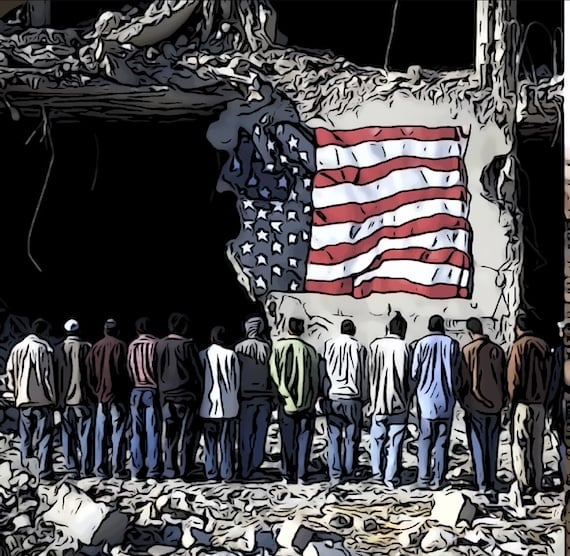
No Extermination without Representation: U.S. Election 2024

“No Extermination without Representation,” Digital, Midjourney / Clip2Comic, 2024

Farhang Jahanpour

TFF Associate & former Board member

November 3, 2024

On November 5, the American people go to the polls in one of the most consequential elections for the United States and the world. Normally, outsiders should not interfere in other countries’ elections, although the United States has a habit of interfering in other countries’ elections, often overtly and sometimes with the use of coups, plots, subversion, etc.

However, as the Americans chanted “no taxation without representation” when they were fighting for their independence and tried to shake off the yoke of a foreign power over their lives, it is now appropriate for the people of the world to say “no extermination without representation.” If the rest of the world cannot have representation in US elections, at least we are entitled to express a view about it, especially when it affects the well-being or even the continued existence of the rest of the world.

This article was initially published by Informed Comment/Juan Cole here

I am writing this not as an enemy of the United States, but as a long-time friend and admirer. From my childhood, I heard glowing praise of America and its history from my father who had spent many years of his life as a young man in New York and who was a great lover of that country. I wrote a PhD thesis on Oriental Influences on the Work of Ralph Waldo Emerson when I came to study in England, and spent a wonderful summer in the United States visiting Emerson’s house in Concorde and doing research on his work at the Weidner Library at Harvard. Later on, I spent a year at Harvard as a Senior Fulbright visiting scholar teaching courses on Persian and American literature.

I also established the first Department of American Studies in Iran when I served as professor and Dean of the Faculty of Languages at the University of Isfahan. I also helped arrange the conference on the 200th anniversary of American Independence at the University of Shiraz, which served as the main anniversary conference in the Middle East and Asia. So, I have many reasons to be interested in the outcome of the US election.

The United States continues to be the most consequential country in the world. By nominal GDP, the United States is still the biggest economy in the world, and even by PPP, it is the second richest country. However, from a military point of view, it is by far the most powerful country compared to all its rivals. Never in world history has a country possessed such overwhelming power in all the corners of the world. While Russia and China can be regarded as regional superpowers, the United States is the only hyperpower with global reach and can even be regarded as the sole world hegemon.

As American generals are fond of repeating, the United States enjoys “full spectrum dominance” on land, on sea and in the air, and they are not reluctant to use America’s awesome military power. There are more than 750 U.S. military bases in at least 80 countries. They are spread from Europe to the Middle East to the Far East, right up to Japan, Australia, South Korea, and many offshore bases all over the world. NATO, which the United States leads, has 32 members and constitutes by far the biggest military alliance, surrounding Russia.

In addition to NATO in the West (which has also taken part in US wars in Afghanistan and the Middle East), there are a number of US-led alliances aimed at containing China. Following the Australia-UK-US (AUKUS) and Japan-U.S.-South Korea trilaterals, and the U.S.-Japan-India-Australia Quad, the latest US-Japan-Philippines military alliance is yet another initiative to isolate China and enhance the US’s position in the Asia-Pacific.

Since the Second World War when, on the ruins of European and Asian empires, the United States became the richest and strongest country in the world, it tried to extend its power and became a virtual empire. Although many justifications have been put forward for the use of nuclear bombs in Hiroshima and Nagasaki, the available evidence shows that one of the main reasons for their use was a demonstration of US power to Russia, which was emerging as the main US rival in the form of the former Soviet Union.

Shortly after the Second World War, the United States tried to stop the communist advance in the Far East with the invasions of Korea, Vietnam, Laos and Cambodia, killing many millions of people in those countries. Those wars were really proxy wars between the United States and the Soviet Union and China. While during the Cold War, there existed some military balance between the Western and Soviet blocs, after the collapse of the Soviet Union in 1991, the United States felt that all restrictions on her had been lifted and she could act as the sole superpower in a unipolar world. That gave rise to the US’s Operation Desert Shield to expel the Iraqi forces from Kuwait, which killed tens of thousands of Iraqi forces.

The war was followed by the invasion of Afghanistan following the 9/11 terrorist outrage, and later Iraq, and different military campaigns in Libya, Syria, Somalia, Yemen, etc. Those wars killed a few million people and cost a few trillion dollars to US taxpayers. Following the expansion of NATO to nearly all former Warsaw Pact member states, and plans to bring Ukraine into NATO, President Putin felt he had no alternative but to invade Ukraine to prevent the establishment of NATO bases in the country that he regarded as Russia’s backyard.

Since the Russian invasion of Ukraine, the U.S. Congress has provided Ukraine with at least $175b of military and humanitarian assistance. This is in addition to billions of dollars of military and economic aid given to Ukraine by Europe and other NATO members.

Since the horrendous HAMAS attack on Israel on 7 October, the Israeli government has conducted a merciless war and massacre on Palestinians in Gaza and the West Bank, and lately on Lebanon, which has killed at least 44,000, most of them women and children, 134-146 journalists, 120 academics, over 224 humanitarian aid workers, including 179 employees of UNRWA, and has injured hundreds of thousands of civilians. Most people in the Global South and even in Europe and the United States cannot understand how a Democratic administration can so blindly support a regime which according to ICJ, the world’s highest judicial authority, is engaged in “plausible genocide” and whose leaders are accused by the ICC of war crimes.

Although the Biden administration carries the major responsibility for arming Israel and becoming complicit in its war crimes, the decision of the Trump administration to grant Jerusalem and the Golan Heights to Israel, contrary to international law, and bribe some subservient Arab regimes to normalise relations with Israel in some phoney deals, known as the Abraham Accords, created a feeling of impunity among Israeli leaders who feel they can commit any crime and violate any international law without any sanctions or punishments. As a result, Israel has been acting as though it is above the law and can openly challenge and ignore numerous UN Security Council and General Assembly resolutions. This blatant lawlessness and impunity endangers the entire international order and bodes ill for the future of the so-called “rules-based international order”.

In a landmark ruling on 19 July 2024, the ICJ “declared that Israel’s occupation of the Gaza strip and the West Bank, including East Jerusalem, is unlawful, along with the associated settlement regime, annexation and use of natural resources.” It called on Israel to immediately withdraw its forces and settlements from the occupied territories and pay reparation to the Palestinians. Not only has the US not implemented that resolution, but it has continued to deliver the most-deadly weapons to Israel enabling its genocide in Gaza and war crimes in the West Bank and Lebanon.

The scope of the war on Gaza has now expanded to neighbouring countries with dangerous confrontations between Israel and Iran, Syria, Iraq and Yemen. Far from punishing Israel for those war crimes, the United States has imposed further sanctions on Iran and several other Middle Eastern countries. Iran and Russia are two of the most sanctioned countries in the world. Not only have those unilateral sanctions not forced those countries to surrender to US demands, but they have also pushed Iran closer to Russia and Russia closer to China.

The recent BRICS summit in Kazan, held from 22-24 October, was convened with the participation of five new members, namely Egypt, Ethiopia, Iran, Saudi Arabia and the United Arab Emirates. The new Nine-member BRICS partnership accounts for 45% of the world’s population and 30% of the world’s land surface. Its combined GDP of around US$65 trillion (35% of global GDP PPP) and an estimated US$5.2 trillion in combined foreign reserves are larger than that of the G7 bloc.

The wars raging in Ukraine and the Middle East and growing conflict with China have brought the world to the brink of a devastating world war with unimaginable consequences. The planet is now in a more dangerous position than at any time since the Second World War. At the same time, the United States is now more isolated than ever. A good example of US isolation can be seen in the vote at the United Nations General Assembly on 30th October 2024, demanding an end to the US embargo on Cuba. Only the United States and Israel voted against the resolution, Moldova abstained, and 187 countries, including all European countries, Australia, New Zealand, Japan, and Canada, voted for it. This level of isolation, the whole world against the United States and Israel, is unprecedented.

Most American voters do not usually pay much attention to foreign affairs, but as can be seen from the above examples, in the current interconnected world no country can keep itself immune to international developments. What the United States does in its foreign policy matters and will boomerang back to itself. Without presuming to tell the Americans how to vote in the forthcoming election, I only wish to urge them to pay more attention to the US’s foreign policies and to American values that must govern those relations.

Related Posts

Photo above: Carl Fredrik Reuterswärd’s Non-Violence outside UN Headquarters in New York. Kirill Levin, CC BY-NC-SA 2. Jan Oberg November 3, 2026 I am happy to be published in Horizons which is produced by the Center for International Relations and Sustainable Development, CIRSD, in Belgrade. My contribution brings out a radical re-thinking of what concepts such as defence, security, deterrence – and peace – may mean if we want to create a more peaceful world. It also summarises a few things I have been working with the last few decades. Please read it here Og her er den på dansk, takket være Johnny Baltzersens lynhurtige oversættelse
UNITE-tillid, DREAM-velstand og andre konstruktive komponenter Normally we publish articles in English here. But this is a translation of a very important TFF document that should reach as many as possible in Denmark since this country’s government has been one of the most hardline in Europe and, up till now at least, has refused to use diplomacy and, instead, spent tremendous sums on arming Ukraine with the express goal of defeating Russia. Thus this – unique – article is in Danish. Vi er Johnny Baltzersen og hans Fælles Sikkerhed – Fælles Fremtid på Substack overmåde taknemmelige for at have oversat og publiceret TFF’s 2025-portfølje for fredsidéer med henblik på Ukraines fremtid. Vi håber den nu kan nå mange flere danskere – som også vil sprede den og skabe debat – nu den danske regerings og folketingspartiernes politik på dette område siden 2022 står nu – forudsigeligt – ved vejs ende....
Jan Oberg TFF director October 28, 2026 Exactly one month has now passed since I published my criticism of the introduction to the special issue on Johan Galtung published by the Journal of Global Security Studies, JoGSS, and of Tor Egil Førland’s chapter about Galtung which serves as a preview to his forthcoming biography of Galtung to be published by PRIO. See the original on The Transnational here and the same article on TFF Substack with many general and critical comments and, in particular, the people who decided to withdraw from the biography project in protest. The special issue itself was extraordinary. It was devoted to the intellectual legacy of one of the founders of peace research and contained a number of strong assessments of his personality, scholarship, intellectual trajectory, and public role. Such assessments are, of course, entirely legitimate. No scholar is beyond criticism, and neither was Johan Galtung....

Recent Articles

Photo above: Carl Fredrik Reuterswärd’s Non-Violence outside UN Headquarters in New York. Kirill Levin, CC BY-NC-SA 2. Jan Oberg November 3, 2026 I am happy to be published in Horizons which is produced by the Center for International Relations and Sustainable Development, CIRSD, in Belgrade. My contribution brings out a radical re-thinking of what concepts such as defence, security, deterrence – and peace – may mean if we want to create a more peaceful world. It also summarises a few things I have been working with the last few decades. Please read it here Og her er den på dansk, takket være Johnny Baltzersens lynhurtige oversættelse
UNITE-tillid, DREAM-velstand og andre konstruktive komponenter Normally we publish articles in English here. But this is a translation of a very important TFF document that should reach as many as possible in Denmark since this country’s government has been one of the most hardline in Europe and, up till now at least, has refused to use diplomacy and, instead, spent tremendous sums on arming Ukraine with the express goal of defeating Russia. Thus this – unique – article is in Danish. Vi er Johnny Baltzersen og hans Fælles Sikkerhed – Fælles Fremtid på Substack overmåde taknemmelige for at have oversat og publiceret TFF’s 2025-portfølje for fredsidéer med henblik på Ukraines fremtid. Vi håber den nu kan nå mange flere danskere – som også vil sprede den og skabe debat – nu den danske regerings og folketingspartiernes politik på dette område siden 2022 står nu – forudsigeligt – ved vejs ende....
Jan Oberg TFF director October 28, 2026 Exactly one month has now passed since I published my criticism of the introduction to the special issue on Johan Galtung published by the Journal of Global Security Studies, JoGSS, and of Tor Egil Førland’s chapter about Galtung which serves as a preview to his forthcoming biography of Galtung to be published by PRIO. See the original on The Transnational here and the same article on TFF Substack with many general and critical comments and, in particular, the people who decided to withdraw from the biography project in protest. The special issue itself was extraordinary. It was devoted to the intellectual legacy of one of the founders of peace research and contained a number of strong assessments of his personality, scholarship, intellectual trajectory, and public role. Such assessments are, of course, entirely legitimate. No scholar is beyond criticism, and neither was Johan Galtung....

TFF on Substack

Discover and subscribe to more peace materials on TFF Substack

Most Popular

Photo above: Carl Fredrik Reuterswärd’s Non-Violence outside UN Headquarters in New York. Kirill Levin, CC BY-NC-SA 2. Jan Oberg November 3, 2026 I am happy to be published in Horizons which is produced by the Center for International Relations and Sustainable Development, CIRSD, in Belgrade. My contribution brings out a radical re-thinking of what concepts such as defence, security, deterrence – and peace – may mean if we want to create a more peaceful world. It also summarises a few things I have been working with the last few decades. Please read it here Og her er den på dansk, takket være Johnny Baltzersens lynhurtige oversættelse
UNITE-tillid, DREAM-velstand og andre konstruktive komponenter Normally we publish articles in English here. But this is a translation of a very important TFF document that should reach as many as possible in Denmark since this country’s government has been one of the most hardline in Europe and, up till now at least, has refused to use diplomacy and, instead, spent tremendous sums on arming Ukraine with the express goal of defeating Russia. Thus this – unique – article is in Danish. Vi er Johnny Baltzersen og hans Fælles Sikkerhed – Fælles Fremtid på Substack overmåde taknemmelige for at have oversat og publiceret TFF’s 2025-portfølje for fredsidéer med henblik på Ukraines fremtid. Vi håber den nu kan nå mange flere danskere – som også vil sprede den og skabe debat – nu den danske regerings og folketingspartiernes politik på dette område siden 2022 står nu – forudsigeligt – ved vejs ende....
Jan Oberg TFF director October 28, 2026 Exactly one month has now passed since I published my criticism of the introduction to the special issue on Johan Galtung published by the Journal of Global Security Studies, JoGSS, and of Tor Egil Førland’s chapter about Galtung which serves as a preview to his forthcoming biography of Galtung to be published by PRIO. See the original on The Transnational here and the same article on TFF Substack with many general and critical comments and, in particular, the people who decided to withdraw from the biography project in protest. The special issue itself was extraordinary. It was devoted to the intellectual legacy of one of the founders of peace research and contained a number of strong assessments of his personality, scholarship, intellectual trajectory, and public role. Such assessments are, of course, entirely legitimate. No scholar is beyond criticism, and neither was Johan Galtung....
Read More
knotted gun
Photo above: Carl Fredrik Reuterswärd’s Non-Violence outside UN Headquarters in New York. Kirill Levin, CC BY-NC-SA 2. Jan Oberg November 3, 2026 I am happy to be published in Horizons which is produced by the Center for International Relations and Sustainable Development, CIRSD, in Belgrade. My contribution brings out a radical re-thinking of what concepts such as defence, security, deterrence – and peace – may mean if we want to create a more peaceful world. It also summarises a few things I have been working with the last few decades. Please read it here Og her er den på dansk, takket være Johnny Baltzersens lynhurtige oversættelse
TFFPortfolioVign
UNITE-tillid, DREAM-velstand og andre konstruktive komponenter Normally we publish articles in English here. But this is a translation of a very important TFF document that should reach as many as possible in Denmark since this country’s government has been one of the most hardline in Europe and, up till now at least, has refused to use diplomacy and, instead, spent tremendous sums on arming Ukraine with the express goal of defeating Russia. Thus this – unique – article is in Danish. Vi er Johnny Baltzersen og hans Fælles Sikkerhed – Fælles Fremtid på Substack overmåde taknemmelige for at have oversat og publiceret TFF’s 2025-portfølje for fredsidéer med henblik på Ukraines fremtid. Vi håber den nu kan nå mange flere danskere – som også vil sprede den og skabe debat – nu den danske regerings og folketingspartiernes politik på dette område siden 2022 står nu – forudsigeligt – ved vejs ende....
JoGSS-Silent
Jan Oberg TFF director October 28, 2026 Exactly one month has now passed since I published my criticism of the introduction to the special issue on Johan Galtung published by the Journal of Global Security Studies, JoGSS, and of Tor Egil Førland’s chapter about Galtung which serves as a preview to his forthcoming biography of Galtung to be published by PRIO. See the original on The Transnational here and the same article on TFF Substack with many general and critical comments and, in particular, the people who decided to withdraw from the biography project in protest. The special issue itself was extraordinary. It was devoted to the intellectual legacy of one of the founders of peace research and contained a number of strong assessments of his personality, scholarship, intellectual trajectory, and public role. Such assessments are, of course, entirely legitimate. No scholar is beyond criticism, and neither was Johan Galtung....
Screenshot 2026-10-26 115647
An aspect of Iran’s culture and civilisation you’ve probably never heard about. Don’t be surprised if the US and Israel also try to bomb them. Jan ObergTFF director October 26, 2026 Today – under the “USraeli” threat of new “annihilating” bombings – opens the 7th International Conference on Peace and Conflict Resolution at Tehran’s University. As far as I can tell, this is the only permanent, advanced peace research institution in West Asia/the Middle East. Perhaps more countries in that region could be inspired? I mean, how many military “security” institutes and military academies do they have? Many peace research institutes and university departments have been established since the 1950s in the West. They are now all under attack; some have closed down, some have gone mainstream, yet others kept the name but do nothing to research peace and disseminate results or advice; instead, they cooperate with militarism’s platforms such...
Screenshot 2026-10-15 141837
Let’s discuss using AI to create peace – in contrast to boring geopolitics devoid of creative healing and visions. Jan Oberg TFF director October 15, 2026 I asked VEED to create a short video exemplifying how peace is preferable to war, then chose the lady as a template. Simple as that. In less than a minute, it produced this video, which any peace-loving person would appreciate. The only problem is that human intelligence (HI), at least the one that exists among Western decision-makers, isn’t half as moral or smart as AI. I have used AI to dialogue about peace and peace plans, creative conflict resolution and visions of a better future for humankind. It so happens that I am having more stimulating, intelligent, creative and moral discussions with AI than I could possibly have with any EU or NATO leader today. Yes, AI has very problematic and dangerous aspects; used...
girl-5894831_1280
Below are TFF-related media mentions, comments, videos and social media posts published elsewhere but not on this homepage. We happen to catch and list only a fraction. Regarding video comments and debates, we recommend that you go to the TFF Video Channel on Substack where many of them are reproduced. Jan Oberg is a contributor to China Daily – 52 million daily clicks – and Global Times, CGTN and CCTV (the national television), China Investment, Xinhua News Agency and several others. Articles and videos on these media very often multiply into countless Chinese (and Western media) that re-post them from these main media. Thanks to The China Academy, his analyses, interviews and comments are frequently posted on YouTube channels such as Thinkers Forum and Wave Media. These videos are often re-posted on Bilibili (China’s YouTube), the China Content Center on TikTok, and on the Chinese edition of TikTok, Douyin.com. This means reaching hundreds of millions of viewers worldwide over a year. While there are too many to catch on all these...




