
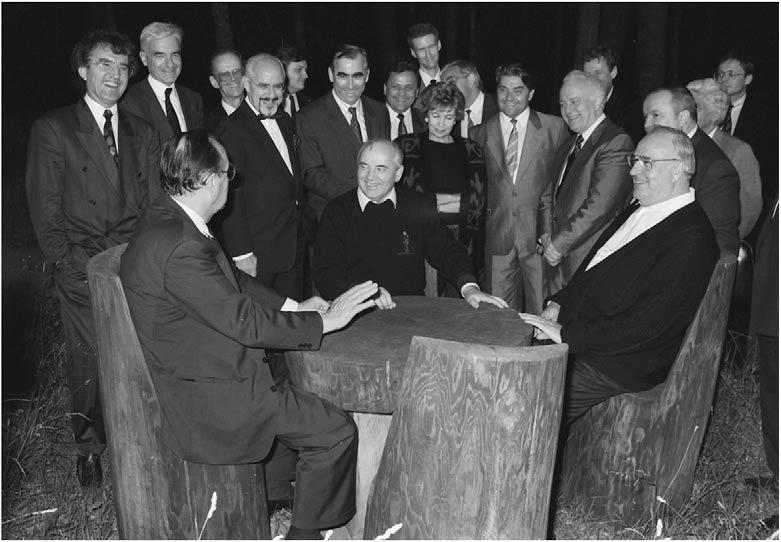
Michail Gorbachev discussing German unification with Hans-Dietrich Genscher and Helmut Kohl in Russia, July 15, 1990. Photo: Bundesbildstelle / Presseund Informationsamt der Bundesregierung.

By Svetlana Savranskaya and Tom Blanton
January 7, 2022
Declassified documents show security assurances against NATO expansion to Soviet leaders from Baker, Bush, Genscher, Kohl, Gates, Mitterrand, Thatcher, Hurd, Major, and Woerner.
Slavic Studies Panel Addresses “Who Promised What to Whom on NATO Expansion?”
Washington D.C., December 12, 2017 – U.S. Secretary of State James Baker’s famous “not one inch eastward” assurance about NATO expansion in his meeting with Soviet leader Mikhail Gorbachev on February 9, 1990, was part of a cascade of assurances about Soviet security given by Western leaders to Gorbachev and other Soviet officials throughout the process of German unification in 1990 and on into 1991, according to declassified U.S., Soviet, German, British and French documents posted today by the National Security Archive at George Washington University.
Originally published by the National Security Archive at George Washington University
The documents show that multiple national leaders were considering and rejecting Central and Eastern European membership in NATO as of early 1990 and through 1991, that discussions of NATO in the context of German unification negotiations in 1990 were not at all narrowly limited to the status of East German territory, and that subsequent Soviet and Russian complaints about being misled about NATO expansion were founded in written contemporaneous memcons and telcons at the highest levels.
The documents reinforce former CIA Director Robert Gates’s criticism of “pressing ahead with expansion of NATO eastward [in the 1990s], when Gorbachev and others were led to believe that wouldn’t happen.”[1] The key phrase, buttressed by the documents, is “led to believe.”
President George H.W. Bush had assured Gorbachev during the Malta summit in December 1989 that the U.S. would not take advantage (“I have not jumped up and down on the Berlin Wall”) of the revolutions in Eastern Europe to harm Soviet interests; but neither Bush nor Gorbachev at that point (or for that matter, West German Chancellor Helmut Kohl) expected so soon the collapse of East Germany or the speed of German unification.[2]
The first concrete assurances by Western leaders on NATO began on January 31, 1990, when West German Foreign Minister Hans-Dietrich Genscher opened the bidding with a major public speech at Tutzing, in Bavaria, on German unification.
The U.S. Embassy in Bonn (see Document 1) informed Washington that Genscher made clear “that the changes in Eastern Europe and the German unification process must not lead to an ‘impairment of Soviet security interests.’ Therefore, NATO should rule out an ‘expansion of its territory towards the east, i.e. moving it closer to the Soviet borders.’” The Bonn cable also noted Genscher’s proposal to leave the East German territory out of NATO military structures even in a unified Germany in NATO.[3]
This latter idea of special status for the GDR territory was codified in the final German unification treaty signed on September 12, 1990, by the Two-Plus-Four foreign ministers (see Document 25).
The former idea about “closer to the Soviet borders” is written down not in treaties but in multiple memoranda of conversation between the Soviets and the highest-level Western interlocutors (Genscher, Kohl, Baker, Gates, Bush, Mitterrand, Thatcher, Major, Woerner, and others) offering assurances throughout 1990 and into 1991 about protecting Soviet security interests and including the USSR in new European security structures.
The two issues were related but not the same. Subsequent analysis sometimes conflated the two and argued that the discussion did not involve all of Europe. The documents published below show clearly that it did.
The “Tutzing formula” immediately became the center of a flurry of important diplomatic discussions over the next 10 days in 1990, leading to the crucial February 10, 1990, meeting in Moscow between Kohl and Gorbachev when the West German leader achieved Soviet assent in principle to German unification in NATO, as long as NATO did not expand to the east. The Soviets would need much more time to work with their domestic opinion (and financial aid from the West Germans) before formally signing the deal in September 1990.
The conversations before Kohl’s assurance involved explicit discussion of NATO expansion, the Central and East European countries, and how to convince the Soviets to accept unification. For example, on February 6, 1990, when Genscher met with British Foreign Minister Douglas Hurd, the British record showed Genscher saying, “The Russians must have some assurance that if, for example, the Polish Government left the Warsaw Pact one day, they would not join NATO the next.” (See Document 2)
Having met with Genscher on his way into discussions with the Soviets, Baker repeated exactly the Genscher formulation in his meeting with Foreign Minister Eduard Shevardnadze on February 9, 1990, (see Document 4); and even more importantly, face to face with Gorbachev.
Not once, but three times, Baker tried out the “not one inch eastward” formula with Gorbachev in the February 9, 1990, meeting. He agreed with Gorbachev’s statement in response to the assurances that “NATO expansion is unacceptable.”
Baker assured Gorbachev that “neither the President nor I intend to extract any unilateral advantages from the processes that are taking place,” and that the Americans understood that “not only for the Soviet Union but for other European countries as well it is important to have guarantees that if the United States keeps its presence in Germany within the framework of NATO, not an inch of NATO’s present military jurisdiction will spread in an eastern direction.” (See Document 6)
Afterwards, Baker wrote to Helmut Kohl who would meet with the Soviet leader on the next day, with much of the very same language. Baker reported: “And then I put the following question to him [Gorbachev]. Would you prefer to see a united Germany outside of NATO, independent and with no U.S. forces or would you prefer a unified Germany to be tied to NATO, with assurances that NATO’s jurisdiction would not shift one inch eastward from its present position?
He answered that the Soviet leadership was giving real thought to all such options [….] He then added, ‘Certainly any extension of the zone of NATO would be unacceptable.’” Baker added in parentheses, for Kohl’s benefit, “By implication, NATO in its current zone might be acceptable.” (See Document 8)
Well-briefed by the American secretary of state, the West German chancellor understood a key Soviet bottom line, and assured Gorbachev on February 10, 1990: “We believe that NATO should not expand the sphere of its activity.” (See Document 9) After this meeting, Kohl could hardly contain his excitement at Gorbachev’s agreement in principle for German unification and, as part of the Helsinki formula that states choose their own alliances, so Germany could choose NATO. Kohl described in his memoirs walking all night around Moscow – but still understanding there was a price still to pay.
All the Western foreign ministers were on board with Genscher, Kohl, and Baker. Next came the British foreign minister, Douglas Hurd, on April 11, 1990. At this point, the East Germans had voted overwhelmingly for the deutschmark and for rapid unification, in the March 18 elections in which Kohl had surprised almost all observers with a real victory.
Kohl’s analyses (first explained to Bush on December 3, 1989) that the GDR’s collapse would open all possibilities, that he had to run to get to the head of the train, that he needed U.S. backing, that unification could happen faster than anyone thought possible – all turned out to be correct.
Monetary union would proceed as early as July and the assurances about security kept coming. Hurd reinforced the Baker-Genscher-Kohl message in his meeting with Gorbachev in Moscow, April 11, 1990, saying that Britain clearly “recognized the importance of doing nothing to prejudice Soviet interests and dignity.” (See Document 15)
The Baker conversation with Shevardnadze on May 4, 1990, as Baker described it in his own report to President Bush, most eloquently described what Western leaders were telling Gorbachev exactly at the moment: “I used your speech and our recognition of the need to adapt NATO, politically and militarily, and to develop CSCE to reassure Shevardnadze that the process would not yield winners and losers. Instead, it would produce a new legitimate European structure – one that would be inclusive, not exclusive.” (See Document 17)
Baker said it again, directly to Gorbachev on May 18, 1990 in Moscow, giving Gorbachev his “nine points,” which included the transformation of NATO, strengthening European structures, keeping Germany non-nuclear, and taking Soviet security interests into account.
Baker started off his remarks, “Before saying a few words about the German issue, I wanted to emphasize that our policies are not aimed at separating Eastern Europe from the Soviet Union. We had that policy before. But today we are interested in building a stable Europe, and doing it together with you.” (See Document 18)
The French leader Francois Mitterrand was not in a mind-meld with the Americans, quite the contrary, as evidenced by his telling Gorbachev in Moscow on May 25, 1990, that he was “personally in favor of gradually dismantling the military blocs”; but Mitterrand continued the cascade of assurances by saying the West must “create security conditions for you, as well as European security as a whole.” (See Document 19) Mitterrand immediately wrote Bush in a “Cher George” letter about his conversation with the Soviet leader, that “we would certainly not refuse to detail the guarantees that he would have a right to expect for his country’s security.” (See Document 20)
At the Washington summit on May 31, 1990, Bush went out of his way to assure Gorbachev that Germany in NATO would never be directed at the USSR: “Believe me, we are not pushing Germany towards unification, and it is not us who determines the pace of this process. And of course, we have no intention, even in our thoughts, to harm the Soviet Union in any fashion. That is why we are speaking in favor of German unification in NATO without ignoring the wider context of the CSCE, taking the traditional economic ties between the two German states into consideration. Such a model, in our view, corresponds to the Soviet interests as well.” (See Document 21)
The “Iron Lady” also pitched in, after the Washington summit, in her meeting with Gorbachev in London on June 8, 1990. Thatcher anticipated the moves the Americans (with her support) would take in the early July NATO conference to support Gorbachev with descriptions of the transformation of NATO towards a more political, less militarily threatening, alliance. She said to Gorbachev: “We must find ways to give the Soviet Union confidence that its security would be assured…. CSCE could be an umbrella for all this, as well as being the forum which brought the Soviet Union fully into discussion about the future of Europe.” (See Document 22)
The NATO London Declaration on July 5, 1990 had quite a positive effect on deliberations in Moscow, according to most accounts, giving Gorbachev significant ammunition to counter his hardliners at the Party Congress which was taking place at that moment. Some versions of this history assert that an advance copy was provided to Shevardnadze’s aides, while others describe just an alert that allowed those aides to take the wire service copy and produce a Soviet positive assessment before the military or hardliners could call it propaganda.
As Kohl said to Gorbachev in Moscow on July 15, 1990, as they worked out the final deal on German unification: “We know what awaits NATO in the future, and I think you are now in the know as well,” referring to the NATO London Declaration. (See Document 23)
In his phone call to Gorbachev on July 17, Bush meant to reinforce the success of the Kohl-Gorbachev talks and the message of the London Declaration. Bush explained: “So what we tried to do was to take account of your concerns expressed to me and others, and we did it in the following ways: by our joint declaration on non-aggression; in our invitation to you to come to NATO; in our agreement to open NATO to regular diplomatic contact with your government and those of the Eastern European countries; and our offer on assurances on the future size of the armed forces of a united Germany – an issue I know you discussed with Helmut Kohl.
We also fundamentally changed our military approach on conventional and nuclear forces. We conveyed the idea of an expanded, stronger CSCE with new institutions in which the USSR can share and be part of the new Europe.” (See Document 24)
The documents show that Gorbachev agreed to German unification in NATO as the result of this cascade of assurances, and on the basis of his own analysis that the future of the Soviet Union depended on its integration into Europe, for which Germany would be the decisive actor.
He and most of his allies believed that some version of the common European home was still possible and would develop alongside the transformation of NATO to lead to a more inclusive and integrated European space, that the post-Cold War settlement would take account of the Soviet security interests. The alliance with Germany would not only overcome the Cold War but also turn on its head the legacy of the Great Patriotic War.
But inside the U.S. government, a different discussion continued, a debate about relations between NATO and Eastern Europe. Opinions differed, but the suggestion from the Defense Department as of October 25, 1990 was to leave “the door ajar” for East European membership in NATO. (See Document 27) The view of the State Department was that NATO expansion was not on the agenda, because it was not in the interest of the U.S. to organize “an anti-Soviet coalition” that extended to the Soviet borders, not least because it might reverse the positive trends in the Soviet Union. (See Document 26) The Bush administration took the latter view. And that’s what the Soviets heard.
As late as March 1991, according to the diary of the British ambassador to Moscow, British Prime Minister John Major personally assured Gorbachev, “We are not talking about the strengthening of NATO.” Subsequently, when Soviet defense minister Marshal Dmitri Yazov asked Major about East European leaders’ interest in NATO membership, the British leader responded, “Nothing of the sort will happen.” (See Document 28)
When Russian Supreme Soviet deputies came to Brussels to see NATO and meet with NATO secretary-general Manfred Woerner in July 1991, Woerner told the Russians that “We should not allow […] the isolation of the USSR from the European community.” According to the Russian memorandum of conversation, “Woerner stressed that the NATO Council and he are against the expansion of NATO (13 of 16 NATO members support this point of view).” (See Document 30)
Thus, Gorbachev went to the end of the Soviet Union assured that the West was not threatening his security and was not expanding NATO. Instead, the dissolution of the USSR was brought about by Russians (Boris Yeltsin and his leading advisory Gennady Burbulis) in concert with the former party bosses of the Soviet republics, especially Ukraine, in December 1991.
The Cold War was long over by then. The Americans had tried to keep the Soviet Union together (see the Bush “Chicken Kiev” speech on August 1, 1991). NATO’s expansion was years in the future, when these disputes would erupt again, and more assurances would come to Russian leader Boris Yeltsin.
The Archive compiled these declassified documents for a panel discussion on November 10, 2017 at the annual conference of the Association for Slavic, East European and Eurasian Studies (ASEEES) in Chicago under the title “Who Promised What to Whom on NATO Expansion?” The panel included:
* Mark Kramer from the Davis Center at Harvard, editor of the Journal of Cold War Studies, whose 2009 Washington Quarterly article argued that the “no-NATO-enlargement pledge” was a “myth”;[4]
* Joshua R. Itkowitz Shifrinson from the Bush School at Texas A&M, whose 2016 International Security article argued the U.S. was playing a double game in 1990, leading Gorbachev to believe NATO would be subsumed in a new European security structure, while working to ensure hegemony in Europe and the maintenance of NATO;[5]
* James Goldgeier from American University, who wrote the authoritative book on the Clinton decision on NATO expansion, Not Whether But When, and described the misleading U.S. assurances to Russian leader Boris Yeltsin in a 2016 WarOnTheRocks article;[6]
* Svetlana Savranskaya and Tom Blanton from the National Security Archive, whose most recent book, The Last Superpower Summits: Gorbachev, Reagan, and Bush: Conversations That Ended the Cold War (CEU Press, 2016) analyzes and publishes the declassified transcripts and related documents from all of Gorbachev’s summits with U.S. presidents, including dozens of assurances about protecting the USSR’s security interests.[7]
[Today’s posting is the first of two on the subject. The second part will cover the Yeltsin discussions with Western leaders about NATO.]
Originally published by the National Security Archive at George Washington University
Please help TFF remain truly independent by contributing if you benefited from this article
Note
For more links concerning the Ukraine conflict, please see Better World Link – which is a very useful link resource on numerous other issues too.





