Martin Luther King’s Warning of America’s Spiritual Death

Dr. Gary G. Kohls

February 9, 2021

A half-century ago, The New York Times accused Martin Luther King Jr. of “slander” for decrying the Vietnam War and The Washington Post detected “unsupported fantasies” in his speech, recalled more favourably by Gary G. Kohls. Originally published on Jan. 19, 2014; slightly edited for the time element.

Originally posted on Consortium News on January 19, 2021

Martin Luther King Jr.’s Riverside Church speech was titled “Beyond Vietnam: A Time to Break Silence.” It was delivered exactly one year before his April 4, 1968 assassination in Memphis. In the speech, King declared, “A nation that continues year after year to spend more money on military defense than on programs of social uplift is approaching spiritual death.”

A mug shot photo of the Rev. Martin Luther King Jr.

The people who heard that speech recognized it as one of the most powerful speeches ever given articulating the immorality of the Vietnam War and its destructive impact on social progress in the United States. In explaining his decision to follow his conscience and speak out against U.S. militarism, King said:

“I knew that America would never invest the necessary funds or energies in rehabilitation of its poor so long as adventures like Vietnam continued to draw men and skills and money like some demonic destructive suction tube. So I was increasingly compelled to see the war as an enemy of the poor and to attack it as such.”

But King went farther, diagnosing the broader disease of militarism and violence that was endangering the soul of the United States. King said, “I could never again raise my voice against the violence of the oppressed in the ghettos without having first spoken clearly to the greatest purveyor of violence in the world today — my own government.”

Poisoning America’s Soul

King knew very well that the disease of violence was killing off more than social progress in America. Violence was sickening the nation’s soul as well. He added, “If America’s soul becomes totally poisoned, part of the autopsy must read ‘Vietnam’.” King urged his fellow citizens to take up the causes of the world’s oppressed, rather than taking the side of the oppressors. He said:

“I am convinced that if we are to get on the right side of the world revolution, we as a nation must undergo a radical revolution of values. We must rapidly begin the shift from a ‘thing-oriented’ society to a ‘person-oriented’ society. When machines and computers, profit motives and property rights are considered more important than people, the giant triplets of racism, materialism and militarism are incapable of being conquered.

“We are confronted with the fierce urgency of now. In this unfolding conundrum of life and history there is such a thing as being too late. Procrastination is still the thief of time. Life often leaves us standing bare, naked and dejected with a lost opportunity. We still have a choice today; nonviolent coexistence or violent co-annihilation. We must move past indecision to action. We must find new ways to speak for peace and justice throughout the developing world a world that borders on our doors.

“If we do not act we shall surely be dragged down the long, dark and shameful corridors of time reserved for those who possess power without compassion, might without morality and strength without sight.”

King pointed to an alternate path into the future: “Now let us rededicate ourselves to the long and bitter but beautiful struggle for a new world. This is the calling of the sons of God, and our brothers wait eagerly for our response. Shall we say the odds are too great? Shall we tell them the struggle is too hard?”

Signing His Own Death Warrant

By denouncing so forcefully the war crimes that the U.S. military was committing daily in the killing fields of Vietnam, some of King’s followers understood that he had just signed his own death warrant. But King, being a person of conscience, was compelled to express his deep sense of moral outrage over the horrific maiming, suffering and dying of millions of innocent Vietnamese civilians in that unjust war that afflicted mostly unarmed women and children and that was going to leave behind lethal poisons in the soil, water and unborn babies that would last for generations.

Martin Luther King Jr. monument in Washington DC. (Photo by Robert Parry)

He knew that non-combatants are always the major victims of modern warfare, especially wars that indiscriminately used highly lethal weapons that rained down from the air, especially the U.S. Air Force’s favorite weapon, napalm — the flaming, jellied gasoline that burned the flesh off of whatever part of the burning adult or child it splashed onto.

King also connected the racist acts (of American soldiers joyfully killing dispensable non-white “gooks” and “slants” — often shooting at “anything that moves”) on the battlefields of Southeast Asia to the oppression, impoverishment, imprisoning and lynching of dispensable, deprived non-white “niggers” in America.

King saw the connections between the violence of racism and the violence of poverty. He saw that the withholding of economic and educational opportunities came from the fear of “the other” and the perceived need to protect the white culture’s wealth and privilege with violence if necessary.

King knew, too, that fortunes are made in every war, and the war in Vietnam was no exception. In his speeches, he talked about that unwelcome reality that the ruling class preferred not be discussed. That meant his well-attended Riverside Church speech threatened not only the powerful interests already arrayed against his civil rights struggle but also the interests of the war profiteers and the national security establishment.

War is Good Business

The longer the Vietnam War lasted, the more the weapons manufacturers thrived. With their huge profits, there was a strong incentive for these financial elites to continue the carnage. And therefore the Wall Street war profiteers financed, out of their ill-gotten gains, battalions of industry lobbyists and pro-military propagandists who descended upon Washington, DC, and the Pentagon to claim even more tax dollars for weapons research, development and manufacture.

Nick Ut’s famous photo of terrified South Vietnamese children fleeing from a napalm attack on the village of Trang Bang in 1972. The girl, Phan Thi Kim Phuc, has ripped off her burning clothes.

With that funding secured, armies of desperate jobs-seekers were hired to work in thousands of weapons factories that were strategically placed in congressional districts almost everywhere, with weapons research grants likewise being awarded to virtually every university in the nation. Thus, weapons-manufacturing and R&D soon became vitally important for almost every legislator’s home district economy as well as for the household budgets of millions of American voters who indirectly benefitted from the U.S. military’s killing, maiming, displacement, starvation and suffering of non-white people in war zones.

King’s anti-war stance was based on his Christianity and on the ethics and life of Jesus, but it was also based on his standing as a revered international peace and justice icon. Those factors made him a dangerous threat to the military/industrial/congressional/security complex.

The powerful forces that were working hard to discredit King had already infiltrated the civil rights movement. Their efforts, cunningly led by the proto-fascist and racist J. Edgar Hoover and his obedient FBI, accelerated after the Riverside speech. The FBI ramped up the smear campaigns against King. Eventually he was “neutralized” with a bullet to the head. [The case for believing that King’s murder was not simply the act of lone gunman James Earl Ray is laid out in many studies, including attorney William F. Pepper’s An Act of State: The Execution of Martin Luther King.]

King’s Prophetic Vision

Now, five decades after his anti-war speech (which was widely kept from the public), it is clear how prophetic King’s observations were. America is indeed losing its soul. Violence, racism, militarism and economic oppression are still American epidemics.

Both upper- and middle-class investors of get-rich-quick schemes in America have succumbed to predatory lenders, cannibalistic corporate mergers and acquisitions, psychopathic multinational corporate schemers, corrupt crony capitalists, and the rapist/exploiters of the land and water by extractive industries all schemes that will eventually burst as part of predictable economic bubbles.

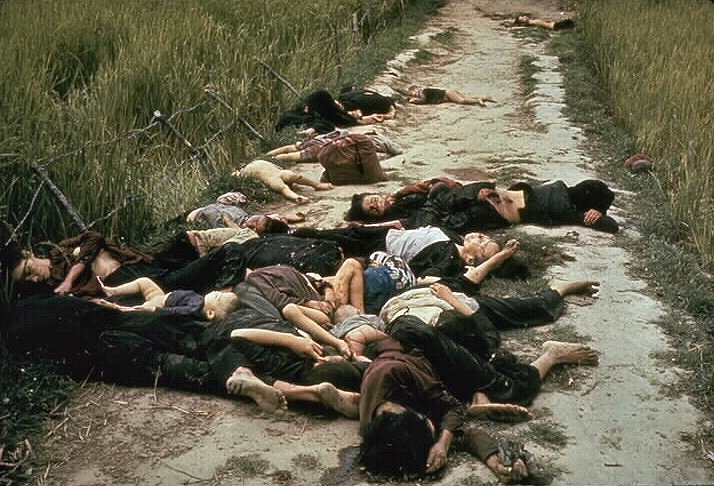
Photos of victims of the My Lai massacre in Vietnam galvanized public awareness about the barbarity of the war. (Photo taken by U. S. Army photographer Ronald L. Haeberle)

Those busted bubbles regularly wipe out investors (except for the large, deep-pocketed “insiders” who, usually being forewarned, will have sold their holdings just in time, before the publicly revealed “bust”), leaving the taxpayers to bail out the financial messes that were created by the so-called “invisible hand of the market” but are really caused by the cunning work of corporate gamblers.

King was trying to warn us not just about the oncoming epidemic of violence toward victims at home but also about the tens of millions of people around the world who were and are still being victimized by U.S. military misadventures. King was also warning us about the multinational corporate war profiteers whose interests are facilitated and protected by the U.S. military whether they are operating in Asia, Latin America, Africa or the Middle East.

The Pentagon budget averages well over $700 billion per year, including wars that are often illegal and unconstitutional. That amounts to $2 billion per day with no visible return on investment, except for the military contractors, the oil industries and Wall Street financiers.

Vast sums also are needed to address the physical and mental health costs needed for the palliative care for the permanently maimed and psychologically-traumatized veterans. Hundreds of millions of dollars more are spent paying down the interest payments on past military debts.

All those potentially bankrupting costs represent money that will never be available for programs of social uplift like combatting racism, poverty and hunger, or paying for affordable housing/healthcare, universal education or meaningful job creation. Can anyone else hear a demonic laugh reverberating down Wall Street?

King was warning America about its oncoming spiritual death if it didn’t convert itself away from military violence. But most observers of the U.S. see America still worshipping at the altars of the Gods of War and Greed. Our children may be doomed.

The vast majority of American Christian churches (whether fundamentalist, conservative, moderate or liberal, with very few exceptions) have failed King’s vision, despite the lip service they sometimes give to King on MLK Day. Churches whose members were brought up on the Myth of American Exceptionalism (and the myth of being “God’s chosen people”) consistently refuse to take a stand against the satanic nature of war.

Past the Point of No Return?

If America is to avert future financial and military catastrophes, King’s central warnings about the “triple evils” of militarism, racism and economic oppression must be heeded. That means a retreat from worldwide network of budget-busting military bases. And, if America wants to shed the justified label of “Rogue Nation,” the covert killing operations of its secret black ops mercenary military units all around the world must be stopped, as should the infamous extrajudicial assassinations by America’s unmanned drones.

At the start of the U.S. invasion of Iraq in 2003, President George W. Bush ordered the U.S. military to conduct a devastating aerial assault on Baghdad, known as “shock and awe.”

If King’s 50-year-old warning continues to be ignored, America’s future is bleak. The future holds the dark seeds of economic chaos, hyperinflation, unendurable poverty, increasing racial/minority hostility, worsening malnutrition, armed rebellion, street fighting, and perhaps, ultimately, institution of a reactionary totalitarian/surveillance police state in order to control citizen protests and quell rebellions.

In 1967, many Americans considered King hopeful vision for a better future as irrational idealism. He was told that the task was too great, the obstacles were too imposing, and there was no will for even the churches to reverse their age-old, conservative pseudo-patriotism and society’s institutional racism. I suspect that many of the churches that called King a communist and therefore ignored him back then wish that they could turn back the clock and give King’s (and Jesus’s) path a try.

King finished his speech with these challenges: “War is not the answer. We still have a choice today; nonviolent coexistence or violent co-annihilation. We must move past indecision to action. We must find new ways to speak for peace and justice throughout the developing world a world that borders on our doors. If we do not act we shall surely be dragged down the long dark and shameful corridors of time reserved for those who possess power without compassion, might without morality and strength without sight.”

And he had these sobering words for the churches that are immersed in a polytheistic culture (the worship of multiple gods, including the gods of war and mammon) and thus are tempted to quietly ally themselves with those gods rather than the God of Love that King was devoted to:

“I have traveled the length and breadth of Alabama, Mississippi and all the other southern states. I have looked at her beautiful churches with their lofty spires pointing heavenward. I have beheld the impressive outlay of her massive religious education buildings. Over and over again I have found myself asking: ‘What kind of people worship here? Who is their God?’”

Today, the task is even tougher, the obstacles much more imposing, but the path that King outlined remains.

Please help TFF remain truly independent and highly productive by contributing if you benefited from this article

Dr Gary G. Kohls is a retired physician who writes about peace, justice, militarism, mental health and religious issues. More about him and his articles here.

Related Posts

Jan Oberg TFF director October 13, 2026 According to Alfred Nobel’s will, the Nobel Peace Prize shall be awarded: ”to the person who has done the most or best to advance fellowship among nations, the abolition or reduction of standing armies, and the establishment and promotion of peace congresses.” Further down, he also expresses how the prize for the “champions of peace” shall be decided: “that for champions of peace by a committee of five persons to be selected by the Norwegian Storting. Alfred Nobel’s will is remarkably short and clear. But few seem to have read it. Nobel did not say that the committee itself should consist of members of parliament. He entrusted the Storting with appointing five persons. In principle, it could have selected diplomats, mediators, peace researchers, conflict-resolution specialists, or other individuals with recognised expertise in matters of peace from around the world. Instead, the Storting gradually...
Advocates of nuclear disarmament are regularly dismissed by the champions of nuclear deterrence as naïve and unrealistic, utopian or even irresponsible. Yet this ‘doctrine’ of deterrence, regarded by France as the ‘cornerstone’ of its national security, is based on quasi-religious beliefs, a theory that cannot be proven, risky gambles and fragile assumptions. So much so that one might legitimately ask which side the ‘Care Bears’ are on. Marc FinaudVice-President of Initiatives for Nuclear Disarmament (IDN) October 9, 2026 This article was originally published on Pressenza When it comes to these things being treated as religious concepts, look here. Idealists and realists It was Hubert Védrine, François Mitterrand’s former Foreign Minister, who repeatedly coined the phrase: ‘Europeans are a sort of Care Bears who don’t realise they’re living in Jurassic Park’. He applies this reference to the cartoon for well-behaved children not only to what he regards as weakness or idealism...
What the West Borrowed from Asia and What It Left Behind Jan Krikke October 8, 2026 The article was originally published here In the late 1960s, the musical Hair announced that the Age of Aquarius was dawning. Its opening anthem promised a transformation of human consciousness: an era of peace, harmony and understanding. Half a century later, a familiar echo of that promise is a meditation app offered by your employer. You can find it in the same list of benefits as the pension plan and the gym discount. How did a spiritual revolution become an employee benefit? The answer lies in the history of the movement known as New Age: where it came from, what it borrowed from Asia, and why the meaning of what it borrowed changed in the process. Two definitions will help. New Age is a loose label for a wide range of spiritual practices and...

Recent Articles

Below are TFF-related media mentions, comments, videos and social media posts published elsewhere but not on this homepage. We happen to catch and list only a fraction. Regarding video comments and debates, we recommend that you go to the TFF Video Channel on Substack where many of them are reproduced. Jan Oberg is a contributor to China Daily – 52 million daily clicks – and Global Times, CGTN and CCTV (the national television), China Investment, Xinhua News Agency and several others. Articles and videos on these media very often multiply into countless Chinese (and Western media) that re-post them from these main media. Thanks to The China Academy, his analyses, interviews and comments are frequently posted on YouTube channels such as Thinkers Forum and Wave Media. These videos are often re-posted on Bilibili (China’s YouTube), the China Content Center on TikTok, and on the Chinese edition of TikTok, Douyin.com. This means reaching hundreds of millions of viewers worldwide over a year. While there are too many to catch on all these...
Jan Oberg TFF director October 13, 2026 According to Alfred Nobel’s will, the Nobel Peace Prize shall be awarded: ”to the person who has done the most or best to advance fellowship among nations, the abolition or reduction of standing armies, and the establishment and promotion of peace congresses.” Further down, he also expresses how the prize for the “champions of peace” shall be decided: “that for champions of peace by a committee of five persons to be selected by the Norwegian Storting. Alfred Nobel’s will is remarkably short and clear. But few seem to have read it. Nobel did not say that the committee itself should consist of members of parliament. He entrusted the Storting with appointing five persons. In principle, it could have selected diplomats, mediators, peace researchers, conflict-resolution specialists, or other individuals with recognised expertise in matters of peace from around the world. Instead, the Storting gradually...
The Quest for Humane Survival Richard Falk Professor emeritus, Princeton UniversityTFF Associate since 1986October 12, 2026 After decades of teaching and writing about international law in academic frameworks that were not institutionally situated within law school environments—at Princeton and the University of California, Santa Barbara—I found myself most receptive to the TWAIL outlook. It has been especially illuminating in clarifying the extent to which international law evolved as a dialogical critique of Europe’s efforts to legitimize its colonial undertakings. In particular, TWAIL has exposed how international law has functioned to legalize the subjugation of Third World peoples, securing conditions for exploitative investment and trade relations, the coercive enforcement of public debts, and an ideology of cultural superiority. TWAIL’s exposure of these economic legacies of colonialism has influenced my understanding of the history and development of international law, broadly conceived, as an ideological project of the Western sub-system of the world...

TFF on Substack

Discover and subscribe to more peace materials on TFF Substack

Most Popular

Below are TFF-related media mentions, comments, videos and social media posts published elsewhere but not on this homepage. We happen to catch and list only a fraction. Regarding video comments and debates, we recommend that you go to the TFF Video Channel on Substack where many of them are reproduced. Jan Oberg is a contributor to China Daily – 52 million daily clicks – and Global Times, CGTN and CCTV (the national television), China Investment, Xinhua News Agency and several others. Articles and videos on these media very often multiply into countless Chinese (and Western media) that re-post them from these main media. Thanks to The China Academy, his analyses, interviews and comments are frequently posted on YouTube channels such as Thinkers Forum and Wave Media. These videos are often re-posted on Bilibili (China’s YouTube), the China Content Center on TikTok, and on the Chinese edition of TikTok, Douyin.com. This means reaching hundreds of millions of viewers worldwide over a year. While there are too many to catch on all these...
Jan Oberg TFF director October 13, 2026 According to Alfred Nobel’s will, the Nobel Peace Prize shall be awarded: ”to the person who has done the most or best to advance fellowship among nations, the abolition or reduction of standing armies, and the establishment and promotion of peace congresses.” Further down, he also expresses how the prize for the “champions of peace” shall be decided: “that for champions of peace by a committee of five persons to be selected by the Norwegian Storting. Alfred Nobel’s will is remarkably short and clear. But few seem to have read it. Nobel did not say that the committee itself should consist of members of parliament. He entrusted the Storting with appointing five persons. In principle, it could have selected diplomats, mediators, peace researchers, conflict-resolution specialists, or other individuals with recognised expertise in matters of peace from around the world. Instead, the Storting gradually...
The Quest for Humane Survival Richard Falk Professor emeritus, Princeton UniversityTFF Associate since 1986October 12, 2026 After decades of teaching and writing about international law in academic frameworks that were not institutionally situated within law school environments—at Princeton and the University of California, Santa Barbara—I found myself most receptive to the TWAIL outlook. It has been especially illuminating in clarifying the extent to which international law evolved as a dialogical critique of Europe’s efforts to legitimize its colonial undertakings. In particular, TWAIL has exposed how international law has functioned to legalize the subjugation of Third World peoples, securing conditions for exploitative investment and trade relations, the coercive enforcement of public debts, and an ideology of cultural superiority. TWAIL’s exposure of these economic legacies of colonialism has influenced my understanding of the history and development of international law, broadly conceived, as an ideological project of the Western sub-system of the world...
Read More
girl-5894831_1280
Below are TFF-related media mentions, comments, videos and social media posts published elsewhere but not on this homepage. We happen to catch and list only a fraction. Regarding video comments and debates, we recommend that you go to the TFF Video Channel on Substack where many of them are reproduced. Jan Oberg is a contributor to China Daily – 52 million daily clicks – and Global Times, CGTN and CCTV (the national television), China Investment, Xinhua News Agency and several others. Articles and videos on these media very often multiply into countless Chinese (and Western media) that re-post them from these main media. Thanks to The China Academy, his analyses, interviews and comments are frequently posted on YouTube channels such as Thinkers Forum and Wave Media. These videos are often re-posted on Bilibili (China’s YouTube), the China Content Center on TikTok, and on the Chinese edition of TikTok, Douyin.com. This means reaching hundreds of millions of viewers worldwide over a year. While there are too many to catch on all these...
Nobel-Prize-Plaque
Jan Oberg TFF director October 13, 2026 According to Alfred Nobel’s will, the Nobel Peace Prize shall be awarded: ”to the person who has done the most or best to advance fellowship among nations, the abolition or reduction of standing armies, and the establishment and promotion of peace congresses.” Further down, he also expresses how the prize for the “champions of peace” shall be decided: “that for champions of peace by a committee of five persons to be selected by the Norwegian Storting. Alfred Nobel’s will is remarkably short and clear. But few seem to have read it. Nobel did not say that the committee itself should consist of members of parliament. He entrusted the Storting with appointing five persons. In principle, it could have selected diplomats, mediators, peace researchers, conflict-resolution specialists, or other individuals with recognised expertise in matters of peace from around the world. Instead, the Storting gradually...
law-419057_1280
The Quest for Humane Survival Richard Falk Professor emeritus, Princeton UniversityTFF Associate since 1986October 12, 2026 After decades of teaching and writing about international law in academic frameworks that were not institutionally situated within law school environments—at Princeton and the University of California, Santa Barbara—I found myself most receptive to the TWAIL outlook. It has been especially illuminating in clarifying the extent to which international law evolved as a dialogical critique of Europe’s efforts to legitimize its colonial undertakings. In particular, TWAIL has exposed how international law has functioned to legalize the subjugation of Third World peoples, securing conditions for exploitative investment and trade relations, the coercive enforcement of public debts, and an ideology of cultural superiority. TWAIL’s exposure of these economic legacies of colonialism has influenced my understanding of the history and development of international law, broadly conceived, as an ideological project of the Western sub-system of the world...
images-2
Advocates of nuclear disarmament are regularly dismissed by the champions of nuclear deterrence as naïve and unrealistic, utopian or even irresponsible. Yet this ‘doctrine’ of deterrence, regarded by France as the ‘cornerstone’ of its national security, is based on quasi-religious beliefs, a theory that cannot be proven, risky gambles and fragile assumptions. So much so that one might legitimately ask which side the ‘Care Bears’ are on. Marc FinaudVice-President of Initiatives for Nuclear Disarmament (IDN) October 9, 2026 This article was originally published on Pressenza When it comes to these things being treated as religious concepts, look here. Idealists and realists It was Hubert Védrine, François Mitterrand’s former Foreign Minister, who repeatedly coined the phrase: ‘Europeans are a sort of Care Bears who don’t realise they’re living in Jurassic Park’. He applies this reference to the cartoon for well-behaved children not only to what he regards as weakness or idealism...
8824b09f-33a5-43f9-9fd0-550f28cda24d_1536x1024
What the West Borrowed from Asia and What It Left Behind Jan Krikke October 8, 2026 The article was originally published here In the late 1960s, the musical Hair announced that the Age of Aquarius was dawning. Its opening anthem promised a transformation of human consciousness: an era of peace, harmony and understanding. Half a century later, a familiar echo of that promise is a meditation app offered by your employer. You can find it in the same list of benefits as the pension plan and the gym discount. How did a spiritual revolution become an employee benefit? The answer lies in the history of the movement known as New Age: where it came from, what it borrowed from Asia, and why the meaning of what it borrowed changed in the process. Two definitions will help. New Age is a loose label for a wide range of spiritual practices and...
Screenshot 2026-10-04 210142
Small and different + among the 10% most active + 9,000 texts + 150 Associates + 60 000 a day — and a stubborn belief that peace is smarter and must be secured by peaceful means. In 2026, the Transnational Foundation for Peace and Future Research (TFF) turns 40. On Monday, October 5, 2026, a new TFF homepage will go live — a new gateway to more than 9,000 articles, analyses, research papers and other contributions produced over four decades of independent peace research. But this is not simply a new website. For four decades, TFF has worked from a simple conviction: peace is smarter than militarism and can be brought about by peaceful means. This is not merely an aspiration. It is the principle expressed in the UN Charter and the Gandhian tradition that has guided our work from the beginning. TFF is a research-based, independent and people-financed foundation....