February 14, 2024
Now more than ever, we need a more effective United Nations; one with an appropriate instrument for preventing armed conflict and advancing sustainable common security.
Despite having primary responsibility for the maintenance of international peace and security, the UN still lacks a dedicated capacity to respond rapidly and reliably to prevent armed conflict and protect people.
As a result, the world has witnessed humanitarian crises in Rwanda, Srebrenica, the Democratic Republic of the Congo, Sir Lanka, Darfur, Libya, Iraq, Syria, Afghanistan, Yemen, Myanmar, Tigray, the Ukraine, Sudan and Israel/Palestine/Gaza. Despite the promise of “never again”, mass atrocities occur again and again.
Even before the war on Gaza, UN Secretary-General Antonio Guterres warned, “the world is now facing the highest number of violent conflicts since 1945. He identified the crux of the problem, “we have no instruments to deal with crisis…we live in a dangerous situation.”
You might think governments around the world would be scrambling to find new ways ‘to save succeeding generations from the scourge of war’, to prevent armed conflict, to protect people at risk and to shift spending priorities away from more preparation for war to address our climate emergency and sustainable development.
Sadly, despite Guterres’ pleas for big and bold ideas, the new UN Agenda for Peace offered little hope, and few new ideas.
Last month, UN Under-Secretary General for Peace Operations, Jean-Pierre Lacroix, repeated the plea, “the international community and multilateral system “need a more diverse set of tools and responses to address widening challenges.”
A useful point from Buckminister Fuller was that, “you never change things by fighting the existing reality. To change something, build a new model that makes the existing model obsolete.”
There is a new model – a crucial tool for dangerous times…
Last February, a proposed United Nations Emergency Peace Service (UNEPS) was selected by the Global Futures Forum from 40 peace and security proposals submitted. It’s now part of the People’s Pact For The Future, to be raised at the 2024 UN Summit of the Future.
A UNEPS is a simple idea. Much as civil society depends on professional emergency services, promptly available 24/7, our world needs a “UN 112/911.”
With this one development – a ‘112/911 first responder’ – the UN would finally have a capacity to fulfil four of its tougher assigned tasks – preventing armed conflict, protecting civilians at extreme risk, ensuring prompt start-up of demanding peace operations, and addressing human needs where other actors either cannot or will not.
Equally important, a UN ‘emergency security-provider’ would encourage military build-down and the wider disarmament process urgently needed.
One Step to Help
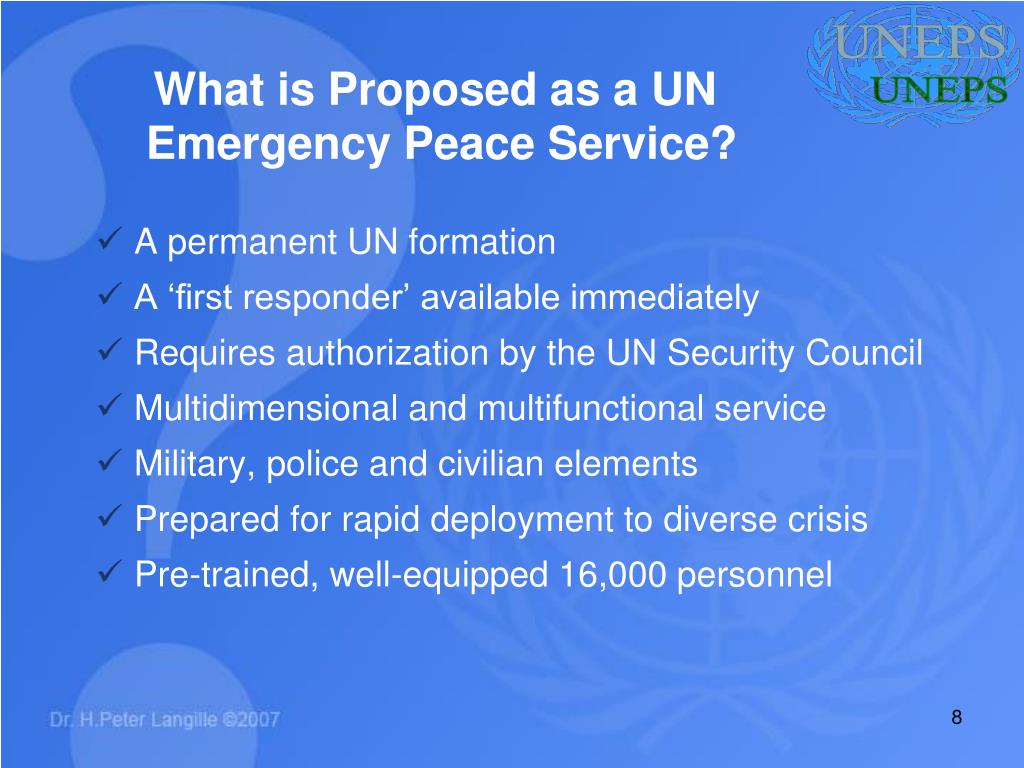
The proposed UN Emergency Peace Service is for a permanent, standing UN formation; highly trained and well-equipped; ready for immediate deployment upon authorization of the UN Security Council. Another objective of this service is to inspire people, political will and the funding required.
Unlike prior proposals, a UNEPS is to complement existing UN arrangements, to be multidimensional (i.e., civilian, police & military) and multifunctional (for humanitarian, security, health and environmental crises), as well as gender-equitable.
This service would draw on dedicated individuals, recruited world-wide (selected, trained and employed by the UN), rather than national contingents to ensure rapid and reliable UN responses. A UNEPS is a new model that would help to offset the political pressure governments face when confronted with awkward decisions about whether to deploy their people into potentially high-risk operations. There would be no shortage of applicants from the best and brightest worldwide as this would be a unique opportunity to serve humanity.
A UNEPS need not be large, but composed of 13,500 personnel, located at a designated UN base under an operational headquarters and two mobile mission headquarters.
Five potential benefits are evident.
First, fast.
UN peace operations would improve with a standing first-responder to manage the initial six months of demanding operations.
Instead of taking 6 months-to-a year or more to deploy national contingents, there would be immediate access to a dedicated UN service to address a wider array of emergencies.
A UNEPS is to deliver more assistance faster and in a more sophisticated manner. Small teams of experts and planners are included to coordinate the larger formations’ immediate and subsequent responses to diverse crises. With its modular formation, UNEPS deployments can be tailored to various mission-specific requirements.
Thus, a UNEPS would clearly be a more reliable and rapid first responder; one that could also serve as a vanguard, strategic reserve and a modest security guarantor, both to deter violent crime and respond, when necessary, to prevent conflict and protect civilians.
Second, the elusive key to prevention.
It’s far easier to prevent conflicts and protect civilians when help arrives promptly, before conflicts escalate and violence spreads. As with a police or defense effort, it’s best to be known to have credible means to deter aggression and, when required, the means to intervene to stop crimes. In practice, this usually works by having a legitimate capacity that is recognized and ready to respond as needed.
A standing UNEPS would convey a legitimate presence ready 24/7 to discourage violence. Its deployable elements should be sufficient to deter most, if not all belligerents, to operate in high-risk environments and to intervene if needed to stop aggressive parties.
Third, useful.
In what’s increasingly a global neighbourhood under strain, there will be a greater need for universal emergency services. A UNEPS is to provide prompt help in complex emergencies.
Aside from police services to restore law and order and a military formation to deter aggression and maintain security, there would be an array of civilian teams to provide essential services for conflict resolution, human rights, health care, disaster assistance and quick impact peacebuilding projects.
With a gender-equitable composition, peacemaking and peacebuilding would improve. Standards should also rise system-wide.
As an integrated first-responder, a UNEPS is not limited to simply stopping direct violence, but also extends to initiating quick-impact and long-term projects. With a focus on human needs, it should help to counter structural violence (exploitation and exclusion), and stem cultural violence. By including specialists in conflict resolution and mediation, human rights monitors and educators, peacebuilding advisory units, and medical teams, there is a far better prospect of stemming or solving a crisis.
Fourth, wider security.
Equally important, a UNEPS would be an ‘emergency security provider’ to offset fears and encourage wider disarmament. This isn’t a new idea, but one that’s now urgent.
As early as 1961, officials in the U.S. State Department acknowledged in ‘Freedom From War’ that preventing war and encouraging wider disarmament “can only be achieved” by a more effective UN with a UN Peace Force to safeguard legitimate interests.
The ‘security dilemma’ driving numerous states to arm-up in response to anarchy and uncertainty over potentially aggressive neighbours needs to be offset by a UN assurance of support. Similarly, it should be understood that progress in wider disarmament and even the UN Treaty on the Prohibition of Nuclear Weapons (TPNW) depends on a coherent alternative to nuclear and conventional deterrence.
For both, the alternative need not be similar to what exists – large or powerfully destructive. It needs to be credible, respected and widely valued.
A UNEPS would be a more sophisticated option than a UN force. As an emergency security provider, its likely roles would be similar to that of a ‘first-responder’, a trip-wire, a vanguard and a standing presence to dissuade, deter and, respond rapidly if necessary. The minimal deterrent and modest military capacity within are appropriate and likely to be adequate.
In this capacity, a UNEPS does not require heavy military elements nor a capacity for mid-to-high-intensity war-fighting. In representing the international community, it’s unlikely to encounter violent resistance from any national armed force. If needed for back-up and support, the five permanent members of the UN Security Council (France, China, Russia, the United States and the United Kingdom) will continue to have ample capacity in the near term. But they should not need so much in the long-term.
With a credible and legitimate UN capacity to offset fears and to deter aggression, a UNEPS would provide an incentive for countries to scale back on preparing for more war.
Further, a UN that could respond rapidly and reliably to prevent armed conflict would offset the need for nuclear and conventional deterrence, which underpin the current system of mutually-assured destruction and our ‘balance of terror’. And, that would also offset the ‘unwarranted influence’ now pushing for further confrontation. Within a few years, there would be no legitimate basis for offensive force projection or expeditionary capacity. Weapon sales would decline, with fewer threats and less violent conflict. Then, governments would have sufficient resources to address our shared climate emergency, poverty reduction and real social needs.
Fifth, cost-effective.
The ever-higher costs and risks of war are unsustainable. The cost of preparing for more war is now over $2.2-trillion annually, but that is dwarfed by the damage caused, with the Global Peace Index reporting, “the economic impact of violence at $17.5-trillion in 2022, equivalent to 12.9 per cent of global GDP, or $2,200 per person” – absorbing resources urgently needed.
A UNEPS would inevitably entail a substantive investment. Start-up costs would be in the range of $3.5 billion (U.S.), with annual recurring costs of approximately $1.5 billion and, incremental costs for field operations of approximately $1.2 billion. These costs would likely be shared proportionally among 193 Member States as part of each nation’s assessed share of the UN regular budget.
A UNEPS would not only help to prevent the escalation of volatile conflicts and deter groups from armed violence; it could also drastically cut the size, the length and the frequency of UN operations. Even with success in just one of these areas, it should provide a substantive return on the investment.
For now, a UNEPS is simply an option to a dysfunctional war-prone system. And, it’s a cost-effective alternative to the ever-higher costs and risks of ‘national security’ systems, largely designed to either threaten others or, to kill and destroy them.
While relatively small in size, this ‘ounce of prevention’ would be worth a ton of cure.
The potential savings might yet appeal to the UN’s Member States. And, the bonus of a big joint project involving the Permanent Five members of the UN Security Council (Britain, China, France, Russia and the United States) is that in draining the fuel from confrontation to encourage cooperation, governments will have far more resources to help both their own people and the more vulnerable.
Like it or not, further confrontation can only have a lose-lose outcome. If it goes hot and nuclear in the short-term, most die miserably; if it extends into the long-term, there will be insufficient co-operation and resources to deal with climate breakdown, sacrificing all succeeding generations.
The future, if there is to be one, will depend on far deeper cooperation, with a far more effective UN.
A UNEPS is no longer ‘mission-impossible’ nor all that radical. The idea stems from an earlier government of Canada report, Towards A Rapid Reaction Capability For The United Nations, submitted to the UN General Assembly.
Two former U.S. House Resolutions (H-Res 180 & H-Res 213), acknowledged that a UNEPS “could save millions of lives and billions of dollars and is in the interests of the United States.” In 2017, the British Labour Party raised a UNEPS as a peace priority and promptly discovered wide receptivity to the idea. So, the idea has the potential to inspire a wider constituency of support, which is a key step toward the political will and financial support required.
Of course, there’s no assurance that a UNEPS will be developed, let alone discussed at the 2024 UN Summit of the Future. That’s likely to depend on support and solidarity, on political champions; a broader network of NGOs and institutes, progressive parties and officials in inclined Member States.
Conclusion: A solution to multiple problems
The proposed UN Emergency Peace Service is no panacea, but it would be a game-changer for a more effective UN; for a more legitimate rules-based system; for rapid and reliable responses to prevent armed conflict and protect civilians at risk; for addressing human needs, with prompt help and security, and; for developing the trust that enables wider disarmament.
In short, this would be a crucial step toward an urgently needed, UN-centred, global peace system.
Clearly, the major impediment to this development is not financial as the cost-savings would likely be in trillions of dollars.
Once again, what is needed most is forward-thinking political leadership.
Unfortunately, it’s only in the aftermath of tragic wars and/or genocides that governments worldwide consider new approaches and substantive reforms.
Yet the next opportune moment isn’t far off. Like it or not, system change will soon be a survival imperative, even for the great power, permanent members of the UN Security Council, even for the UN system. Shortly, they will need viable policy options that provide a win-win solution to the world’s more pressing problems.
Paradigm shifts do happen when prevailing systems are deemed inadequate or failing and, when another option is widely viewed as better.
For any hoping to give peace a better chance, a ‘UN 112/911’ is a viable policy option, albeit one that will definitely need help to become a reality.
Ideas, even good ideas, don’t work unless they attract and mobilize those who care to work for the better world.
In the words of the late Sir Brian Urquhart (1919-2021*):
“This venture is of the greatest importance both to the UN as a responsible institution and to the millions as of yet unknown, innocent victims who might, in the future, be saved by this essential addition to the UN’s capacity to act on their behalf. There is one overwhelming argument for the United Nations Emergency Peace Service. It is desperately needed, and it is needed as soon as possible.”

The author
Dr. H. Peter Langille specializes in peace and conflict studies, United Nations peace operations and independent analysis of defence and security policy. More about his education and research here. He can be reached at: hpl@globalcommonsecurity.org
*) Sir Brian Urquhart was also a TFF Associate for more than 20 years until his death.
Recommended reading
Learn more about this very important idea and related projects at Sustainable Common Security.
Jan Oberg (2023)
Towards a new peace and security thinking for the multi-polar, cooperative and peaceful world
Endorsements of the UNEPS idea
TFF is proud to have been associated with the UNEPS idea for years.