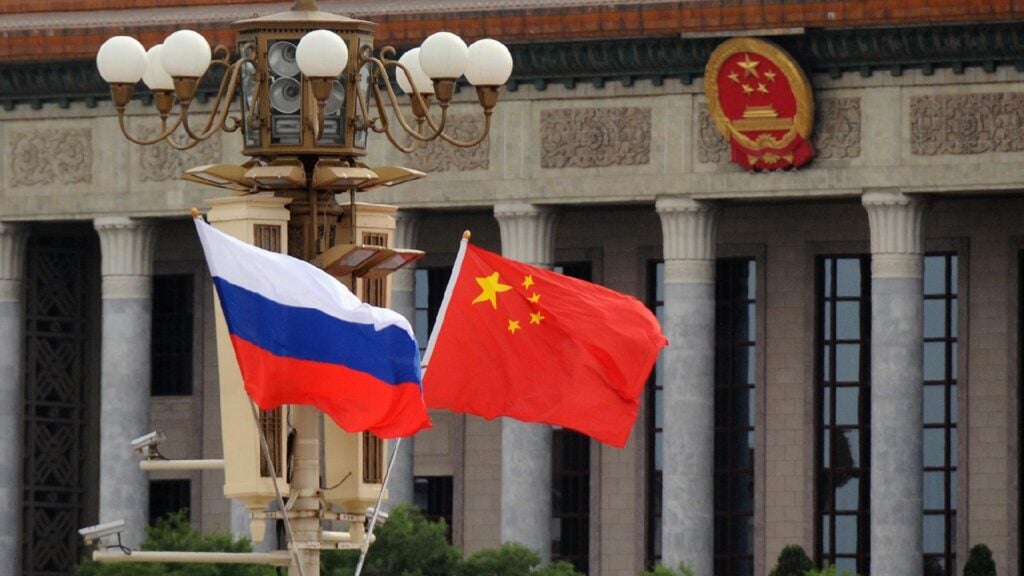
Joint Article by Chinese and Russian Ambassadors: Respecting People’s Democratic Rights

The embassy of the People’s Republic of China in the United States of America

10 December 2021

This Joint Article was published on ”The National Interest”. Qin Gang is the Chinese Ambassador to the United States. Anatoly Antonov is the Russian Ambassador to the United States.

We publish it here on The Transnational because we believe it is a historic document both because of China-Russia cooperation which is increasing rapidly and because it makes the important point that the US no longer has any legitimate – or exceptionalist – right to tell others how to operate.

The upcoming American-led online Summit for Democracy will stoke ideological confrontation. Faced with an array of global challenges, countries urgently need to strengthen coordination and cooperation for common progress.

The United States will be hosting the online Summit for Democracy on December 9-10, 2021, empowering itself to define who is to attend the event and who is not, who is a “democratic country” and who is not eligible for such status. An evident product of its Cold-War mentality, this will stoke up ideological confrontation and a rift in the world, creating new “dividing lines.”

This trend contradicts the development of the modern world. It is impossible to prevent the shaping of a global polycentric architecture but could strain the objective process. China and Russia firmly reject this move.

Originally published at China-embassy.org

Peace, development, fairness, justice, democracy, and freedom are common values of humanity. Democracy is not a prerogative of a certain country or a group of countries, but a universal right of all peoples. It can be realized in multiple ways, and no model can fit all countries.

Whether a country’s path works depends on whether it meets the country’s realities, follows the trend of the times, and brings about economic development, social stability and progress, and better lives for the people. Ultimately, it relies on the support of the people and will be proven by its contribution to human progress.

Therefore, a basic criterion of democracy should be about the people, i.e. whether the people have the right to govern their country, whether their needs are met, and whether they have a sense of fulfilment and happiness.

If the people are only awakened when casting their votes and sent back to hibernation when the voting is over, if they are served with sweet-sounding slogans in campaigns but have no say after the election, if they are wooed during canvassing but left out in the cold after that, this is not a genuine democracy.

What China has is an extensive, whole-process socialist democracy. It reflects the people’s will, suits the country’s realities, and enjoys strong support from the people.

In China, the people have the right to elections, and they can get deeply involved in national governance, exercising their power through the People’s Congresses at the national and other levels. China has eight non-Communist parties participating in governance, as well as a unique system and corresponding institutions of political consultation.

On matters concerning people’s keen interests, there are broad-based and sufficient consultations and discussions before any decision is made. Policies and measures can only be introduced when there is a consensus that they are what the people want and will serve the people’s needs.

It has been proved that the whole-process democracy works in China, and works very well. China calls for building a community with a shared future for mankind. As residents of the same global village, we should handle international affairs through consultation.

Russia is a democratic federative law-governed state with a republican form of government. Democracy is the fundamental principle of its political system. The democratic institutions were further strengthened by the amendments to the Constitution adopted through a referendum in 2020.

In Russia, the development of democracy is closely connected to culture and traditions. Traditions of its parliamentarianism go back over a hundred years. Russia’s political system is evolving steadily and needs a stable and calm environment that guarantees the rights and interests of its people.

Democracy is not just about domestic governance; it should also be reflected in international relations. A truly democratic government will support democracy in international relations. It will not foster hegemony and division abroad while building democracy and unity at home. The path to prosperity of nations goes through respectful cooperation with each other, despite some differences in views on particular issues.

The sovereignty, security, and development interests of a country should not be violated. Interfering in other countries’ internal affairs—under the pretext of fighting corruption, promoting democratic values, or protecting human rights—hindering their development, wielding the big stick of sanctions, and even infringing on their sovereignty, unity and territorial integrity go against the UN Charter and other basic norms of international law and are obviously anti-democratic.

No country has the right to judge the world’s vast and varied political landscape by a single yardstick, and having other countries copy one’s political system through color revolution, regime change and even use of force go against international law, and are obviously anti-democratic.

International affairs should be handled in accordance with the principles of extensive consultation, joint contribution, and shared benefits, and decided in the spirit of true multilateralism.

There should be a more inclusive global governance, not something like “might makes right.” Seeking supremacy and putting oneself always first are acts of hegemonism and unilateralism, and are obviously anti-democratic.

Common security and development are a prevailing aspiration of the international community. Using ideology to bring down other countries, and promote a geo-strategy for absolute security will lead to division and confrontation, and are obviously anti-democratic.

There is only one international system in the world, i.e. the international system with the United Nations at its core. There is only one international order, i.e. the one underpinned by international law. And there is only one set of rules, i.e. the basic norms governing international relations based on the purposes and principles of the UN Charter.

Flaunting the “rules-based international order” without referencing the UN and international law and attempting to replace international rules with the dictums of certain blocs falls into the category of revisionism and is obviously anti-democratic.

There has seen no shortage of wars and turmoil worldwide to prove that spreading “democracy,” its political system, and values against other countries’ will severely undermine regional and international peace, security, and stability.

Bombings of Yugoslavia, military intervention in Iraq, Afghanistan, and Libya, and “democratic transformation” do nothing but harm. Countries should focus on running their own affairs well, not condescendingly criticizing others.

There is no need to worry about democracy in Russia and China. Certain foreign governments better think about themselves and what is going on in their homes. Is it freedom when various rallies in their countries are dispersed with rubber bullets and tear gas? It does not look very much like freedom.

Faced with an array of global challenges, countries urgently need to strengthen coordination and cooperation for common progress. Especially today when the international community needs to improve cooperation between all countries to counter the pandemic of COVID-19, foster economic development, and neutralize cross-border threats.

China and Russia call on countries: to stop using “value-based diplomacy” to provoke division and confrontation; to practice mutual respect and win-win cooperation in international relations, and to work for harmonious coexistence between countries with different social systems, ideologies, histories, cultures, and development levels.

Originally published at China-embassy.org

Please help TFF remain truly independent by contributing if you benefited from this article

Related Posts

It’s a matter of principles, courage, vision and pulling together – while the militarist world is falling apart… Peter Langille October 3, 2026 “Here, then, is the problem which we present to you, stark and dreadful and inescapable: Shall we put an end to the human race; or shall mankind renounce war?”The Bertrand Russell—Albert Einstein Manifesto, July 9, 1955 ⁕ The forecast for what’s ahead is worrisome. The sharp rise in armed conflicts over the past three years is adding to what was already the highest level in over seventy years. Genocides, which should be prevented are supported. A shared climate emergency that jeopardises survival is ignored. Diverse polls now suggest that people are war-weary, worried and interested in a more effective United Nations. And, there are viable policy options for a more secure world! Yet governments are doubling-down, betting on more war and investing heavily. If current trends persist,...
The agreement is catastrophic both because of what it says and what it doesn’t mention. It reduces further the major asset of security policies: Freedom of action. Jan Oberg TFF director September 25, 2026 A couple of hours before the agreement was signed on September 22, 2026, I published the following 13 hypotheses about what it would most likely contain on TFF Substack (in English). I was wrong on only the first point. Contrary to what Trump had written on his Truth Social platform, it does not appear to come into force immediately. In fact, it turned out to be worse than even I had anticipated. After these hypotheses now come a number of reflections in light of what the agreement actually contains, and does not contain, as well as the way in which it has generally been presented by major media outlets and by the public-service broadcaster DR. My...
Jan Oberg May 15, 2026 Go to this Fox News page and scroll the whole way down: President Donald Trump tells the world that his meeting with President Xi Jinping yielded a lot of very concrete political and economic results – of course, only where the Chinese side, according to him, agreed with him. He does not mention the Taiwan issue, but Secretary of State, Marco Rubio, says that it did not feature prominently in their talks and that the US policy on Taiwan has not changed. Then go to China Daily – or Global Times – and you will see that for the Chinese it is framework, principles, structure of cooperation etc. that matters – all embedded in the overall idea of “constructive bilateral relationship of strategic stability.” Nowhere is any concrete agreement or deal – all that Trump refers to – mentioned. At the general level, this gives you insights into the very different social...

Recent Articles

The Quest for Humane Survival Richard Falk Professor emeritus, Princeton UniversityTFF Associate since 1986October 12, 2026 After decades of teaching and writing about international law in academic frameworks that were not institutionally situated within law school environments—at Princeton and the University of California, Santa Barbara—I found myself most receptive to the TWAIL outlook. It has been especially illuminating in clarifying the extent to which international law evolved as a dialogical critique of Europe’s efforts to legitimize its colonial undertakings. In particular, TWAIL has exposed how international law has functioned to legalize the subjugation of Third World peoples, securing conditions for exploitative investment and trade relations, the coercive enforcement of public debts, and an ideology of cultural superiority. TWAIL’s exposure of these economic legacies of colonialism has influenced my understanding of the history and development of international law, broadly conceived, as an ideological project of the Western sub-system of the world...
Advocates of nuclear disarmament are regularly dismissed by the champions of nuclear deterrence as naïve and unrealistic, utopian or even irresponsible. Yet this ‘doctrine’ of deterrence, regarded by France as the ‘cornerstone’ of its national security, is based on quasi-religious beliefs, a theory that cannot be proven, risky gambles and fragile assumptions. So much so that one might legitimately ask which side the ‘Care Bears’ are on. Marc FinaudVice-President of Initiatives for Nuclear Disarmament (IDN) October 9, 2026 This article was originally published on Pressenza When it comes to these things being treated as religious concepts, look here. Idealists and realists It was Hubert Védrine, François Mitterrand’s former Foreign Minister, who repeatedly coined the phrase: ‘Europeans are a sort of Care Bears who don’t realise they’re living in Jurassic Park’. He applies this reference to the cartoon for well-behaved children not only to what he regards as weakness or idealism...
What the West Borrowed from Asia and What It Left Behind Jan Krikke October 8, 2026 The article was originally published here In the late 1960s, the musical Hair announced that the Age of Aquarius was dawning. Its opening anthem promised a transformation of human consciousness: an era of peace, harmony and understanding. Half a century later, a familiar echo of that promise is a meditation app offered by your employer. You can find it in the same list of benefits as the pension plan and the gym discount. How did a spiritual revolution become an employee benefit? The answer lies in the history of the movement known as New Age: where it came from, what it borrowed from Asia, and why the meaning of what it borrowed changed in the process. Two definitions will help. New Age is a loose label for a wide range of spiritual practices and...

TFF on Substack

Discover and subscribe to more peace materials on TFF Substack

Most Popular

The Quest for Humane Survival Richard Falk Professor emeritus, Princeton UniversityTFF Associate since 1986October 12, 2026 After decades of teaching and writing about international law in academic frameworks that were not institutionally situated within law school environments—at Princeton and the University of California, Santa Barbara—I found myself most receptive to the TWAIL outlook. It has been especially illuminating in clarifying the extent to which international law evolved as a dialogical critique of Europe’s efforts to legitimize its colonial undertakings. In particular, TWAIL has exposed how international law has functioned to legalize the subjugation of Third World peoples, securing conditions for exploitative investment and trade relations, the coercive enforcement of public debts, and an ideology of cultural superiority. TWAIL’s exposure of these economic legacies of colonialism has influenced my understanding of the history and development of international law, broadly conceived, as an ideological project of the Western sub-system of the world...
Advocates of nuclear disarmament are regularly dismissed by the champions of nuclear deterrence as naïve and unrealistic, utopian or even irresponsible. Yet this ‘doctrine’ of deterrence, regarded by France as the ‘cornerstone’ of its national security, is based on quasi-religious beliefs, a theory that cannot be proven, risky gambles and fragile assumptions. So much so that one might legitimately ask which side the ‘Care Bears’ are on. Marc FinaudVice-President of Initiatives for Nuclear Disarmament (IDN) October 9, 2026 This article was originally published on Pressenza When it comes to these things being treated as religious concepts, look here. Idealists and realists It was Hubert Védrine, François Mitterrand’s former Foreign Minister, who repeatedly coined the phrase: ‘Europeans are a sort of Care Bears who don’t realise they’re living in Jurassic Park’. He applies this reference to the cartoon for well-behaved children not only to what he regards as weakness or idealism...
What the West Borrowed from Asia and What It Left Behind Jan Krikke October 8, 2026 The article was originally published here In the late 1960s, the musical Hair announced that the Age of Aquarius was dawning. Its opening anthem promised a transformation of human consciousness: an era of peace, harmony and understanding. Half a century later, a familiar echo of that promise is a meditation app offered by your employer. You can find it in the same list of benefits as the pension plan and the gym discount. How did a spiritual revolution become an employee benefit? The answer lies in the history of the movement known as New Age: where it came from, what it borrowed from Asia, and why the meaning of what it borrowed changed in the process. Two definitions will help. New Age is a loose label for a wide range of spiritual practices and...
Read More
law-419057_1280
The Quest for Humane Survival Richard Falk Professor emeritus, Princeton UniversityTFF Associate since 1986October 12, 2026 After decades of teaching and writing about international law in academic frameworks that were not institutionally situated within law school environments—at Princeton and the University of California, Santa Barbara—I found myself most receptive to the TWAIL outlook. It has been especially illuminating in clarifying the extent to which international law evolved as a dialogical critique of Europe’s efforts to legitimize its colonial undertakings. In particular, TWAIL has exposed how international law has functioned to legalize the subjugation of Third World peoples, securing conditions for exploitative investment and trade relations, the coercive enforcement of public debts, and an ideology of cultural superiority. TWAIL’s exposure of these economic legacies of colonialism has influenced my understanding of the history and development of international law, broadly conceived, as an ideological project of the Western sub-system of the world...
images-2
Advocates of nuclear disarmament are regularly dismissed by the champions of nuclear deterrence as naïve and unrealistic, utopian or even irresponsible. Yet this ‘doctrine’ of deterrence, regarded by France as the ‘cornerstone’ of its national security, is based on quasi-religious beliefs, a theory that cannot be proven, risky gambles and fragile assumptions. So much so that one might legitimately ask which side the ‘Care Bears’ are on. Marc FinaudVice-President of Initiatives for Nuclear Disarmament (IDN) October 9, 2026 This article was originally published on Pressenza When it comes to these things being treated as religious concepts, look here. Idealists and realists It was Hubert Védrine, François Mitterrand’s former Foreign Minister, who repeatedly coined the phrase: ‘Europeans are a sort of Care Bears who don’t realise they’re living in Jurassic Park’. He applies this reference to the cartoon for well-behaved children not only to what he regards as weakness or idealism...
8824b09f-33a5-43f9-9fd0-550f28cda24d_1536x1024
What the West Borrowed from Asia and What It Left Behind Jan Krikke October 8, 2026 The article was originally published here In the late 1960s, the musical Hair announced that the Age of Aquarius was dawning. Its opening anthem promised a transformation of human consciousness: an era of peace, harmony and understanding. Half a century later, a familiar echo of that promise is a meditation app offered by your employer. You can find it in the same list of benefits as the pension plan and the gym discount. How did a spiritual revolution become an employee benefit? The answer lies in the history of the movement known as New Age: where it came from, what it borrowed from Asia, and why the meaning of what it borrowed changed in the process. Two definitions will help. New Age is a loose label for a wide range of spiritual practices and...
Screenshot 2026-10-04 210142
Small and different + among the 10% most active + 9,000 texts + 150 Associates + 60 000 a day — and a stubborn belief that peace is smarter and must be secured by peaceful means. In 2026, the Transnational Foundation for Peace and Future Research (TFF) turns 40. On Monday, October 5, 2026, a new TFF homepage will go live — a new gateway to more than 9,000 articles, analyses, research papers and other contributions produced over four decades of independent peace research. But this is not simply a new website. For four decades, TFF has worked from a simple conviction: peace is smarter than militarism and can be brought about by peaceful means. This is not merely an aspiration. It is the principle expressed in the UN Charter and the Gandhian tradition that has guided our work from the beginning. TFF is a research-based, independent and people-financed foundation....
Living-Peace-Sign-Budapest-copy
Tony Robinson October 4, 2026 Violence is easy to recognise when someone is being beaten, shot or killed. It becomes more difficult when nobody is holding a weapon. Poverty, discrimination, exploitation and repression can restrict a human life just as effectively, although they do so in very different ways and with very different consequences. Simply adding more categories to an ever-growing list of forms of violence does not really solve the problem. The more interesting question is what all these different situations have in common and why it makes sense to describe them using the same word. Human beings do not simply react to what happens around them. They remember the past, imagine things that do not yet exist, make plans and undertake projects. Workers organise because they imagine different working conditions; people migrate because they imagine another life somewhere else; social movements emerge because people refuse to accept the...
b54a1f10-8c65-4f0b-9dd5-4abc0a7d04cc_2659x2659
It’s a matter of principles, courage, vision and pulling together – while the militarist world is falling apart… Peter Langille October 3, 2026 “Here, then, is the problem which we present to you, stark and dreadful and inescapable: Shall we put an end to the human race; or shall mankind renounce war?”The Bertrand Russell—Albert Einstein Manifesto, July 9, 1955 ⁕ The forecast for what’s ahead is worrisome. The sharp rise in armed conflicts over the past three years is adding to what was already the highest level in over seventy years. Genocides, which should be prevented are supported. A shared climate emergency that jeopardises survival is ignored. Diverse polls now suggest that people are war-weary, worried and interested in a more effective United Nations. And, there are viable policy options for a more secure world! Yet governments are doubling-down, betting on more war and investing heavily. If current trends persist,...