

John Mcevoy: Deathly Silence – Journalists Who Mocked Assange Have Nothing to Say About CIA Plans to Kill Him

John Mcevoy

November 25, 2021

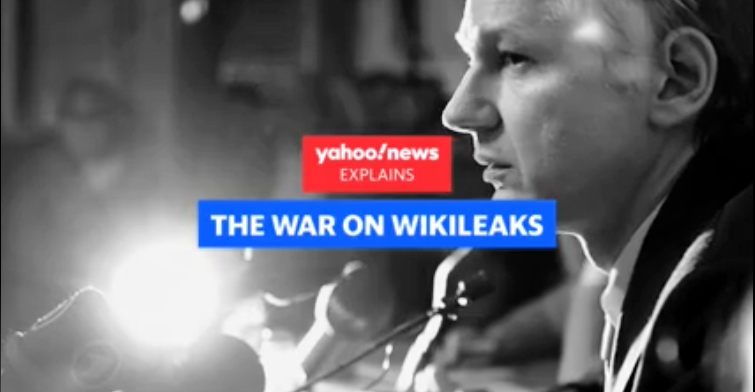
Yahoo! News (9/26/21) published a bombshell report detailing the US Central Intelligence Agency’s “secret war plans against WikiLeaks,” including clandestine plots to kill or kidnap publisher Julian Assange while he took refuge in the Ecuadorian embassy in London.

Following WikiLeaks‘ publication of the Vault 7 files in 2017—the largest leak in CIA history, which exposed how US and UK intelligence agencies could hack into household devices—the US government designated WikiLeaks as a “non-state hostile intelligence service” (The Hill, 4/13/17), providing legal cover to target the organization as if it were an adversarial spy agency.

Originally published at FAIR.org

Within this context, the Donald Trump administration reportedly requested “sketches” or “options” for how to kill Assange, according to the Yahoo! expose (written by Zach Dorfman, Sean D. Naylor and Michael Isikoff), while the CIA drew up plans to kidnap him. (Assange was expelled from the embassy in 2019 and has since then been in British prison, fighting a demand that he be extradited to the US to face charges of espionage—FAIR.org, 11/13/20.)

Shortly after publication, former CIA director Mike Pompeo (Yahoo! News, 9/29/21) seemed to confirm the report’s findings, declaring that the former US intelligence officials who spoke with Yahoo! “should all be prosecuted for speaking about classified activity inside the CIA.”

Ghoulish indifference

It would seem that covert plans for the state-sanctioned murder on British soil of an award-winning journalist should attract sustained, wall-to-wall media coverage.

The news, however, has been met by Western establishment media with ghoulish indifference—a damning indictment of an industry that feverishly condemns attacks on press freedom in Official Enemy states.

BBC News, one of the most-read news outlets in the world, appears to have covered the story just once—in the Somali-language section of the BBC website (Media Lens on Twitter, 9/30/21).

Neither the New York Times or Washington Post, two of the world’s leading corporate news organizations, have published any articles about Assange since July 2021.

To its credit, since the story first broke on September 26, the Guardian has reported twice on the CIA-led conspiracy to kill or kidnap Assange. But to offer perspective, during the week after Russian opposition figure Alexei Navalny was reported to have been poisoned by the Russian government, the Guardian published 16 separate pieces on the issue, including video reports and opinion pieces.

Similarly, a Nexis search of British newspapers for the word “Navalny” brings up 288 results from August 20–25, 2020. The same search for “Assange” between September 26–October 1, 2021, brings up a meager 29 results—one of which, a notable exception, was a Patrick Cockburn piece in the Independent (10/1/21).

Crucial relief

As is typical of stories that embarrass the Western intelligence services, independent media provided crucial relief to the backdrop of chilling indifference, with the Grayzone’s Aaron Maté (YouTube, 9/30/21) conducting a rigorous interview with one of the report’s authors, Michael Isikoff.

Indeed, the Grayzone (5/14/20) was the first outlet to provide evidence of a CIA-linked proposal to “kidnap or poison Assange” in May 2020. The story, however, was almost universally ignored, suggesting that, as Joe Lauria wrote in Consortium News (10/2/21), “until something appears in the mainstream media, it didn’t happen.”

One thing the corporate media cannot be accused of with regards to Assange, however, is inconsistency. After a key witness in the Department of Justice’s case against the publisher admitted to providing the US prosecution with false testimony, a detail that should ordinarily turn a case to dust, the corporate media responded by ignoring the story almost entirely. As Alan MacLeod wrote for FAIR.org (7/2/21):

The complete uniformity with which corporate media have treated this latest bombshell news raises even more concerns about how fundamentally intertwined and aligned they are with the interests of the US government.

Even after it was revealed that the UC Global security firm that targeted Assange had also spied on journalists at the Washington Post and New York Times, neither outlet mounted any protest (Grayzone, 9/18/20).

Perhaps most remarkably, UK judge Vanessa Baraitser relied on a falsified CNN report (7/15/19)  to justify the CIA’s spying operation against Assange (Grayzone, 5/1/21). Now, CNN’s website contains no reports on the agency’s plans to kill or kidnap Assange.

The prevailing silence has extended into the NGO industry. Amnesty International, which refused in 2019 to consider Assange a prisoner of conscience, has said nothing about the latest revelations. Likewise, Index on Censorship, which describes itself as “The Global Voice of Free Expression,” hasn’t responded to the story.

The establishment media’s dismissal of Assange supports Edward Herman and Noam Chomsky’s framework of “worthy” and “unworthy” political dissidents, with Assange situated firmly in the latter camp.

‘Only barrier is pride’

The present circumstances become even more deplorable upon consideration of the corporate journalists who arrogantly diminished, or even delighted in, Assange’s concerns for his own safety.

The Guardian’s James Ball (1/10/18) published a now infamous article headlined, “The Only Barrier to Julian Assange Leaving Ecuador’s Embassy Is Pride.” “The WikiLeaks founder is unlikely to face prosecution in the US,” the subhead confidently asserted. The column concluded:

Assange does not want to be trapped in Ecuador’s embassy, and his hosts do not want him there. Their problem is that what’s keeping him trapped there is not so much the iniquitous actions of world powers, but pride.

In a later article (3/29/18), Ball insisted that Assange “should hold his hands up and leave the embassy.”

Ball, at least, has written something on the latest revelations, but his article in the London Times (10/03/21) remains typically scornful of Assange’s persona.

The Guardian’s Marina Hyde (5/19/17) took a similar angle. Under the headline “The Moral of the Assange Story? Wait Long Enough, and Bad Stuff Goes Away,” Hyde wrote that “Captain WikiLeaks will get out of pretend-jail eventually.” More than four years later, Assange is in Belmarsh prison, “the closest comparison in the United Kingdom to Guantánamo,” according to the House of Commons Foreign Affairs Committee. Hyde has said nothing of the very real plans to murder or kidnap him.

In the same vein, journalist Suzanne Moore—who had previously publicly mocked Assange on a number of occasions—wrote in the New Statesman (4/12/19) after Assange’s arrest:

We are all bored out of our minds with Brexit when a demented-looking gnome is pulled out of the Ecuadorian embassy by the secret police of the deep state. Or “the met,” as normal people call them.

Moore, winner of the Orwell Prize for journalism in 2019, was not the first of her colleagues to ridicule WikiLeaks and its supporters as paranoid about an increasingly powerful state security apparatus. A column by the Guardian‘s Nick Cohen (6/23/12) offered “supporters of Julian Assange” as a “definition of paranoia”:

Assange’s supporters do not tell us how the Americans could prosecute the incontinent leaker. American democracy is guilty of many crimes and corruptions. But the First Amendment to the US constitution is the finest defense of freedom of speech yet written. The American Civil Liberties Union thinks it would be unconstitutional for a judge to punish Assange.

And, in any case, “Britain has a notoriously lax extradition treaty with the United States.”

Blinded by propaganda

It is of little surprise, then, that the Guardian, among other news outlets, refused to publish the words of UN special rapporteur on torture Nils Melzer, who wrote in June 2019:

In the end, it finally dawned on me that I had been blinded by propaganda, and that Assange had been systematically slandered to divert attention from the crimes he exposed. Once he had been dehumanized through isolation, ridicule and shame, just like the witches we used to burn at the stake, it was easy to deprive him of his most fundamental rights without provoking public outrage worldwide.

The Assange case once again demonstrates that when erroneous reporting falls on the right side of the US and UK foreign policy establishment, editorial standards are set aside, and journalistic failures are met with zero accountability.

As such, it’s important to remember those journalists who watched on, pointing, laughing, comfortable in the knowledge that their work would never produce the impact nor risk of WikiLeaks—and then said nothing as the right to a free press was removed in broad daylight.

Originally published at FAIR.org

John McEvoy

John McEvoy is an independent journalist whose work has featured in the International History Review, Declassified UK, the Canary, Tribune, Brasil Wire and others.

Please help TFF remain truly independent by contributing if you benefited from this article

Related Posts

Below are TFF-related media mentions, comments, videos and social media posts published elsewhere but not on this homepage. We happen to catch and list only a fraction. Regarding video comments and debates, we recommend that you go to the TFF Video Channel on Substack where many of them are reproduced. Jan Oberg is a contributor to China Daily – 52 million daily clicks – and Global Times, CGTN and CCTV (the national television), China Investment, Xinhua News Agency and several others. Articles and videos on these media very often multiply into countless Chinese (and Western media) that re-post them from these main media. Thanks to The China Academy, his analyses, interviews and comments are frequently posted on YouTube channels such as Thinkers Forum and Wave Media. These videos are often re-posted on Bilibili (China’s YouTube), the China Content Center on TikTok, and on the Chinese edition of TikTok, Douyin.com. This means reaching hundreds of millions of viewers worldwide over a year. While there are too many to catch on all these...
Jan Oberg May 15, 2026 Go to this Fox News page and scroll the whole way down: President Donald Trump tells the world that his meeting with President Xi Jinping yielded a lot of very concrete political and economic results – of course, only where the Chinese side, according to him, agreed with him. He does not mention the Taiwan issue, but Secretary of State, Marco Rubio, says that it did not feature prominently in their talks and that the US policy on Taiwan has not changed. Then go to China Daily – or Global Times – and you will see that for the Chinese it is framework, principles, structure of cooperation etc. that matters – all embedded in the overall idea of “constructive bilateral relationship of strategic stability.” Nowhere is any concrete agreement or deal – all that Trump refers to – mentioned. At the general level, this gives you insights into the very different social...
Lena Petrova of “World Affairs In Context” with more than half a million subscribers on YouTube wanted to explore what a peace researcher like me has to say about, among other things, the First and the Second Cold War and why eethics has disappeared from politics. I am particularly happy about this conversation that also yielded an amazing number of very appreciative comments on YouTube. No doubt, people are longing for alternatives, including peace perspectives.

Recent Articles

Tony Robinson October 4, 2026 Violence is easy to recognise when someone is being beaten, shot or killed. It becomes more difficult when nobody is holding a weapon. Poverty, discrimination, exploitation and repression can restrict a human life just as effectively, although they do so in very different ways and with very different consequences. Simply adding more categories to an ever-growing list of forms of violence does not really solve the problem. The more interesting question is what all these different situations have in common and why it makes sense to describe them using the same word. Human beings do not simply react to what happens around them. They remember the past, imagine things that do not yet exist, make plans and undertake projects. Workers organise because they imagine different working conditions; people migrate because they imagine another life somewhere else; social movements emerge because people refuse to accept the...
It’s a matter of principles, courage, vision and pulling together – while the militarist world is falling apart… Peter Langille October 3, 2026 “Here, then, is the problem which we present to you, stark and dreadful and inescapable: Shall we put an end to the human race; or shall mankind renounce war?”The Bertrand Russell—Albert Einstein Manifesto, July 9, 1955 ⁕ The forecast for what’s ahead is worrisome. The sharp rise in armed conflicts over the past three years is adding to what was already the highest level in over seventy years. Genocides, which should be prevented are supported. A shared climate emergency that jeopardises survival is ignored. Diverse polls now suggest that people are war-weary, worried and interested in a more effective United Nations. And, there are viable policy options for a more secure world! Yet governments are doubling-down, betting on more war and investing heavily. If current trends persist,...
Johan Galtung 1930-2024October 2015 Published here on October 3, 2026 Let us focus on Civilization for conflict analysis and remedies. Major forms of disorder use violence; war is state organized violence. The most belligerent states are the United States of America and Israel, both with civilization roots. National Evangelism, the US Protestant Christian civilization– more national than evangelical–justifies US warfare as exceptionalism of a people chosen by God, with a manifest destiny to run the world. Orthodox Judaism justifies Israeli warfare to conquer and expand from Nile to Euphrates as a religious right and duty to the Eternal One. The third most belligerent country, the UK, no longer believes it is God-chosen but chosen by the USA; not quite the same but something. But the root cause of global disorder lies in the Occident–with Islam–seeing itself as the single, universal civilization valid for all at all times, all others being...

TFF on Substack

Discover and subscribe to more peace materials on TFF Substack

Most Popular

Tony Robinson October 4, 2026 Violence is easy to recognise when someone is being beaten, shot or killed. It becomes more difficult when nobody is holding a weapon. Poverty, discrimination, exploitation and repression can restrict a human life just as effectively, although they do so in very different ways and with very different consequences. Simply adding more categories to an ever-growing list of forms of violence does not really solve the problem. The more interesting question is what all these different situations have in common and why it makes sense to describe them using the same word. Human beings do not simply react to what happens around them. They remember the past, imagine things that do not yet exist, make plans and undertake projects. Workers organise because they imagine different working conditions; people migrate because they imagine another life somewhere else; social movements emerge because people refuse to accept the...
It’s a matter of principles, courage, vision and pulling together – while the militarist world is falling apart… Peter Langille October 3, 2026 “Here, then, is the problem which we present to you, stark and dreadful and inescapable: Shall we put an end to the human race; or shall mankind renounce war?”The Bertrand Russell—Albert Einstein Manifesto, July 9, 1955 ⁕ The forecast for what’s ahead is worrisome. The sharp rise in armed conflicts over the past three years is adding to what was already the highest level in over seventy years. Genocides, which should be prevented are supported. A shared climate emergency that jeopardises survival is ignored. Diverse polls now suggest that people are war-weary, worried and interested in a more effective United Nations. And, there are viable policy options for a more secure world! Yet governments are doubling-down, betting on more war and investing heavily. If current trends persist,...
Johan Galtung 1930-2024October 2015 Published here on October 3, 2026 Let us focus on Civilization for conflict analysis and remedies. Major forms of disorder use violence; war is state organized violence. The most belligerent states are the United States of America and Israel, both with civilization roots. National Evangelism, the US Protestant Christian civilization– more national than evangelical–justifies US warfare as exceptionalism of a people chosen by God, with a manifest destiny to run the world. Orthodox Judaism justifies Israeli warfare to conquer and expand from Nile to Euphrates as a religious right and duty to the Eternal One. The third most belligerent country, the UK, no longer believes it is God-chosen but chosen by the USA; not quite the same but something. But the root cause of global disorder lies in the Occident–with Islam–seeing itself as the single, universal civilization valid for all at all times, all others being...
Read More
Living-Peace-Sign-Budapest-copy
Tony Robinson October 4, 2026 Violence is easy to recognise when someone is being beaten, shot or killed. It becomes more difficult when nobody is holding a weapon. Poverty, discrimination, exploitation and repression can restrict a human life just as effectively, although they do so in very different ways and with very different consequences. Simply adding more categories to an ever-growing list of forms of violence does not really solve the problem. The more interesting question is what all these different situations have in common and why it makes sense to describe them using the same word. Human beings do not simply react to what happens around them. They remember the past, imagine things that do not yet exist, make plans and undertake projects. Workers organise because they imagine different working conditions; people migrate because they imagine another life somewhere else; social movements emerge because people refuse to accept the...
b54a1f10-8c65-4f0b-9dd5-4abc0a7d04cc_2659x2659
It’s a matter of principles, courage, vision and pulling together – while the militarist world is falling apart… Peter Langille October 3, 2026 “Here, then, is the problem which we present to you, stark and dreadful and inescapable: Shall we put an end to the human race; or shall mankind renounce war?”The Bertrand Russell—Albert Einstein Manifesto, July 9, 1955 ⁕ The forecast for what’s ahead is worrisome. The sharp rise in armed conflicts over the past three years is adding to what was already the highest level in over seventy years. Genocides, which should be prevented are supported. A shared climate emergency that jeopardises survival is ignored. Diverse polls now suggest that people are war-weary, worried and interested in a more effective United Nations. And, there are viable policy options for a more secure world! Yet governments are doubling-down, betting on more war and investing heavily. If current trends persist,...
010
Johan Galtung 1930-2024October 2015 Published here on October 3, 2026 Let us focus on Civilization for conflict analysis and remedies. Major forms of disorder use violence; war is state organized violence. The most belligerent states are the United States of America and Israel, both with civilization roots. National Evangelism, the US Protestant Christian civilization– more national than evangelical–justifies US warfare as exceptionalism of a people chosen by God, with a manifest destiny to run the world. Orthodox Judaism justifies Israeli warfare to conquer and expand from Nile to Euphrates as a religious right and duty to the Eternal One. The third most belligerent country, the UK, no longer believes it is God-chosen but chosen by the USA; not quite the same but something. But the root cause of global disorder lies in the Occident–with Islam–seeing itself as the single, universal civilization valid for all at all times, all others being...
Screenshot 2026-10-02 011738
Jan ObergPhD, director, The Transnational Foundation for Peace and Future Research, TFFLund, Sweden October 2, 2026 This is my full original manuscript. The Chinese Academy of Social Science, CASS, makes two publications out if it. 1. China’s Five-year plan emphasized the capabilities of basic research and original innovation. It is regarded as the goal of the future social development, which, as required, should be significantly enhanced. Can you comment on the importance of original innovation in research and academic study? I believe it is easier to define “original innovation” in the natural sciences than in social sciences. The breaking points of what constitutes something new, or innovative, are not quite as sharp in the latter. But in both fields it is about opening up something that was closed, unseen, unexplored before – making manifest what was earlier latent. Innovations come in many forms and shapes – naming something that was not...
arctic-circle-map
The agreement is catastrophic both because of what it says and what it doesn’t mention. It reduces further the major asset of security policies: Freedom of action. Jan Oberg TFF director September 25, 2026 A couple of hours before the agreement was signed on September 22, 2026, I published the following 13 hypotheses about what it would most likely contain on TFF Substack (in English). I was wrong on only the first point. Contrary to what Trump had written on his Truth Social platform, it does not appear to come into force immediately. In fact, it turned out to be worse than even I had anticipated. After these hypotheses now come a number of reflections in light of what the agreement actually contains, and does not contain, as well as the way in which it has generally been presented by major media outlets and by the public-service broadcaster DR. My...
girl-5894831_1280
Below are TFF-related media mentions, comments, videos and social media posts published elsewhere but not on this homepage. We happen to catch and list only a fraction. Regarding video comments and debates, we recommend that you go to the TFF Video Channel on Substack where many of them are reproduced. Jan Oberg is a contributor to China Daily – 52 million daily clicks – and Global Times, CGTN and CCTV (the national television), China Investment, Xinhua News Agency and several others. Articles and videos on these media very often multiply into countless Chinese (and Western media) that re-post them from these main media. Thanks to The China Academy, his analyses, interviews and comments are frequently posted on YouTube channels such as Thinkers Forum and Wave Media. These videos are often re-posted on Bilibili (China’s YouTube), the China Content Center on TikTok, and on the Chinese edition of TikTok, Douyin.com. This means reaching hundreds of millions of viewers worldwide over a year. While there are too many to catch on all these...




