
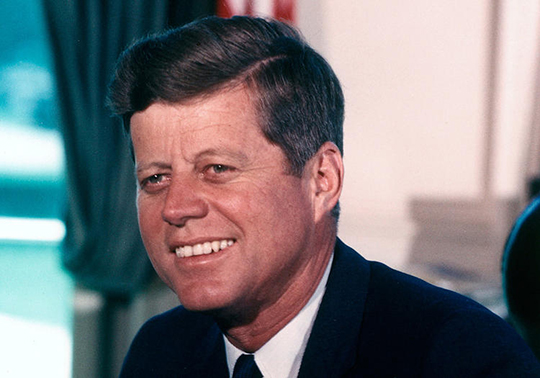
JFK Made a Forgotten Turn Toward Peace Before He Was Killed: We’ve Abandoned it Entirely


By Patricia Hynes

Co-author: Frances Crowe

June 4, 2018

Greenfield, MA (Informed Comment) – Fifty-five years ago on June 10, 1963, President John F. Kennedy delivered a commencement address at American University that, in fewer than 30 minutes, turned traditional national security policy on its head. Kennedy proclaimed that world peace is “the most important topic on earth….not merely peace for Americans but peace for all men and women – not merely peace in our time but peace for all time.”

His speech was hailed by then Soviet Union premier Nikita Khrushchev as “the greatest speech by any American President since Roosevelt.”

Originally published at Informed Comment by Juan Cole here


Eight months earlier, both men had faced the terrifying possibility of nuclear holocaust in a showdown between the United States and the Soviet Union, remembered to history as the Cuban Missile Crisis. Shaken but emboldened by it, Kennedy laid out a principled, strategic and humanistic vision for ending the arms race and dissipating the hostile Cold War rhetoric and culture. He led by example in honoring the Russian people “for their many achievements –in science and space, in economic and industrial growth, in culture and in acts of courage” (alluding to 20 million Russians killed in World War II). And he announced a proposed direct line of communication between Moscow and Washington.

Within two months of his commencement address, both former Cold War antagonists and Britain signed the Partial Nuclear Test Ban Treaty, prohibiting nuclear testing in the atmosphere, outer space and under water, resulting in substantial reduction of radioactive contamination. President Kennedy was assassinated before being able to construct a path toward complete and permanent disarmament.

Let us contrast Kennedy’s words and convictions expressed on June 10, 1963 with our government’s present-day national defense posture. These two diverging roads – Kennedy’s, the one less traveled by – lay before us.

JFK
“What kind of peace do we seek…?” Not one “enforced on the world by American weapons of war…I am talking about…the kind of peace…that enables people…to hope and to build a better life for their children – not merely peace for Americans but peace for all men and women.”

Stockpiling weapons – nuclear and non-nuclear – “is not the only” nor the most efficient means of achieving peace, he continues. Both the United States and the Soviet Union “are devoting massive sums of money that could be better devoted to combatting ignorance, poverty, and disease…New weapons beget new counterweapons.”

The Pentagon
2018 opened with a new National Defense Posture: The greatest threat to U.S national security and prosperity is now Russia and China, with terrorism relegated to a second tier. Elsewhere the Pentagon speaks of 4+1 threats: Russia, China, North Korea, Iran and terrorism. Their chief concern is that the 2018-19 defense budget –morbidly obese by comparison with the funds dedicated to diplomacy – is not large enough for conducting war on all these fronts.

President Trump’s proposed national defense budget for next fiscal year, recently passed overwhelmingly by Republicans and Democrats in the House of Representatives, allocates 18 times more funding ($717 billion) to military defense than to his proposed budget for diplomacy ($39 billion).

China’s response to U.S. war talk? The United States has unparalleled military might, spending three times more on military than China, remarks Chinese foreign ministry spokesman Geng Shuang. Yet its sense of insecurity is “beyond comprehension.” He urged the United States to abandon its confrontation mindset and move with the trend of the times – multipolarity, that is, numerous power centers in the world. Bluntly put: get used to sharing power with other regions, alliances and countries.


JFK
“The pursuit of peace is not as dramatic as the pursuit of war…but we have no more urgent task…Too many of us think it is impossible…But that is a dangerous, defeatist belief…Our problems are man-made – therefore, they can be solved by [us].”

Resolving to end war for good is not a perfect guarantee, he continues, but it does offer “far more security and far fewer risks than an unabated, uncontrolled, unpredictable arms race.”

“… We can seek a relaxation of tensions without relaxing our guard…we are willing and able to engage in peaceful competition with any people on earth.” What will this require, he asks. “Increased understanding” with our enemies, which requires “increased contact and communication.” The goal is complete disarmament achieved in stages while building “new institutions of peace which would take the place of arms.”

The Pentagon
Since 9/11 we have expended more than $250 billion dollars on training soldiers and security officers from at least 150 countries in the name of combatting terrorism and promoting democracy, international peace and security. The results: no tangible national security benefit in Middle East and African countries; and no evidence of an increase in democratic values and civilian control of armed forces. If anything, the opposite: a doubling of military-backed coups in the home countries of militaries we have trained. The program, according to a former U.S. commanding officer for Africa, Carter Ham, succeeded in transmission of military skills, but failed to spend enough time on promoting good governance and democratic values.

Vietnam veteran and foreign policy historian Andrew Bacevich asserts that the goal of the United States since the fall of the Soviet Union and end of the Cold War has been to remake the world in its own image: to “align everybody from A to Z – Afghanistan to Zimbabwe with American values and the American way of life.” With this goal, the U.S. embroiled itself for decades now in “a series of costly, senseless, unsuccessful and ultimately counterproductive wars.” Millions have been killed; countries, broken; trillions in U.S. war debt, accumulated; and terrorism abroad and at home, fueled.


JFK
If we cannot end now our differences, at least we can focus on our “common interests” and work to “make the world safe for diversity” of ideas, beliefs, forms of economy and government. “For in the final analysis, we all inhabit this small planet. We all breathe the same air. We all cherish our children’s future. And we are all mortal.”

How far we have diverged as a country from this principled, strategic and humanistic vision for our national security toward one of moral collapse. The road taken by Trump and his administration – clutching to military superpower status, abandoning the multiparty nuclear agreement with Iran and the Paris climate agreement, threatening to use nuclear weapons, and eroding decades of environmental protection – leads only to hate, hostility and extreme peril.


H. Patricia Hynes is a retired professor of environmental health, directs the Traprock Center for Peace and Justice in western Massachusetts. She has written and edited 7 books, among them The Recurring Silent Spring. She writes and speaks on issues of war and militarism with an emphasis on women, environment, and public health.

Co-author Frances Crowe is a much-honored lifelong activist for peace and justice who lives in western Massachusetts.


Recommended reading

About the background of the speech and who contributed to it – Wikipedia

Full transcript of the speech

The American University’s video with students who were present and various experts

 

Related Posts

Tony Robinson October 4, 2026 Violence is easy to recognise when someone is being beaten, shot or killed. It becomes more difficult when nobody is holding a weapon. Poverty, discrimination, exploitation and repression can restrict a human life just as effectively, although they do so in very different ways and with very different consequences. Simply adding more categories to an ever-growing list of forms of violence does not really solve the problem. The more interesting question is what all these different situations have in common and why it makes sense to describe them using the same word. Human beings do not simply react to what happens around them. They remember the past, imagine things that do not yet exist, make plans and undertake projects. Workers organise because they imagine different working conditions; people migrate because they imagine another life somewhere else; social movements emerge because people refuse to accept the...
It’s a matter of principles, courage, vision and pulling together – while the militarist world is falling apart… Peter Langille October 3, 2026 “Here, then, is the problem which we present to you, stark and dreadful and inescapable: Shall we put an end to the human race; or shall mankind renounce war?”The Bertrand Russell—Albert Einstein Manifesto, July 9, 1955 ⁕ The forecast for what’s ahead is worrisome. The sharp rise in armed conflicts over the past three years is adding to what was already the highest level in over seventy years. Genocides, which should be prevented are supported. A shared climate emergency that jeopardises survival is ignored. Diverse polls now suggest that people are war-weary, worried and interested in a more effective United Nations. And, there are viable policy options for a more secure world! Yet governments are doubling-down, betting on more war and investing heavily. If current trends persist,...
Johan Galtung 1930-2024October 2015 Published here on October 3, 2026 Let us focus on Civilization for conflict analysis and remedies. Major forms of disorder use violence; war is state organized violence. The most belligerent states are the United States of America and Israel, both with civilization roots. National Evangelism, the US Protestant Christian civilization– more national than evangelical–justifies US warfare as exceptionalism of a people chosen by God, with a manifest destiny to run the world. Orthodox Judaism justifies Israeli warfare to conquer and expand from Nile to Euphrates as a religious right and duty to the Eternal One. The third most belligerent country, the UK, no longer believes it is God-chosen but chosen by the USA; not quite the same but something. But the root cause of global disorder lies in the Occident–with Islam–seeing itself as the single, universal civilization valid for all at all times, all others being...

Recent Articles

Tony Robinson October 4, 2026 Violence is easy to recognise when someone is being beaten, shot or killed. It becomes more difficult when nobody is holding a weapon. Poverty, discrimination, exploitation and repression can restrict a human life just as effectively, although they do so in very different ways and with very different consequences. Simply adding more categories to an ever-growing list of forms of violence does not really solve the problem. The more interesting question is what all these different situations have in common and why it makes sense to describe them using the same word. Human beings do not simply react to what happens around them. They remember the past, imagine things that do not yet exist, make plans and undertake projects. Workers organise because they imagine different working conditions; people migrate because they imagine another life somewhere else; social movements emerge because people refuse to accept the...
It’s a matter of principles, courage, vision and pulling together – while the militarist world is falling apart… Peter Langille October 3, 2026 “Here, then, is the problem which we present to you, stark and dreadful and inescapable: Shall we put an end to the human race; or shall mankind renounce war?”The Bertrand Russell—Albert Einstein Manifesto, July 9, 1955 ⁕ The forecast for what’s ahead is worrisome. The sharp rise in armed conflicts over the past three years is adding to what was already the highest level in over seventy years. Genocides, which should be prevented are supported. A shared climate emergency that jeopardises survival is ignored. Diverse polls now suggest that people are war-weary, worried and interested in a more effective United Nations. And, there are viable policy options for a more secure world! Yet governments are doubling-down, betting on more war and investing heavily. If current trends persist,...
Johan Galtung 1930-2024October 2015 Published here on October 3, 2026 Let us focus on Civilization for conflict analysis and remedies. Major forms of disorder use violence; war is state organized violence. The most belligerent states are the United States of America and Israel, both with civilization roots. National Evangelism, the US Protestant Christian civilization– more national than evangelical–justifies US warfare as exceptionalism of a people chosen by God, with a manifest destiny to run the world. Orthodox Judaism justifies Israeli warfare to conquer and expand from Nile to Euphrates as a religious right and duty to the Eternal One. The third most belligerent country, the UK, no longer believes it is God-chosen but chosen by the USA; not quite the same but something. But the root cause of global disorder lies in the Occident–with Islam–seeing itself as the single, universal civilization valid for all at all times, all others being...

TFF on Substack

Discover and subscribe to more peace materials on TFF Substack

Most Popular

Tony Robinson October 4, 2026 Violence is easy to recognise when someone is being beaten, shot or killed. It becomes more difficult when nobody is holding a weapon. Poverty, discrimination, exploitation and repression can restrict a human life just as effectively, although they do so in very different ways and with very different consequences. Simply adding more categories to an ever-growing list of forms of violence does not really solve the problem. The more interesting question is what all these different situations have in common and why it makes sense to describe them using the same word. Human beings do not simply react to what happens around them. They remember the past, imagine things that do not yet exist, make plans and undertake projects. Workers organise because they imagine different working conditions; people migrate because they imagine another life somewhere else; social movements emerge because people refuse to accept the...
It’s a matter of principles, courage, vision and pulling together – while the militarist world is falling apart… Peter Langille October 3, 2026 “Here, then, is the problem which we present to you, stark and dreadful and inescapable: Shall we put an end to the human race; or shall mankind renounce war?”The Bertrand Russell—Albert Einstein Manifesto, July 9, 1955 ⁕ The forecast for what’s ahead is worrisome. The sharp rise in armed conflicts over the past three years is adding to what was already the highest level in over seventy years. Genocides, which should be prevented are supported. A shared climate emergency that jeopardises survival is ignored. Diverse polls now suggest that people are war-weary, worried and interested in a more effective United Nations. And, there are viable policy options for a more secure world! Yet governments are doubling-down, betting on more war and investing heavily. If current trends persist,...
Johan Galtung 1930-2024October 2015 Published here on October 3, 2026 Let us focus on Civilization for conflict analysis and remedies. Major forms of disorder use violence; war is state organized violence. The most belligerent states are the United States of America and Israel, both with civilization roots. National Evangelism, the US Protestant Christian civilization– more national than evangelical–justifies US warfare as exceptionalism of a people chosen by God, with a manifest destiny to run the world. Orthodox Judaism justifies Israeli warfare to conquer and expand from Nile to Euphrates as a religious right and duty to the Eternal One. The third most belligerent country, the UK, no longer believes it is God-chosen but chosen by the USA; not quite the same but something. But the root cause of global disorder lies in the Occident–with Islam–seeing itself as the single, universal civilization valid for all at all times, all others being...
Read More
Living-Peace-Sign-Budapest-copy
Tony Robinson October 4, 2026 Violence is easy to recognise when someone is being beaten, shot or killed. It becomes more difficult when nobody is holding a weapon. Poverty, discrimination, exploitation and repression can restrict a human life just as effectively, although they do so in very different ways and with very different consequences. Simply adding more categories to an ever-growing list of forms of violence does not really solve the problem. The more interesting question is what all these different situations have in common and why it makes sense to describe them using the same word. Human beings do not simply react to what happens around them. They remember the past, imagine things that do not yet exist, make plans and undertake projects. Workers organise because they imagine different working conditions; people migrate because they imagine another life somewhere else; social movements emerge because people refuse to accept the...
b54a1f10-8c65-4f0b-9dd5-4abc0a7d04cc_2659x2659
It’s a matter of principles, courage, vision and pulling together – while the militarist world is falling apart… Peter Langille October 3, 2026 “Here, then, is the problem which we present to you, stark and dreadful and inescapable: Shall we put an end to the human race; or shall mankind renounce war?”The Bertrand Russell—Albert Einstein Manifesto, July 9, 1955 ⁕ The forecast for what’s ahead is worrisome. The sharp rise in armed conflicts over the past three years is adding to what was already the highest level in over seventy years. Genocides, which should be prevented are supported. A shared climate emergency that jeopardises survival is ignored. Diverse polls now suggest that people are war-weary, worried and interested in a more effective United Nations. And, there are viable policy options for a more secure world! Yet governments are doubling-down, betting on more war and investing heavily. If current trends persist,...
010
Johan Galtung 1930-2024October 2015 Published here on October 3, 2026 Let us focus on Civilization for conflict analysis and remedies. Major forms of disorder use violence; war is state organized violence. The most belligerent states are the United States of America and Israel, both with civilization roots. National Evangelism, the US Protestant Christian civilization– more national than evangelical–justifies US warfare as exceptionalism of a people chosen by God, with a manifest destiny to run the world. Orthodox Judaism justifies Israeli warfare to conquer and expand from Nile to Euphrates as a religious right and duty to the Eternal One. The third most belligerent country, the UK, no longer believes it is God-chosen but chosen by the USA; not quite the same but something. But the root cause of global disorder lies in the Occident–with Islam–seeing itself as the single, universal civilization valid for all at all times, all others being...
Screenshot 2026-10-02 011738
Jan ObergPhD, director, The Transnational Foundation for Peace and Future Research, TFFLund, Sweden October 2, 2026 This is my full original manuscript. The Chinese Academy of Social Science, CASS, makes two publications out if it. 1. China’s Five-year plan emphasized the capabilities of basic research and original innovation. It is regarded as the goal of the future social development, which, as required, should be significantly enhanced. Can you comment on the importance of original innovation in research and academic study? I believe it is easier to define “original innovation” in the natural sciences than in social sciences. The breaking points of what constitutes something new, or innovative, are not quite as sharp in the latter. But in both fields it is about opening up something that was closed, unseen, unexplored before – making manifest what was earlier latent. Innovations come in many forms and shapes – naming something that was not...
arctic-circle-map
The agreement is catastrophic both because of what it says and what it doesn’t mention. It reduces further the major asset of security policies: Freedom of action. Jan Oberg TFF director September 25, 2026 A couple of hours before the agreement was signed on September 22, 2026, I published the following 13 hypotheses about what it would most likely contain on TFF Substack (in English). I was wrong on only the first point. Contrary to what Trump had written on his Truth Social platform, it does not appear to come into force immediately. In fact, it turned out to be worse than even I had anticipated. After these hypotheses now come a number of reflections in light of what the agreement actually contains, and does not contain, as well as the way in which it has generally been presented by major media outlets and by the public-service broadcaster DR. My...
girl-5894831_1280
Below are TFF-related media mentions, comments, videos and social media posts published elsewhere but not on this homepage. We happen to catch and list only a fraction. Regarding video comments and debates, we recommend that you go to the TFF Video Channel on Substack where many of them are reproduced. Jan Oberg is a contributor to China Daily – 52 million daily clicks – and Global Times, CGTN and CCTV (the national television), China Investment, Xinhua News Agency and several others. Articles and videos on these media very often multiply into countless Chinese (and Western media) that re-post them from these main media. Thanks to The China Academy, his analyses, interviews and comments are frequently posted on YouTube channels such as Thinkers Forum and Wave Media. These videos are often re-posted on Bilibili (China’s YouTube), the China Content Center on TikTok, and on the Chinese edition of TikTok, Douyin.com. This means reaching hundreds of millions of viewers worldwide over a year. While there are too many to catch on all these...




