
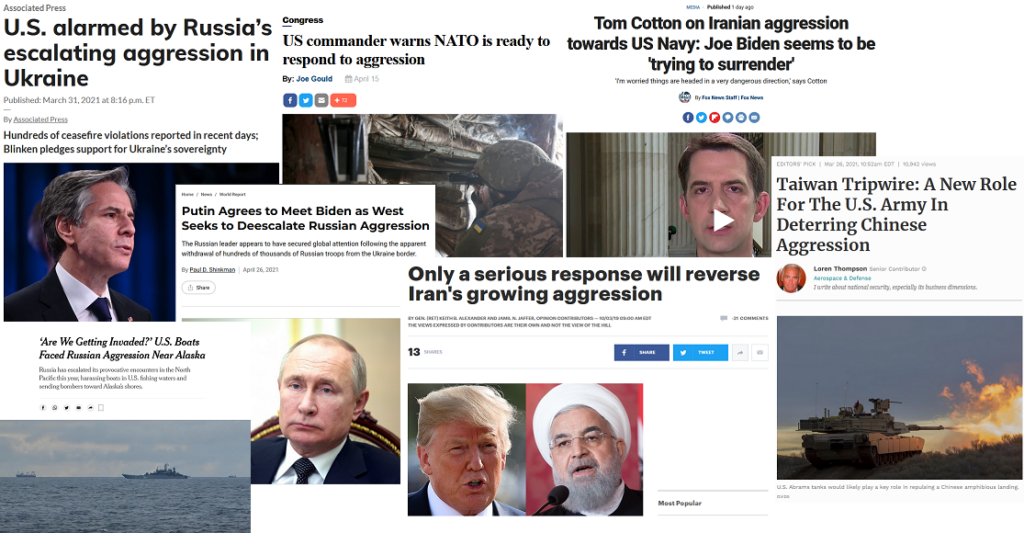

It’s Aggression when ‘they’ do it, but Defence when ‘we’ do worse

Alan Macleod

May 17, 2021

Aggression, in international politics, is commonly defined as the use of armed force against another sovereign state, not justified by self-defense or international authority. Any state being described as aggressive in foreign or international reporting, therefore, is almost by definition in the wrong.

Originally posted on FAIR.org, April 30, 2021

It’s a word that seems easy to apply to the United States, which launched 81 foreign interventions between 1946 and 2000 alone. In the 21st century, the United States has attacked, invaded or occupied the sovereign states of Afghanistan, Iraq, Libya, Syria, Pakistan, Yemen and Somalia.
Despite the US record, Western corporate media overwhelmingly reserve the word “aggression” for official enemy nations—whether or not it’s warranted. In contrast, US behavior is almost never categorized as aggressive, thereby giving readers a misleading picture of the world.

Perhaps the most notable internationally aggressive act in recent memory was the Trump administration’s assassination of Iranian general and political leader Qassem Soleimani last year. Yet in its long and detailed report on the event, the Washington Post (1/4/20) managed to present Iran as the aggressor. The US was merely “choos[ing] this moment to explore an operation against the leader of Iran’s Quds Force, after tolerating Iranian aggression in the Persian Gulf for months,” in the Post’s words.

It also gave space to senior US officials to falsely claim Soleimani was aiming to carry out an “imminent” attack on hundreds of Americans. In fact, he was in Iraq for peace talks designed to bring an end to war between states in the region. The Iraqi prime minister revealed that he had invited Soleimani personally, and had asked for and received Washington’s blessing to host him. Trump instead used that information to kill him.

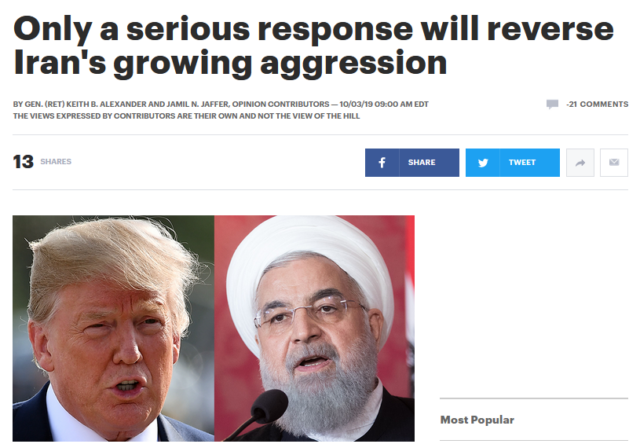
For months, media had been awash with stories, based on US officials’ proclamations, that Iranian aggression was just around the corner (e.g., Yahoo! News,  1/2/20; Reuters, 4/12/19; New York Times, 11/23/19; Washington Post, 6/22/19). The Hill (10/3/19) gave a retired general space to demand that we must “defend ourselves” by carrying out a “serious response” against Iran, who is “test[ing] our resolve with aggressive actions.”

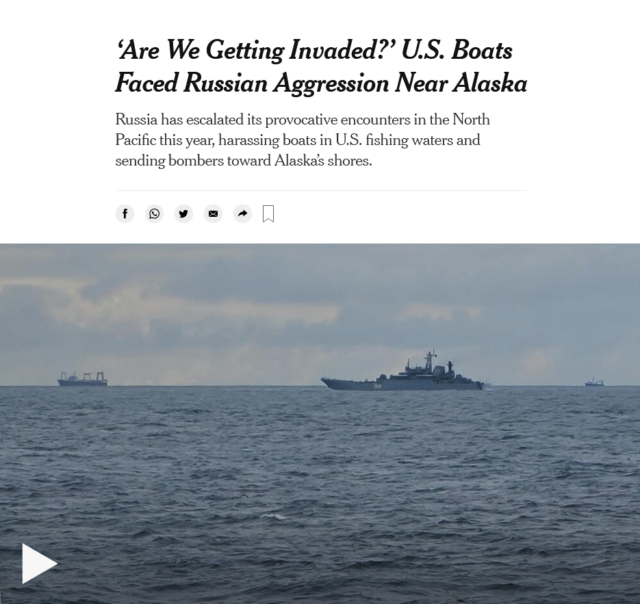
Russia is another country constantly portrayed as aggressive. The New York Times (11/12/20) described a US fishing boat’s mix up with the Russian navy off the coast of Kamchatka as typical Russian aggression, complete with the headline, “Are We Getting Invaded?” The Military Times (6/26/20) worried that any reduction in US troops in Germany could “embolden Russian aggression.” And a headline from the Hill (11/14/19) claimed that “Putin’s Aggression Exposes Russia’s Decline.” In the same sentence that publicized a report advocating that NATO expand to take on China directly, the Wall Street Journal (12/1/20) warned of “Russian aggression.” Suffice to say, tooling up for an intercontinental war against another nuclear power was not framed as Western warmongering.
Other enemy states, such as China (New York Times, 10/6/20; CNBC, 8/3/20; Forbes, 3/26/21), North Korea (Atlantic, 11/23/10; CNN, 8/9/17; Associated Press, 3/8/21) and Venezuela (Wall Street Journal, 11/18/05; Fox News, 3/10/14; Daily Express, 9/30/19) are also routinely accused of or denounced for “aggression.”

Corporate media even present the Taliban’s actions in their own country against Western occupation troops as “aggression” (Guardian 7/26/06; CBS News, 11/27/13; Reuters, 3/26/21). The New York Times (11/24/20) recently worried about the Taliban’s “aggression on the battlefield,” while presenting the US—a country that invaded Afghanistan in 2001 and still has not left—as supposedly committed to the “peace process.”

Even as the US has been flying squadrons of nuclear bombers from North Dakota to Iran and back, each time in effect simulating dropping atomic bombs on the country, media have framed this as a “defensive move” (Politico, 12/30/20) meant to stop “Iranian aggression” (Defense One, 1/27/20) by “deter[ring] Iran from attacking American troops in the region” (New York Times, 12/30/20).

In February, President Joe Biden ordered an airstrike on a Syrian village against what the White House claimed were Iran-backed forces. The Department of Defense absurdly insisted that the attack was meant to “deescalate” the situation, a claim that was lamentably uncritically repeated in corporate media, with Politico (2/25/21) writing that “the strike was defensive in nature” and a response to previous attacks on US troops in Iraq. Needless to say, it did not question the legitimacy of American troops being stationed across the Middle East.
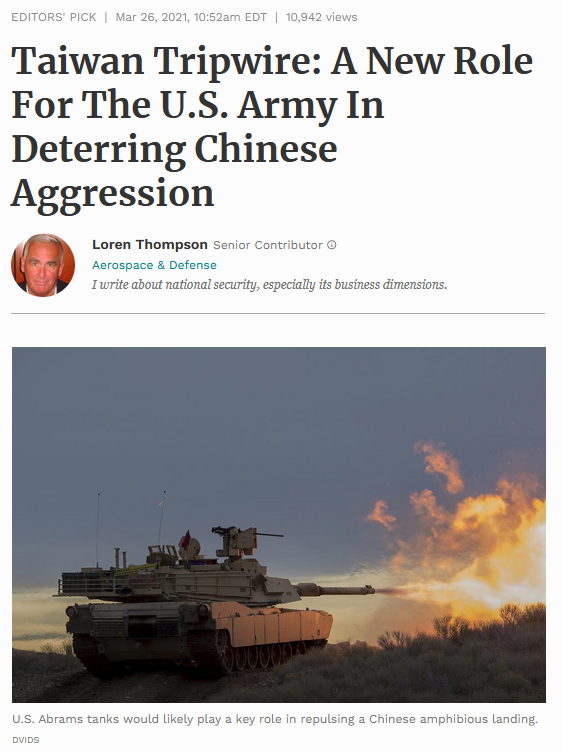
Forbes (3/26/21)

That the US, by definition, is always acting defensively and never aggressively is close to an iron law of journalism. The US attack on Southeast Asia is arguably the worst international crime since the end of World War II, causing some 3.8 million Vietnamese deaths alone. Yet in their seminal study of the media, Manufacturing Consent, Edward Herman and Noam Chomsky (Extra!, 12/87) were unable to find a single mention of a US “attack” on Vietnam. Instead, the war was commonly framed as the “defense” of South Vietnam from the Communist North.

Even decades later, US actions in Vietnam are still often described as a “defense” (e.g., Wall Street Journal, 4/29/05; Christian Science Monitor, 1/22/07; Politico, 10/10/15; Foreign Policy, 9/27/17). In a 2018 autopsy of the conflict headlined “What Went Wrong in Vietnam,” New Yorker staff writer Louis Menand (2/26/18) wrote that “our policy was to enable South Vietnam to defend itself” as the US “tried to prevent Vietnam from becoming a Communist state.” “Millions died in that struggle,” he adds, as if the perpetrators of the violence were unknown.

It was a similar story with the US invasion of Grenada in 1983, which was presented as a defense against “Soviet and Cuban aggression in the Western hemisphere” (San Diego Union-Tribune, 10/26/83).

US News (4/26/21)

There have only been three uses of the phrases “American aggression” or “US aggression” in the New York Times over the past year. All came in the mouths of Chinese officials, and in stories focusing on supposedly aggressive Chinese actions. For example, at the end of a long article warning about how China is “pressing its territorial claims aggressively” from the Himalayas to the South China Sea, in paragraph 28 the Times (6/26/20) noted that Beijing’s priority is “confronting what it considers American aggression in China’s neighborhood.” Meanwhile, two articles (10/5/20, 10/23/20) mention that Chinese disinformation calls the Korean War the “war to resist American aggression and aid Korea”. But these were written off as “visceral” and “pugnacious” “propaganda” by the Times.

Likewise, when the phrase “American aggression” appears at all in other leading publications, it is largely only in scare quotes or in the mouths of groups long demonized in corporate media, such as the Houthi rebels in Yemen (Washington Post, 2/5/21), the Syrian government of Bashar al-Assad (Associated Press, 2/26/21) or Saddam Hussein’s generals (CNN, 3/3/03).

The concept of US belligerence is simply not being discussed seriously in the corporate press, leading to the conclusion that the word “aggression” in newspeak means little more than “actions we don’t like carried out by enemy states.”

We bring you high-quality analyses and documents like this on a permanent basis. Why not appreciate TFF’s true independence and productivity by contributing if you benefited from this article? Thanks.

Alan MacLeod @AlanRMacLeod is a member of the Glasgow University Media Group. His latest book, Propaganda in the Information Age: Still Manufacturing Consent, was published by Routledge in May 2019.


Related Posts

Below are TFF-related media mentions, comments, videos and social media posts published elsewhere but not on this homepage. We happen to catch and list only a fraction. Regarding video comments and debates, we recommend that you go to the TFF Video Channel on Substack where many of them are reproduced. Jan Oberg is a contributor to China Daily – 52 million daily clicks – and Global Times, CGTN and CCTV (the national television), China Investment, Xinhua News Agency and several others. Articles and videos on these media very often multiply into countless Chinese (and Western media) that re-post them from these main media. Thanks to The China Academy, his analyses, interviews and comments are frequently posted on YouTube channels such as Thinkers Forum and Wave Media. These videos are often re-posted on Bilibili (China’s YouTube), the China Content Center on TikTok, and on the Chinese edition of TikTok, Douyin.com. This means reaching hundreds of millions of viewers worldwide over a year. While there are too many to catch on all these...
A friendly quarrel while we agree that the US sanctions are a weapon of mass destruction and kill more people than wars do. And that we must talk much more about sanctions than we have so far. Jan Oberg, TFF director March 16, 2026 John Mearsheimer recently stated that U.S. sanctions murdered around 38 million people between 1971 and 2021 – see the video below. It is a dramatic figure, and it has spread quickly because it captures, in one sentence, the enormous human cost of modern sanctions. I share his concern about the destructive effects of economic coercion. But the specific number he cites — and the way he attributes it — deserves a friendly academic clarification. The figure comes from a 2023 Lancet Global Health article estimating the mortality effects of unilateral U.S. and EU sanctions over the past half‑century. This is the first point where Mearsheimer’s shorthand diverges from the text: the study...
Photos © TFF 2000 Read PressInfo 90 “Lift the Sanctions and Bring More Aid to Yugoslavia” See Pictures from Belgrade © TFF 2000 Please reprint, copy, archive, quote or re-post this item, but please retain the source.

Recent Articles

Tony Robinson October 4, 2026 Violence is easy to recognise when someone is being beaten, shot or killed. It becomes more difficult when nobody is holding a weapon. Poverty, discrimination, exploitation and repression can restrict a human life just as effectively, although they do so in very different ways and with very different consequences. Simply adding more categories to an ever-growing list of forms of violence does not really solve the problem. The more interesting question is what all these different situations have in common and why it makes sense to describe them using the same word. Human beings do not simply react to what happens around them. They remember the past, imagine things that do not yet exist, make plans and undertake projects. Workers organise because they imagine different working conditions; people migrate because they imagine another life somewhere else; social movements emerge because people refuse to accept the...
It’s a matter of principles, courage, vision and pulling together – while the militarist world is falling apart… Peter Langille October 3, 2026 “Here, then, is the problem which we present to you, stark and dreadful and inescapable: Shall we put an end to the human race; or shall mankind renounce war?”The Bertrand Russell—Albert Einstein Manifesto, July 9, 1955 ⁕ The forecast for what’s ahead is worrisome. The sharp rise in armed conflicts over the past three years is adding to what was already the highest level in over seventy years. Genocides, which should be prevented are supported. A shared climate emergency that jeopardises survival is ignored. Diverse polls now suggest that people are war-weary, worried and interested in a more effective United Nations. And, there are viable policy options for a more secure world! Yet governments are doubling-down, betting on more war and investing heavily. If current trends persist,...
Johan Galtung 1930-2024October 2015 Published here on October 3, 2026 Let us focus on Civilization for conflict analysis and remedies. Major forms of disorder use violence; war is state organized violence. The most belligerent states are the United States of America and Israel, both with civilization roots. National Evangelism, the US Protestant Christian civilization– more national than evangelical–justifies US warfare as exceptionalism of a people chosen by God, with a manifest destiny to run the world. Orthodox Judaism justifies Israeli warfare to conquer and expand from Nile to Euphrates as a religious right and duty to the Eternal One. The third most belligerent country, the UK, no longer believes it is God-chosen but chosen by the USA; not quite the same but something. But the root cause of global disorder lies in the Occident–with Islam–seeing itself as the single, universal civilization valid for all at all times, all others being...

TFF on Substack

Discover and subscribe to more peace materials on TFF Substack

Most Popular

Tony Robinson October 4, 2026 Violence is easy to recognise when someone is being beaten, shot or killed. It becomes more difficult when nobody is holding a weapon. Poverty, discrimination, exploitation and repression can restrict a human life just as effectively, although they do so in very different ways and with very different consequences. Simply adding more categories to an ever-growing list of forms of violence does not really solve the problem. The more interesting question is what all these different situations have in common and why it makes sense to describe them using the same word. Human beings do not simply react to what happens around them. They remember the past, imagine things that do not yet exist, make plans and undertake projects. Workers organise because they imagine different working conditions; people migrate because they imagine another life somewhere else; social movements emerge because people refuse to accept the...
It’s a matter of principles, courage, vision and pulling together – while the militarist world is falling apart… Peter Langille October 3, 2026 “Here, then, is the problem which we present to you, stark and dreadful and inescapable: Shall we put an end to the human race; or shall mankind renounce war?”The Bertrand Russell—Albert Einstein Manifesto, July 9, 1955 ⁕ The forecast for what’s ahead is worrisome. The sharp rise in armed conflicts over the past three years is adding to what was already the highest level in over seventy years. Genocides, which should be prevented are supported. A shared climate emergency that jeopardises survival is ignored. Diverse polls now suggest that people are war-weary, worried and interested in a more effective United Nations. And, there are viable policy options for a more secure world! Yet governments are doubling-down, betting on more war and investing heavily. If current trends persist,...
Johan Galtung 1930-2024October 2015 Published here on October 3, 2026 Let us focus on Civilization for conflict analysis and remedies. Major forms of disorder use violence; war is state organized violence. The most belligerent states are the United States of America and Israel, both with civilization roots. National Evangelism, the US Protestant Christian civilization– more national than evangelical–justifies US warfare as exceptionalism of a people chosen by God, with a manifest destiny to run the world. Orthodox Judaism justifies Israeli warfare to conquer and expand from Nile to Euphrates as a religious right and duty to the Eternal One. The third most belligerent country, the UK, no longer believes it is God-chosen but chosen by the USA; not quite the same but something. But the root cause of global disorder lies in the Occident–with Islam–seeing itself as the single, universal civilization valid for all at all times, all others being...
Read More
Living-Peace-Sign-Budapest-copy
Tony Robinson October 4, 2026 Violence is easy to recognise when someone is being beaten, shot or killed. It becomes more difficult when nobody is holding a weapon. Poverty, discrimination, exploitation and repression can restrict a human life just as effectively, although they do so in very different ways and with very different consequences. Simply adding more categories to an ever-growing list of forms of violence does not really solve the problem. The more interesting question is what all these different situations have in common and why it makes sense to describe them using the same word. Human beings do not simply react to what happens around them. They remember the past, imagine things that do not yet exist, make plans and undertake projects. Workers organise because they imagine different working conditions; people migrate because they imagine another life somewhere else; social movements emerge because people refuse to accept the...
b54a1f10-8c65-4f0b-9dd5-4abc0a7d04cc_2659x2659
It’s a matter of principles, courage, vision and pulling together – while the militarist world is falling apart… Peter Langille October 3, 2026 “Here, then, is the problem which we present to you, stark and dreadful and inescapable: Shall we put an end to the human race; or shall mankind renounce war?”The Bertrand Russell—Albert Einstein Manifesto, July 9, 1955 ⁕ The forecast for what’s ahead is worrisome. The sharp rise in armed conflicts over the past three years is adding to what was already the highest level in over seventy years. Genocides, which should be prevented are supported. A shared climate emergency that jeopardises survival is ignored. Diverse polls now suggest that people are war-weary, worried and interested in a more effective United Nations. And, there are viable policy options for a more secure world! Yet governments are doubling-down, betting on more war and investing heavily. If current trends persist,...
010
Johan Galtung 1930-2024October 2015 Published here on October 3, 2026 Let us focus on Civilization for conflict analysis and remedies. Major forms of disorder use violence; war is state organized violence. The most belligerent states are the United States of America and Israel, both with civilization roots. National Evangelism, the US Protestant Christian civilization– more national than evangelical–justifies US warfare as exceptionalism of a people chosen by God, with a manifest destiny to run the world. Orthodox Judaism justifies Israeli warfare to conquer and expand from Nile to Euphrates as a religious right and duty to the Eternal One. The third most belligerent country, the UK, no longer believes it is God-chosen but chosen by the USA; not quite the same but something. But the root cause of global disorder lies in the Occident–with Islam–seeing itself as the single, universal civilization valid for all at all times, all others being...
Screenshot 2026-10-02 011738
Jan ObergPhD, director, The Transnational Foundation for Peace and Future Research, TFFLund, Sweden October 2, 2026 This is my full original manuscript. The Chinese Academy of Social Science, CASS, makes two publications out if it. 1. China’s Five-year plan emphasized the capabilities of basic research and original innovation. It is regarded as the goal of the future social development, which, as required, should be significantly enhanced. Can you comment on the importance of original innovation in research and academic study? I believe it is easier to define “original innovation” in the natural sciences than in social sciences. The breaking points of what constitutes something new, or innovative, are not quite as sharp in the latter. But in both fields it is about opening up something that was closed, unseen, unexplored before – making manifest what was earlier latent. Innovations come in many forms and shapes – naming something that was not...
arctic-circle-map
The agreement is catastrophic both because of what it says and what it doesn’t mention. It reduces further the major asset of security policies: Freedom of action. Jan Oberg TFF director September 25, 2026 A couple of hours before the agreement was signed on September 22, 2026, I published the following 13 hypotheses about what it would most likely contain on TFF Substack (in English). I was wrong on only the first point. Contrary to what Trump had written on his Truth Social platform, it does not appear to come into force immediately. In fact, it turned out to be worse than even I had anticipated. After these hypotheses now come a number of reflections in light of what the agreement actually contains, and does not contain, as well as the way in which it has generally been presented by major media outlets and by the public-service broadcaster DR. My...
girl-5894831_1280
Below are TFF-related media mentions, comments, videos and social media posts published elsewhere but not on this homepage. We happen to catch and list only a fraction. Regarding video comments and debates, we recommend that you go to the TFF Video Channel on Substack where many of them are reproduced. Jan Oberg is a contributor to China Daily – 52 million daily clicks – and Global Times, CGTN and CCTV (the national television), China Investment, Xinhua News Agency and several others. Articles and videos on these media very often multiply into countless Chinese (and Western media) that re-post them from these main media. Thanks to The China Academy, his analyses, interviews and comments are frequently posted on YouTube channels such as Thinkers Forum and Wave Media. These videos are often re-posted on Bilibili (China’s YouTube), the China Content Center on TikTok, and on the Chinese edition of TikTok, Douyin.com. This means reaching hundreds of millions of viewers worldwide over a year. While there are too many to catch on all these...



