
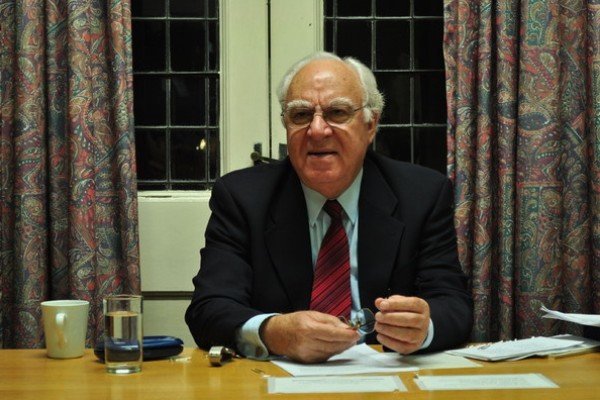
Iranian foreign Minister Zarif at SIPRI and the human rights defenders

Iran’s Foreign Minister Dr Mohammad Javad Zarif gave a speech at the Stockholm International Peace Research Institute (SIPRI). SIPRI is a highly respected research institute with a special place in the hearts of peace-lovers throughout the world.

In a world where there are so many think thanks and organisations advocating war and conflict, the few peace institutes have a big role to play to fill the void and provide an alternative voice to the dominant clamour of corporate media that represent the establishment and its reliance upon conflict and the military-industrial complex.


The sanctions on Iran violate international law

The latest series of American extraterritorial sanctions on Iran have given rise to enormous hardships and food and medical shortages experienced by ordinary Iranians.

The dispatch of military forces and warships to the Persian Gulf have brought the world to the verge of another devastating war in the Middle East that could make the disastrous invasion of Iraq look like child’s play.

There is no need to point out that these sanctions are violations of the Security Council Resolution 2231 that called for the lifting of all sanctions on Iran. In fact, they amount to a declaration of war and constitute economic terrorism.

Under these dire circumstances, it was praiseworthy of SIPRI to invite the Iranian foreign minister, who is personally under US sanctions, to speak.

As the Trump administration and the Israeli right-wing government try to suppress Zarif’s voice and prevent his message of rapprochement with the West being heard, it is important for peace institutes to provide him with a platform to put the counter-argument.

Iran and the French proposal

It was quite indicative that as soon as the reports about Zarif’s surprise visit to Biarritz where the G-7 summit was in progress were released, Israel’s Prime Minister Benjamin Netanyahu panicked and made desperate attempts to get in touch with President Trump who was in the middle of meetings with other heads of states to warn him against meeting with Zarif.

Netanyahu also contacted President Emmanuel Macron protesting against his mediation efforts, saying that this was not the right time for it. (1)

However, European officials seem to be coalescing behind the French proposal to provide Iran with a credit line of some $15 billion, allowing Iran to sell at least 700,000 barrels of oil a day (twice the current amount that Iran is exporting, but less than a third of what she was exporting prior to the sanctions).

European diplomats have also swung behind French efforts to ease US-Iran tensions. On Friday 29th August French Foreign Minister Jean-Yves Le Drian briefed his European counterparts on the talks in his meeting with them in the Finnish capital.

German Foreign Minister Heiko Maas welcomed the move and said: “We are all of the view that the momentum that may be there…has to be seized.”  (2)

Iranian Foreign Minister Zarif has also called the French proposals “productive”, and Iranian officials will be travelling to France in the coming days to continue work on those proposals.

In the midst of the dangers that the world is facing and the efforts that are made to prevent military clashes, SIPRI’s invitation to Zarif to address that institute assumed greater significance.

Zarif’s intellectually impressive speech

In his wide-ranging address that was delivered without notes, Zarif touched on a number of very important regional and international issues. He talked about the details of Iran’s nuclear deal (the Joint Comprehensive Plan of Action or JCPOA) that was negotiated laboriously over two years, not only with the United States but with all the five permanent members of the Security Council, plus Germany, and was unanimously endorsed by the European Union and the Security Council Resolution 2231.

Zarif referred to a large number of binding international agreements that Trump has violated, including the Paris Climate Accord, the IMF (Intermediate-Range Nuclear Forces Treaty), various UN resolutions on the Israeli-Palestinian conflict, etc.

He talked about the need for mutual adherence to international treaties, pointing out that unilateral violation of international law will result in chaos and the law of the jungle.

He stressed that in the contemporary world no country can ensure its own security at the expense of the security of other states.

He warned that no amount of sophisticated weapons sold to client states in the Middle East can safeguard regional security. On the contrary, it will lead to greater instability and conflict.

He spoke about the importance of freedom of navigation, but added that either all countries enjoy this right or no country that needs to transit through the narrow Strait of Hormuz, most of which lies within Iranian territorial waters, will experience security.

Above all, he talked about the need for collective regional security, pointing out that in the very first article that he published in a leading Arab newspaper as foreign minister he called on all regional countries to join Iran in a regional security pact to ensure that none of the countries of the region would have to rely on a foreign force to ensure their security.

The media were unable to convey the speech

In view of these and many other important issues that he raised in order to establish peace and security in the Middle East and prevent another major war, it was expected that the distinguished audience would try to ask about those issues and expand the discussion about how to achieve peace and security in that critical region.

Instead, most of the MPs and journalists who asked questions and took part in the discussions dwelt upon Iran’s “barbaric” treatment of women, minorities, homosexuals, opposition forces, and dissidents.

They challenged him about the number of dual nationals that are going through the Iranian judicial system, etc.

Human rights and wrong in Iran – once more time

I am the first to admit that the human rights situation in Iran is not satisfactory and needs a great deal of improvement, as I have stated on many occasions in the past and written extensively about in my various articles.

Not only is Iran’s judiciary independent of the government, it is in the hands of the hardliners that are opposed to the government and who wish to embarrass it.

Many court rulings in Iran are unfair and arbitrary and political in nature. The Iranian judiciary needs fundamental change and it must be forced to observe the rule of law and due process.

There are at the moment about a dozen dual nationals from Austria Britain, France, Sweden and the United States whose cases are going through the Iranian judicial system. Most of them are charged with espionage or trying to undermine Iranian national security, in most cases wrongly.

Having seen the effect of the so-called colour revolutions in a number of East European countries, Iranian hardliners are deeply suspicious of some Iranian nationals who have close and extensive relations with foreign governments and organisations.

They fear that they wish to bring down the Iranian government. Open declarations by US officials in support of regime change in Iran, and Saudi and Western support for some terrorist organisations such as the Mojahedin-e Khalq or ethnic separatists in Iran only strengthen those suspicions.

It is right and proper for foreign journalists and politicians to criticise human rights violations in Iran. Some of these politicians may even be quite sincere, and their criticism may be out of genuine concern for the plight of the victims of the Iranian judicial system.

However, the point that Zarif rightly made in his response to those charges was that their support for human rights was selective.

All Iranians would like to see human rights respected fully in Iran and the highest standards observed.

Many Iranian people, especially women who are fighting against compulsory hijab, have taken part in many public protests, written open letters to the authorities, including a letter by 14 brave female activists to Iran’s clerical leader Ayatollah Ali Khamenei calling on him to resign and allow the government to run the country without his interference.

The comparative perspective

However, despite Iran’s human rights violations, its record does not compare with what is going on in Afghanistan, Iraq, Syria, Libya, Yemen, and Somalia which the United States and her Western allies have invaded on dishonest pretexts based on sheer lies.

In all those countries, millions of people have been killed, many more millions have been made homeless, towns and cities have been destroyed and a flood of refugees has turned toward other countries, including Europe.

Even now, many years after the initial invasions, hundreds of people are being killed on a daily basis, and millions are living as refugees in dreadful conditions in various refugee camps all over the world.

Eighteen years after invading Afghanistan, spending perhaps more than a trillion dollars, killing and maiming hundreds of thousands of people, the United States has failed in its mission and the Taliban is resurgent and controls more than half of the country.

The number of casualties from bombings and terrorist acts in Afghanistan in the past year has been larger than in many preceding years.

As a result, US officials have been forced to start talking to the Taliban, behind the backs of the Afghan government, trying to reach an agreement with them in order to allow the United States to withdraw its 18,000 forces currently in Afghanistan.

Syria, a beautiful and prosperous country prior to Western efforts to topple President Bashar Assad, has been turned into rubble with over half a million people killed, and the carnage is still continuing.

The same is true of Libya, which has been split into two halves. A former warlord, General Khalifa Haftar, attacked Tripoli with the weapons that the UAE had purchased from the United States, and after many bombings and killings he was forced to retreat emptyhanded.

Meanwhile, the Saudi-led coalition’s bombing of the poorest country in the region, Yemen, has killed tens of thousands and has produced the worst humanitarian disaster according to the United Nations. The list goes on and on.

Even compared to some of her neighbours that have not been invaded, Iran’s human rights situation is better.

Saudi Arabia beheads dozens of people for political and religious offences every year, and it is illegal to have a single church, synagogue or temple anywhere in Saudi Arabia.

Turkey holds the largest number of journalists in prisons for political reasons.

Israel implements apartheid policies towards the Palestinians, imprisons thousands of Palestinians, including children, and is guilty of repeated attacks and war crimes against the defenceless people of Gaza.

Yet, none of those countries is criticised as strongly as Iran because they are US allies.

Iran has got the largest university population in the Middle East, with some of her universities ranked among the best in the world. In the 2013-14 academic year, more than 4.5 million students enrolled in Iranian universities, with over 750,000 graduates each year. Almost regularly, women constitute about 60% of all university students.

Tens of millions of pupils attend free primary and secondary education. The rate of literary in Iran is among the highest in the world, with Iran’s educational, scientific and technological developments placing it among the advanced countries in the world, according to the UN.

Iran is one of the few countries in the world that manufactures and launches her own satellites, and has mastered the full nuclear enrichment cycle.

Iran is one of the top six or seven countries in the world in nanotechnology. It produces nearly 97% of its medical needs, manufactures most of its military equipment and is a leading vehicle manufacturer in the region.

Millions of Iranians and refugees receive free medical treatment. Despite unfair and illegal US sanctions, still tens of millions of Iranian workers go to work in the morning and return home safe and sound taking care of the basic needs of their families.

All of these are important achievements, especially in the war-ravaged Middle East, and Iran was also subjected to eight years of a devastating war with Iraq that inflicted nearly a trillion dollars worth of damage on the country.

The human rights record of the United States

While it is perfectly right to criticise Iran’s human rights record, it is also important to put these issues into perspective and see who is the greatest violator of human rights.

Apart from having the largest rate of mass shootings, homicides and the largest prison population in the world, the US’s main violation of human rights concern its foreign adventures.

At the moment, the United States is openly violating an international agreement endorsed unanimously by the EU and by the Security Council. It is openly calling for regime change in Iran.

It has imposed extraterritorial sanctions on Iran which are hurting the ordinary people. If it is allowed to attack Iran, it can kill millions, destroy the country and produce a flood of refugees to the West, the like of which we have not seen before.

Those who are sincere in their defence of human rights should raise their voices against the US’s imperialist and aggressive policies and make sure that the United States does not launch another war based on fabricated excuses.

They should call on the US administration to return to the JCPOA and lift its illegal sanctions on Iran.

At the same time, the best way to improve Iran’s human rights record is to engage her in dialogue and bring her closer to the West, as the JCPOA was doing.

Related Posts

Johan Galtung 1930-2024October 2015 Published here on October 3, 2026 Let us focus on Civilization for conflict analysis and remedies. Major forms of disorder use violence; war is state organized violence. The most belligerent states are the United States of America and Israel, both with civilization roots. National Evangelism, the US Protestant Christian civilization– more national than evangelical–justifies US warfare as exceptionalism of a people chosen by God, with a manifest destiny to run the world. Orthodox Judaism justifies Israeli warfare to conquer and expand from Nile to Euphrates as a religious right and duty to the Eternal One. The third most belligerent country, the UK, no longer believes it is God-chosen but chosen by the USA; not quite the same but something. But the root cause of global disorder lies in the Occident–with Islam–seeing itself as the single, universal civilization valid for all at all times, all others being...
Jan ObergPhD, director, The Transnational Foundation for Peace and Future Research, TFFLund, Sweden October 2, 2026 This is my full original manuscript. The Chinese Academy of Social Science, CASS, makes two publications out if it. 1. China’s Five-year plan emphasized the capabilities of basic research and original innovation. It is regarded as the goal of the future social development, which, as required, should be significantly enhanced. Can you comment on the importance of original innovation in research and academic study? I believe it is easier to define “original innovation” in the natural sciences than in social sciences. The breaking points of what constitutes something new, or innovative, are not quite as sharp in the latter. But in both fields it is about opening up something that was closed, unseen, unexplored before – making manifest what was earlier latent. Innovations come in many forms and shapes – naming something that was not...
The agreement is catastrophic both because of what it says and what it doesn’t mention. It reduces further the major asset of security policies: Freedom of action. Jan Oberg TFF director September 25, 2026 A couple of hours before the agreement was signed on September 22, 2026, I published the following 13 hypotheses about what it would most likely contain on TFF Substack (in English). I was wrong on only the first point. Contrary to what Trump had written on his Truth Social platform, it does not appear to come into force immediately. In fact, it turned out to be worse than even I had anticipated. After these hypotheses now come a number of reflections in light of what the agreement actually contains, and does not contain, as well as the way in which it has generally been presented by major media outlets and by the public-service broadcaster DR. My...

Recent Articles

Tony Robinson October 4, 2026 Violence is easy to recognise when someone is being beaten, shot or killed. It becomes more difficult when nobody is holding a weapon. Poverty, discrimination, exploitation and repression can restrict a human life just as effectively, although they do so in very different ways and with very different consequences. Simply adding more categories to an ever-growing list of forms of violence does not really solve the problem. The more interesting question is what all these different situations have in common and why it makes sense to describe them using the same word. Human beings do not simply react to what happens around them. They remember the past, imagine things that do not yet exist, make plans and undertake projects. Workers organise because they imagine different working conditions; people migrate because they imagine another life somewhere else; social movements emerge because people refuse to accept the...
It’s a matter of principles, courage, vision and pulling together – while the militarist world is falling apart… Peter Langille October 3, 2026 “Here, then, is the problem which we present to you, stark and dreadful and inescapable: Shall we put an end to the human race; or shall mankind renounce war?”The Bertrand Russell—Albert Einstein Manifesto, July 9, 1955 ⁕ The forecast for what’s ahead is worrisome. The sharp rise in armed conflicts over the past three years is adding to what was already the highest level in over seventy years. Genocides, which should be prevented are supported. A shared climate emergency that jeopardises survival is ignored. Diverse polls now suggest that people are war-weary, worried and interested in a more effective United Nations. And, there are viable policy options for a more secure world! Yet governments are doubling-down, betting on more war and investing heavily. If current trends persist,...
Johan Galtung 1930-2024October 2015 Published here on October 3, 2026 Let us focus on Civilization for conflict analysis and remedies. Major forms of disorder use violence; war is state organized violence. The most belligerent states are the United States of America and Israel, both with civilization roots. National Evangelism, the US Protestant Christian civilization– more national than evangelical–justifies US warfare as exceptionalism of a people chosen by God, with a manifest destiny to run the world. Orthodox Judaism justifies Israeli warfare to conquer and expand from Nile to Euphrates as a religious right and duty to the Eternal One. The third most belligerent country, the UK, no longer believes it is God-chosen but chosen by the USA; not quite the same but something. But the root cause of global disorder lies in the Occident–with Islam–seeing itself as the single, universal civilization valid for all at all times, all others being...

TFF on Substack

Discover and subscribe to more peace materials on TFF Substack

Most Popular

Tony Robinson October 4, 2026 Violence is easy to recognise when someone is being beaten, shot or killed. It becomes more difficult when nobody is holding a weapon. Poverty, discrimination, exploitation and repression can restrict a human life just as effectively, although they do so in very different ways and with very different consequences. Simply adding more categories to an ever-growing list of forms of violence does not really solve the problem. The more interesting question is what all these different situations have in common and why it makes sense to describe them using the same word. Human beings do not simply react to what happens around them. They remember the past, imagine things that do not yet exist, make plans and undertake projects. Workers organise because they imagine different working conditions; people migrate because they imagine another life somewhere else; social movements emerge because people refuse to accept the...
It’s a matter of principles, courage, vision and pulling together – while the militarist world is falling apart… Peter Langille October 3, 2026 “Here, then, is the problem which we present to you, stark and dreadful and inescapable: Shall we put an end to the human race; or shall mankind renounce war?”The Bertrand Russell—Albert Einstein Manifesto, July 9, 1955 ⁕ The forecast for what’s ahead is worrisome. The sharp rise in armed conflicts over the past three years is adding to what was already the highest level in over seventy years. Genocides, which should be prevented are supported. A shared climate emergency that jeopardises survival is ignored. Diverse polls now suggest that people are war-weary, worried and interested in a more effective United Nations. And, there are viable policy options for a more secure world! Yet governments are doubling-down, betting on more war and investing heavily. If current trends persist,...
Johan Galtung 1930-2024October 2015 Published here on October 3, 2026 Let us focus on Civilization for conflict analysis and remedies. Major forms of disorder use violence; war is state organized violence. The most belligerent states are the United States of America and Israel, both with civilization roots. National Evangelism, the US Protestant Christian civilization– more national than evangelical–justifies US warfare as exceptionalism of a people chosen by God, with a manifest destiny to run the world. Orthodox Judaism justifies Israeli warfare to conquer and expand from Nile to Euphrates as a religious right and duty to the Eternal One. The third most belligerent country, the UK, no longer believes it is God-chosen but chosen by the USA; not quite the same but something. But the root cause of global disorder lies in the Occident–with Islam–seeing itself as the single, universal civilization valid for all at all times, all others being...
Read More
Living-Peace-Sign-Budapest-copy
Tony Robinson October 4, 2026 Violence is easy to recognise when someone is being beaten, shot or killed. It becomes more difficult when nobody is holding a weapon. Poverty, discrimination, exploitation and repression can restrict a human life just as effectively, although they do so in very different ways and with very different consequences. Simply adding more categories to an ever-growing list of forms of violence does not really solve the problem. The more interesting question is what all these different situations have in common and why it makes sense to describe them using the same word. Human beings do not simply react to what happens around them. They remember the past, imagine things that do not yet exist, make plans and undertake projects. Workers organise because they imagine different working conditions; people migrate because they imagine another life somewhere else; social movements emerge because people refuse to accept the...
b54a1f10-8c65-4f0b-9dd5-4abc0a7d04cc_2659x2659
It’s a matter of principles, courage, vision and pulling together – while the militarist world is falling apart… Peter Langille October 3, 2026 “Here, then, is the problem which we present to you, stark and dreadful and inescapable: Shall we put an end to the human race; or shall mankind renounce war?”The Bertrand Russell—Albert Einstein Manifesto, July 9, 1955 ⁕ The forecast for what’s ahead is worrisome. The sharp rise in armed conflicts over the past three years is adding to what was already the highest level in over seventy years. Genocides, which should be prevented are supported. A shared climate emergency that jeopardises survival is ignored. Diverse polls now suggest that people are war-weary, worried and interested in a more effective United Nations. And, there are viable policy options for a more secure world! Yet governments are doubling-down, betting on more war and investing heavily. If current trends persist,...
010
Johan Galtung 1930-2024October 2015 Published here on October 3, 2026 Let us focus on Civilization for conflict analysis and remedies. Major forms of disorder use violence; war is state organized violence. The most belligerent states are the United States of America and Israel, both with civilization roots. National Evangelism, the US Protestant Christian civilization– more national than evangelical–justifies US warfare as exceptionalism of a people chosen by God, with a manifest destiny to run the world. Orthodox Judaism justifies Israeli warfare to conquer and expand from Nile to Euphrates as a religious right and duty to the Eternal One. The third most belligerent country, the UK, no longer believes it is God-chosen but chosen by the USA; not quite the same but something. But the root cause of global disorder lies in the Occident–with Islam–seeing itself as the single, universal civilization valid for all at all times, all others being...
Screenshot 2026-10-02 011738
Jan ObergPhD, director, The Transnational Foundation for Peace and Future Research, TFFLund, Sweden October 2, 2026 This is my full original manuscript. The Chinese Academy of Social Science, CASS, makes two publications out if it. 1. China’s Five-year plan emphasized the capabilities of basic research and original innovation. It is regarded as the goal of the future social development, which, as required, should be significantly enhanced. Can you comment on the importance of original innovation in research and academic study? I believe it is easier to define “original innovation” in the natural sciences than in social sciences. The breaking points of what constitutes something new, or innovative, are not quite as sharp in the latter. But in both fields it is about opening up something that was closed, unseen, unexplored before – making manifest what was earlier latent. Innovations come in many forms and shapes – naming something that was not...
arctic-circle-map
The agreement is catastrophic both because of what it says and what it doesn’t mention. It reduces further the major asset of security policies: Freedom of action. Jan Oberg TFF director September 25, 2026 A couple of hours before the agreement was signed on September 22, 2026, I published the following 13 hypotheses about what it would most likely contain on TFF Substack (in English). I was wrong on only the first point. Contrary to what Trump had written on his Truth Social platform, it does not appear to come into force immediately. In fact, it turned out to be worse than even I had anticipated. After these hypotheses now come a number of reflections in light of what the agreement actually contains, and does not contain, as well as the way in which it has generally been presented by major media outlets and by the public-service broadcaster DR. My...
girl-5894831_1280
Below are TFF-related media mentions, comments, videos and social media posts published elsewhere but not on this homepage. We happen to catch and list only a fraction. Regarding video comments and debates, we recommend that you go to the TFF Video Channel on Substack where many of them are reproduced. Jan Oberg is a contributor to China Daily – 52 million daily clicks – and Global Times, CGTN and CCTV (the national television), China Investment, Xinhua News Agency and several others. Articles and videos on these media very often multiply into countless Chinese (and Western media) that re-post them from these main media. Thanks to The China Academy, his analyses, interviews and comments are frequently posted on YouTube channels such as Thinkers Forum and Wave Media. These videos are often re-posted on Bilibili (China’s YouTube), the China Content Center on TikTok, and on the Chinese edition of TikTok, Douyin.com. This means reaching hundreds of millions of viewers worldwide over a year. While there are too many to catch on all these...




