
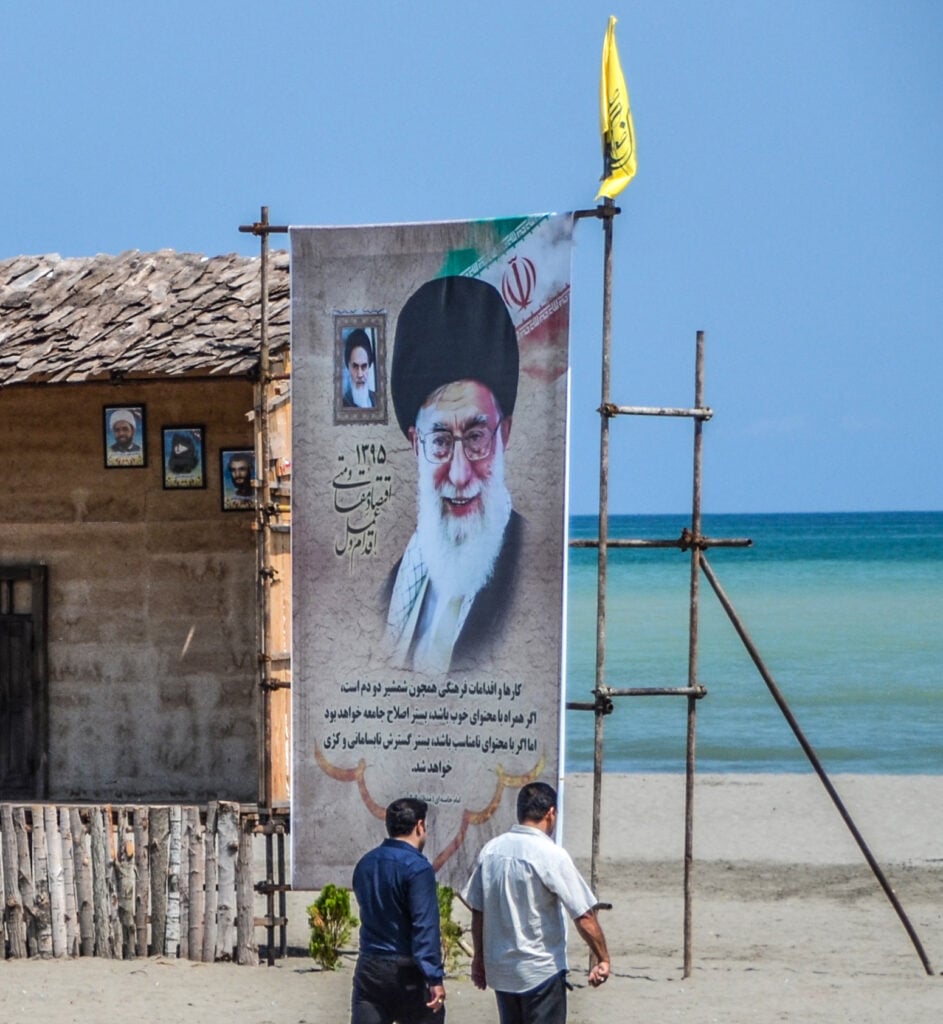
Iran at Crossroads on 40th Anniversary of Its Islamic Revolution

On February 11, 2019, the Islamic Republic of Iran marks the fortieth anniversary of the victory of the Islamic Revolution. In his latest speech at a conference of the Mojahedin-e Khalq (MEK), for which he received huge fees, National Security Advisor John Bolton said:

The outcome of the president’s policy review should be to determine that the Ayatollah Khomeini’s 1979 revolution will not last until its fortieth birthday. I have said for more than ten years since coming to these events that the declared policy of the United States of America should be the overthrow of the mullahs’ regime in Tehran…and that is why before 2019 we here will celebrate in Tehran.

Even more ominously, late last year Bolton instructed the Pentagon to produce options for attacking Iran.

Addressing the same conference on June 29, 2018, President Trump’s personal lawyer Rudy Giuliani also predicted: “Freedom is right around the corner … next year I want to have this convention in Tehran.” More than two dozen former and current U.S. officials, both Republicans and Democrats, have spoken before the MEK conferences, conveying more or less the same message.

The imminent demise of the Islamic Republic of Iran might have been slightly exaggerated. In fact, in response to these threats, the celebrations of the fortieth anniversary of the revolution may be even more elaborate than in previous years. But there is no doubt that the Iranian government is facing a number of daunting domestic and foreign challenges.

A Brief Spring

After the landmark nuclear deal that froze most of Iran’s nuclear activities and blocked all paths to the acquisition of nuclear weapons, the country witnessed a short-lived spring, with dozens of Western companies and corporations rushing to do business with it. The Iranian government announced that it was in the market for some 400 medium- and long-range planes, as well as 100 shorter-haul aircraft. Iran signed a deal for the purchase of 118 Airbus planes, at a total cost of $25 billion, as well as another $20 billion deal with Boeing.

With a population of 82 million well-educated and Western-leaning people, Iran is very attractive as a market for Western goods. Iran owns the world’s second largest gas and second largest (fourth if shale oil is included) oil reserves, thus making it the biggest source of combined hydrocarbon deposits in the world. Iran also ranks very high in coal, chromium, zinc, copper, iron ore, lead, manganese, and sulfur mines, among others.

Iran’s geostrategic position in the Middle East—between Afghanistan, Pakistan, the Indian subcontinent and Central Asia in the East and Turkey and Europe in the West, and between Russia in the north and the Persian Gulf and the Indian Ocean in the South—has made it very attractive to all foreign powers. It is also a very important link in China’s Belt and Road Initiative, BRI.

The Trump Turn

However, with the Trump administration’s unilateral withdrawal from the nuclear agreement in May 2018, the hopes for better economic prospects, as well as greater rapprochement with the West, came to a crushing halt. Most Western corporations pulled out of Iran, and many agreements signed for the purchase of aircraft were cancelled.

Fearful of U.S. sanctions, many banks also refused to deal with Iran, even in the case of food and medicine that are not technically included in the list of sanctioned items. Even China’s Bank of Kunlun, which had processed most Chinese payment for Iranian oil, announced on December 20 that it would stop processing payments when its current waver runs out in April.

As a result, Iran’s economy, which had experienced healthy growth during the previous two years, has been devastated and the Iranian currency crashed.

Speaking at the ceremonies marking the start of the so-called Ten Days of Dawn, the anniversary of Ayatollah Khomeini’s return to Iran on February 1, President Hassan Rouhani admitted that Iran is facing its most severe economic challenge in 40 years, for which he blamed U.S.-imposed sanctions.

Although Trump’s pressure and sanctions have failed to force the Iranian government to come back to the negotiating table, they have unfortunately had the effect of undermining the moderate and centrist policies of President Rouhani and his desire to get closer to the West. They have also pushed Iranians closer to the hardline faction, because they have seen that the United States violates its agreements and cannot be trusted as a friend.

On January 31, as a clear rebuff to the Trump administration, the European Union, led by the British, German, and French foreign ministers, announced the creation of INSTEX (Instrument in Support of Trade Exchanges) to enable European banks to do business with Iran. Although this mechanism will help Iran import some much-needed food and medicine, it will not likely put an end to Iran’s economic woes.

Meanwhile, after choosing Saudi Arabia and Israel as the first countries to visit after his inauguration, Trump signed agreements for the sale of $110 billion of weapons to Saudi Arabia. He has also spoken about the need to create a so-called Arab NATO, composed of Sunni states hostile to Iran, and Secretary of State Mike Pompeo is also convening a conference in Poland later this month to mobilize opposition to Iran.

To add to all these problems, Iran has also been suffering the worst drought of the past 40 years, with many lakes and rivers drying up, putting agriculture and even drinking water under a great deal of strain.

Domestic Challenges

The combination of these political, economic, and ecological difficulties has posed unprecedented challenges to the Iranian government. Economic hardships have given rise to massive nationwide demonstrations, which have continued for over a year. The protests erupted on December 28, 2017 in the conservative city of Mashhad, which is regarded as the holiest city in Iran, but soon they spread to more than 80 towns and cities across the country.

Although the protests have been contained, at least for now, and have not brought about the immediate collapse of the clerical regime as many of its detractors had been hoping and agitating for, the widespread nature of the protests nevertheless shows the depth of anger and dissatisfaction among the lower- and working-class people who had been regarded as the staunchest supporters of the clerics.

Although the massive demonstrations following the controversial 2009 election that gave rise to the so-called Green Movement were led mainly by educated middle-class groups and had an identifiable leadership with a clear agenda and political demands, the latest protests have been mainly spontaneous riots by the lower classes, with no clear network or leadership, and this makes them less predictable and more dangerous.

The combination of these foreign and domestic challenges to Iran means that the Iranian political and religious establishment must make some drastic changes in its ideology, system of government, and domestic and foreign policies if it hopes to escape major social upheaval leading to the possible collapse of the system.

Refusing to change is not an option if Iran wishes to avoid the fate of other countries—such as Afghanistan, Iraq, Libya, and Syria—that have fallen prey to foreign meddling and invasion.

As far as its foreign policy is concerned, Iran should abide by the nuclear agreement despite U.S. provocations. Resuming enrichment at levels beyond those permitted in the agreement would be exactly the excuse that the Trump administration is looking for.

Iran should welcome the hand of friendship and the relief provided by the EU, even if inadequate, and should try to strengthen its relations with the outside world. Europe appreciates the role that Iran played in fighting against the Islamic State in Syria and Iraq.

In fact, Iraqi and Kurdish officials have openly stated that, had it not been for Iran’s timely assistance against the Islamic State, the terrorist movement would have pushed to Baghdad and Erbil.

Although Saudi Arabia has repeatedly rebuffed Iran’s attempts at rapprochement, the Iranian government should continue with its policy of trying to get closer to its neighbors and establishing a system of collective security.

For better or worse, Iran has to live with those countries long after U.S. forces have withdrawn from the region.

Iran’s Choices

Domestically, Iran should respond to the legitimate demands of the majority of the population that in all recent elections have voted for reformist candidates and called for greater openness and more freedoms.

Iran should learn from the experience of the Soviet Union and other revolutions that collapsed because they failed to respond to the demands of their people. Today’s Iran is very different from the one that supported the Islamic revolution 40 years ago.

The most fundamental principle that needs to be changed is Ayatollah Khomeini’s concept of velayat-e faqih or the guardianship of the clerics. This was an innovation with no precedent in Islamic history, and many young Iranians have rejected it in favor of the sovereignty of the people.

Iran’s young generation does not need clerical guardians. Most of the problems created by the unrepresentative bodies in the Islamic Republic—such as the Guardian Council, the Expediency Council, the Assembly of Experts, and the unjust judicial system—stem from the position of velayat-e faqih represented at the moment by Ayatollah Ali Khamenei who serves as an obstacle on the path of the more progressive government.

Many societies in the world are religious without being ruled by the clergy. If the Islamic Republic does not understand the severity of the present time and does not change some of its outdated and undemocratic principles, it will lose the remaining support of the people and will create a tempting target for foreign meddling.

Farhang Jahanpour is a former professor and dean of the Faculty of Languages at the University of Isfahan, and a former Senior Research Scholar at Harvard. He is also a TFF Associate and former Board member of the foundation.
For the past 30 years he has been teaching courses on the Middle East at the Department of Continuing Education and is a member of Kellogg College at the University of Oxford.

Related Posts

Johan Galtung 1930-2024October 2015 Published here on October 3, 2026 Let us focus on Civilization for conflict analysis and remedies. Major forms of disorder use violence; war is state organized violence. The most belligerent states are the United States of America and Israel, both with civilization roots. National Evangelism, the US Protestant Christian civilization– more national than evangelical–justifies US warfare as exceptionalism of a people chosen by God, with a manifest destiny to run the world. Orthodox Judaism justifies Israeli warfare to conquer and expand from Nile to Euphrates as a religious right and duty to the Eternal One. The third most belligerent country, the UK, no longer believes it is God-chosen but chosen by the USA; not quite the same but something. But the root cause of global disorder lies in the Occident–with Islam–seeing itself as the single, universal civilization valid for all at all times, all others being...
Jan ObergPhD, director, The Transnational Foundation for Peace and Future Research, TFFLund, Sweden October 2, 2026 This is my full original manuscript. The Chinese Academy of Social Science, CASS, makes two publications out if it. 1. China’s Five-year plan emphasized the capabilities of basic research and original innovation. It is regarded as the goal of the future social development, which, as required, should be significantly enhanced. Can you comment on the importance of original innovation in research and academic study? I believe it is easier to define “original innovation” in the natural sciences than in social sciences. The breaking points of what constitutes something new, or innovative, are not quite as sharp in the latter. But in both fields it is about opening up something that was closed, unseen, unexplored before – making manifest what was earlier latent. Innovations come in many forms and shapes – naming something that was not...
The agreement is catastrophic both because of what it says and what it doesn’t mention. It reduces further the major asset of security policies: Freedom of action. Jan Oberg TFF director September 25, 2026 A couple of hours before the agreement was signed on September 22, 2026, I published the following 13 hypotheses about what it would most likely contain on TFF Substack (in English). I was wrong on only the first point. Contrary to what Trump had written on his Truth Social platform, it does not appear to come into force immediately. In fact, it turned out to be worse than even I had anticipated. After these hypotheses now come a number of reflections in light of what the agreement actually contains, and does not contain, as well as the way in which it has generally been presented by major media outlets and by the public-service broadcaster DR. My...

Recent Articles

Tony Robinson October 4, 2026 Violence is easy to recognise when someone is being beaten, shot or killed. It becomes more difficult when nobody is holding a weapon. Poverty, discrimination, exploitation and repression can restrict a human life just as effectively, although they do so in very different ways and with very different consequences. Simply adding more categories to an ever-growing list of forms of violence does not really solve the problem. The more interesting question is what all these different situations have in common and why it makes sense to describe them using the same word. Human beings do not simply react to what happens around them. They remember the past, imagine things that do not yet exist, make plans and undertake projects. Workers organise because they imagine different working conditions; people migrate because they imagine another life somewhere else; social movements emerge because people refuse to accept the...
It’s a matter of principles, courage, vision and pulling together – while the militarist world is falling apart… Peter Langille October 3, 2026 “Here, then, is the problem which we present to you, stark and dreadful and inescapable: Shall we put an end to the human race; or shall mankind renounce war?”The Bertrand Russell—Albert Einstein Manifesto, July 9, 1955 ⁕ The forecast for what’s ahead is worrisome. The sharp rise in armed conflicts over the past three years is adding to what was already the highest level in over seventy years. Genocides, which should be prevented are supported. A shared climate emergency that jeopardises survival is ignored. Diverse polls now suggest that people are war-weary, worried and interested in a more effective United Nations. And, there are viable policy options for a more secure world! Yet governments are doubling-down, betting on more war and investing heavily. If current trends persist,...
Johan Galtung 1930-2024October 2015 Published here on October 3, 2026 Let us focus on Civilization for conflict analysis and remedies. Major forms of disorder use violence; war is state organized violence. The most belligerent states are the United States of America and Israel, both with civilization roots. National Evangelism, the US Protestant Christian civilization– more national than evangelical–justifies US warfare as exceptionalism of a people chosen by God, with a manifest destiny to run the world. Orthodox Judaism justifies Israeli warfare to conquer and expand from Nile to Euphrates as a religious right and duty to the Eternal One. The third most belligerent country, the UK, no longer believes it is God-chosen but chosen by the USA; not quite the same but something. But the root cause of global disorder lies in the Occident–with Islam–seeing itself as the single, universal civilization valid for all at all times, all others being...

TFF on Substack

Discover and subscribe to more peace materials on TFF Substack

Most Popular

Tony Robinson October 4, 2026 Violence is easy to recognise when someone is being beaten, shot or killed. It becomes more difficult when nobody is holding a weapon. Poverty, discrimination, exploitation and repression can restrict a human life just as effectively, although they do so in very different ways and with very different consequences. Simply adding more categories to an ever-growing list of forms of violence does not really solve the problem. The more interesting question is what all these different situations have in common and why it makes sense to describe them using the same word. Human beings do not simply react to what happens around them. They remember the past, imagine things that do not yet exist, make plans and undertake projects. Workers organise because they imagine different working conditions; people migrate because they imagine another life somewhere else; social movements emerge because people refuse to accept the...
It’s a matter of principles, courage, vision and pulling together – while the militarist world is falling apart… Peter Langille October 3, 2026 “Here, then, is the problem which we present to you, stark and dreadful and inescapable: Shall we put an end to the human race; or shall mankind renounce war?”The Bertrand Russell—Albert Einstein Manifesto, July 9, 1955 ⁕ The forecast for what’s ahead is worrisome. The sharp rise in armed conflicts over the past three years is adding to what was already the highest level in over seventy years. Genocides, which should be prevented are supported. A shared climate emergency that jeopardises survival is ignored. Diverse polls now suggest that people are war-weary, worried and interested in a more effective United Nations. And, there are viable policy options for a more secure world! Yet governments are doubling-down, betting on more war and investing heavily. If current trends persist,...
Johan Galtung 1930-2024October 2015 Published here on October 3, 2026 Let us focus on Civilization for conflict analysis and remedies. Major forms of disorder use violence; war is state organized violence. The most belligerent states are the United States of America and Israel, both with civilization roots. National Evangelism, the US Protestant Christian civilization– more national than evangelical–justifies US warfare as exceptionalism of a people chosen by God, with a manifest destiny to run the world. Orthodox Judaism justifies Israeli warfare to conquer and expand from Nile to Euphrates as a religious right and duty to the Eternal One. The third most belligerent country, the UK, no longer believes it is God-chosen but chosen by the USA; not quite the same but something. But the root cause of global disorder lies in the Occident–with Islam–seeing itself as the single, universal civilization valid for all at all times, all others being...
Read More
Living-Peace-Sign-Budapest-copy
Tony Robinson October 4, 2026 Violence is easy to recognise when someone is being beaten, shot or killed. It becomes more difficult when nobody is holding a weapon. Poverty, discrimination, exploitation and repression can restrict a human life just as effectively, although they do so in very different ways and with very different consequences. Simply adding more categories to an ever-growing list of forms of violence does not really solve the problem. The more interesting question is what all these different situations have in common and why it makes sense to describe them using the same word. Human beings do not simply react to what happens around them. They remember the past, imagine things that do not yet exist, make plans and undertake projects. Workers organise because they imagine different working conditions; people migrate because they imagine another life somewhere else; social movements emerge because people refuse to accept the...
b54a1f10-8c65-4f0b-9dd5-4abc0a7d04cc_2659x2659
It’s a matter of principles, courage, vision and pulling together – while the militarist world is falling apart… Peter Langille October 3, 2026 “Here, then, is the problem which we present to you, stark and dreadful and inescapable: Shall we put an end to the human race; or shall mankind renounce war?”The Bertrand Russell—Albert Einstein Manifesto, July 9, 1955 ⁕ The forecast for what’s ahead is worrisome. The sharp rise in armed conflicts over the past three years is adding to what was already the highest level in over seventy years. Genocides, which should be prevented are supported. A shared climate emergency that jeopardises survival is ignored. Diverse polls now suggest that people are war-weary, worried and interested in a more effective United Nations. And, there are viable policy options for a more secure world! Yet governments are doubling-down, betting on more war and investing heavily. If current trends persist,...
010
Johan Galtung 1930-2024October 2015 Published here on October 3, 2026 Let us focus on Civilization for conflict analysis and remedies. Major forms of disorder use violence; war is state organized violence. The most belligerent states are the United States of America and Israel, both with civilization roots. National Evangelism, the US Protestant Christian civilization– more national than evangelical–justifies US warfare as exceptionalism of a people chosen by God, with a manifest destiny to run the world. Orthodox Judaism justifies Israeli warfare to conquer and expand from Nile to Euphrates as a religious right and duty to the Eternal One. The third most belligerent country, the UK, no longer believes it is God-chosen but chosen by the USA; not quite the same but something. But the root cause of global disorder lies in the Occident–with Islam–seeing itself as the single, universal civilization valid for all at all times, all others being...
Screenshot 2026-10-02 011738
Jan ObergPhD, director, The Transnational Foundation for Peace and Future Research, TFFLund, Sweden October 2, 2026 This is my full original manuscript. The Chinese Academy of Social Science, CASS, makes two publications out if it. 1. China’s Five-year plan emphasized the capabilities of basic research and original innovation. It is regarded as the goal of the future social development, which, as required, should be significantly enhanced. Can you comment on the importance of original innovation in research and academic study? I believe it is easier to define “original innovation” in the natural sciences than in social sciences. The breaking points of what constitutes something new, or innovative, are not quite as sharp in the latter. But in both fields it is about opening up something that was closed, unseen, unexplored before – making manifest what was earlier latent. Innovations come in many forms and shapes – naming something that was not...
arctic-circle-map
The agreement is catastrophic both because of what it says and what it doesn’t mention. It reduces further the major asset of security policies: Freedom of action. Jan Oberg TFF director September 25, 2026 A couple of hours before the agreement was signed on September 22, 2026, I published the following 13 hypotheses about what it would most likely contain on TFF Substack (in English). I was wrong on only the first point. Contrary to what Trump had written on his Truth Social platform, it does not appear to come into force immediately. In fact, it turned out to be worse than even I had anticipated. After these hypotheses now come a number of reflections in light of what the agreement actually contains, and does not contain, as well as the way in which it has generally been presented by major media outlets and by the public-service broadcaster DR. My...
girl-5894831_1280
Below are TFF-related media mentions, comments, videos and social media posts published elsewhere but not on this homepage. We happen to catch and list only a fraction. Regarding video comments and debates, we recommend that you go to the TFF Video Channel on Substack where many of them are reproduced. Jan Oberg is a contributor to China Daily – 52 million daily clicks – and Global Times, CGTN and CCTV (the national television), China Investment, Xinhua News Agency and several others. Articles and videos on these media very often multiply into countless Chinese (and Western media) that re-post them from these main media. Thanks to The China Academy, his analyses, interviews and comments are frequently posted on YouTube channels such as Thinkers Forum and Wave Media. These videos are often re-posted on Bilibili (China’s YouTube), the China Content Center on TikTok, and on the Chinese edition of TikTok, Douyin.com. This means reaching hundreds of millions of viewers worldwide over a year. While there are too many to catch on all these...




