

I Gandhis fotspår 7 – Saltmarschen – Gandhis och min egen

Så här började det…

Gandhi skickade den 2 mars 1930 ett brev till den engelske vicekungen i Indien, Lord Irwin, och förvarnade honom om att en aktion för civil olydnad skulle ta sin början den 12 juli. Han intygar att han inte kan skada någon engelsman men att hela det brittiska kolonialväldet är exploaterande, har förstört indisk kultur och gjort folket till slavar och att man uppenbarligen inte ämnar genomföra några ändringar som kunde påverka kommersiella intressen. Skattesystemet syftar till att slå ut bönderna.

“Även saltet som bönderna behöver för livets uppehälle har skattebelagts så att de ska betala mest”, skrev Gandhi. “Men själv har Ni en lön kring 7000 dollar per månad. Det är 235 dollar per dag mot den indiska genomsnittsinkomsten på 4 cent! Så mycket kan ni knappast ens använda, så jag är övertygad om att Ni ger det till välgörenhet. Men ett sådant system förtjänar att hamna på soptippen. Bara organiserad ickevåld kan stoppa den brittiska regeringens organiserade våld.”

Gandhi fortsätter med att förklara att deltagarna i denna aktion för civil olydnad kommer att “bortse” ifrån saltskatten och är redo att gå i fängelse om inte brevet appellerar till Irwins hjärta. Skulle Irwin vara beredd att diskutera kommer aktionen att avblåsas. Brevet är, intygar Gandhi, inte ett hot utan ett uttryck för öppen kommunikation, en satyagrahis (sanningskämpes) första plikt.

Irwin själv svarade inte. Han arresterade inte heller Gandhi. Då.

Saltmarschen börjar 12 mars 1930 kl 06:30

Knappt 80 Gandhi-anhängare lämnade Sabarmati den 12 mars 06.30. Tanken var att vandra söderut längs västkusten, samla stöd i byarna, hålla tal och mobilisera pressen hemma och i England. Ingen, inte heller Gandhi, visste den morgonen hur eller var det skulle sluta, nämligen på en gudsförgäten strand i en liten ort, Dandi, den 5 april, 385 kilometer söderut.
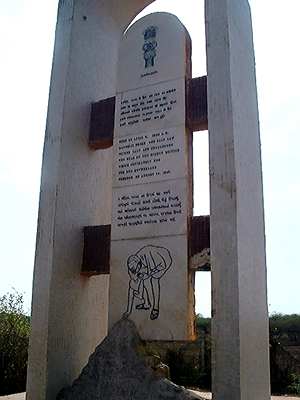
Monumentet i Dandi där Gandhi plockade upp en näve salt – Photo Jan Öberg, © TFF 2001

Men saltet var alltså det symboliska medlet, Indiens självständighet målet – som inte uppnåddes för än 17 år senare!

För snart 20 år sedan upprepade Tom Weber, australiensisk Gandhi-expert och TFF-rådgivare, hela marschen på egen hand. Hans tegelstenstora bok där han genom “deltagande observation” utforskar Saltmarschen kom ut 1997, On the Salt March. The Historiography of Gandhi’s March to Dandi, (Harper Collins, Delhi, 594 sidor).

Med en blandning av skönlitteratur och litterär road movie gör Weber en minutiös efterforskning av alla källor och samtalar med alla som då var med på Marschen. Han har skapat en ovärderlig kronologi och analys av denna politiska aktion för självständighet, kanske historiens egendomligaste. Det är absurd teater, existentialism, symbolpolitik och realpolitik i ett, det är fars och tragedi, det är Dramat vid Havet genom vilket engelsmännen äntligen förstod att det var början till slutet.

Den som sett Gandhi-filmen kommer ihåg de mycket brutala scenerna vid Saltverken i Dharasana. 2500 satyagrahi hade kommit upp ifrån Bombay. Rad efter rad av vitklädda, obeväpnade marschdeltagare klubbades ned och låg blödande. Redan första dagen dödades 2 och 320 sårades. Många arresterades, fängelserna fylldes snabbt och Gandhi fördes till Punas fängelse.

Detta inträffade några dagar efter det att han nära havet i Dandi hade plockat upp en lerig klump med lite sand i och därmed trotsat det brittiska herraväldet. Som Louis Fischer skriver i sin klassiske biografi, The Life of Mahatma Gandhi (Harper & Row 1950): “Indien var nu fritt. Tekniskt, legalt hade dock inget förändrats. Tagore förklarade skillnaden: De som bor i England inser nu att Europa fullständigt har förlorat sin moraliska prestige.”

Min egen marsch  

Den 12 mars i år kl 06.30 marscherade jag själv ut genom Sabarmati-ashramens grind, i samma höga tempo, de första 6-7 kilometrarna ned till Ellis Bridge. En nästan full måne stod i väst medan solen gick upp över floden. Människor tittade ut under sina filter på denna märkliga man (som var jag) med kamera, papper och penna: good morning! Jag försökte föreställa mig hur marschdeltagarna tänkte just då. De hade lämnat hustrur och barn bakom sig i ashramen, helt medvetna om att de skulle kunna komma att dö för Indiens sak.

Morgon på Ashram Road 1 – Photo Jan Öberg, © TFF 2001

Idag är Ashram Road en trespårig väg med butiker, biografer etc. För 71 år sedan var den en grusväg mellan stadskärnan och den by som omgav ashramen.Luften är rimligt klar, det infernaliska trafikbullret har inte börjat än. En kamel pinkar just som jag passerar den.

Jag når fram till Gandhi-bron 07.15 där det står en jättestaty av Gandhi, nu badad på ena sidan i solens röda ljus. Han står mitt i trafiken, omgiven av reklam, också för cigaretter och sprit. Stackars Mahatma!

Gandhi på Ashram Road – Photo Jan Öberg, © TFF 2001

Vidare förbi Nehru Bridge och 07.50 över Ellis Bridge in mot centrum. Jag tittar ned i den nästan uttorkade floddalen där flera män sitter på huk och skiter.

Jag promenerar till Ahmedabads lyxiga Holiday Inn och äter frukost med gudomligt god ananas lassi (yoghurt). Där kan jag samtidig skriva över mina noter ifrån papper till min palm-dator. Det är fascinerande att kunna gå in och ur olika världar på noll tid. Frågan är om vi överhuvudtaget lever i den samma?
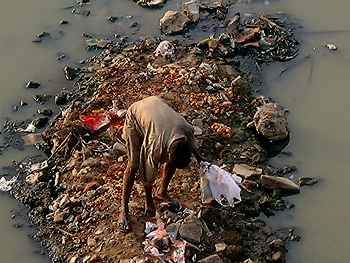
Morgon i Sabarmati-floden – Photo Jan Öberg, © TFF 2001

Så långt första etappen av min privata Saltmarsch. I en följande artikel kommer jag ut till havet. I bil. Med en som var med då, 1930.


Peace & future researcher + ‌Art Photographer

Related Posts

LONDON – So far so good, at least on the wider level. While internally Iraq seems on the edge of chaos, the much heralded clash of civilizations between the Muslim and Judaeo-Christian worlds has yet to become apparent. We have anger and despair aplenty in the Arab and Muslim worlds. But very little rushing to the standard and there was no great pilgrimage of warriors to join the fight, as happened when the Soviet Union invaded Afghanistan twenty years ago, and then, having driven the Red Army out, were left to ferment in that mountainous redoubt. With the armaments supplied by the CIA the mujahidin were transformed into Al Qaeda that became, for a relatively brief moment as these things go, ‘the greatest threat to the homeland that America has ever known.’ Nevertheless a ‘Cold War’ between much of the Muslim world and the West is certainly in full swing. Winston...
The Challenge of Nuclear Weaponsin the Twenty-first CenturyA Path Forward The peoples and governments of the world face an urgent challenge relating to weaponry of mass destruction and particularly to nuclear weaponry.  At the crossroads of technology, terrorism, geopolitical ambition, and policies of preemption are new and potent dangers for humanity. Despite ending the nuclear standoff of the Cold War era, nuclear weaponry is again menacing the peoples of the world with catastrophic possibilities.  We recognize the need for any government to pursue its security interests in accordance with international law; and further, we recognize that distinctive threats to these interests now exist as a result of an active international terrorist network having declared war on the United States and its allies. Nonetheless, we reject the assessment of the current US administration that upgrading a reliance on nuclear weapons is in any sense justified as a response. We find it...
By Karin Wegestal MP, the Social Democratic Partyon behalf of the Swedish Committee for Solidarity with the Yugoslav People During the last decade, the Federal Republic of Yugoslavia has received more than 500,000 refugees from Croatia and Bosnia, and another 300,000 internally displaced persons, mainly from the province Kosovo and Metohia. For a country with about ten million inhabitants, such an influx of homeless people is obviously a very heavy burden – even under peaceful conditions. But in addition to that, the Federal Republic of Yugoslavia has been the subject to sanctions from the western powers for close to ten years and its infrastructure was badly hurt through Nato’s intense bombardment during 78 days in 1999. The result of all this is that Yugoslavia, once the most developed industrial country in Eastern Europe, is today the poorest country in Europe. In Serbia excluding Kosovo, with about ten million inhabitants and...

Recent Articles

Jan Oberg TFF director October 28, 2026 Exactly one month has now passed since I published my criticism of the introduction to the special issue on Johan Galtung published by the Journal of Global Security Studies, JoGSS, and of Tor Egil Førland’s chapter about Galtung which serves as a preview to his forthcoming biography of Galtung to be published by PRIO. See the original on The Transnational here and the same article on TFF Substack with many general and critical comments and, in particular, the people who decided to withdraw from the biography project in protest. The special issue itself was extraordinary. It was devoted to the intellectual legacy of one of the founders of peace research and contained a number of strong assessments of his personality, scholarship, intellectual trajectory, and public role. Such assessments are, of course, entirely legitimate. No scholar is beyond criticism, and neither was Johan Galtung....
An aspect of Iran’s culture and civilisation you’ve probably never heard about. Don’t be surprised if the US and Israel also try to bomb them. Jan ObergTFF director October 26, 2026 Today – under the “USraeli” threat of new “annihilating” bombings – opens the 7th International Conference on Peace and Conflict Resolution at Tehran’s University. As far as I can tell, this is the only permanent, advanced peace research institution in West Asia/the Middle East. Perhaps more countries in that region could be inspired? I mean, how many military “security” institutes and military academies do they have? Many peace research institutes and university departments have been established since the 1950s in the West. They are now all under attack; some have closed down, some have gone mainstream, yet others kept the name but do nothing to research peace and disseminate results or advice; instead, they cooperate with militarism’s platforms such...
Let’s discuss using AI to create peace – in contrast to boring geopolitics devoid of creative healing and visions. Jan Oberg TFF director October 15, 2026 I asked VEED to create a short video exemplifying how peace is preferable to war, then chose the lady as a template. Simple as that. In less than a minute, it produced this video, which any peace-loving person would appreciate. The only problem is that human intelligence (HI), at least the one that exists among Western decision-makers, isn’t half as moral or smart as AI. I have used AI to dialogue about peace and peace plans, creative conflict resolution and visions of a better future for humankind. It so happens that I am having more stimulating, intelligent, creative and moral discussions with AI than I could possibly have with any EU or NATO leader today. Yes, AI has very problematic and dangerous aspects; used...

TFF on Substack

Discover and subscribe to more peace materials on TFF Substack

Most Popular

Jan Oberg TFF director October 28, 2026 Exactly one month has now passed since I published my criticism of the introduction to the special issue on Johan Galtung published by the Journal of Global Security Studies, JoGSS, and of Tor Egil Førland’s chapter about Galtung which serves as a preview to his forthcoming biography of Galtung to be published by PRIO. See the original on The Transnational here and the same article on TFF Substack with many general and critical comments and, in particular, the people who decided to withdraw from the biography project in protest. The special issue itself was extraordinary. It was devoted to the intellectual legacy of one of the founders of peace research and contained a number of strong assessments of his personality, scholarship, intellectual trajectory, and public role. Such assessments are, of course, entirely legitimate. No scholar is beyond criticism, and neither was Johan Galtung....
An aspect of Iran’s culture and civilisation you’ve probably never heard about. Don’t be surprised if the US and Israel also try to bomb them. Jan ObergTFF director October 26, 2026 Today – under the “USraeli” threat of new “annihilating” bombings – opens the 7th International Conference on Peace and Conflict Resolution at Tehran’s University. As far as I can tell, this is the only permanent, advanced peace research institution in West Asia/the Middle East. Perhaps more countries in that region could be inspired? I mean, how many military “security” institutes and military academies do they have? Many peace research institutes and university departments have been established since the 1950s in the West. They are now all under attack; some have closed down, some have gone mainstream, yet others kept the name but do nothing to research peace and disseminate results or advice; instead, they cooperate with militarism’s platforms such...
Let’s discuss using AI to create peace – in contrast to boring geopolitics devoid of creative healing and visions. Jan Oberg TFF director October 15, 2026 I asked VEED to create a short video exemplifying how peace is preferable to war, then chose the lady as a template. Simple as that. In less than a minute, it produced this video, which any peace-loving person would appreciate. The only problem is that human intelligence (HI), at least the one that exists among Western decision-makers, isn’t half as moral or smart as AI. I have used AI to dialogue about peace and peace plans, creative conflict resolution and visions of a better future for humankind. It so happens that I am having more stimulating, intelligent, creative and moral discussions with AI than I could possibly have with any EU or NATO leader today. Yes, AI has very problematic and dangerous aspects; used...
Read More
JoGSS-Silent
Jan Oberg TFF director October 28, 2026 Exactly one month has now passed since I published my criticism of the introduction to the special issue on Johan Galtung published by the Journal of Global Security Studies, JoGSS, and of Tor Egil Førland’s chapter about Galtung which serves as a preview to his forthcoming biography of Galtung to be published by PRIO. See the original on The Transnational here and the same article on TFF Substack with many general and critical comments and, in particular, the people who decided to withdraw from the biography project in protest. The special issue itself was extraordinary. It was devoted to the intellectual legacy of one of the founders of peace research and contained a number of strong assessments of his personality, scholarship, intellectual trajectory, and public role. Such assessments are, of course, entirely legitimate. No scholar is beyond criticism, and neither was Johan Galtung....
Screenshot 2026-10-26 115647
An aspect of Iran’s culture and civilisation you’ve probably never heard about. Don’t be surprised if the US and Israel also try to bomb them. Jan ObergTFF director October 26, 2026 Today – under the “USraeli” threat of new “annihilating” bombings – opens the 7th International Conference on Peace and Conflict Resolution at Tehran’s University. As far as I can tell, this is the only permanent, advanced peace research institution in West Asia/the Middle East. Perhaps more countries in that region could be inspired? I mean, how many military “security” institutes and military academies do they have? Many peace research institutes and university departments have been established since the 1950s in the West. They are now all under attack; some have closed down, some have gone mainstream, yet others kept the name but do nothing to research peace and disseminate results or advice; instead, they cooperate with militarism’s platforms such...
Screenshot 2026-10-15 141837
Let’s discuss using AI to create peace – in contrast to boring geopolitics devoid of creative healing and visions. Jan Oberg TFF director October 15, 2026 I asked VEED to create a short video exemplifying how peace is preferable to war, then chose the lady as a template. Simple as that. In less than a minute, it produced this video, which any peace-loving person would appreciate. The only problem is that human intelligence (HI), at least the one that exists among Western decision-makers, isn’t half as moral or smart as AI. I have used AI to dialogue about peace and peace plans, creative conflict resolution and visions of a better future for humankind. It so happens that I am having more stimulating, intelligent, creative and moral discussions with AI than I could possibly have with any EU or NATO leader today. Yes, AI has very problematic and dangerous aspects; used...
girl-5894831_1280
Below are TFF-related media mentions, comments, videos and social media posts published elsewhere but not on this homepage. We happen to catch and list only a fraction. Regarding video comments and debates, we recommend that you go to the TFF Video Channel on Substack where many of them are reproduced. Jan Oberg is a contributor to China Daily – 52 million daily clicks – and Global Times, CGTN and CCTV (the national television), China Investment, Xinhua News Agency and several others. Articles and videos on these media very often multiply into countless Chinese (and Western media) that re-post them from these main media. Thanks to The China Academy, his analyses, interviews and comments are frequently posted on YouTube channels such as Thinkers Forum and Wave Media. These videos are often re-posted on Bilibili (China’s YouTube), the China Content Center on TikTok, and on the Chinese edition of TikTok, Douyin.com. This means reaching hundreds of millions of viewers worldwide over a year. While there are too many to catch on all these...
Nobel-Prize-Plaque
Jan Oberg TFF director October 13, 2026 According to Alfred Nobel’s will, the Nobel Peace Prize shall be awarded: ”to the person who has done the most or best to advance fellowship among nations, the abolition or reduction of standing armies, and the establishment and promotion of peace congresses.” Further down, he also expresses how the prize for the “champions of peace” shall be decided: “that for champions of peace by a committee of five persons to be selected by the Norwegian Storting. Alfred Nobel’s will is remarkably short and clear. But few seem to have read it. Nobel did not say that the committee itself should consist of members of parliament. He entrusted the Storting with appointing five persons. In principle, it could have selected diplomats, mediators, peace researchers, conflict-resolution specialists, or other individuals with recognised expertise in matters of peace from around the world. Instead, the Storting gradually...
law-419057_1280
The Quest for Humane Survival Richard Falk Professor emeritus, Princeton UniversityTFF Associate since 1986October 12, 2026 After decades of teaching and writing about international law in academic frameworks that were not institutionally situated within law school environments—at Princeton and the University of California, Santa Barbara—I found myself most receptive to the TWAIL outlook. It has been especially illuminating in clarifying the extent to which international law evolved as a dialogical critique of Europe’s efforts to legitimize its colonial undertakings. In particular, TWAIL has exposed how international law has functioned to legalize the subjugation of Third World peoples, securing conditions for exploitative investment and trade relations, the coercive enforcement of public debts, and an ideology of cultural superiority. TWAIL’s exposure of these economic legacies of colonialism has influenced my understanding of the history and development of international law, broadly conceived, as an ideological project of the Western sub-system of the world...




