
How about a peace race instead of an arms race?

By Dr. Lawrence Wittner

June 5, 2019

In late April, the highly-respected Stockholm International Peace Research Institute reported that, in 2018, world military expenditures rose to a record $1.82 trillion. The biggest military spender by far was the United States, which increased its military budget by nearly 5 percent to $649 billion (36 percent of the global total). But most other nations also joined the race for bigger and better ways to destroy one another through war.

Originally publishes on Counterpunch.org on May 29th, 2019 here

This situation represents a double tragedy. First, in a world bristling with weapons of vast destructive power, it threatens the annihilation of the human race. Second, as vast resources are poured into war and preparations for it, a host of other problems―poverty, environmental catastrophe, access to education and healthcare, and more―fail to be adequately addressed.

But these circumstances can be changed, as shown by past efforts to challenge runaway militarism.

Seymour Melman’s “The Peace Race”

During the late 1950s, the spiraling nuclear arms race, poverty in economically underdeveloped nations, and underfunded public services in the United States inspired considerable thought among socially-conscious Americans.

Seymour Melman, a professor of industrial engineering at Columbia University and a peace activist, responded by writing The Peace Race, a mass market paperback published in 1961 (and you can read it here). The book argued that military spending was undermining the U.S. economy and other key aspects of American life, and that it should be replaced by a combination of economic aid abroad and increased public spending at home. (Melman’s books here).

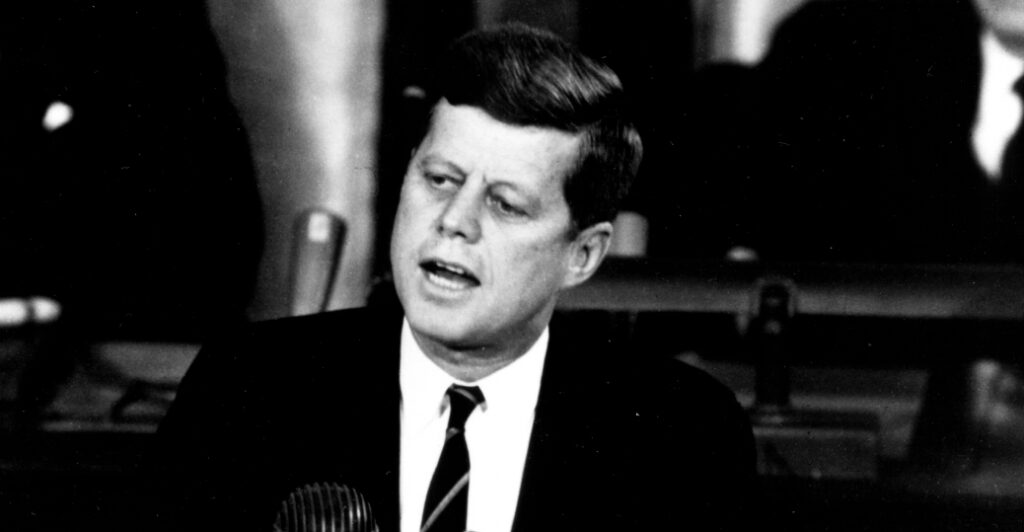
Melman’s popular book, and particularly its rhetoric about a “peace race,” quickly came to the attention of the new U.S. President, John F. Kennedy. On September 25, 1961, dismayed by the Soviet Union’s recent revival of nuclear weapons testing, Kennedy used the occasion of his address to the United Nations to challenge the Russians “not to an arms race, but to a peace race.”

Warning that “mankind must put an end to war―or war will put an end to mankind,” he invited nations to “join in dismantling the national capacity to wage war.”

Kennedy’s “peace race” speech praised obliquely, but powerfully, what was the most ambitious plan for disarmament of the Cold War era: the McCloy-Zorin Accords. This historic US-USSR agreement, presented to the UN only five days before, outlined a detailed plan for “general and complete disarmament.”

It provided for the abolition of national armed forces, the elimination of weapons stockpiles, and the discontinuance of military expenditures in a sequence of stages, each verified by an international disarmament organization before the next stage began.

During this process, disarmament progress would “be accompanied by measures to strengthen institutions for maintaining peace and the settlement of international disputes by peaceful means.”

In December 1961, the McCloy-Zorin Accords were adopted unanimously by the UN General Assembly.

The McCloy-Zorin Accords

Although the accelerating nuclear arms race – symbolized by Soviet and American nuclear testing – slowed the momentum toward disarmament provided by the McCloy-Zorin Accords and Kennedy’s “peace race” address, disarmament continued as a very live issue. The National Committee for a Sane Nuclear Policy (SANE), America’s largest peace organization, publicly lauded Kennedy’s “peace race” speech and called for “the launching of a Peace Race” in which the two Cold War blocs joined “to end the arms race, contain their power within constructive bounds, and encourage peaceful social change.”

For its part, the U.S. Arms Control and Disarmament Agency, created by the Kennedy administration to address disarmament issues, drafted an official U.S. government proposal, Blueprint for the Peace Race, which Kennedy submitted to the United Nations on April 18, 1962. Leading off with Kennedy’s challenge “not to an arms race, but to a peace race,” the proposal called for general and complete disarmament and proposed moving in verifiable steps toward that goal.

Nothing as sweeping as this followed, at least in part because much of the subsequent public attention and government energy went into curbing the nuclear arms race. A central concern along these lines was nuclear weapons testing, an issue dealt with in 1963 by the Partial Test Ban Treaty, signed that August by the U.S., Soviet, and British governments.

In setting the stage for this treaty, Kennedy drew upon Norman Cousins, the co-chair of SANE, to serve as his intermediary with Soviet Premier Nikita Khrushchev. Progress in containing the nuclear arms race continued with subsequent great power agreements, particularly the signing of the nuclear Nonproliferation Treaty of 1968.

As is often the case, modest reform measures undermine the drive for more thoroughgoing alternatives. Certainly, this was true with respect to general and complete disarmament.

Peace activists, of course, continued to champion stronger measures. Thus, Martin Luther King, Jr. used the occasion of his Nobel Peace Prize lecture in Oslo, on December 11, 1964, to declare: “We must shift the arms race into a ‘peace race.’” But, with important curbs on the nuclear arms race in place, much of the public and most government leaders turned to other issues.

Has nothing Changed?

Today, of course, we face not only an increasingly militarized world, but even a resumption of the nuclear arms race, as nuclear powers brazenly scrap nuclear arms control and disarmament treaties and threaten one another, as well as non-nuclear nations, with nuclear war.

Perhaps it’s time to revive the demand for more thoroughgoing global disarmament. Why not wage a peace race instead of an arms race – one bringing an end to the immense dangers and vast waste of resources caused by massive preparations for war?

In the initial stage of this race, how about an immediate cut of 10 percent in every nation’s military budget, thus retaining the current military balance while freeing up $182 billion for the things that make life worth living?

As the past agreements of the U.S. and Soviet governments show us, it’s not at all hard to draw up a reasonable, acceptable plan providing for verification and enforcement.

All that’s lacking, it seems, is the will to act.

The author

Dr. Lawrence Wittner is an American historian who has written extensively on peace movements, foreign policy, and economic inequality. He is also a Professor of History emeritus at SUNY/Albany and the author of Confronting the Bomb (Stanford University Press.)

Related Posts

Tony Robinson October 4, 2026 Violence is easy to recognise when someone is being beaten, shot or killed. It becomes more difficult when nobody is holding a weapon. Poverty, discrimination, exploitation and repression can restrict a human life just as effectively, although they do so in very different ways and with very different consequences. Simply adding more categories to an ever-growing list of forms of violence does not really solve the problem. The more interesting question is what all these different situations have in common and why it makes sense to describe them using the same word. Human beings do not simply react to what happens around them. They remember the past, imagine things that do not yet exist, make plans and undertake projects. Workers organise because they imagine different working conditions; people migrate because they imagine another life somewhere else; social movements emerge because people refuse to accept the...
It’s a matter of principles, courage, vision and pulling together – while the militarist world is falling apart… Peter Langille October 3, 2026 “Here, then, is the problem which we present to you, stark and dreadful and inescapable: Shall we put an end to the human race; or shall mankind renounce war?”The Bertrand Russell—Albert Einstein Manifesto, July 9, 1955 ⁕ The forecast for what’s ahead is worrisome. The sharp rise in armed conflicts over the past three years is adding to what was already the highest level in over seventy years. Genocides, which should be prevented are supported. A shared climate emergency that jeopardises survival is ignored. Diverse polls now suggest that people are war-weary, worried and interested in a more effective United Nations. And, there are viable policy options for a more secure world! Yet governments are doubling-down, betting on more war and investing heavily. If current trends persist,...
Johan Galtung 1930-2024October 2015 Published here on October 3, 2026 Let us focus on Civilization for conflict analysis and remedies. Major forms of disorder use violence; war is state organized violence. The most belligerent states are the United States of America and Israel, both with civilization roots. National Evangelism, the US Protestant Christian civilization– more national than evangelical–justifies US warfare as exceptionalism of a people chosen by God, with a manifest destiny to run the world. Orthodox Judaism justifies Israeli warfare to conquer and expand from Nile to Euphrates as a religious right and duty to the Eternal One. The third most belligerent country, the UK, no longer believes it is God-chosen but chosen by the USA; not quite the same but something. But the root cause of global disorder lies in the Occident–with Islam–seeing itself as the single, universal civilization valid for all at all times, all others being...

Recent Articles

Tony Robinson October 4, 2026 Violence is easy to recognise when someone is being beaten, shot or killed. It becomes more difficult when nobody is holding a weapon. Poverty, discrimination, exploitation and repression can restrict a human life just as effectively, although they do so in very different ways and with very different consequences. Simply adding more categories to an ever-growing list of forms of violence does not really solve the problem. The more interesting question is what all these different situations have in common and why it makes sense to describe them using the same word. Human beings do not simply react to what happens around them. They remember the past, imagine things that do not yet exist, make plans and undertake projects. Workers organise because they imagine different working conditions; people migrate because they imagine another life somewhere else; social movements emerge because people refuse to accept the...
It’s a matter of principles, courage, vision and pulling together – while the militarist world is falling apart… Peter Langille October 3, 2026 “Here, then, is the problem which we present to you, stark and dreadful and inescapable: Shall we put an end to the human race; or shall mankind renounce war?”The Bertrand Russell—Albert Einstein Manifesto, July 9, 1955 ⁕ The forecast for what’s ahead is worrisome. The sharp rise in armed conflicts over the past three years is adding to what was already the highest level in over seventy years. Genocides, which should be prevented are supported. A shared climate emergency that jeopardises survival is ignored. Diverse polls now suggest that people are war-weary, worried and interested in a more effective United Nations. And, there are viable policy options for a more secure world! Yet governments are doubling-down, betting on more war and investing heavily. If current trends persist,...
Johan Galtung 1930-2024October 2015 Published here on October 3, 2026 Let us focus on Civilization for conflict analysis and remedies. Major forms of disorder use violence; war is state organized violence. The most belligerent states are the United States of America and Israel, both with civilization roots. National Evangelism, the US Protestant Christian civilization– more national than evangelical–justifies US warfare as exceptionalism of a people chosen by God, with a manifest destiny to run the world. Orthodox Judaism justifies Israeli warfare to conquer and expand from Nile to Euphrates as a religious right and duty to the Eternal One. The third most belligerent country, the UK, no longer believes it is God-chosen but chosen by the USA; not quite the same but something. But the root cause of global disorder lies in the Occident–with Islam–seeing itself as the single, universal civilization valid for all at all times, all others being...

TFF on Substack

Discover and subscribe to more peace materials on TFF Substack

Most Popular

Tony Robinson October 4, 2026 Violence is easy to recognise when someone is being beaten, shot or killed. It becomes more difficult when nobody is holding a weapon. Poverty, discrimination, exploitation and repression can restrict a human life just as effectively, although they do so in very different ways and with very different consequences. Simply adding more categories to an ever-growing list of forms of violence does not really solve the problem. The more interesting question is what all these different situations have in common and why it makes sense to describe them using the same word. Human beings do not simply react to what happens around them. They remember the past, imagine things that do not yet exist, make plans and undertake projects. Workers organise because they imagine different working conditions; people migrate because they imagine another life somewhere else; social movements emerge because people refuse to accept the...
It’s a matter of principles, courage, vision and pulling together – while the militarist world is falling apart… Peter Langille October 3, 2026 “Here, then, is the problem which we present to you, stark and dreadful and inescapable: Shall we put an end to the human race; or shall mankind renounce war?”The Bertrand Russell—Albert Einstein Manifesto, July 9, 1955 ⁕ The forecast for what’s ahead is worrisome. The sharp rise in armed conflicts over the past three years is adding to what was already the highest level in over seventy years. Genocides, which should be prevented are supported. A shared climate emergency that jeopardises survival is ignored. Diverse polls now suggest that people are war-weary, worried and interested in a more effective United Nations. And, there are viable policy options for a more secure world! Yet governments are doubling-down, betting on more war and investing heavily. If current trends persist,...
Johan Galtung 1930-2024October 2015 Published here on October 3, 2026 Let us focus on Civilization for conflict analysis and remedies. Major forms of disorder use violence; war is state organized violence. The most belligerent states are the United States of America and Israel, both with civilization roots. National Evangelism, the US Protestant Christian civilization– more national than evangelical–justifies US warfare as exceptionalism of a people chosen by God, with a manifest destiny to run the world. Orthodox Judaism justifies Israeli warfare to conquer and expand from Nile to Euphrates as a religious right and duty to the Eternal One. The third most belligerent country, the UK, no longer believes it is God-chosen but chosen by the USA; not quite the same but something. But the root cause of global disorder lies in the Occident–with Islam–seeing itself as the single, universal civilization valid for all at all times, all others being...
Read More
Living-Peace-Sign-Budapest-copy
Tony Robinson October 4, 2026 Violence is easy to recognise when someone is being beaten, shot or killed. It becomes more difficult when nobody is holding a weapon. Poverty, discrimination, exploitation and repression can restrict a human life just as effectively, although they do so in very different ways and with very different consequences. Simply adding more categories to an ever-growing list of forms of violence does not really solve the problem. The more interesting question is what all these different situations have in common and why it makes sense to describe them using the same word. Human beings do not simply react to what happens around them. They remember the past, imagine things that do not yet exist, make plans and undertake projects. Workers organise because they imagine different working conditions; people migrate because they imagine another life somewhere else; social movements emerge because people refuse to accept the...
b54a1f10-8c65-4f0b-9dd5-4abc0a7d04cc_2659x2659
It’s a matter of principles, courage, vision and pulling together – while the militarist world is falling apart… Peter Langille October 3, 2026 “Here, then, is the problem which we present to you, stark and dreadful and inescapable: Shall we put an end to the human race; or shall mankind renounce war?”The Bertrand Russell—Albert Einstein Manifesto, July 9, 1955 ⁕ The forecast for what’s ahead is worrisome. The sharp rise in armed conflicts over the past three years is adding to what was already the highest level in over seventy years. Genocides, which should be prevented are supported. A shared climate emergency that jeopardises survival is ignored. Diverse polls now suggest that people are war-weary, worried and interested in a more effective United Nations. And, there are viable policy options for a more secure world! Yet governments are doubling-down, betting on more war and investing heavily. If current trends persist,...
010
Johan Galtung 1930-2024October 2015 Published here on October 3, 2026 Let us focus on Civilization for conflict analysis and remedies. Major forms of disorder use violence; war is state organized violence. The most belligerent states are the United States of America and Israel, both with civilization roots. National Evangelism, the US Protestant Christian civilization– more national than evangelical–justifies US warfare as exceptionalism of a people chosen by God, with a manifest destiny to run the world. Orthodox Judaism justifies Israeli warfare to conquer and expand from Nile to Euphrates as a religious right and duty to the Eternal One. The third most belligerent country, the UK, no longer believes it is God-chosen but chosen by the USA; not quite the same but something. But the root cause of global disorder lies in the Occident–with Islam–seeing itself as the single, universal civilization valid for all at all times, all others being...
Screenshot 2026-10-02 011738
Jan ObergPhD, director, The Transnational Foundation for Peace and Future Research, TFFLund, Sweden October 2, 2026 This is my full original manuscript. The Chinese Academy of Social Science, CASS, makes two publications out if it. 1. China’s Five-year plan emphasized the capabilities of basic research and original innovation. It is regarded as the goal of the future social development, which, as required, should be significantly enhanced. Can you comment on the importance of original innovation in research and academic study? I believe it is easier to define “original innovation” in the natural sciences than in social sciences. The breaking points of what constitutes something new, or innovative, are not quite as sharp in the latter. But in both fields it is about opening up something that was closed, unseen, unexplored before – making manifest what was earlier latent. Innovations come in many forms and shapes – naming something that was not...
arctic-circle-map
The agreement is catastrophic both because of what it says and what it doesn’t mention. It reduces further the major asset of security policies: Freedom of action. Jan Oberg TFF director September 25, 2026 A couple of hours before the agreement was signed on September 22, 2026, I published the following 13 hypotheses about what it would most likely contain on TFF Substack (in English). I was wrong on only the first point. Contrary to what Trump had written on his Truth Social platform, it does not appear to come into force immediately. In fact, it turned out to be worse than even I had anticipated. After these hypotheses now come a number of reflections in light of what the agreement actually contains, and does not contain, as well as the way in which it has generally been presented by major media outlets and by the public-service broadcaster DR. My...
girl-5894831_1280
Below are TFF-related media mentions, comments, videos and social media posts published elsewhere but not on this homepage. We happen to catch and list only a fraction. Regarding video comments and debates, we recommend that you go to the TFF Video Channel on Substack where many of them are reproduced. Jan Oberg is a contributor to China Daily – 52 million daily clicks – and Global Times, CGTN and CCTV (the national television), China Investment, Xinhua News Agency and several others. Articles and videos on these media very often multiply into countless Chinese (and Western media) that re-post them from these main media. Thanks to The China Academy, his analyses, interviews and comments are frequently posted on YouTube channels such as Thinkers Forum and Wave Media. These videos are often re-posted on Bilibili (China’s YouTube), the China Content Center on TikTok, and on the Chinese edition of TikTok, Douyin.com. This means reaching hundreds of millions of viewers worldwide over a year. While there are too many to catch on all these...




