
Gandhi’s Despair and the Struggle for Truth and Love

By Robert J. Burrowes

January 18, 2019

‘When I despair, I remember that all through history the ways of truth and love have always won. There have been tyrants, and murderers, and for a time they can seem invincible, but in the end they always fall. Think of it – always.’ M.K. Gandhi

As we remember Gandhi Jayanti on 2 October, the Mahatma’s 149th birthday and the International Day of Nonviolence or his death on January 30, there is plenty of room for despair.

Never before has the Earth and its many inhabitants been under siege as they are now, more than 100 years after Gandhi started warning us of the predicament in which we are embroiled and presenting his strategy for addressing it before it spiraled out of control.

Whether it is the threat of nuclear war, the ongoing wars in many parts of the world and particularly the Middle East, the multiple and synergistic threats to the global environment or the ongoing climate catastrophe, the Earth is under assault on all fronts and its precious lifeforms (human and otherwise) are being killed outright in vast numbers and driven to extinction at the rate of 200 species daily.

And the evidence is rapidly accumulating that humans themselves will be extinct by 2026 as well. See ‘Human Extinction by 2026? A Last Ditch Strategy to Fight for Human Survival’.

Moreover, unlike the tyrants to which Gandhi was referring, the current ‘tyrant’ is a global elite that has acquired extraordinary power to kill and destroy as they pursue their insane compulsion to accumulate and control resources at the expense of life. See ‘The Global Elite is Insane Revisited’.

So are we to give up in despair? To quit without a fight? Or even delude ourselves that nothing needs to be done? Obviously, these were not ways that Gandhi would contemplate because, as noted in his words cited above: ‘the ways of truth and love have always won’. Although, as Gandhi did not bother to add: we must struggle, relentlessly, to ensure that truth and love prevail.

And, fortunately, there are many people around the world who agree with him.

Tackling the pervasive violence in our world requires a comprehensive strategy involving many campaigns focused on a wide range of peace, justice and environmental issues, and substantial mobilization. There is no single or simple path. Let me tell you about some of the people engaged in this effort and the nature of their commitment, together with what connects their involvement.

Remarkable activist and progressive journalist Abby Martin, based in the USA, was formerly creator and presenter of the investigative news program ‘Breaking the Set’ and is now creator and presenter of its successor program ‘The Empire Files’. With the support of her fine team, Abby researches and presents reports from ‘inside history’s biggest empire… recording a world shaped by war & inequality’ so that the truth is exposed for all to see. Abby, who is also an artist, interviews a wide range of people from ‘ordinary’ activists to progressive intellectuals to political leaders to penetrate the veil of obscurity cast by the global elite’s corporate media. You can watch Abby’s terrific programs, providing insight into how our incredibly violent world works, on her website ‘The Empire Files’. You can also read about the latest attack on her work and how you can help in the article ‘US Sanctions Shut Down “The Empire Files” with Abby Martin’. Keep fighting Abby! We are with you all the way.

In Romania, Ina Curic – TFF Associate and board member – writes illustrated children’s books designed to teach children a variety of lessons for living an empowered, socially and environmentally conscious life.

Her book Queen Rain, King Wind: The Practice of Heart Gardening was published in May and Anagrania’s Challenge: Turning Conflict into Opportunity has just been published. Anagrania’s Challenge is a beautifully created story that offers clear and simple guidance on three subjects vital to our shared future on Earth: what we need to be ourselves, what we need to be healthy, and that acceptance of uniqueness and creatively dealing with conflict are essential if we are to live together and celebrate the benefits and advantages of our differences.

If you are looking for children’s books that promote nonviolent living and conflict resolution, you will have trouble finding better books than those by Ina. You can read about Ina, as well as how to obtain her books, on her website Imagine Creatively.

Pakistani Canadian Dr. Mahboob A. Khawaja is a scholar who writes searing critiques of international relations exposing the deep conflicts driving global events. Two of his recent articles are ‘World Affairs and Insanity as Entertainment: Are We at the End of Human Morality?’ and ‘Mankind Must Know: The UNO and Global Leaders are a Menace to Peace and Problem-Solving’.

Moreover, in support of his son Momin, a computer science graduate and IT entrepreneur, who has been unjustly imprisoned since 2004 on terrorism charges (and facing a sentence of life plus 24 years), Mahboob has created a website to raise awareness of Momin’s struggle for justice and freedom, and organized a petition for those who wish to express their support for him.

Edith Rubinstein in Belgium is definitely an ‘activist senior’. Now 86 and in a center of recuperation following a severe depression and bout of unconsciousness earlier this year, Edith still has her computer and continues her work as an activist. ‘Because I am an activist since a very long time, a feminist, a woman in Black, and I translated free Ecofeminism from Maria Mies and Vandana Shiva…. Since many years, I have translated alternative articles and finally it made me sick.’ In fact, Edith admits, ‘I am completely “abnormal”. Somebody who feels bad to live in a world where hundreds of thousand people are killed or die … because they have nothing to eat anymore and nobody seems to care…. I feel very bad to live in this kind of world. Yes, terrible what is happening in the Congo! But unfortunately it is not the only case. And I am very scandalized by the behavior of the Western World!!!!’

Zakia Haddouch in Morocco continues to report the extraordinarily difficult circumstances of people in that country as she and other activists continue their various struggles to bring some semblance of justice to Moroccan affairs. One prominent issue is the ongoing debate in relation to ‘the forced military service (for both young female and male subjects and I don’t say citizens). It was lately decreed by the king.’

Another struggle is taking place in the wake of the death of Mohcine Fikri on 28 October 2016, who was crushed to death in a rubbish truck trying to recover merchandise confiscated by a policeman. Following this event, Hirak (literally ‘The Movement’) was born and it quickly mobilized widespread support for its vigorous protests. While most of Hirak’s concerns are about local issues, it draws upon a national repertory of nonviolent actions fueled by the experiences of activists around the country.

Between October 2016 and May 2017, and faced with social unrest of an unprecedented vitality which increasingly challenged him personally, Mohamed VI remained silent. However, when Hirak leader Nasser Zefzazi – who has never failed to stress nonviolence and advocate self-restraint – interrupted a sermon on 26 May 2017 in which an imam claimed the social movement was tantamount to a ‘fratricidal struggle or even civil war within Islam’, the government took this pretext to clamp down on Hirak.

Many activists were jailed – over 200 so far – and demonstrations are now systematically broken up. Zefzazi was among those arrested (on 29 May 2017) and, along with other members of Hirak, subsequently jailed for 20 years. The repression has nipped in the bud any hopes for resolving the crisis quickly. But this doesn’t mean that Zakia and other activists have been intimidated into silence or inaction.

Daniel Dalai reports modestly about his visionary initiative Earthgardens in Guatemala. Earthgardens provides opportunities for girls to realize and practice their inherent leadership potential, particularly as part of Eco-Teams in preserving natural biodiversity. ‘More and more 3rd world governments are proving to be a colossal waste of money as corrupt politicians get rich without addressing local needs. The Sembradores’ model of Girl Power is gaining acceptance as people realize girls are more efficient, more concerned, and less corruptible in solving the simple problems of local needs. Clean water, cheap electricity, food production, and tourist development are urgent needs in many parts of the globe.

You may become a volunteer working with children or an Eco-Team assessor in Latin America or Africa.’ Please contact Kate Teggins earthgardens@outlook.com The beautiful Earthgardens website has just been updated and the stunning photos alone will tell you much about what these remarkable girls are doing. See Earthgardens.

Young Nigerian Idowu Jawando has been reflecting deeply on the shocking state of our world and his own role in fixing that. ‘Over here in Lagos civilization advances steadily with all its domination and exploitation, squeezing the juice out of all of us. But yet here and there, traces of a smile, the fragrance of love releases its perfume… things seem bearable for a while.

The big question on my mind is this: Can civilization be deconstructed? A part of me thinks: Yes of course, it is the actions of individuals that create this world, these same individuals also have the power to take everything down. But how about the police, the armies, the nuclear weapons and what-have you?

Things are the way they are because of force. And most especially the threat of starvation too. It forces us into activities and relationships not of our choosing. Civilization uses and discards the people, over and over, squeezing them like lemons.

‘Will the global leaders who are driven to this insane struggle for power and profit suddenly grow a compassionate nature, one that has no doubt been lost a long time ago? You and I know they won’t. With all the disasters that go on, we still see them stripping the earth bare of its life, still forcing people into precarious situations. We find ourselves at a quandary. I personally find myself in a very stifling situation, but I try my best not to let it define, instead I study it as one would study a dangerous toy….

‘Indeed I have found that tenderness impacts strength and courage in others, this is something I have seen in my own existence. But can one be tender to an oppressor? I guess if there was a mass refusal of this world and all its mechanisms, there will be a lot of headway. Such a situation in my own thinking, won’t be one of making demands to any government, but collectively and individually deciding how we want to live our beautiful mortal lives and what we want the world around us to reflect: the ugliness of mindless profit-seeking or co-creative play with earthly life.

‘Many just go through life unquestioningly, accepting the state of things as normal; as well, the walls that prevent us from truly connecting with one another, is one major obstacle. The education, religious systems only encourage people to be followers, never masters of themselves…. I will keep thinking about this. I realize it might take my whole life and then more, to tackle the evils of the world. But it would please me if I am moving inch by inch and encouraging others to do the same. The torch of freedom must never be extinguished. But must pass from generation to generation.’

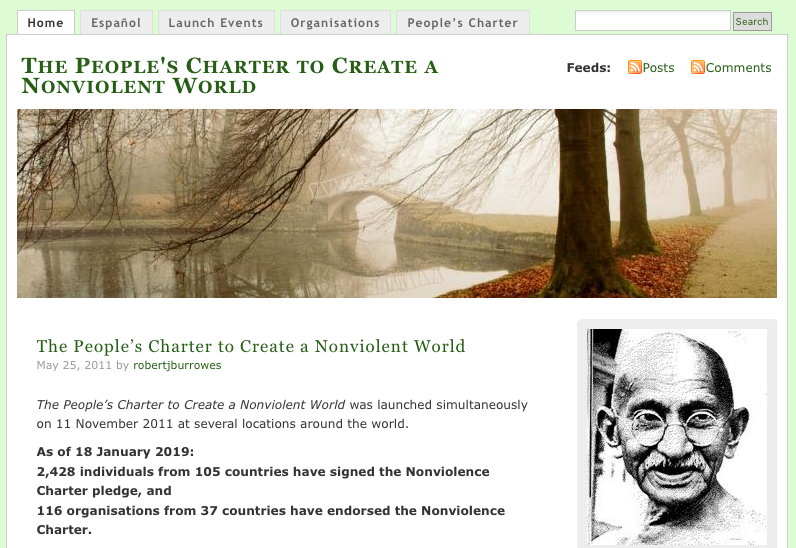
Each of the inspiring individuals mentioned above is a signatory of ‘The People’s Charter to Create a Nonviolent World’. If you feel inclined to join this worldwide movement to end violence in all of its manifestations, you are welcome to sign the Charter pledge too.

Like those individuals mentioned above, signatories of the Nonviolence Charter come from a diverse range of backgrounds. They live all over the world (in 105 countries). They represent a wide range of genders, races, religions, classes and abilities. And they work on a phenomenal variety of issues with an increasing number recognizing the need to work on ending violence against children.

As Gandhi noted:

‘If we are to reach real peace in this world and if we are to carry on a real war against war, we shall have to begin with children.’

This requires us to understand the cause of violence, including violence against children – see ‘Why Violence?’ and ‘Fearless Psychology and Fearful Psychology: Principles and Practice’ – and to consider making ‘My Promise to Children’. In some cases, it means undertaking the personal healing necessary to nurture children powerfully. See ‘Putting Feelings First’.

Recognizing, as Gandhi put it, that ‘Earth provides enough to satisfy every [person’s] needs, but not every [person’s] greed’, others are tackling the full range of environmental and climate challenges by participating in ‘The Flame Tree Project to Save Life on Earth’.

And given the elite insanity that drives violence in many contexts, still other signatories are engaged in nonviolent struggles – see Nonviolent Campaign Strategy – or national liberation struggles – see Nonviolent Defense/Liberation Strategy – to tackle violence in these contexts.

So if you are inclined to ponder the meaning of Gandhi’s life, you just need to picture a man dressed simply in khadi, walking to the sea to collect salt in defiance of the law of the British occupying power.

The Reverend Martin Luther King Jr. once noted: ‘The enemy is violence.’ But for Gandhi: ‘The enemy is fear.’

This is because it is fear that drives violence but also fear that prevents us responding strategically and nonviolently to the violence in our world.

As Gandhi observed: ‘You may never know what results come of your actions, but if you do nothing there will be no results.’

So as humans are beckoned to extinction within the next few years, Gandhi would remind us that ‘The future depends on what we do in the present.’

What will you do?
Robert J. Burrowes

Robert J. Burrowes
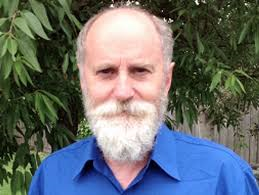
– has a lifetime commitment to understanding and ending human violence. He has done extensive research since 1966 in an effort to understand why human beings are violent and has been a nonviolent activist since 1981. He is the author of ‘Why Violence?’ Here his email address is and his website is here.

Related Posts

Tony Robinson October 4, 2026 Violence is easy to recognise when someone is being beaten, shot or killed. It becomes more difficult when nobody is holding a weapon. Poverty, discrimination, exploitation and repression can restrict a human life just as effectively, although they do so in very different ways and with very different consequences. Simply adding more categories to an ever-growing list of forms of violence does not really solve the problem. The more interesting question is what all these different situations have in common and why it makes sense to describe them using the same word. Human beings do not simply react to what happens around them. They remember the past, imagine things that do not yet exist, make plans and undertake projects. Workers organise because they imagine different working conditions; people migrate because they imagine another life somewhere else; social movements emerge because people refuse to accept the...
It’s a matter of principles, courage, vision and pulling together – while the militarist world is falling apart… Peter Langille October 3, 2026 “Here, then, is the problem which we present to you, stark and dreadful and inescapable: Shall we put an end to the human race; or shall mankind renounce war?”The Bertrand Russell—Albert Einstein Manifesto, July 9, 1955 ⁕ The forecast for what’s ahead is worrisome. The sharp rise in armed conflicts over the past three years is adding to what was already the highest level in over seventy years. Genocides, which should be prevented are supported. A shared climate emergency that jeopardises survival is ignored. Diverse polls now suggest that people are war-weary, worried and interested in a more effective United Nations. And, there are viable policy options for a more secure world! Yet governments are doubling-down, betting on more war and investing heavily. If current trends persist,...
Johan Galtung 1930-2024October 2015 Published here on October 3, 2026 Let us focus on Civilization for conflict analysis and remedies. Major forms of disorder use violence; war is state organized violence. The most belligerent states are the United States of America and Israel, both with civilization roots. National Evangelism, the US Protestant Christian civilization– more national than evangelical–justifies US warfare as exceptionalism of a people chosen by God, with a manifest destiny to run the world. Orthodox Judaism justifies Israeli warfare to conquer and expand from Nile to Euphrates as a religious right and duty to the Eternal One. The third most belligerent country, the UK, no longer believes it is God-chosen but chosen by the USA; not quite the same but something. But the root cause of global disorder lies in the Occident–with Islam–seeing itself as the single, universal civilization valid for all at all times, all others being...

Recent Articles

Tony Robinson October 4, 2026 Violence is easy to recognise when someone is being beaten, shot or killed. It becomes more difficult when nobody is holding a weapon. Poverty, discrimination, exploitation and repression can restrict a human life just as effectively, although they do so in very different ways and with very different consequences. Simply adding more categories to an ever-growing list of forms of violence does not really solve the problem. The more interesting question is what all these different situations have in common and why it makes sense to describe them using the same word. Human beings do not simply react to what happens around them. They remember the past, imagine things that do not yet exist, make plans and undertake projects. Workers organise because they imagine different working conditions; people migrate because they imagine another life somewhere else; social movements emerge because people refuse to accept the...
It’s a matter of principles, courage, vision and pulling together – while the militarist world is falling apart… Peter Langille October 3, 2026 “Here, then, is the problem which we present to you, stark and dreadful and inescapable: Shall we put an end to the human race; or shall mankind renounce war?”The Bertrand Russell—Albert Einstein Manifesto, July 9, 1955 ⁕ The forecast for what’s ahead is worrisome. The sharp rise in armed conflicts over the past three years is adding to what was already the highest level in over seventy years. Genocides, which should be prevented are supported. A shared climate emergency that jeopardises survival is ignored. Diverse polls now suggest that people are war-weary, worried and interested in a more effective United Nations. And, there are viable policy options for a more secure world! Yet governments are doubling-down, betting on more war and investing heavily. If current trends persist,...
Johan Galtung 1930-2024October 2015 Published here on October 3, 2026 Let us focus on Civilization for conflict analysis and remedies. Major forms of disorder use violence; war is state organized violence. The most belligerent states are the United States of America and Israel, both with civilization roots. National Evangelism, the US Protestant Christian civilization– more national than evangelical–justifies US warfare as exceptionalism of a people chosen by God, with a manifest destiny to run the world. Orthodox Judaism justifies Israeli warfare to conquer and expand from Nile to Euphrates as a religious right and duty to the Eternal One. The third most belligerent country, the UK, no longer believes it is God-chosen but chosen by the USA; not quite the same but something. But the root cause of global disorder lies in the Occident–with Islam–seeing itself as the single, universal civilization valid for all at all times, all others being...

TFF on Substack

Discover and subscribe to more peace materials on TFF Substack

Most Popular

Tony Robinson October 4, 2026 Violence is easy to recognise when someone is being beaten, shot or killed. It becomes more difficult when nobody is holding a weapon. Poverty, discrimination, exploitation and repression can restrict a human life just as effectively, although they do so in very different ways and with very different consequences. Simply adding more categories to an ever-growing list of forms of violence does not really solve the problem. The more interesting question is what all these different situations have in common and why it makes sense to describe them using the same word. Human beings do not simply react to what happens around them. They remember the past, imagine things that do not yet exist, make plans and undertake projects. Workers organise because they imagine different working conditions; people migrate because they imagine another life somewhere else; social movements emerge because people refuse to accept the...
It’s a matter of principles, courage, vision and pulling together – while the militarist world is falling apart… Peter Langille October 3, 2026 “Here, then, is the problem which we present to you, stark and dreadful and inescapable: Shall we put an end to the human race; or shall mankind renounce war?”The Bertrand Russell—Albert Einstein Manifesto, July 9, 1955 ⁕ The forecast for what’s ahead is worrisome. The sharp rise in armed conflicts over the past three years is adding to what was already the highest level in over seventy years. Genocides, which should be prevented are supported. A shared climate emergency that jeopardises survival is ignored. Diverse polls now suggest that people are war-weary, worried and interested in a more effective United Nations. And, there are viable policy options for a more secure world! Yet governments are doubling-down, betting on more war and investing heavily. If current trends persist,...
Johan Galtung 1930-2024October 2015 Published here on October 3, 2026 Let us focus on Civilization for conflict analysis and remedies. Major forms of disorder use violence; war is state organized violence. The most belligerent states are the United States of America and Israel, both with civilization roots. National Evangelism, the US Protestant Christian civilization– more national than evangelical–justifies US warfare as exceptionalism of a people chosen by God, with a manifest destiny to run the world. Orthodox Judaism justifies Israeli warfare to conquer and expand from Nile to Euphrates as a religious right and duty to the Eternal One. The third most belligerent country, the UK, no longer believes it is God-chosen but chosen by the USA; not quite the same but something. But the root cause of global disorder lies in the Occident–with Islam–seeing itself as the single, universal civilization valid for all at all times, all others being...
Read More
Living-Peace-Sign-Budapest-copy
Tony Robinson October 4, 2026 Violence is easy to recognise when someone is being beaten, shot or killed. It becomes more difficult when nobody is holding a weapon. Poverty, discrimination, exploitation and repression can restrict a human life just as effectively, although they do so in very different ways and with very different consequences. Simply adding more categories to an ever-growing list of forms of violence does not really solve the problem. The more interesting question is what all these different situations have in common and why it makes sense to describe them using the same word. Human beings do not simply react to what happens around them. They remember the past, imagine things that do not yet exist, make plans and undertake projects. Workers organise because they imagine different working conditions; people migrate because they imagine another life somewhere else; social movements emerge because people refuse to accept the...
b54a1f10-8c65-4f0b-9dd5-4abc0a7d04cc_2659x2659
It’s a matter of principles, courage, vision and pulling together – while the militarist world is falling apart… Peter Langille October 3, 2026 “Here, then, is the problem which we present to you, stark and dreadful and inescapable: Shall we put an end to the human race; or shall mankind renounce war?”The Bertrand Russell—Albert Einstein Manifesto, July 9, 1955 ⁕ The forecast for what’s ahead is worrisome. The sharp rise in armed conflicts over the past three years is adding to what was already the highest level in over seventy years. Genocides, which should be prevented are supported. A shared climate emergency that jeopardises survival is ignored. Diverse polls now suggest that people are war-weary, worried and interested in a more effective United Nations. And, there are viable policy options for a more secure world! Yet governments are doubling-down, betting on more war and investing heavily. If current trends persist,...
010
Johan Galtung 1930-2024October 2015 Published here on October 3, 2026 Let us focus on Civilization for conflict analysis and remedies. Major forms of disorder use violence; war is state organized violence. The most belligerent states are the United States of America and Israel, both with civilization roots. National Evangelism, the US Protestant Christian civilization– more national than evangelical–justifies US warfare as exceptionalism of a people chosen by God, with a manifest destiny to run the world. Orthodox Judaism justifies Israeli warfare to conquer and expand from Nile to Euphrates as a religious right and duty to the Eternal One. The third most belligerent country, the UK, no longer believes it is God-chosen but chosen by the USA; not quite the same but something. But the root cause of global disorder lies in the Occident–with Islam–seeing itself as the single, universal civilization valid for all at all times, all others being...
Screenshot 2026-10-02 011738
Jan ObergPhD, director, The Transnational Foundation for Peace and Future Research, TFFLund, Sweden October 2, 2026 This is my full original manuscript. The Chinese Academy of Social Science, CASS, makes two publications out if it. 1. China’s Five-year plan emphasized the capabilities of basic research and original innovation. It is regarded as the goal of the future social development, which, as required, should be significantly enhanced. Can you comment on the importance of original innovation in research and academic study? I believe it is easier to define “original innovation” in the natural sciences than in social sciences. The breaking points of what constitutes something new, or innovative, are not quite as sharp in the latter. But in both fields it is about opening up something that was closed, unseen, unexplored before – making manifest what was earlier latent. Innovations come in many forms and shapes – naming something that was not...
arctic-circle-map
The agreement is catastrophic both because of what it says and what it doesn’t mention. It reduces further the major asset of security policies: Freedom of action. Jan Oberg TFF director September 25, 2026 A couple of hours before the agreement was signed on September 22, 2026, I published the following 13 hypotheses about what it would most likely contain on TFF Substack (in English). I was wrong on only the first point. Contrary to what Trump had written on his Truth Social platform, it does not appear to come into force immediately. In fact, it turned out to be worse than even I had anticipated. After these hypotheses now come a number of reflections in light of what the agreement actually contains, and does not contain, as well as the way in which it has generally been presented by major media outlets and by the public-service broadcaster DR. My...
girl-5894831_1280
Below are TFF-related media mentions, comments, videos and social media posts published elsewhere but not on this homepage. We happen to catch and list only a fraction. Regarding video comments and debates, we recommend that you go to the TFF Video Channel on Substack where many of them are reproduced. Jan Oberg is a contributor to China Daily – 52 million daily clicks – and Global Times, CGTN and CCTV (the national television), China Investment, Xinhua News Agency and several others. Articles and videos on these media very often multiply into countless Chinese (and Western media) that re-post them from these main media. Thanks to The China Academy, his analyses, interviews and comments are frequently posted on YouTube channels such as Thinkers Forum and Wave Media. These videos are often re-posted on Bilibili (China’s YouTube), the China Content Center on TikTok, and on the Chinese edition of TikTok, Douyin.com. This means reaching hundreds of millions of viewers worldwide over a year. While there are too many to catch on all these...




