
Gandhi is still relevant – and can inspire a new form of politics today

By Tom Shillam

January 14, 2019

Seventy years after Gandhi’s assassination on the streets of New Delhi, Ramachandra Guha’s new book, Gandhi: The Years That Changed the World, 1914-48, reopens a familiar debate around his legacy. What was Gandhi’s message? What were his politics? What can we learn from him today? And is he still relevant?

Guha, presenting the second half of a biography that began with his 2013 book, Gandhi Before India, offers a straightforward but detailed narrative in which “the Mahatma” negotiates a principled path between the warring political trends of the age.

This article was originally published by The Conversation on November 28, 2018

Historian of empire, Bernard Porter, welcomed Guha’s work and its subtle defence of a “gentler, more tolerant and consensual forms of politics” that is now, in the age of Donald Trump, Brexit and Jair Bolsonaro in Brazil, on the decline in the West and elsewhere.

Others are more biting.

Fellow Gandhi scholar Faisal Devji charges Guha with neutralising the Mahatma’s radicalism. Meanwhile, author Pankaj Mishra, reexamining Gandhi’s writings in a “post-truth age” of “furious revisionism”, uncovers a “relentlessly counter-intuitive thought” left untapped by Guha’s tales of a “bland do-gooder”.

Seventy years after Gandhi’s assassination on the streets of New Delhi, Ramachandra Guha’s new book, Gandhi: The Years That Changed the World, 1914-48, reopens a familiar debate around his legacy. What was Gandhi’s message? What were his politics? What can we learn from him today? And is he still relevant?

Resurrection

All these accounts, however, seek to resurrect Gandhi as a political mentor for today. Modern politics – and its new formula of Twitter hashtags, populist sloganeering and strongman dictators – may seem an unlikely place for the teachings of Gandhi to offer fresh inspiration. But just such a thing also happened during the Cold War, when politics faced some very similar problems.

Gandhi is sometimes imagined sitting beside a spinning wheel pouring scorn on science and modernity. Indeed, when asked by a reporter what he thought of “Western civilisation”, he famously replied: “I think it would be a good idea.”

But his politics were more complex than this. Gandhi read the works of Western political thinkers including John Ruskin and Leo Tolstoy. India was being sucked into a global economy based on the exploitation and automation of labour. Industrial capitalism – and its partner, imperialism – only cemented uneven power relations and alienated one Indian from the next. He believed what was needed, instead, was a social and economic life based around local production for local needs, something that would also foster greater cultural enjoyment.

But is the current post-truth age still able to make use of this simple, authentic message?

A look into early 1950s Indian history provides some clues. When India achieved independence in August 1947 – with Jawaharlal Nehru as its first prime minister – Gandhi, it is supposed, remained as a spiritual and moral, rather than political, guide. His vision of a “village India” died in 1948 with his assassin Nathuram Godse’s bullet. And as Cold War ideological competition ramped up between communism and capitalism, rapid and centralised economic growth seemed inevitable.
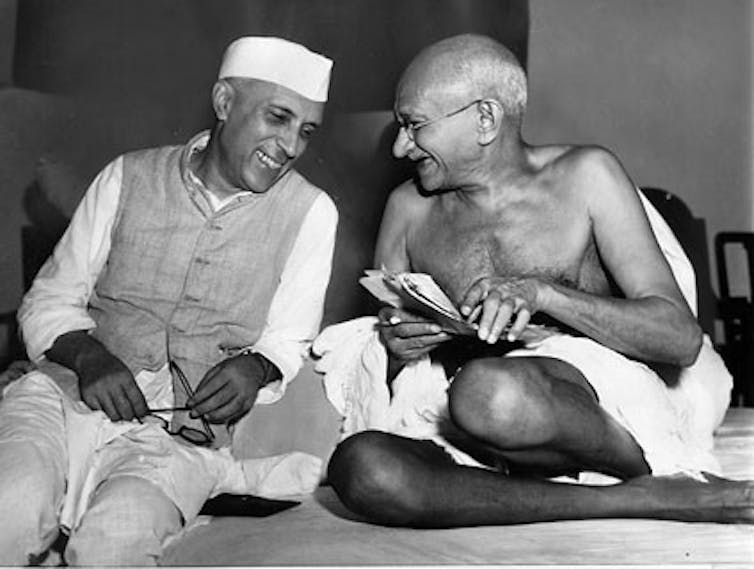
Nehru and Gandhi share a joke in Mumbai, 1946.
By Max Desfor for Associated Press

Some intellectuals, however, returned to the Mahatma’s ideas in this new and hostile climate. In 1950, the CIA covertly funded the formation of the Congress for Cultural Freedom (CCF), an organisation which brought together liberal and leftist intellectuals from around the world to discuss the threat posed by Soviet collectivism to free cultural expression.

In sponsoring conferences and magazines in which these intellectuals could articulate their views, the CIA hoped it could channel their anti-authoritarianism to a useful Cold War end. But this did not work out. CCF branches often acted as repositories for radical aspirations which could find no other home.

The Indian Committee for Cultural Freedom (ICCF), formed in 1951, was a striking example. Freedom First, its maiden publication, eschewed cultural criticism for discussions of domestic politics. The CCF’s push for the formation of a new journal, Quest, which reversed this was in vain, with one writer taking the opportunity to rail against a Westernised Indian “ruling class” whose interest in state-led development was bound to create “a situation reminiscent of the looking-glass world” – in other words, to impose Western ideologies onto India.

A stateless society

These writers – often former freedom fighters who had gone to prison for their travails – wanted a new egalitarian politics they sometimes termed “direct democracy”. Views on how this should be approached varied, and as the decade wore on, some took to advocating for a pro-capitalist, if also welfare state-friendly, programme.

Others, though, found in Gandhi a source of optimism. In 1951, Vinoba Bhave and other social reformers committed to Gandhi’s “sarvodaya” – progress of all – concept, founded the “Bhoodan Movement”. This was aimed at encouraging landowners to redistribute land without violence and rapidly reduce inequality in agrarian India.

This fascinated the ICCF. Marathi trade unionist and columnist, Prabhakar Padhye, named Bhoodan one of several reform movements capable of constituting “a new social force in the life of the country”. The ICCF’s annual conference welcomed the movement, with speakers calling for a “Gandhian” politics which made “cooperation, rather than competition, the rule of life”.
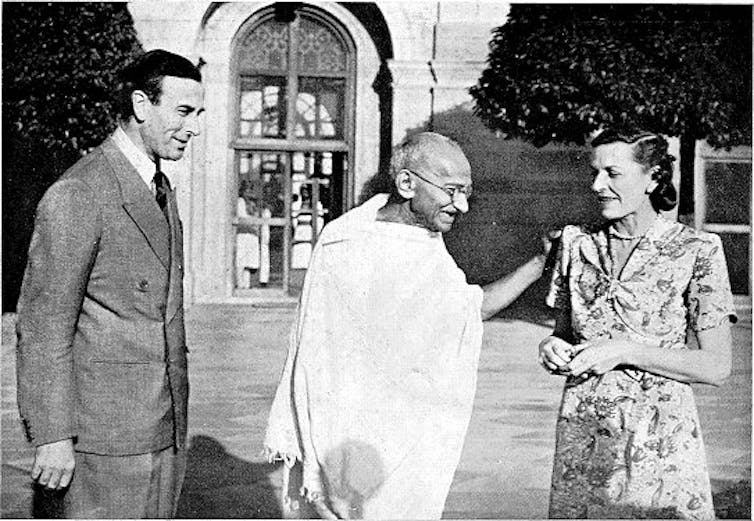
Gandhi with Lord and Lady Mountbatten. Via Wikimedia Commons

Soon, key ICCF writer, Minoo Masani, reported on a tour undertaken around the Indian state of Bihar with fellow member Jayaprakash Narayan. Speaking with crowds of peasants and rural poor, Narayan bracketed together totalitarianism and the welfare state as inherently coercive. What the pair supported was “Gandhism” – or a more spontaneous and participatory politics which “like anarchism or communism, visualises ultimately a stateless society”.

The point is that these intellectuals were drawing on Gandhi in defiance of an oppressive global political climate and its relentless classification of different ideas and visions as good or bad, communist or anti-communist, modernist or traditional.

In its vacuous rhetoric and sleazy sloganeering, the early Cold War era was like today. And then, as now, Gandhi’s ideas were of renewed interest. As we now face a global dearth of alternative political ideas, perhaps it’s no wonder we are turning again to the Mahatma for inspiration.

Related Posts

Tony Robinson October 4, 2026 Violence is easy to recognise when someone is being beaten, shot or killed. It becomes more difficult when nobody is holding a weapon. Poverty, discrimination, exploitation and repression can restrict a human life just as effectively, although they do so in very different ways and with very different consequences. Simply adding more categories to an ever-growing list of forms of violence does not really solve the problem. The more interesting question is what all these different situations have in common and why it makes sense to describe them using the same word. Human beings do not simply react to what happens around them. They remember the past, imagine things that do not yet exist, make plans and undertake projects. Workers organise because they imagine different working conditions; people migrate because they imagine another life somewhere else; social movements emerge because people refuse to accept the...
It’s a matter of principles, courage, vision and pulling together – while the militarist world is falling apart… Peter Langille October 3, 2026 “Here, then, is the problem which we present to you, stark and dreadful and inescapable: Shall we put an end to the human race; or shall mankind renounce war?”The Bertrand Russell—Albert Einstein Manifesto, July 9, 1955 ⁕ The forecast for what’s ahead is worrisome. The sharp rise in armed conflicts over the past three years is adding to what was already the highest level in over seventy years. Genocides, which should be prevented are supported. A shared climate emergency that jeopardises survival is ignored. Diverse polls now suggest that people are war-weary, worried and interested in a more effective United Nations. And, there are viable policy options for a more secure world! Yet governments are doubling-down, betting on more war and investing heavily. If current trends persist,...
Johan Galtung 1930-2024October 2015 Published here on October 3, 2026 Let us focus on Civilization for conflict analysis and remedies. Major forms of disorder use violence; war is state organized violence. The most belligerent states are the United States of America and Israel, both with civilization roots. National Evangelism, the US Protestant Christian civilization– more national than evangelical–justifies US warfare as exceptionalism of a people chosen by God, with a manifest destiny to run the world. Orthodox Judaism justifies Israeli warfare to conquer and expand from Nile to Euphrates as a religious right and duty to the Eternal One. The third most belligerent country, the UK, no longer believes it is God-chosen but chosen by the USA; not quite the same but something. But the root cause of global disorder lies in the Occident–with Islam–seeing itself as the single, universal civilization valid for all at all times, all others being...

Recent Articles

Tony Robinson October 4, 2026 Violence is easy to recognise when someone is being beaten, shot or killed. It becomes more difficult when nobody is holding a weapon. Poverty, discrimination, exploitation and repression can restrict a human life just as effectively, although they do so in very different ways and with very different consequences. Simply adding more categories to an ever-growing list of forms of violence does not really solve the problem. The more interesting question is what all these different situations have in common and why it makes sense to describe them using the same word. Human beings do not simply react to what happens around them. They remember the past, imagine things that do not yet exist, make plans and undertake projects. Workers organise because they imagine different working conditions; people migrate because they imagine another life somewhere else; social movements emerge because people refuse to accept the...
It’s a matter of principles, courage, vision and pulling together – while the militarist world is falling apart… Peter Langille October 3, 2026 “Here, then, is the problem which we present to you, stark and dreadful and inescapable: Shall we put an end to the human race; or shall mankind renounce war?”The Bertrand Russell—Albert Einstein Manifesto, July 9, 1955 ⁕ The forecast for what’s ahead is worrisome. The sharp rise in armed conflicts over the past three years is adding to what was already the highest level in over seventy years. Genocides, which should be prevented are supported. A shared climate emergency that jeopardises survival is ignored. Diverse polls now suggest that people are war-weary, worried and interested in a more effective United Nations. And, there are viable policy options for a more secure world! Yet governments are doubling-down, betting on more war and investing heavily. If current trends persist,...
Johan Galtung 1930-2024October 2015 Published here on October 3, 2026 Let us focus on Civilization for conflict analysis and remedies. Major forms of disorder use violence; war is state organized violence. The most belligerent states are the United States of America and Israel, both with civilization roots. National Evangelism, the US Protestant Christian civilization– more national than evangelical–justifies US warfare as exceptionalism of a people chosen by God, with a manifest destiny to run the world. Orthodox Judaism justifies Israeli warfare to conquer and expand from Nile to Euphrates as a religious right and duty to the Eternal One. The third most belligerent country, the UK, no longer believes it is God-chosen but chosen by the USA; not quite the same but something. But the root cause of global disorder lies in the Occident–with Islam–seeing itself as the single, universal civilization valid for all at all times, all others being...

TFF on Substack

Discover and subscribe to more peace materials on TFF Substack

Most Popular

Tony Robinson October 4, 2026 Violence is easy to recognise when someone is being beaten, shot or killed. It becomes more difficult when nobody is holding a weapon. Poverty, discrimination, exploitation and repression can restrict a human life just as effectively, although they do so in very different ways and with very different consequences. Simply adding more categories to an ever-growing list of forms of violence does not really solve the problem. The more interesting question is what all these different situations have in common and why it makes sense to describe them using the same word. Human beings do not simply react to what happens around them. They remember the past, imagine things that do not yet exist, make plans and undertake projects. Workers organise because they imagine different working conditions; people migrate because they imagine another life somewhere else; social movements emerge because people refuse to accept the...
It’s a matter of principles, courage, vision and pulling together – while the militarist world is falling apart… Peter Langille October 3, 2026 “Here, then, is the problem which we present to you, stark and dreadful and inescapable: Shall we put an end to the human race; or shall mankind renounce war?”The Bertrand Russell—Albert Einstein Manifesto, July 9, 1955 ⁕ The forecast for what’s ahead is worrisome. The sharp rise in armed conflicts over the past three years is adding to what was already the highest level in over seventy years. Genocides, which should be prevented are supported. A shared climate emergency that jeopardises survival is ignored. Diverse polls now suggest that people are war-weary, worried and interested in a more effective United Nations. And, there are viable policy options for a more secure world! Yet governments are doubling-down, betting on more war and investing heavily. If current trends persist,...
Johan Galtung 1930-2024October 2015 Published here on October 3, 2026 Let us focus on Civilization for conflict analysis and remedies. Major forms of disorder use violence; war is state organized violence. The most belligerent states are the United States of America and Israel, both with civilization roots. National Evangelism, the US Protestant Christian civilization– more national than evangelical–justifies US warfare as exceptionalism of a people chosen by God, with a manifest destiny to run the world. Orthodox Judaism justifies Israeli warfare to conquer and expand from Nile to Euphrates as a religious right and duty to the Eternal One. The third most belligerent country, the UK, no longer believes it is God-chosen but chosen by the USA; not quite the same but something. But the root cause of global disorder lies in the Occident–with Islam–seeing itself as the single, universal civilization valid for all at all times, all others being...
Read More
Living-Peace-Sign-Budapest-copy
Tony Robinson October 4, 2026 Violence is easy to recognise when someone is being beaten, shot or killed. It becomes more difficult when nobody is holding a weapon. Poverty, discrimination, exploitation and repression can restrict a human life just as effectively, although they do so in very different ways and with very different consequences. Simply adding more categories to an ever-growing list of forms of violence does not really solve the problem. The more interesting question is what all these different situations have in common and why it makes sense to describe them using the same word. Human beings do not simply react to what happens around them. They remember the past, imagine things that do not yet exist, make plans and undertake projects. Workers organise because they imagine different working conditions; people migrate because they imagine another life somewhere else; social movements emerge because people refuse to accept the...
b54a1f10-8c65-4f0b-9dd5-4abc0a7d04cc_2659x2659
It’s a matter of principles, courage, vision and pulling together – while the militarist world is falling apart… Peter Langille October 3, 2026 “Here, then, is the problem which we present to you, stark and dreadful and inescapable: Shall we put an end to the human race; or shall mankind renounce war?”The Bertrand Russell—Albert Einstein Manifesto, July 9, 1955 ⁕ The forecast for what’s ahead is worrisome. The sharp rise in armed conflicts over the past three years is adding to what was already the highest level in over seventy years. Genocides, which should be prevented are supported. A shared climate emergency that jeopardises survival is ignored. Diverse polls now suggest that people are war-weary, worried and interested in a more effective United Nations. And, there are viable policy options for a more secure world! Yet governments are doubling-down, betting on more war and investing heavily. If current trends persist,...
010
Johan Galtung 1930-2024October 2015 Published here on October 3, 2026 Let us focus on Civilization for conflict analysis and remedies. Major forms of disorder use violence; war is state organized violence. The most belligerent states are the United States of America and Israel, both with civilization roots. National Evangelism, the US Protestant Christian civilization– more national than evangelical–justifies US warfare as exceptionalism of a people chosen by God, with a manifest destiny to run the world. Orthodox Judaism justifies Israeli warfare to conquer and expand from Nile to Euphrates as a religious right and duty to the Eternal One. The third most belligerent country, the UK, no longer believes it is God-chosen but chosen by the USA; not quite the same but something. But the root cause of global disorder lies in the Occident–with Islam–seeing itself as the single, universal civilization valid for all at all times, all others being...
Screenshot 2026-10-02 011738
Jan ObergPhD, director, The Transnational Foundation for Peace and Future Research, TFFLund, Sweden October 2, 2026 This is my full original manuscript. The Chinese Academy of Social Science, CASS, makes two publications out if it. 1. China’s Five-year plan emphasized the capabilities of basic research and original innovation. It is regarded as the goal of the future social development, which, as required, should be significantly enhanced. Can you comment on the importance of original innovation in research and academic study? I believe it is easier to define “original innovation” in the natural sciences than in social sciences. The breaking points of what constitutes something new, or innovative, are not quite as sharp in the latter. But in both fields it is about opening up something that was closed, unseen, unexplored before – making manifest what was earlier latent. Innovations come in many forms and shapes – naming something that was not...
arctic-circle-map
The agreement is catastrophic both because of what it says and what it doesn’t mention. It reduces further the major asset of security policies: Freedom of action. Jan Oberg TFF director September 25, 2026 A couple of hours before the agreement was signed on September 22, 2026, I published the following 13 hypotheses about what it would most likely contain on TFF Substack (in English). I was wrong on only the first point. Contrary to what Trump had written on his Truth Social platform, it does not appear to come into force immediately. In fact, it turned out to be worse than even I had anticipated. After these hypotheses now come a number of reflections in light of what the agreement actually contains, and does not contain, as well as the way in which it has generally been presented by major media outlets and by the public-service broadcaster DR. My...
girl-5894831_1280
Below are TFF-related media mentions, comments, videos and social media posts published elsewhere but not on this homepage. We happen to catch and list only a fraction. Regarding video comments and debates, we recommend that you go to the TFF Video Channel on Substack where many of them are reproduced. Jan Oberg is a contributor to China Daily – 52 million daily clicks – and Global Times, CGTN and CCTV (the national television), China Investment, Xinhua News Agency and several others. Articles and videos on these media very often multiply into countless Chinese (and Western media) that re-post them from these main media. Thanks to The China Academy, his analyses, interviews and comments are frequently posted on YouTube channels such as Thinkers Forum and Wave Media. These videos are often re-posted on Bilibili (China’s YouTube), the China Content Center on TikTok, and on the Chinese edition of TikTok, Douyin.com. This means reaching hundreds of millions of viewers worldwide over a year. While there are too many to catch on all these...




