
In 2020, I wrote an impressionistic article, ”Could everyday micro malfunctions be signs of a coming macro breakdown?”

It was inspired by the brilliant sociologist C. Wright Mill’s concept of the sociological imagination.

Out of many more, I selected 14 examples of everyday things that I had experienced simply did not work, from lost luggage and flight delays to bank cards that prevent payment, postal services that do not bring out parcels and letters on time, and French pay road toll that prevents you from paying, etc.

To quote one example from the article:

”A little story about the decay in my town: I arrive in Lund where I live, after 6 weeks travelling around entirely on my own in China. Everything has worked perfectly there – trains, flights, ticket reservations, no queues anywhere, my WeChat app, ATMs, etc – although English is still a problem for an ignorant person such as I who do not speak Chinese.

It’s Sunday morning at 7 am, and I get out of the Lund Central station only to see lots of litter all over – and no taxis. I call my company and they arrive slowly (in contrast to the Chinese system, I can not follow the taxi’s position and do not know how long it will take to arrive – but OK).
The driver doesn’t have a clue where the street I am going to in this relatively small town is. His GPS doesn’t work and neither, btw, does his taximeter. He suggests a price I know is way too high, and I suggest a lower price, which he grumpily accepts. Having arrived at my home address, I want to pay him, but I need a receipt – but he has no paper or pen, shouts that he doesn’t want my money and slams the door. I had probably taken a taxi about 50-60 times in China and not once been treated unprofessionally or rudely. And they all took me to where I wanted to go without my help.”

I firmly believe that the small can be related to bigger issues and trends. And vice versa. That is, if you have a bit of the sociological imagination…

This article was originally written for and published by the Transcend Media Service, TMS,
on December 4, 2023

Deja vue! Two days ago I returned from 30 days of travelling around China with my dear wife and TFF co-founder, Christina Spannar – Shanghai, Beijing, Xi’an, Hangzhou, Shenzhen and Nanjing. Sweden is 10 million people, China is 1400. From a visitor’s point of view, China is a service society where things work and people are remarkably kind and helpful (of course, with the exception of a few who, like everywhere else, are rude, incompetent, or both.

We landed at Pudong Airport in Shanghai but, of course, did not yet have a Chinese SIM card, so we can’t pay for the metro ticket downtown by either showing or scanning a QR code in the WeChat or Alipay apps that everyone uses in the now basically cash-free China. We thought cash would do at least at this particular place, but a rude woman in the ticket office tells us to go to a ticketing machine which, unfortunately, we do not manage to get a ticket out of.

A lady in her 30s with a child comes up to us and says in English: Can I help you? We thankfully accept, and she then tries to get a ticket out of the machine: No luck either. She is also turned down at the ticket counter, but then says: ’Don’t worry, let me pay your ticket for you!’

Thanking her warmly for her help, we sent a thought back home: Would anybody in our town, Lund in Sweden, have volunteered to pay the tickets for an elderly Chinese couple who were unable upon arrival to pay at a Swedish ticketing machine?

The Chinese are great at technology but also great at sometimes overdoing it. For instance, at many restaurants, you must now scan a QR code to see the menu; the idea is that you tick off what you want in the digital menu, the price for the meal is calculated and the order sent directly by the waiter to the kitchen and payment is then easy as a piece of cake. That is, if you can manage that digital menu on your phone…

It is actually much easier with a printed menu where you can see pictures of the different dishes, can ask the waiter a question and point out for him or her what you want, and then s/he registers your order. So, over-digitalisation does exist – and it is annoying even for some Chinese themselves.

That said, it is a society that works extremely well. Surveillance – oh yes, but it has a positive side too, in contrast to similar surveillance in the West: It increases efficiency and makes systems work smoothly. It has to when you organise social services, shopping, transport, etc., for 1400 million people and their daily needs.

High-speed trains depart on time – sometimes before time because everybody is checked before boarding. All a foreigner needs to show is the passport; trains and planes work ticket-free by means of that. No checking and irritation later when you have boarded the train. Station floors are spotlessly clean, and so are the trains – and they run at 350 km/hour, in the future, with Maglev technology, at 600 km/hour.

Per kilometre, trains are much cheaper than in Sweden. Taxis cost 25-30% of taxis in Sweden. Why? Because China wants to reduce private car-driving – which also means that if you live in a big city and own more than one car, the second car must not be used on certain weekdays. For the common good.

And now to the world order change story.

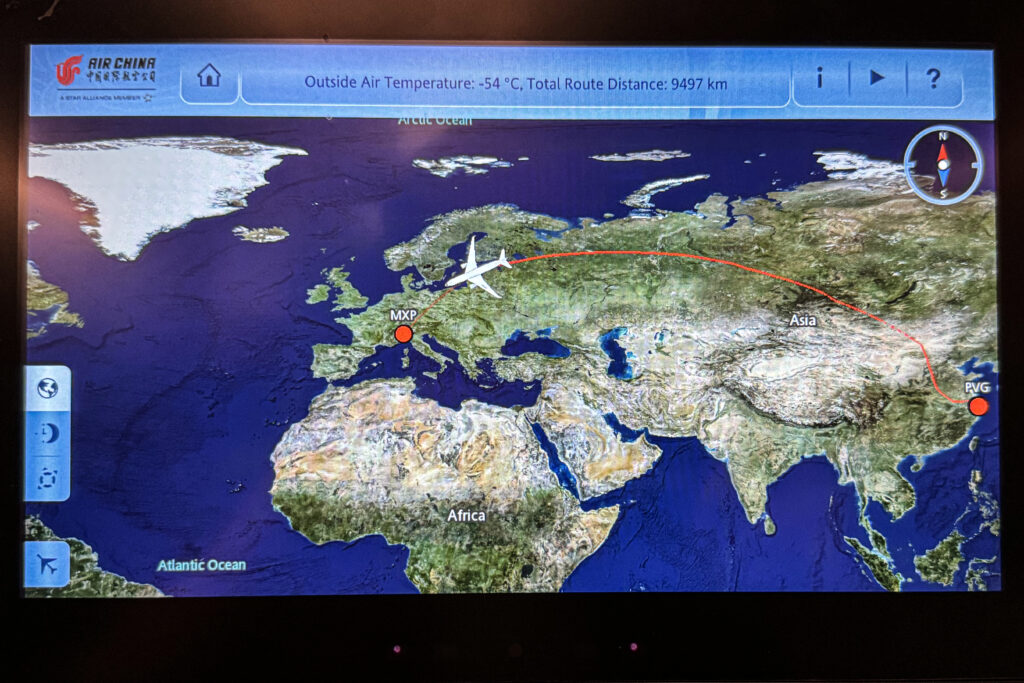
We depart on time from Shanghai and fly 12 hours over Russia on Air China. By the way, that’s what airline companies from war-provoking NATO/EU countries can no longer do. We have a stopover in Milan, Italy, to continue on Scandinavian Airlines System, SAS, to Copenhagen, a two-hour flight. Air China arrives to Milan 15 minutes before schedule, but SAS takes off 50 min after schedule, and no explanation is given. Oh yes, there is a plane in front of us, and we are in a departure queue. Why we are in that queue 50 min late is never mentioned, nor apologised for.

At Copenhagen Airport, everything is chaos. The reason given is ”weather conditions” and signal failures – the winter has come as a surprise! At this regional-international hub, we are told – in Danish – to wait 50 min for busses. Long story short, we do get on a train to Gothenburg, but arriving at Malmö, Sweden, we are told that all must disembark and catch another train on a far-away platform – very nice for two elderly people with 40+ kilos of luggage.

Arriving at Lund, the station platform is full of ice but covered with some salt and gravel. At bus stops, no snow has been cleared, a failsafe method to make people fall when entering the bus. And finally, the bus driver forgets to stop where we had pressed the stop button to get off. High snow there, too.

World politics and trends can be observed at the micro, local, and everyday levels. And those ”small” events I have described here are indicators of much larger macro-problems. To put it crudely: The West is, in comparison with China and others, becoming a mal- or dysfunctional society. You’ll begin to notice it if you apply the sociological imagination and stop seeing these everyday occurrences as personal problems you must find individual solutions to.

Europe and the US are – again to put it crudely – falling apart. Warfare, militarism, sanctions on Russia, price-hikes, you name it – all of it undermines the capacity of the civil service and welfare society we once were, not the least in Scandinavia. Priorities have become perverse – guns before butter.

Add to that the – general and stupid – idea that individualism, maximising the individual’s profit in a broad sense, will lead to the common best for all. Add to that the decrease in education, professionalism and service – destroyed by the marketisation of everything. Add to that huge coordination and management deficiencies and lack of commitment among employees, often for very understandable reasons. And add to that the complete lack of a social ethos: that we all pull together to create a better society for all.

To quote a figure from an Oscar Wilde play: ”We now know the price of everything and the value of nothing!”

China has created value.

Instead of being curious – forget being positive or negative about China, just be curious – the US-dominated West is bent on fighting China to the bitter end. No one else must challenge Western-dominating habits and ways of thinking. It’s completely delusional and self-destructive.

China – human history’s most impressive socio-economic welfare development over just 40 years – doesn’t merit anything but scorn and negative media stories.

A society in which prices is everything and value nothing will pay a very high price for its outdated social cosmology, decline denial and lack of will to learn from others. But it will tell itself – and you and me – that others have nothing of value…

So, think of world order changes next time some everyday malfunction hits you! And thank the US militarist foreign policy, George W. Bush and the Global War On Terror next time you pass, more or less stripped, through an airport security check…


Peace & future researcher + ‌Art Photographer

Related Posts

Below are TFF-related media mentions, comments, videos and social media posts published elsewhere but not on this homepage. We happen to catch and list only a fraction. Regarding video comments and debates, we recommend that you go to the TFF Video Channel on Substack where many of them are reproduced. Jan Oberg is a contributor to China Daily – 52 million daily clicks – and Global Times, CGTN and CCTV (the national television), China Investment, Xinhua News Agency and several others. Articles and videos on these media very often multiply into countless Chinese (and Western media) that re-post them from these main media. Thanks to The China Academy, his analyses, interviews and comments are frequently posted on YouTube channels such as Thinkers Forum and Wave Media. These videos are often re-posted on Bilibili (China’s YouTube), the China Content Center on TikTok, and on the Chinese edition of TikTok, Douyin.com. This means reaching hundreds of millions of viewers worldwide over a year. While there are too many to catch on all these...
Jan Oberg TFF director October 13, 2026 According to Alfred Nobel’s will, the Nobel Peace Prize shall be awarded: ”to the person who has done the most or best to advance fellowship among nations, the abolition or reduction of standing armies, and the establishment and promotion of peace congresses.” Further down, he also expresses how the prize for the “champions of peace” shall be decided: “that for champions of peace by a committee of five persons to be selected by the Norwegian Storting. Alfred Nobel’s will is remarkably short and clear. But few seem to have read it. Nobel did not say that the committee itself should consist of members of parliament. He entrusted the Storting with appointing five persons. In principle, it could have selected diplomats, mediators, peace researchers, conflict-resolution specialists, or other individuals with recognised expertise in matters of peace from around the world. Instead, the Storting gradually...
The Quest for Humane Survival Richard Falk Professor emeritus, Princeton UniversityTFF Associate since 1986October 12, 2026 After decades of teaching and writing about international law in academic frameworks that were not institutionally situated within law school environments—at Princeton and the University of California, Santa Barbara—I found myself most receptive to the TWAIL outlook. It has been especially illuminating in clarifying the extent to which international law evolved as a dialogical critique of Europe’s efforts to legitimize its colonial undertakings. In particular, TWAIL has exposed how international law has functioned to legalize the subjugation of Third World peoples, securing conditions for exploitative investment and trade relations, the coercive enforcement of public debts, and an ideology of cultural superiority. TWAIL’s exposure of these economic legacies of colonialism has influenced my understanding of the history and development of international law, broadly conceived, as an ideological project of the Western sub-system of the world...

Recent Articles

Below are TFF-related media mentions, comments, videos and social media posts published elsewhere but not on this homepage. We happen to catch and list only a fraction. Regarding video comments and debates, we recommend that you go to the TFF Video Channel on Substack where many of them are reproduced. Jan Oberg is a contributor to China Daily – 52 million daily clicks – and Global Times, CGTN and CCTV (the national television), China Investment, Xinhua News Agency and several others. Articles and videos on these media very often multiply into countless Chinese (and Western media) that re-post them from these main media. Thanks to The China Academy, his analyses, interviews and comments are frequently posted on YouTube channels such as Thinkers Forum and Wave Media. These videos are often re-posted on Bilibili (China’s YouTube), the China Content Center on TikTok, and on the Chinese edition of TikTok, Douyin.com. This means reaching hundreds of millions of viewers worldwide over a year. While there are too many to catch on all these...
Jan Oberg TFF director October 13, 2026 According to Alfred Nobel’s will, the Nobel Peace Prize shall be awarded: ”to the person who has done the most or best to advance fellowship among nations, the abolition or reduction of standing armies, and the establishment and promotion of peace congresses.” Further down, he also expresses how the prize for the “champions of peace” shall be decided: “that for champions of peace by a committee of five persons to be selected by the Norwegian Storting. Alfred Nobel’s will is remarkably short and clear. But few seem to have read it. Nobel did not say that the committee itself should consist of members of parliament. He entrusted the Storting with appointing five persons. In principle, it could have selected diplomats, mediators, peace researchers, conflict-resolution specialists, or other individuals with recognised expertise in matters of peace from around the world. Instead, the Storting gradually...
The Quest for Humane Survival Richard Falk Professor emeritus, Princeton UniversityTFF Associate since 1986October 12, 2026 After decades of teaching and writing about international law in academic frameworks that were not institutionally situated within law school environments—at Princeton and the University of California, Santa Barbara—I found myself most receptive to the TWAIL outlook. It has been especially illuminating in clarifying the extent to which international law evolved as a dialogical critique of Europe’s efforts to legitimize its colonial undertakings. In particular, TWAIL has exposed how international law has functioned to legalize the subjugation of Third World peoples, securing conditions for exploitative investment and trade relations, the coercive enforcement of public debts, and an ideology of cultural superiority. TWAIL’s exposure of these economic legacies of colonialism has influenced my understanding of the history and development of international law, broadly conceived, as an ideological project of the Western sub-system of the world...

TFF on Substack

Discover and subscribe to more peace materials on TFF Substack

Most Popular

Below are TFF-related media mentions, comments, videos and social media posts published elsewhere but not on this homepage. We happen to catch and list only a fraction. Regarding video comments and debates, we recommend that you go to the TFF Video Channel on Substack where many of them are reproduced. Jan Oberg is a contributor to China Daily – 52 million daily clicks – and Global Times, CGTN and CCTV (the national television), China Investment, Xinhua News Agency and several others. Articles and videos on these media very often multiply into countless Chinese (and Western media) that re-post them from these main media. Thanks to The China Academy, his analyses, interviews and comments are frequently posted on YouTube channels such as Thinkers Forum and Wave Media. These videos are often re-posted on Bilibili (China’s YouTube), the China Content Center on TikTok, and on the Chinese edition of TikTok, Douyin.com. This means reaching hundreds of millions of viewers worldwide over a year. While there are too many to catch on all these...
Jan Oberg TFF director October 13, 2026 According to Alfred Nobel’s will, the Nobel Peace Prize shall be awarded: ”to the person who has done the most or best to advance fellowship among nations, the abolition or reduction of standing armies, and the establishment and promotion of peace congresses.” Further down, he also expresses how the prize for the “champions of peace” shall be decided: “that for champions of peace by a committee of five persons to be selected by the Norwegian Storting. Alfred Nobel’s will is remarkably short and clear. But few seem to have read it. Nobel did not say that the committee itself should consist of members of parliament. He entrusted the Storting with appointing five persons. In principle, it could have selected diplomats, mediators, peace researchers, conflict-resolution specialists, or other individuals with recognised expertise in matters of peace from around the world. Instead, the Storting gradually...
The Quest for Humane Survival Richard Falk Professor emeritus, Princeton UniversityTFF Associate since 1986October 12, 2026 After decades of teaching and writing about international law in academic frameworks that were not institutionally situated within law school environments—at Princeton and the University of California, Santa Barbara—I found myself most receptive to the TWAIL outlook. It has been especially illuminating in clarifying the extent to which international law evolved as a dialogical critique of Europe’s efforts to legitimize its colonial undertakings. In particular, TWAIL has exposed how international law has functioned to legalize the subjugation of Third World peoples, securing conditions for exploitative investment and trade relations, the coercive enforcement of public debts, and an ideology of cultural superiority. TWAIL’s exposure of these economic legacies of colonialism has influenced my understanding of the history and development of international law, broadly conceived, as an ideological project of the Western sub-system of the world...
Read More
girl-5894831_1280
Below are TFF-related media mentions, comments, videos and social media posts published elsewhere but not on this homepage. We happen to catch and list only a fraction. Regarding video comments and debates, we recommend that you go to the TFF Video Channel on Substack where many of them are reproduced. Jan Oberg is a contributor to China Daily – 52 million daily clicks – and Global Times, CGTN and CCTV (the national television), China Investment, Xinhua News Agency and several others. Articles and videos on these media very often multiply into countless Chinese (and Western media) that re-post them from these main media. Thanks to The China Academy, his analyses, interviews and comments are frequently posted on YouTube channels such as Thinkers Forum and Wave Media. These videos are often re-posted on Bilibili (China’s YouTube), the China Content Center on TikTok, and on the Chinese edition of TikTok, Douyin.com. This means reaching hundreds of millions of viewers worldwide over a year. While there are too many to catch on all these...
Nobel-Prize-Plaque
Jan Oberg TFF director October 13, 2026 According to Alfred Nobel’s will, the Nobel Peace Prize shall be awarded: ”to the person who has done the most or best to advance fellowship among nations, the abolition or reduction of standing armies, and the establishment and promotion of peace congresses.” Further down, he also expresses how the prize for the “champions of peace” shall be decided: “that for champions of peace by a committee of five persons to be selected by the Norwegian Storting. Alfred Nobel’s will is remarkably short and clear. But few seem to have read it. Nobel did not say that the committee itself should consist of members of parliament. He entrusted the Storting with appointing five persons. In principle, it could have selected diplomats, mediators, peace researchers, conflict-resolution specialists, or other individuals with recognised expertise in matters of peace from around the world. Instead, the Storting gradually...
law-419057_1280
The Quest for Humane Survival Richard Falk Professor emeritus, Princeton UniversityTFF Associate since 1986October 12, 2026 After decades of teaching and writing about international law in academic frameworks that were not institutionally situated within law school environments—at Princeton and the University of California, Santa Barbara—I found myself most receptive to the TWAIL outlook. It has been especially illuminating in clarifying the extent to which international law evolved as a dialogical critique of Europe’s efforts to legitimize its colonial undertakings. In particular, TWAIL has exposed how international law has functioned to legalize the subjugation of Third World peoples, securing conditions for exploitative investment and trade relations, the coercive enforcement of public debts, and an ideology of cultural superiority. TWAIL’s exposure of these economic legacies of colonialism has influenced my understanding of the history and development of international law, broadly conceived, as an ideological project of the Western sub-system of the world...
images-2
Advocates of nuclear disarmament are regularly dismissed by the champions of nuclear deterrence as naïve and unrealistic, utopian or even irresponsible. Yet this ‘doctrine’ of deterrence, regarded by France as the ‘cornerstone’ of its national security, is based on quasi-religious beliefs, a theory that cannot be proven, risky gambles and fragile assumptions. So much so that one might legitimately ask which side the ‘Care Bears’ are on. Marc FinaudVice-President of Initiatives for Nuclear Disarmament (IDN) October 9, 2026 This article was originally published on Pressenza When it comes to these things being treated as religious concepts, look here. Idealists and realists It was Hubert Védrine, François Mitterrand’s former Foreign Minister, who repeatedly coined the phrase: ‘Europeans are a sort of Care Bears who don’t realise they’re living in Jurassic Park’. He applies this reference to the cartoon for well-behaved children not only to what he regards as weakness or idealism...
8824b09f-33a5-43f9-9fd0-550f28cda24d_1536x1024
What the West Borrowed from Asia and What It Left Behind Jan Krikke October 8, 2026 The article was originally published here In the late 1960s, the musical Hair announced that the Age of Aquarius was dawning. Its opening anthem promised a transformation of human consciousness: an era of peace, harmony and understanding. Half a century later, a familiar echo of that promise is a meditation app offered by your employer. You can find it in the same list of benefits as the pension plan and the gym discount. How did a spiritual revolution become an employee benefit? The answer lies in the history of the movement known as New Age: where it came from, what it borrowed from Asia, and why the meaning of what it borrowed changed in the process. Two definitions will help. New Age is a loose label for a wide range of spiritual practices and...
Screenshot 2026-10-04 210142
Small and different + among the 10% most active + 9,000 texts + 150 Associates + 60 000 a day — and a stubborn belief that peace is smarter and must be secured by peaceful means. In 2026, the Transnational Foundation for Peace and Future Research (TFF) turns 40. On Monday, October 5, 2026, a new TFF homepage will go live — a new gateway to more than 9,000 articles, analyses, research papers and other contributions produced over four decades of independent peace research. But this is not simply a new website. For four decades, TFF has worked from a simple conviction: peace is smarter than militarism and can be brought about by peaceful means. This is not merely an aspiration. It is the principle expressed in the UN Charter and the Gandhian tradition that has guided our work from the beginning. TFF is a research-based, independent and people-financed foundation....




