
Farhang Jahanpour: Women are the Victors in Iranian Officials’ Trial Balloon on Abolishing the Morals Police

An account of the situation and of the worst and best-case scenarios for Iran’s future

Oxford (Special to Informed Comment)

Various Iranian and foreign news agencies have reported that Iran’s Prosecutor General has announced the shutting down of the. Guidance Patrol (often referred to in the West as the morality police). In response to a question about the dismantling of the Guidance Patrol, Prosecutor General Mohammad Jafar Montazeri said: “The Guidance Patrol has nothing to do with the Judiciary. It was dismantled by the same organisation [presumably the Revolution Guards and the law-enforcement forces] that had established it.”

In another meeting held in Qom on the recent protests, he said: “The Majlis [the Parliament] and Supreme Islamic Revolution Council are studying and working on the issue of hijab, and the outcome of those decisions will be announced in 15 days. Such decisions should be based on wisdom.” He added: “After recent events, security and cultural organisations are trying to find a wise solution to this issue. The judiciary is busy working on a bill on the issue of morality and hijab.”

The reports regarding the dismantling of the Guidance Patrol have not been confirmed or denied by other government officials, and it is not clear whether the Prosecutor General was speaking in his personal capacity or whether his remarks reflect the official position of the government, or at least of the judiciary, or whether they are in the form of trial balloons in order to gauge public reaction. There are conflicting reports, with one statement from Iranian state TV denying that the morality police will be abolished.

Article continues after bonus IC video


Euronews: “Iran disbands ‘morality police’ amid two and half months of nationwide protests”

However, there is plenty of evidence to show that the Iranian regime has been rattled by the protests and is trying to find a way out of the biggest domestic crisis it has faced since the establishment of the Islamic Republic.

Earlier this month, Ali Reza Hosseini-Beheshti, the son of the late Ayatollah Mohammad Beheshti, the first head of the Islamic Judiciary, a member of the shadowy Islamic Revolution Council and one of the main architects of the Islamic Republic’s first constitution, called for the election of a Constituent Assembly to write a new constitution. He said that the regime has no other alternative: “The system has only two options. If it wants Iran to survive, it has no choice but to give in to this solution, or else it should openly admit that it attaches no importance to Iran.”

The Iranian Students News Agency, ISNA, has reported that Azar Mansouri, the secretary general of a leading reformist party, accompanied by “a number of political activists” met with the powerful Secretary of the Supreme National Security Council, Ali Shamkhani, on December 4 and offered some proposals to him about how the government should react to the protests. She said: “The ruling establishment must talk to the people, accept its mistakes, and control the microphones that spread hatred and anger the people.” She also called on the government to lift the restrictions on social media, allow peaceful gatherings, free political prisoners and rescind the death sentences. She went on to say that “in order to improve the economic situation, the government must resolve its differences and challenges with America and the West, and must reform its policies in order to make the best use of the capabilities of Iranian expatriates.”

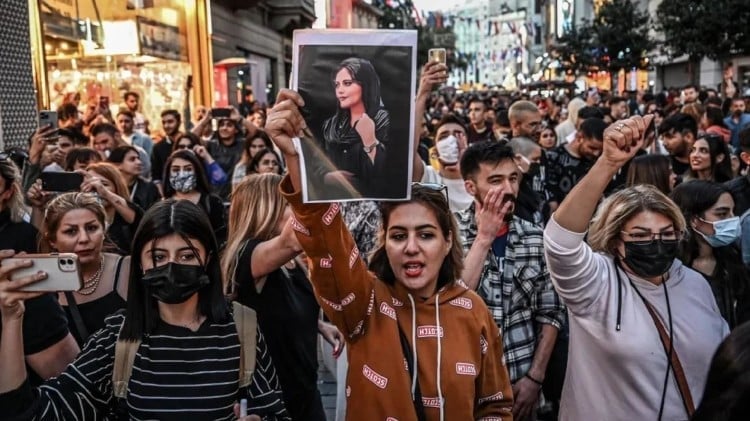
The current nationwide protests started following the tragic death of 22-year-old Mahsa Amini in the custody of the Guidance Patrol on 16 September 2022, and they show no sign of abating. Meanwhile, strikes by many labor unions, such as truck drivers, teachers, university lecturers, oil industry workers and even some conservative merchants in the Tehran bazaar in support of the protestors have continued and are even intensifying.

The regime’s brutal crackdown on the protests has had the opposite effect and has intensified the scope and severity of the protests, despite many casualties. Iran’s Security Council (headed by the Interior Minister Hassan Habibi) has admitted that at least 200 people have died, while IRGC Aerospace head Amir Ali Hajizadeh says that “at least 300 people have been killed or martyred in recent weeks.”

Iran’s deputy foreign minister Ali Bagheri-Kani has claimed that more than 50 law-enforcement personel have also been killed by protestors. Opposition sources put the number of the dead as over 440, with more than 18,000 protestors being arrested and some of them sentenced to death.

It is clear that the women’s uprising in Iran, supported by many men and by remarkable international solidarity, has reached a critical point and, for the first time, it is possible to realistically imagine the end of the clerical regime. Deep cracks have appeared among the leading members of the regime and even of the security forces, and doing nothing and hoping that everything will go back to square one is not an option. The movement is irreversible, and if the reports about the dismantlement of the Guidance Patrol are confirmed, it shows that the women’s revolution has achieved its first tangible gains. However, what is on offer is too little too late. The main question is which direction the events will take from now on.

Although many opposition groups abroad have jumped on the bandwagon and are calling on the people sacrificing everything inside the country to intensify their activities and prepare the way for one such group to return to the country among universal acclaim, the fact remains that the real change will take place inside Iran and not from outside.

A major problem of the revolutionaries under the Shah was that they only wanted to get rid of him, without any plans for an alternative. During the last days of the former regime, I asked a university friend of mine who was very active in the protests what his ideal future regime was. I asked him if he had even read Ayatollah Ruhollah Khomeini’s books and whether he agreed with his views. He answered that even asking such a question was treason to the revolution. The only aim was to get rid of the Shah because, according to him, what replaced him could not be any worse. Of course, given the brutal record of the clerical regime, one can hold that view with more justification about this regime, but this is a very risky course to follow.

Already, many opposition activists have adopted a very intolerant attitude towards any divergent views, but it is at such critical times that cool heads, real debate and dialogue and exchanges of views are needed in order to avoid possible pitfalls. Any serious uprising to topple this unpopular regime is not a game because it affects the future of over 86 million Iranians. The aim should be to establish a democratic system on the ruins of the clerical regime not merely engage in an orgy of destruction.

With its long history, a constitutional revolution nearly 120 years ago, a well-educated and pro-Western population, Iran is perhaps the only country in the Middle East which is totally ready for democracy. The imposed fanatical Islamist regime and people’s long struggle against it has given Iranians a unique experience and a thirst for freedom, as demonstrated in their slogan of “Women, Life, Freedom”.

It is important to avoid the fate of some failed states in the Middle East, such as Iraq, Afghanistan, Syria, Libya, Somalia or Yemen where some US Neoconservatives were trying to establish democracy.

Possible scenarios – including evolutionary change

This is why it is important to at least think about the possible alternatives to the current regime. Possible scenarios may include:

1- The slow-motion collapse of the Islamic regime and the triumph of the protestors without much resistance by the regime’s military and security forces. This option is very unlikely, given the fanatical attachment or subservience of some military forces, especially the IRGC and the Basij militia, to the regime. It is possible that if the regime faces serious threats to its existence those forces will unleash a reign of terror worse that we have ever seen.

2- A foreign military attack on Iran’s nuclear facilities in the hope of weakening the regime and strengthening the protestors. This option too is very unwise and may in fact strengthen the regime, as was the case with the Iran-Iraq war. Most Iranians may detest the regime but they love their country. Nothing will unite them more than a foreign threat or a foreign attack on their country.

3- The possibility of a military coup either by the regular Army or more likely some elements within the IRGC. Far from establishing freedom and democracy in Iran, this option will entrench the violent sections of the regime and will produce a military dictatorship as we have seen in Egypt or Syria. Given the state of chaos in the Middle East and the world, especially after the Russian invasion of Ukraine, any new military action in the Middle East would be catastrophic and would be the last straw to break the back of the global economy.

4- There is some wishful thinking in the West that a different government in Iran would be less nationalistic or assertive than the current regime and would be friendlier towards the West and Israel. Given the extreme hostility of the Neocons towards Iran and the experience of crippling sanctions and maximum pressure imposed by President Trump, and the Israeli record of assassinating many Iranian scientists, it is highly unlikely that any new regime imposed from outside would want or be able to establish closer relations with the West or Israel.

However, this does not mean that there cannot be a constructive path to regime change in Iran.

With an ailing leader, widespread protests and even a profound feeling of disappointment and disillusionment among many members of the regime, there is the possibility of evolutionary, rather than revolutionary or violent change. The major fear of many government officials and security forces is either the disintegration of the country or the possibility of severe reprisals by a new government. This anxiety is not helped by the constant threats issued by some opposition groups, especially those in exile.

We have had the experience of a remarkable peaceful transfer of power in South Africa from an apartheid regime to majority rule. Perhaps the most important factor in the success of that revolution was its promise of peaceful change. Iran needs to follow the path of a Truth and Reconciliation Commission, promising a general amnesty, combined with the rule of law and the punishment of those who have committed major crimes.

A majority of Iranians participated in the Islamic Revolution, and it was not imposed from outside. Most people share in the guilt, although the crimes of those who used the revolution for their own personal gain and who introduced a reign of terror cannot be forgotten or forgiven.

While a violent change in Iran can destabilize the country and even lead to its disintegration, helped by some malign foreign elements, a peaceful and orderly transition can save the country and even serve as a model for others in the Middle East to follow. On the other hand, the collapse or disintegration of Iran will have profound repercussions for the region and will destabilize the entire Middle East and the rest of the world.

Of course, it is not for any of us from the outside to tell Iranians which path to follow, but at least we can make suggestions and warn of possible pitfalls.

The current nationwide protests give one hope that Iranians will choose the option which is more in keeping with their experiences and traditions and to the greater interest of the country. Long-suffering Iranians deserve this.

Please support TFF’s work for peace through research and public education. We are all-volunteer, people-financed and do not accept money from governments or corporations. In other words, one of the very last free research think tanks in this world – and for a noble purpose: Peace by peaceful – intelligent – means. It is fast, easy and secure. Click here. Thanks!
TFF Associate and prolific contributor to The Transnational since 2006. Please see his own very diverse homepage here.

Related Posts

Johan Galtung 1930-2024October 2015 Published here on October 3, 2026 Let us focus on Civilization for conflict analysis and remedies. Major forms of disorder use violence; war is state organized violence. The most belligerent states are the United States of America and Israel, both with civilization roots. National Evangelism, the US Protestant Christian civilization– more national than evangelical–justifies US warfare as exceptionalism of a people chosen by God, with a manifest destiny to run the world. Orthodox Judaism justifies Israeli warfare to conquer and expand from Nile to Euphrates as a religious right and duty to the Eternal One. The third most belligerent country, the UK, no longer believes it is God-chosen but chosen by the USA; not quite the same but something. But the root cause of global disorder lies in the Occident–with Islam–seeing itself as the single, universal civilization valid for all at all times, all others being...
Jan ObergPhD, director, The Transnational Foundation for Peace and Future Research, TFFLund, Sweden October 2, 2026 This is my full original manuscript. The Chinese Academy of Social Science, CASS, makes two publications out if it. 1. China’s Five-year plan emphasized the capabilities of basic research and original innovation. It is regarded as the goal of the future social development, which, as required, should be significantly enhanced. Can you comment on the importance of original innovation in research and academic study? I believe it is easier to define “original innovation” in the natural sciences than in social sciences. The breaking points of what constitutes something new, or innovative, are not quite as sharp in the latter. But in both fields it is about opening up something that was closed, unseen, unexplored before – making manifest what was earlier latent. Innovations come in many forms and shapes – naming something that was not...
The agreement is catastrophic both because of what it says and what it doesn’t mention. It reduces further the major asset of security policies: Freedom of action. Jan Oberg TFF director September 25, 2026 A couple of hours before the agreement was signed on September 22, 2026, I published the following 13 hypotheses about what it would most likely contain on TFF Substack (in English). I was wrong on only the first point. Contrary to what Trump had written on his Truth Social platform, it does not appear to come into force immediately. In fact, it turned out to be worse than even I had anticipated. After these hypotheses now come a number of reflections in light of what the agreement actually contains, and does not contain, as well as the way in which it has generally been presented by major media outlets and by the public-service broadcaster DR. My...

Recent Articles

Tony Robinson October 4, 2026 Violence is easy to recognise when someone is being beaten, shot or killed. It becomes more difficult when nobody is holding a weapon. Poverty, discrimination, exploitation and repression can restrict a human life just as effectively, although they do so in very different ways and with very different consequences. Simply adding more categories to an ever-growing list of forms of violence does not really solve the problem. The more interesting question is what all these different situations have in common and why it makes sense to describe them using the same word. Human beings do not simply react to what happens around them. They remember the past, imagine things that do not yet exist, make plans and undertake projects. Workers organise because they imagine different working conditions; people migrate because they imagine another life somewhere else; social movements emerge because people refuse to accept the...
It’s a matter of principles, courage, vision and pulling together – while the militarist world is falling apart… Peter Langille October 3, 2026 “Here, then, is the problem which we present to you, stark and dreadful and inescapable: Shall we put an end to the human race; or shall mankind renounce war?”The Bertrand Russell—Albert Einstein Manifesto, July 9, 1955 ⁕ The forecast for what’s ahead is worrisome. The sharp rise in armed conflicts over the past three years is adding to what was already the highest level in over seventy years. Genocides, which should be prevented are supported. A shared climate emergency that jeopardises survival is ignored. Diverse polls now suggest that people are war-weary, worried and interested in a more effective United Nations. And, there are viable policy options for a more secure world! Yet governments are doubling-down, betting on more war and investing heavily. If current trends persist,...
Johan Galtung 1930-2024October 2015 Published here on October 3, 2026 Let us focus on Civilization for conflict analysis and remedies. Major forms of disorder use violence; war is state organized violence. The most belligerent states are the United States of America and Israel, both with civilization roots. National Evangelism, the US Protestant Christian civilization– more national than evangelical–justifies US warfare as exceptionalism of a people chosen by God, with a manifest destiny to run the world. Orthodox Judaism justifies Israeli warfare to conquer and expand from Nile to Euphrates as a religious right and duty to the Eternal One. The third most belligerent country, the UK, no longer believes it is God-chosen but chosen by the USA; not quite the same but something. But the root cause of global disorder lies in the Occident–with Islam–seeing itself as the single, universal civilization valid for all at all times, all others being...

TFF on Substack

Discover and subscribe to more peace materials on TFF Substack

Most Popular

Tony Robinson October 4, 2026 Violence is easy to recognise when someone is being beaten, shot or killed. It becomes more difficult when nobody is holding a weapon. Poverty, discrimination, exploitation and repression can restrict a human life just as effectively, although they do so in very different ways and with very different consequences. Simply adding more categories to an ever-growing list of forms of violence does not really solve the problem. The more interesting question is what all these different situations have in common and why it makes sense to describe them using the same word. Human beings do not simply react to what happens around them. They remember the past, imagine things that do not yet exist, make plans and undertake projects. Workers organise because they imagine different working conditions; people migrate because they imagine another life somewhere else; social movements emerge because people refuse to accept the...
It’s a matter of principles, courage, vision and pulling together – while the militarist world is falling apart… Peter Langille October 3, 2026 “Here, then, is the problem which we present to you, stark and dreadful and inescapable: Shall we put an end to the human race; or shall mankind renounce war?”The Bertrand Russell—Albert Einstein Manifesto, July 9, 1955 ⁕ The forecast for what’s ahead is worrisome. The sharp rise in armed conflicts over the past three years is adding to what was already the highest level in over seventy years. Genocides, which should be prevented are supported. A shared climate emergency that jeopardises survival is ignored. Diverse polls now suggest that people are war-weary, worried and interested in a more effective United Nations. And, there are viable policy options for a more secure world! Yet governments are doubling-down, betting on more war and investing heavily. If current trends persist,...
Johan Galtung 1930-2024October 2015 Published here on October 3, 2026 Let us focus on Civilization for conflict analysis and remedies. Major forms of disorder use violence; war is state organized violence. The most belligerent states are the United States of America and Israel, both with civilization roots. National Evangelism, the US Protestant Christian civilization– more national than evangelical–justifies US warfare as exceptionalism of a people chosen by God, with a manifest destiny to run the world. Orthodox Judaism justifies Israeli warfare to conquer and expand from Nile to Euphrates as a religious right and duty to the Eternal One. The third most belligerent country, the UK, no longer believes it is God-chosen but chosen by the USA; not quite the same but something. But the root cause of global disorder lies in the Occident–with Islam–seeing itself as the single, universal civilization valid for all at all times, all others being...
Read More
Living-Peace-Sign-Budapest-copy
Tony Robinson October 4, 2026 Violence is easy to recognise when someone is being beaten, shot or killed. It becomes more difficult when nobody is holding a weapon. Poverty, discrimination, exploitation and repression can restrict a human life just as effectively, although they do so in very different ways and with very different consequences. Simply adding more categories to an ever-growing list of forms of violence does not really solve the problem. The more interesting question is what all these different situations have in common and why it makes sense to describe them using the same word. Human beings do not simply react to what happens around them. They remember the past, imagine things that do not yet exist, make plans and undertake projects. Workers organise because they imagine different working conditions; people migrate because they imagine another life somewhere else; social movements emerge because people refuse to accept the...
b54a1f10-8c65-4f0b-9dd5-4abc0a7d04cc_2659x2659
It’s a matter of principles, courage, vision and pulling together – while the militarist world is falling apart… Peter Langille October 3, 2026 “Here, then, is the problem which we present to you, stark and dreadful and inescapable: Shall we put an end to the human race; or shall mankind renounce war?”The Bertrand Russell—Albert Einstein Manifesto, July 9, 1955 ⁕ The forecast for what’s ahead is worrisome. The sharp rise in armed conflicts over the past three years is adding to what was already the highest level in over seventy years. Genocides, which should be prevented are supported. A shared climate emergency that jeopardises survival is ignored. Diverse polls now suggest that people are war-weary, worried and interested in a more effective United Nations. And, there are viable policy options for a more secure world! Yet governments are doubling-down, betting on more war and investing heavily. If current trends persist,...
010
Johan Galtung 1930-2024October 2015 Published here on October 3, 2026 Let us focus on Civilization for conflict analysis and remedies. Major forms of disorder use violence; war is state organized violence. The most belligerent states are the United States of America and Israel, both with civilization roots. National Evangelism, the US Protestant Christian civilization– more national than evangelical–justifies US warfare as exceptionalism of a people chosen by God, with a manifest destiny to run the world. Orthodox Judaism justifies Israeli warfare to conquer and expand from Nile to Euphrates as a religious right and duty to the Eternal One. The third most belligerent country, the UK, no longer believes it is God-chosen but chosen by the USA; not quite the same but something. But the root cause of global disorder lies in the Occident–with Islam–seeing itself as the single, universal civilization valid for all at all times, all others being...
Screenshot 2026-10-02 011738
Jan ObergPhD, director, The Transnational Foundation for Peace and Future Research, TFFLund, Sweden October 2, 2026 This is my full original manuscript. The Chinese Academy of Social Science, CASS, makes two publications out if it. 1. China’s Five-year plan emphasized the capabilities of basic research and original innovation. It is regarded as the goal of the future social development, which, as required, should be significantly enhanced. Can you comment on the importance of original innovation in research and academic study? I believe it is easier to define “original innovation” in the natural sciences than in social sciences. The breaking points of what constitutes something new, or innovative, are not quite as sharp in the latter. But in both fields it is about opening up something that was closed, unseen, unexplored before – making manifest what was earlier latent. Innovations come in many forms and shapes – naming something that was not...
arctic-circle-map
The agreement is catastrophic both because of what it says and what it doesn’t mention. It reduces further the major asset of security policies: Freedom of action. Jan Oberg TFF director September 25, 2026 A couple of hours before the agreement was signed on September 22, 2026, I published the following 13 hypotheses about what it would most likely contain on TFF Substack (in English). I was wrong on only the first point. Contrary to what Trump had written on his Truth Social platform, it does not appear to come into force immediately. In fact, it turned out to be worse than even I had anticipated. After these hypotheses now come a number of reflections in light of what the agreement actually contains, and does not contain, as well as the way in which it has generally been presented by major media outlets and by the public-service broadcaster DR. My...
girl-5894831_1280
Below are TFF-related media mentions, comments, videos and social media posts published elsewhere but not on this homepage. We happen to catch and list only a fraction. Regarding video comments and debates, we recommend that you go to the TFF Video Channel on Substack where many of them are reproduced. Jan Oberg is a contributor to China Daily – 52 million daily clicks – and Global Times, CGTN and CCTV (the national television), China Investment, Xinhua News Agency and several others. Articles and videos on these media very often multiply into countless Chinese (and Western media) that re-post them from these main media. Thanks to The China Academy, his analyses, interviews and comments are frequently posted on YouTube channels such as Thinkers Forum and Wave Media. These videos are often re-posted on Bilibili (China’s YouTube), the China Content Center on TikTok, and on the Chinese edition of TikTok, Douyin.com. This means reaching hundreds of millions of viewers worldwide over a year. While there are too many to catch on all these...




