
Everybody knows JCPOA was not bilateral agreement between Iran and U.S.

By Javad Heirannia, The Tehran Times
January 24, 2018


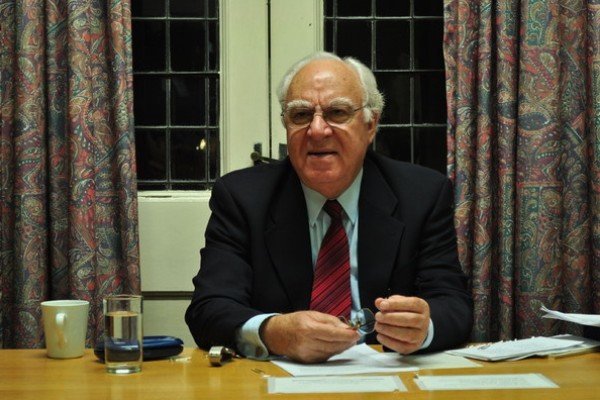
TEHRAN – Professor Farhang Jahanpour, part-time tutor on the Middle East in the Department of Continuing Education at the University of Oxford, tells the Tehran Times that “President Trump’s recent speech on Iran was the most belligerent speech by any U.S. president about Iran since the Iranian revolution.”

“As everybody knows, the Joint Comprehensive Plan of Action (JCPOA) was not a bilateral agreement between Iran and the United States,” Jahanpour tells the Tehran Times in an exclusive interview.

Following is the full text of the interview:


Q: President Trump has decertified the JCPOA. How important is this decision for the survival of the nuclear agreement?

A: President Trump’s recent speech on Iran was the most belligerent speech by any U.S. president about Iran since the Iranian revolution. However, its importance for undermining the nuclear agreement should not be exaggerated. As everybody knows, the Joint Comprehensive Plan of Action (JCPOA) was not a bilateral agreement between Iran and the United States. It was an international agreement between Iran and five permanent members of the Security Council, plus Germany, supported by the European Union and given the force of law by the Security Council Resolution 2231.

Therefore, one member of the agreement cannot unilaterally destroy it. As the EU High Representative for Foreign Affairs Federica Mogherini has rightly said: “The U.S. president has many powers, but this is not one of them.”

It should be pointed out that certification is not a part of the agreement, but an internal U.S. issue. That certification has no international validity. Trump has given a long list of contentious issues about Iran’s alleged malign influences in the region, but none of those issues has anything to do with the nuclear agreement. So Trump’s decertification of the deal will not kill it.

In the short time that he has been in power, Trump has reversed some of President Obama’s major domestic and international achievements.
Domestically, Trump has fallen out with American intelligence organizations, comparing them to the Nazis. He has attacked most of the media as “being the greatest enemy of the people” and producing fake news.

He has attacked “the so-called judges” for trying to block his unconstitutional executive order banning Muslim refugees or immigrants from seven Muslim-majority countries.

He scrapped the critical health care subsidies to hit Obamacare, while the bill that he sent to Congress was not approved.

In foreign policy, he has taken America out of the Paris Climate Accord, which is an agreement within the United Nations Framework Convention on Climate Change, which 195 members have signed and 168 members have already ratified.

He has taken the United States out of the Trans-Pacific Partnership, and on 11 October he announced that the U.S. would drop out of the North American Free Trade Agreement.

The United States and Israel announced that they would withdraw from UNESCO because of its alleged anti-Israeli bias.

However, despite all those major decisions, the sky has not fallen down and international agreements are continuing without the United States. All that he has achieved so far has been to isolate America in the international community.


Q: What were the reasons for his decertification of Iran’s compliance with the nuclear deal? What signal did he want to deliver by doing so?

A: Of course, the decertification of Iran’s compliance with the agreement does not make any sense, since Trump had twice certified it before, and nothing had changed during the intervening period. In fact, as recently as 14 September 2017, Trump waived certain sanctions against Iran as required under the terms of the deal.

During the campaign Trump often criticized the agreement as the worst agreement in history and promised that he would tear it up. In his inaugural address to the UN General Assembly, he called it as “an embarrassment to the United States.” So, by taking this step he wants to reassure his base that he is implementing at least one of his promises.

This decision comes at a time when his administration is in disarray, and when some of the leading figures in his own Republican Party have strongly criticised him. One of the most influential Republicans, the chairman of the Senate Foreign Relations Committee Bob Corker, in an interview with the New York Times said that Trump’s volatility could spark World War III. He added: “He would have to concern anyone who cares about our nation.”

He went on to say: “Look, except for a few people, the vast majority of our caucus understands what we’re dealing with here,” Corker continued. “Of course, they understand the volatility that we’re dealing with and the tremendous amount of work that it takes by people around him to keep him in the middle of the road.” This is very strong criticism by a senator who has to approve Trump’s foreign policy initiatives.

Internationally, the threat of terrorism in the Middle East has not yet ended, the U.S.-supported Saudi Arabia’s disastrous war against Yemen is still continuing killing and wounding scores of people in that poverty-stricken country every day, and above all Trump’s threat of “fire and fury the like of which the world has never seen” against North Korea and the promise that he would totally destroy that country have not worked and that dangerous standoff still continues. Therefore, I believe that his policy over Iran is a way of diverting attention from his growing failures.


Q: Has his policy received much domestic or international support? 

A: Many prominent U.S. officials, such as former presidential candidate Hillary Clinton, former Secretary of State John Kerry who negotiated the agreement, as well as some leading figures in his own administration, including Secretary of State, Secretary of Defense, and chairman of the Joint Chiefs of Staff have said that Iran had been compliant with the agreement and Trump should have certified it.

On the international arena, in addition to Russia and China that have strongly condemned Trump’s decision, some of America’s closest allies in Europe too have spoken openly against him.

As the former German ambassador to the United States Wolfgang Ischinger said, Trump’s decision “will show total disrespect for America’s allies.”

Shortly after Trump’s speech, in a joint statement the leaders of Britain, France, and Germany expressed alarm at Trump’s decision and reaffirmed their total commitment to the Iran deal. “Preserving the J.C.P.O.A. is in our shared national security interest,” Prime Minister Theresa May, President Emmanuel Macron, and Chancellor Angela Merkel said.

“The nuclear deal was the culmination of thirteen years of diplomacy and was a major step towards ensuring that Iran’s nuclear program is not diverted for military purposes.” They noted that the deal was “unanimously endorsed” by the U.N. Security Council, and appealed to the Administration and Congress to “consider the implications to the security of the United States and its allies before taking any steps that might undermine the J.C.P.O.A.”

This level of open opposition to the policies of U.S. president by his closest allies is unprecedented.


Q: It is believed that President Macron has said that it would be necessary to include some articles pertinent to human rights and missile issues within JCPOA. Is this a diversion from common European stance towards the agreement? 

A: No, this is a misreading of what President Macron said. Some of the deal’s critics have seized on Macron’s willingness to supplement the agreement by addressing ballistic missiles and extending the duration of some constraints on Iran’s nuclear program.

However, like leaders of all other P5+1 states, Macron has repeatedly emphasised the primary importance of preserving the JCPOA, but he has said that if there are other issues that the United States is concerned about, they could be discussed separately in a similar forum as 5+1.

That was in no way an endorsement of Trump’s policy. The JCPOA is not re-negotiable.


Q: In your view, how should Iran respond to that provocation? 

A: I believe that the Iranian response has been wise, measures and dignified. President Rouhani was absolutely correct to say: “Today the United States is more than ever isolated in its opposition to the nuclear deal and in its plots against the Iranian people. What was heard today was nothing but the repetition of baseless accusations and swear words that they have repeated for years.”

He said of Trump: “He has not studied international law. Can a president annul a multilateral international treaty on his own? Apparently he does not know that this agreement is not a bilateral agreement solely between Iran and the United States.”

The latest fuss shows that the nuclear agreement was very well negotiated by Iran in order to prevent a subsequent president being able to destroy it. Therefore, Iran should continue with the JCPOA by strengthening ties with Europe and other allies, regardless of Trump’s decision.


Professor Farhang Jahanpour is a former lecturer at the University of Cambridge and a Senior Research Fellow at Harvard. He is a tutor at the Department of Continuing Education and a member of Kellogg College at the University of Oxford and member of the TFF Board.

Related Posts

Johan Galtung 1930-2024October 2015 Published here on October 3, 2026 Let us focus on Civilization for conflict analysis and remedies. Major forms of disorder use violence; war is state organized violence. The most belligerent states are the United States of America and Israel, both with civilization roots. National Evangelism, the US Protestant Christian civilization– more national than evangelical–justifies US warfare as exceptionalism of a people chosen by God, with a manifest destiny to run the world. Orthodox Judaism justifies Israeli warfare to conquer and expand from Nile to Euphrates as a religious right and duty to the Eternal One. The third most belligerent country, the UK, no longer believes it is God-chosen but chosen by the USA; not quite the same but something. But the root cause of global disorder lies in the Occident–with Islam–seeing itself as the single, universal civilization valid for all at all times, all others being...
Jan ObergPhD, director, The Transnational Foundation for Peace and Future Research, TFFLund, Sweden October 2, 2026 This is my full original manuscript. The Chinese Academy of Social Science, CASS, makes two publications out if it. 1. China’s Five-year plan emphasized the capabilities of basic research and original innovation. It is regarded as the goal of the future social development, which, as required, should be significantly enhanced. Can you comment on the importance of original innovation in research and academic study? I believe it is easier to define “original innovation” in the natural sciences than in social sciences. The breaking points of what constitutes something new, or innovative, are not quite as sharp in the latter. But in both fields it is about opening up something that was closed, unseen, unexplored before – making manifest what was earlier latent. Innovations come in many forms and shapes – naming something that was not...
The agreement is catastrophic both because of what it says and what it doesn’t mention. It reduces further the major asset of security policies: Freedom of action. Jan Oberg TFF director September 25, 2026 A couple of hours before the agreement was signed on September 22, 2026, I published the following 13 hypotheses about what it would most likely contain on TFF Substack (in English). I was wrong on only the first point. Contrary to what Trump had written on his Truth Social platform, it does not appear to come into force immediately. In fact, it turned out to be worse than even I had anticipated. After these hypotheses now come a number of reflections in light of what the agreement actually contains, and does not contain, as well as the way in which it has generally been presented by major media outlets and by the public-service broadcaster DR. My...

Recent Articles

Tony Robinson October 4, 2026 Violence is easy to recognise when someone is being beaten, shot or killed. It becomes more difficult when nobody is holding a weapon. Poverty, discrimination, exploitation and repression can restrict a human life just as effectively, although they do so in very different ways and with very different consequences. Simply adding more categories to an ever-growing list of forms of violence does not really solve the problem. The more interesting question is what all these different situations have in common and why it makes sense to describe them using the same word. Human beings do not simply react to what happens around them. They remember the past, imagine things that do not yet exist, make plans and undertake projects. Workers organise because they imagine different working conditions; people migrate because they imagine another life somewhere else; social movements emerge because people refuse to accept the...
It’s a matter of principles, courage, vision and pulling together – while the militarist world is falling apart… Peter Langille October 3, 2026 “Here, then, is the problem which we present to you, stark and dreadful and inescapable: Shall we put an end to the human race; or shall mankind renounce war?”The Bertrand Russell—Albert Einstein Manifesto, July 9, 1955 ⁕ The forecast for what’s ahead is worrisome. The sharp rise in armed conflicts over the past three years is adding to what was already the highest level in over seventy years. Genocides, which should be prevented are supported. A shared climate emergency that jeopardises survival is ignored. Diverse polls now suggest that people are war-weary, worried and interested in a more effective United Nations. And, there are viable policy options for a more secure world! Yet governments are doubling-down, betting on more war and investing heavily. If current trends persist,...
Johan Galtung 1930-2024October 2015 Published here on October 3, 2026 Let us focus on Civilization for conflict analysis and remedies. Major forms of disorder use violence; war is state organized violence. The most belligerent states are the United States of America and Israel, both with civilization roots. National Evangelism, the US Protestant Christian civilization– more national than evangelical–justifies US warfare as exceptionalism of a people chosen by God, with a manifest destiny to run the world. Orthodox Judaism justifies Israeli warfare to conquer and expand from Nile to Euphrates as a religious right and duty to the Eternal One. The third most belligerent country, the UK, no longer believes it is God-chosen but chosen by the USA; not quite the same but something. But the root cause of global disorder lies in the Occident–with Islam–seeing itself as the single, universal civilization valid for all at all times, all others being...

TFF on Substack

Discover and subscribe to more peace materials on TFF Substack

Most Popular

Tony Robinson October 4, 2026 Violence is easy to recognise when someone is being beaten, shot or killed. It becomes more difficult when nobody is holding a weapon. Poverty, discrimination, exploitation and repression can restrict a human life just as effectively, although they do so in very different ways and with very different consequences. Simply adding more categories to an ever-growing list of forms of violence does not really solve the problem. The more interesting question is what all these different situations have in common and why it makes sense to describe them using the same word. Human beings do not simply react to what happens around them. They remember the past, imagine things that do not yet exist, make plans and undertake projects. Workers organise because they imagine different working conditions; people migrate because they imagine another life somewhere else; social movements emerge because people refuse to accept the...
It’s a matter of principles, courage, vision and pulling together – while the militarist world is falling apart… Peter Langille October 3, 2026 “Here, then, is the problem which we present to you, stark and dreadful and inescapable: Shall we put an end to the human race; or shall mankind renounce war?”The Bertrand Russell—Albert Einstein Manifesto, July 9, 1955 ⁕ The forecast for what’s ahead is worrisome. The sharp rise in armed conflicts over the past three years is adding to what was already the highest level in over seventy years. Genocides, which should be prevented are supported. A shared climate emergency that jeopardises survival is ignored. Diverse polls now suggest that people are war-weary, worried and interested in a more effective United Nations. And, there are viable policy options for a more secure world! Yet governments are doubling-down, betting on more war and investing heavily. If current trends persist,...
Johan Galtung 1930-2024October 2015 Published here on October 3, 2026 Let us focus on Civilization for conflict analysis and remedies. Major forms of disorder use violence; war is state organized violence. The most belligerent states are the United States of America and Israel, both with civilization roots. National Evangelism, the US Protestant Christian civilization– more national than evangelical–justifies US warfare as exceptionalism of a people chosen by God, with a manifest destiny to run the world. Orthodox Judaism justifies Israeli warfare to conquer and expand from Nile to Euphrates as a religious right and duty to the Eternal One. The third most belligerent country, the UK, no longer believes it is God-chosen but chosen by the USA; not quite the same but something. But the root cause of global disorder lies in the Occident–with Islam–seeing itself as the single, universal civilization valid for all at all times, all others being...
Read More
Living-Peace-Sign-Budapest-copy
Tony Robinson October 4, 2026 Violence is easy to recognise when someone is being beaten, shot or killed. It becomes more difficult when nobody is holding a weapon. Poverty, discrimination, exploitation and repression can restrict a human life just as effectively, although they do so in very different ways and with very different consequences. Simply adding more categories to an ever-growing list of forms of violence does not really solve the problem. The more interesting question is what all these different situations have in common and why it makes sense to describe them using the same word. Human beings do not simply react to what happens around them. They remember the past, imagine things that do not yet exist, make plans and undertake projects. Workers organise because they imagine different working conditions; people migrate because they imagine another life somewhere else; social movements emerge because people refuse to accept the...
b54a1f10-8c65-4f0b-9dd5-4abc0a7d04cc_2659x2659
It’s a matter of principles, courage, vision and pulling together – while the militarist world is falling apart… Peter Langille October 3, 2026 “Here, then, is the problem which we present to you, stark and dreadful and inescapable: Shall we put an end to the human race; or shall mankind renounce war?”The Bertrand Russell—Albert Einstein Manifesto, July 9, 1955 ⁕ The forecast for what’s ahead is worrisome. The sharp rise in armed conflicts over the past three years is adding to what was already the highest level in over seventy years. Genocides, which should be prevented are supported. A shared climate emergency that jeopardises survival is ignored. Diverse polls now suggest that people are war-weary, worried and interested in a more effective United Nations. And, there are viable policy options for a more secure world! Yet governments are doubling-down, betting on more war and investing heavily. If current trends persist,...
010
Johan Galtung 1930-2024October 2015 Published here on October 3, 2026 Let us focus on Civilization for conflict analysis and remedies. Major forms of disorder use violence; war is state organized violence. The most belligerent states are the United States of America and Israel, both with civilization roots. National Evangelism, the US Protestant Christian civilization– more national than evangelical–justifies US warfare as exceptionalism of a people chosen by God, with a manifest destiny to run the world. Orthodox Judaism justifies Israeli warfare to conquer and expand from Nile to Euphrates as a religious right and duty to the Eternal One. The third most belligerent country, the UK, no longer believes it is God-chosen but chosen by the USA; not quite the same but something. But the root cause of global disorder lies in the Occident–with Islam–seeing itself as the single, universal civilization valid for all at all times, all others being...
Screenshot 2026-10-02 011738
Jan ObergPhD, director, The Transnational Foundation for Peace and Future Research, TFFLund, Sweden October 2, 2026 This is my full original manuscript. The Chinese Academy of Social Science, CASS, makes two publications out if it. 1. China’s Five-year plan emphasized the capabilities of basic research and original innovation. It is regarded as the goal of the future social development, which, as required, should be significantly enhanced. Can you comment on the importance of original innovation in research and academic study? I believe it is easier to define “original innovation” in the natural sciences than in social sciences. The breaking points of what constitutes something new, or innovative, are not quite as sharp in the latter. But in both fields it is about opening up something that was closed, unseen, unexplored before – making manifest what was earlier latent. Innovations come in many forms and shapes – naming something that was not...
arctic-circle-map
The agreement is catastrophic both because of what it says and what it doesn’t mention. It reduces further the major asset of security policies: Freedom of action. Jan Oberg TFF director September 25, 2026 A couple of hours before the agreement was signed on September 22, 2026, I published the following 13 hypotheses about what it would most likely contain on TFF Substack (in English). I was wrong on only the first point. Contrary to what Trump had written on his Truth Social platform, it does not appear to come into force immediately. In fact, it turned out to be worse than even I had anticipated. After these hypotheses now come a number of reflections in light of what the agreement actually contains, and does not contain, as well as the way in which it has generally been presented by major media outlets and by the public-service broadcaster DR. My...
girl-5894831_1280
Below are TFF-related media mentions, comments, videos and social media posts published elsewhere but not on this homepage. We happen to catch and list only a fraction. Regarding video comments and debates, we recommend that you go to the TFF Video Channel on Substack where many of them are reproduced. Jan Oberg is a contributor to China Daily – 52 million daily clicks – and Global Times, CGTN and CCTV (the national television), China Investment, Xinhua News Agency and several others. Articles and videos on these media very often multiply into countless Chinese (and Western media) that re-post them from these main media. Thanks to The China Academy, his analyses, interviews and comments are frequently posted on YouTube channels such as Thinkers Forum and Wave Media. These videos are often re-posted on Bilibili (China’s YouTube), the China Content Center on TikTok, and on the Chinese edition of TikTok, Douyin.com. This means reaching hundreds of millions of viewers worldwide over a year. While there are too many to catch on all these...




