
EU countries in tough spot with U.S. demands on the nuclear deal with Iran, the JCPOA

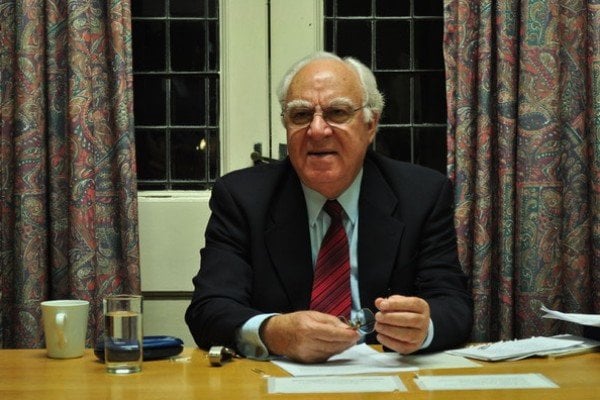
TEHRAN – Farhang Jahanpour, an adjunct professor in the Department of Continuing Education at the University of Oxford and a Middle East expert, says that all other signatories to the JCPOA, including the European Troika (the UK, France and Germany) have stated that they are for the nuclear accord, since Iran has remained committed to the deal. (JCPOA = Joint Comprehensive Plan of Action = the deal about nuclear technology between Iran and the five UN Security Council members + Germany + EU. You can read it here.)

“Nevertheless, EU countries are in a difficult position with the American demands,” Jahanpour tells the Tehran Times in an exclusive interview.

Jahanpour, also a former senior research fellow at Harvard University and TFF Board member, says that Europe is playing a double game with Iran.

“On the one hand, they [European countries] have stated openly that they support the JCPOA and have advised the U.S. to do the same. On the other hand, the Trump Administration is very critical of that agreement and has called on its European allies to fix it, so that President Trump can waive the sanctions.”

Following is the full text of the interview with Professor Farhang Jahanpour:

Q: Newly-leaked documents of the U.S. State Department show that the stance of the U.S. government towards the Iran nuclear deal has softened somewhat. According to these documents, the U.S. has outlined a course of action in which three European countries, Britain, France and Germany, would be “totally committed to improving” the Joint Comprehensive Plan of Action (JCPOA). In return, President Trump would extend Iran sanctions relief, keeping the Obama-era nuclear deal alive.  What does this mean exactly?

A: I believe that one cannot rely too much on leaked documents, especially as the openly-stated stances of most U.S. officials are very hostile towards Iran. What one can say is that there is some disagreement among various U.S. officials about how to deal with the nuclear agreement. Many senior U.S. officials believe that as the JCPOA is an international agreement that has also been endorsed by the EU and the Security Council, it would be wrong for America to violate it, as no country would any longer trust any agreement reached with the United States.

In a panel discussion at the recent Munich Security Conference in Germany, the former Secretary of State John Kerry spoke eloquently about the false statements that are made regarding the nuclear agreement. He stressed that there are no sunset clauses, that even after an initial period when Iran has agreed to stop  enrichment activities, as a confidence-building measure Iran would still remain a member of the NPT, and as Iran has also joined the Additional Protocol it will remain under stringent inspection by the International Atomic Energy Agency, like other NPT members. Therefore, the propaganda against the nuclear agreement is not well founded.


Q:  Citing a senior U.S. official, Reuters has reported that there was some hope to “Fix the Iran Deal” by reaching an agreement on modifying some of the JCPOA’s contents, endorsing a supplementary agreement or referring it to the UN Security Council. If European countries accept U.S. demands, is there a possibility that nuclear talks with Iran, Russia and China will resume?

A: All other signatories to the JCPOA, including the European Troika (UK, France and Germany) have stated repeatedly that they are in favour of honouring the agreement, especially as Iran has complied fully with all commitments. Nevertheless, EU countries are in a difficult position vis-à-vis the American demands. On the one hand, they have stated openly that they support the JCPOA and have advised the U.S. to do the same. On the other hand, the Trump Administration is very critical of that agreement and has called on its European allies to fix it, so that President Trump can waive the sanctions.

The point is that even if the EU were to join the United States to undermine the agreement, China and Russia would continue to support it. So, the three EU countries are between a rock and a hard place. On the one hand, they wish to protect this international agreement, while on the other hand, if they ultimately have to choose between Iran and the United States, they would have to opt for America.

However, as Iranian Deputy Foreign Minister Abbas Araghchi said in a speech at Chatham House in London on 22 February 2018 and in a long interview with the BBC, the reason why EU countries wish to abide by the agreement is not merely for economic reasons, but it is mainly due to the fact that this is the best and the strictest non-proliferation agreement reached between the West and any country, and it can serve as a blueprint for future agreements with other countries that want to develop nuclear energy. He added that the violation of this agreement would mean the belittling of an international agreement, which would erode trust between countries.

He further said that Iran will withdraw from the nuclear deal if there is no economic benefit and if major banks continue to shun dealing with Iran. The whole point about the agreement was that Iran would accept major restrictions on her nuclear programme in return for the lifting of the sanctions and reaping its economic benefits, but big banks have continued to stay away for fear of falling foul of remaining U.S. sanctions. This is against both the letter and the spirit of the agreement.


Q:   Some believe that there are three possible solutions to the Iran deal: 1. Modifying the current agreement, 2. Holding talks to reach a supplementary agreement, or 3. Following up with a new Security Council Resolution in order to add new changes. In your opinion, which one of these options is the most likely outcome?

A: Iranian officials have stated strongly that they are against any modification to this agreement or any supplementary agreement, because this is a complex agreement that was reached after many years of intense talks between Iran and the P5+1, with the help of some of the greatest experts from Iran and the West. If you try to amend it and change any part of it, the whole agreement would unravel. There really is no quick fix approach to the nuclear agreement.
When one listens to U.S. critics of the nuclear deal, it is clear that their objection is not precisely to the clauses of the agreement, but that they are unhappy about a whole host of other issues, including Iran’s missile programme and what they call Iran’s “behaviour” in the region. These are separate issues and should be addressed separately.

Iranian Foreign Minister Mr. Zarif has repeatedly said that the nuclear deal was supposed to serve as a base for future agreements and not as a ceiling. However, if Iran were to take part in new talks on other issues the most important requirement would be that Iran should be able to trust the other side. The violation of the JCPOA has greatly eroded trust in the West, and there is a need for a new approach and a restoration of trust.


Q: So, what kind of agreement do you think can resolve the issue?

A: As everyone knows, the entire Middle East is like a tinderbox. Most Middle Eastern countries have suffered enormously as the result of foreign invasions or civil wars during the past few decades. The problems in Afghanistan, Iraq, Libya, Syria and Yemen have not been resolved and there is a danger of new wars between Israel and her neighbours while the conflict between Israel and the Palestinians is still unresolved.

Under these circumstances, any true statesman should try to resolve some of these problems and bring calm to the Middle East, while also respecting the national interests of different countries. Instability in the region will not only affect the Middle East but will cause major problems for Europe and beyond. The present course of action will only lead to a regional war that might develop into a global war.

Therefore, all major powers and especially the United Nations should try to find a regional solution that will prevent a global conflict. It should be clear to all the regional countries that no one country can rule the region, and that even the hegemony of the superpowers is coming to an end.

The Middle East needs a regional security pact that would bring all the countries together in order to resolve their differences through dialogue and compromise, rather than through the use of force. None of the conflicts in the region has a military solution.

It would be better for the United States to join the EU, Russia and China and the countries in the Middle East to establish, if not an actual union, at least some form of compromise enabling them to concentrate on peace and reconstruction rather than on new conflicts. When the French foreign minister visits Iran in March, Iranian officials should stress the need for a comprehensive regional agreement, rather than tampering with the JCPOA.

Originally published by Tehran Times

Related Posts

Johan Galtung 1930-2024October 2015 Published here on October 3, 2026 Let us focus on Civilization for conflict analysis and remedies. Major forms of disorder use violence; war is state organized violence. The most belligerent states are the United States of America and Israel, both with civilization roots. National Evangelism, the US Protestant Christian civilization– more national than evangelical–justifies US warfare as exceptionalism of a people chosen by God, with a manifest destiny to run the world. Orthodox Judaism justifies Israeli warfare to conquer and expand from Nile to Euphrates as a religious right and duty to the Eternal One. The third most belligerent country, the UK, no longer believes it is God-chosen but chosen by the USA; not quite the same but something. But the root cause of global disorder lies in the Occident–with Islam–seeing itself as the single, universal civilization valid for all at all times, all others being...
Jan ObergPhD, director, The Transnational Foundation for Peace and Future Research, TFFLund, Sweden October 2, 2026 This is my full original manuscript. The Chinese Academy of Social Science, CASS, makes two publications out if it. 1. China’s Five-year plan emphasized the capabilities of basic research and original innovation. It is regarded as the goal of the future social development, which, as required, should be significantly enhanced. Can you comment on the importance of original innovation in research and academic study? I believe it is easier to define “original innovation” in the natural sciences than in social sciences. The breaking points of what constitutes something new, or innovative, are not quite as sharp in the latter. But in both fields it is about opening up something that was closed, unseen, unexplored before – making manifest what was earlier latent. Innovations come in many forms and shapes – naming something that was not...
The agreement is catastrophic both because of what it says and what it doesn’t mention. It reduces further the major asset of security policies: Freedom of action. Jan Oberg TFF director September 25, 2026 A couple of hours before the agreement was signed on September 22, 2026, I published the following 13 hypotheses about what it would most likely contain on TFF Substack (in English). I was wrong on only the first point. Contrary to what Trump had written on his Truth Social platform, it does not appear to come into force immediately. In fact, it turned out to be worse than even I had anticipated. After these hypotheses now come a number of reflections in light of what the agreement actually contains, and does not contain, as well as the way in which it has generally been presented by major media outlets and by the public-service broadcaster DR. My...

Recent Articles

Tony Robinson October 4, 2026 Violence is easy to recognise when someone is being beaten, shot or killed. It becomes more difficult when nobody is holding a weapon. Poverty, discrimination, exploitation and repression can restrict a human life just as effectively, although they do so in very different ways and with very different consequences. Simply adding more categories to an ever-growing list of forms of violence does not really solve the problem. The more interesting question is what all these different situations have in common and why it makes sense to describe them using the same word. Human beings do not simply react to what happens around them. They remember the past, imagine things that do not yet exist, make plans and undertake projects. Workers organise because they imagine different working conditions; people migrate because they imagine another life somewhere else; social movements emerge because people refuse to accept the...
It’s a matter of principles, courage, vision and pulling together – while the militarist world is falling apart… Peter Langille October 3, 2026 “Here, then, is the problem which we present to you, stark and dreadful and inescapable: Shall we put an end to the human race; or shall mankind renounce war?”The Bertrand Russell—Albert Einstein Manifesto, July 9, 1955 ⁕ The forecast for what’s ahead is worrisome. The sharp rise in armed conflicts over the past three years is adding to what was already the highest level in over seventy years. Genocides, which should be prevented are supported. A shared climate emergency that jeopardises survival is ignored. Diverse polls now suggest that people are war-weary, worried and interested in a more effective United Nations. And, there are viable policy options for a more secure world! Yet governments are doubling-down, betting on more war and investing heavily. If current trends persist,...
Johan Galtung 1930-2024October 2015 Published here on October 3, 2026 Let us focus on Civilization for conflict analysis and remedies. Major forms of disorder use violence; war is state organized violence. The most belligerent states are the United States of America and Israel, both with civilization roots. National Evangelism, the US Protestant Christian civilization– more national than evangelical–justifies US warfare as exceptionalism of a people chosen by God, with a manifest destiny to run the world. Orthodox Judaism justifies Israeli warfare to conquer and expand from Nile to Euphrates as a religious right and duty to the Eternal One. The third most belligerent country, the UK, no longer believes it is God-chosen but chosen by the USA; not quite the same but something. But the root cause of global disorder lies in the Occident–with Islam–seeing itself as the single, universal civilization valid for all at all times, all others being...

TFF on Substack

Discover and subscribe to more peace materials on TFF Substack

Most Popular

Tony Robinson October 4, 2026 Violence is easy to recognise when someone is being beaten, shot or killed. It becomes more difficult when nobody is holding a weapon. Poverty, discrimination, exploitation and repression can restrict a human life just as effectively, although they do so in very different ways and with very different consequences. Simply adding more categories to an ever-growing list of forms of violence does not really solve the problem. The more interesting question is what all these different situations have in common and why it makes sense to describe them using the same word. Human beings do not simply react to what happens around them. They remember the past, imagine things that do not yet exist, make plans and undertake projects. Workers organise because they imagine different working conditions; people migrate because they imagine another life somewhere else; social movements emerge because people refuse to accept the...
It’s a matter of principles, courage, vision and pulling together – while the militarist world is falling apart… Peter Langille October 3, 2026 “Here, then, is the problem which we present to you, stark and dreadful and inescapable: Shall we put an end to the human race; or shall mankind renounce war?”The Bertrand Russell—Albert Einstein Manifesto, July 9, 1955 ⁕ The forecast for what’s ahead is worrisome. The sharp rise in armed conflicts over the past three years is adding to what was already the highest level in over seventy years. Genocides, which should be prevented are supported. A shared climate emergency that jeopardises survival is ignored. Diverse polls now suggest that people are war-weary, worried and interested in a more effective United Nations. And, there are viable policy options for a more secure world! Yet governments are doubling-down, betting on more war and investing heavily. If current trends persist,...
Johan Galtung 1930-2024October 2015 Published here on October 3, 2026 Let us focus on Civilization for conflict analysis and remedies. Major forms of disorder use violence; war is state organized violence. The most belligerent states are the United States of America and Israel, both with civilization roots. National Evangelism, the US Protestant Christian civilization– more national than evangelical–justifies US warfare as exceptionalism of a people chosen by God, with a manifest destiny to run the world. Orthodox Judaism justifies Israeli warfare to conquer and expand from Nile to Euphrates as a religious right and duty to the Eternal One. The third most belligerent country, the UK, no longer believes it is God-chosen but chosen by the USA; not quite the same but something. But the root cause of global disorder lies in the Occident–with Islam–seeing itself as the single, universal civilization valid for all at all times, all others being...
Read More
Living-Peace-Sign-Budapest-copy
Tony Robinson October 4, 2026 Violence is easy to recognise when someone is being beaten, shot or killed. It becomes more difficult when nobody is holding a weapon. Poverty, discrimination, exploitation and repression can restrict a human life just as effectively, although they do so in very different ways and with very different consequences. Simply adding more categories to an ever-growing list of forms of violence does not really solve the problem. The more interesting question is what all these different situations have in common and why it makes sense to describe them using the same word. Human beings do not simply react to what happens around them. They remember the past, imagine things that do not yet exist, make plans and undertake projects. Workers organise because they imagine different working conditions; people migrate because they imagine another life somewhere else; social movements emerge because people refuse to accept the...
b54a1f10-8c65-4f0b-9dd5-4abc0a7d04cc_2659x2659
It’s a matter of principles, courage, vision and pulling together – while the militarist world is falling apart… Peter Langille October 3, 2026 “Here, then, is the problem which we present to you, stark and dreadful and inescapable: Shall we put an end to the human race; or shall mankind renounce war?”The Bertrand Russell—Albert Einstein Manifesto, July 9, 1955 ⁕ The forecast for what’s ahead is worrisome. The sharp rise in armed conflicts over the past three years is adding to what was already the highest level in over seventy years. Genocides, which should be prevented are supported. A shared climate emergency that jeopardises survival is ignored. Diverse polls now suggest that people are war-weary, worried and interested in a more effective United Nations. And, there are viable policy options for a more secure world! Yet governments are doubling-down, betting on more war and investing heavily. If current trends persist,...
010
Johan Galtung 1930-2024October 2015 Published here on October 3, 2026 Let us focus on Civilization for conflict analysis and remedies. Major forms of disorder use violence; war is state organized violence. The most belligerent states are the United States of America and Israel, both with civilization roots. National Evangelism, the US Protestant Christian civilization– more national than evangelical–justifies US warfare as exceptionalism of a people chosen by God, with a manifest destiny to run the world. Orthodox Judaism justifies Israeli warfare to conquer and expand from Nile to Euphrates as a religious right and duty to the Eternal One. The third most belligerent country, the UK, no longer believes it is God-chosen but chosen by the USA; not quite the same but something. But the root cause of global disorder lies in the Occident–with Islam–seeing itself as the single, universal civilization valid for all at all times, all others being...
Screenshot 2026-10-02 011738
Jan ObergPhD, director, The Transnational Foundation for Peace and Future Research, TFFLund, Sweden October 2, 2026 This is my full original manuscript. The Chinese Academy of Social Science, CASS, makes two publications out if it. 1. China’s Five-year plan emphasized the capabilities of basic research and original innovation. It is regarded as the goal of the future social development, which, as required, should be significantly enhanced. Can you comment on the importance of original innovation in research and academic study? I believe it is easier to define “original innovation” in the natural sciences than in social sciences. The breaking points of what constitutes something new, or innovative, are not quite as sharp in the latter. But in both fields it is about opening up something that was closed, unseen, unexplored before – making manifest what was earlier latent. Innovations come in many forms and shapes – naming something that was not...
arctic-circle-map
The agreement is catastrophic both because of what it says and what it doesn’t mention. It reduces further the major asset of security policies: Freedom of action. Jan Oberg TFF director September 25, 2026 A couple of hours before the agreement was signed on September 22, 2026, I published the following 13 hypotheses about what it would most likely contain on TFF Substack (in English). I was wrong on only the first point. Contrary to what Trump had written on his Truth Social platform, it does not appear to come into force immediately. In fact, it turned out to be worse than even I had anticipated. After these hypotheses now come a number of reflections in light of what the agreement actually contains, and does not contain, as well as the way in which it has generally been presented by major media outlets and by the public-service broadcaster DR. My...
girl-5894831_1280
Below are TFF-related media mentions, comments, videos and social media posts published elsewhere but not on this homepage. We happen to catch and list only a fraction. Regarding video comments and debates, we recommend that you go to the TFF Video Channel on Substack where many of them are reproduced. Jan Oberg is a contributor to China Daily – 52 million daily clicks – and Global Times, CGTN and CCTV (the national television), China Investment, Xinhua News Agency and several others. Articles and videos on these media very often multiply into countless Chinese (and Western media) that re-post them from these main media. Thanks to The China Academy, his analyses, interviews and comments are frequently posted on YouTube channels such as Thinkers Forum and Wave Media. These videos are often re-posted on Bilibili (China’s YouTube), the China Content Center on TikTok, and on the Chinese edition of TikTok, Douyin.com. This means reaching hundreds of millions of viewers worldwide over a year. While there are too many to catch on all these...




