TFF Associate

Med den uttalade avsikten att underminera Vladimir Putins ställning i Ryssland har Natostaterna och övriga EUstater systematiskt förtigit Kievregimens vägran att följa de avtal den själv skrivit under.

Istället har Ryssland anklagats för dubbelspel och erövrarambitioner. Utvecklingen ser ut så här*:

1. Ukraina förhandlar med EU om ekonomiskt samarbete, vilket skulle innebära att bryta samarbetet med Ryssland. När president Janukovitj av sina ekonomer fick veta vad detta skulle kosta landet, avstod han från att underteckna det framförhandlade EU-avtalet.

2. Detta utlöste Maidanprotesterna, från grupper i västra Ukraina, vilka länge velat ansluta landet västerut. Dessutom deltog Janukovitjanhängare. Skottlossning utbröt från hus omkring torget, med okända skyttar. Detta tolkades som Janukovitjs ansvar.

3. Janukovic och Maidanledarna framförhandlade 21 feb 2014, tillsammans med Frankrikes, Tysklands och Polens utrikesministrar och en representant för Ryssland ett avtal, som gick ut på följande: a. Ömsesidig demobilisering av väpnade grupper.
b. Omedelbart arbete med författningsändringar, först för att begränsa presidentens befogenheter (som tidigare hänt efter den orangea revolutionen 2004).
c. Förhandling av ny författning att antas senast i december 2014.
d. Presidentval ska hållas i december genast efter att författningen antagits.
e. En nationell enhetsregering från båda sidor ska verka fram till valet i december 2014.

4. Underskrifterna på detta avtal ratificerades av Majdanrådet men avvisades av de hårdföra högeraktivisterna, som krävde omedelbar (lagstridig) avsättning av presidenten och förbud mot de två politiska partierna i östra Ukraina, d v s eliminering av den östliga politiska eliten.

5. Den 22 februari grep högerextremisterna makten och avsatte Janukovic som flydde till Ryssland.

6. Västmakterna hade inget att invända mot kuppen, trots att tre ministrar från EU framförhandlat och skrivit undet avtalet föregående dag. Ryssland krävde däremot att avtalet skulle gälla och en ny författning utarbetas. Fick inget stöd från Väst.

7. I mars utropar Krim självständighet från Ukraina, anordnar en folkomröstning på någon vecka och får 90-procentigt stöd för att ingå union med Ryssland. Ryska trupper från flottbasen i Sevastopol höll ukrainsk trupp på avstånd. Processen kallas rysk annektering, men har djupa rötter i historien. Krim har länge förr varit ryskt, och folket känner sig som ryssar. När Ukraina tycktes gå mot väst och bort från Ryssland ville de inte vara med. Ryssland såg en risk att flottbasen plötsligt skulle hamna i ett Natoland genom sveket från Väst (se ovan). Väst har i tysthet godtagit detta, men använder Krim som argument om rysk expansion.

8. Majdanrörelsens nya regering med starkt inslag av högerextremister centraliserar makten av misstro mot ryskt inflytande i öster. Tjänstemän där avskedades och byttes mot västukrainska. Guvernören i Charkov, Michail Dobkin avskedades och åtalades 2 mars för separatism. Två affärsmän från västukraina, Kolomojskij och Taruta blev guvernörer i Dnjepropetrovsk och Donetsk.

9. Östra provinsernas krav på ökat självstyre stöddes av Ryssland. Väst tolkade detta i april som ”rysk aggression”.

10. Förhandlingar startade i april. Lavrov och Kerry skrev ett gemensamt uttalande i Geneve den 17 april, undertecknat av Rysslands, USAs och Ukrainas utrikesministrar. Frågan om författningsreform återupplivades med detta innehåll: En bred nationell dialog ska startas under medverkan från allmänheten i hela landet. Avtalet 21 feb återspeglas, nu fördjupat till relationen mellan centrum och regionerna. Önskemålet i öster var inte självständighet utan ”federalisering”. Väst drev inte denna fråga, trots underskrifterna.

11. Kievregimen förbjöd de östliga partierna och fortsatte rensa ut lokala tjänstemän.

12. Kommentarerna från väst negligerade Geneveuttalandet och Kievs fortsatta centralisering gentemot östukraina. Istället krävde Västmakterna en total avväpning i östra Ukraina. Geneveuttalandet blev helt förvrängt.

13. OSSE inbjöds att övervaka östra regionerna, även på ryskt område, för att förhindra rysk infiltration av militär och för att arbeta diplomatiskt.

14. Kievregimen talar om att ”krossa terroristerna i Öst” och ”de ryska agenterna”. Detta bröt mot Geneveuttalandets krav på att avstå från våld och hot. Detta passerade okommenterat i Väst, som konsekvent feltolkat uttalandet och åtgärdernas tidsföljd.

15. Kiev attackerar östra provinserna i april 2014. Upptrappning i maj och juni.

16. 2 maj: branden i fackföreningarnas hus i Odessa. 9 maj besköt Kievs militär segerdagens demonstranter i Mariupol i östra Ukraina.

17. Mot Rysslands avrådan anordnade protestledarna i öst den 11 maj en folkomröstning som tycktes stödja separation från Ukraina. I slutet av maj befann sig östra regionerna i krigstillstånd.

18. Samtidigt genomförde Kievregimen ett presidentval 25 maj i de västra delarna för att ge sig själv legitimitet. Kommentarerna från Väst talade endast om huruvida Ryssland skulle störa valet! Porosjenko valdes, och avvisades av östra delen av landet, som inte deltagit.

Michail Dobkins kandidatur saboterades effektivt.

19. Ett möte i Normandie 4 juni med Hollande och Merkel presenterade Porosjenkos fredsplan, inledd med vapenvila i 14 dagar. Planens ”decentralisering” betydde bara ”lokala styrelser och försvar av ryska språket”. Guvernörer skulle utnämnas av Porosjenko själv. Plus en serie tvingande krav på protestledarna i öst. Ett ultimatum. 30 juni bröt Porosjenko sin egen vapenvila innan hans plan ens diskuterats. Regelrätt krig inleddes.

20. Västmakterna lät detta ske. 2 juli sammankallade tyske utrikesministern möte mellan ryske och ukrainske utrikesministrarna, som gjorde ett uttalande om nya möten senast 5 juli för att nå hållbar vapenvila. Ukrainas regering nonchalerade uttalandet utan protest från västmakterna som därmed förverkade sin möjlighet att påverka diplomatin.

21. Ukrainas armé led förödande nederlag och ekonomin bröt samman. Inget militärt stöd beviljades från Väst.

22. Den 5 och 19 september hölls förhandlingar i Minsk. Resultat den 5: Minskprotollet, den 19e: Memorandum. Ryska idéer främst från Putin, som gett upp hoppet om Väst. Militärt stöd till upproret i öst började i juli som svar på Kievs offensiv 30 juni. Ryssland sade tydligt nej till upprorsledarnas önskan om självständighet från Ukraina och hävdade den överenskomna författningsreformen för ökat självstyre. Ryssland avstod från underskrift som förhandlare och ville endast agera fredsmäklare genom sina förslag. Protokollet anger närvaro av Normandiegruppen som ”kontaktgrupp” och låtsas vara till för Porosjenkos fredsplan, vilken i praktiken helt upphävs. Paragraf 3 anger att bevilja rebellområdena i Donbass en särställning med lokalt självstyre. Parlamentet godtog lagar även enligt paragraf 7, som återupplivade beslutet om nationell dialog syftande till författningsändring enligt folkets synpunkter.

23. Allt förkastades senare av det nya parlament som valdes i november. Kiev vägrar helt att träffa rebelledarna. Allt lämnades okommenterat av västmakterna. Inget tryck på Kiev.

24. Väst inriktar sig endast på paragraf 4, som uppmanar till permanent övervakning av ukrainsk-ryska gränsen och verifiering av OSSE och skapandet av en säkerhetszon i gränsområdet tillsammans med avhysning av all utländsk militär från Ukraina. Väst ser inte helheten som syftar att bygga förtroende för HELA processen.

I själva verket har OSSE inte inrapporterat några trupprörelser över gränsen.

25. Rebellstyrkorna respekterade vapenvilan medan Kiev underlät dra tillbaka sina tunga vapen och förstärkte sina trupper inför nästa offensiv i januari 2015. (Bröt paragraferna 4-6 i memorandum av 19 sept.) Ingen kritik från Väst. Putin kallade Kievs armé en Natoarmé.

26. Vinterkriget resulterade i ett stort nederlag för Ukrainas armé vid Donetsk flygplats i slutet av januari och i Debaltsevo i mitten av februari.

27. Minskprocessen återupptogs med tysk och fransk medverkan efter ett möte i Moskva mellan Hollande, Merkel och Putin. Nya förhandlingar i Minsk den 11 och 12 februari, med Porosjenko och Lukasjenko liksom rebellmilisen närvarande. (Porosjenko vägrade träffa den sistnämnda) Ett Memorandum undertecknades, på ryska förslag. Där återupprepas avtalet i Minsk I med betydande skärpning av villkoren. Kiev tvangs dra sig tillbaka från kontaktlinjen före nederlaget och ovillkorligt samråda med ledarna i östra Ukraina om villkoren för östs särskilda status och för de val som ska hållas där. Lagen ska träda i kraft före utgången av mars. En bilaga preciserar minimikrav på självstyre, amnesti för rebelledare, erkännande av rebellmilisen som legal polisstyrka och förbud för Kiev att hindra lokala valresultat. Den nya författningen ska avtalas före slutet av december 2015. (paragraf 11).

28. Dessutom finns muntliga avtal mellan Putin och Merkel (i der Spiegel) om att den breda autonomin i öst också ska ge rätt till veto mot anslutning till EU och Nato. Viktigast är dock paragraf 9, som avträder kontrollen över Ukrainas östra gräns till milisen där fram till den dag då förhandlingarna om en ny författning godtagbar för Ryssland och östra Ukraina har slutförts. Porosjenkos s k fredsplan är avförd.

Minskmemorandumet den 12 februari 2015 har antagits som resolution i FNs säkerhetsråd. Säkerhetsrådet ”remains seized of the matter”. Ukrainas president strävar fortsatt emot och vägrar dra tillbaka sina trupper enligt paragraf två som de skrivit under.

29. Väst fortsätter att inte kritisera Ukraina för dess obstruktion mot FN-resolutionen. Istället hotas östra Ukraina och Ryssland av nya sanktioner om de inte följer bestämmelserna i det avtal Ukrainas regering vägrar uppfylla!

Väst följer sina vanärande traditioner.

* Efter Alexander Mercouris ”Kan Ukrainakonflikten lösas på fredlig väg?”
Related Posts

The agreement is catastrophic both because of what it says and what it doesn’t mention. It reduces further the major asset of security policies: Freedom of action. Jan Oberg TFF director September 25, 2026 A couple of hours before the agreement was signed on September 22, 2026, I published the following 13 hypotheses about what it would most likely contain on TFF Substack (in English). I was wrong on only the first point. Contrary to what Trump had written on his Truth Social platform, it does not appear to come into force immediately. In fact, it turned out to be worse than even I had anticipated. After these hypotheses now come a number of reflections in light of what the agreement actually contains, and does not contain, as well as the way in which it has generally been presented by major media outlets and by the public-service broadcaster DR. My...
A friendly quarrel while we agree that the US sanctions are a weapon of mass destruction and kill more people than wars do. And that we must talk much more about sanctions than we have so far. Jan Oberg, TFF director March 16, 2026 John Mearsheimer recently stated that U.S. sanctions murdered around 38 million people between 1971 and 2021 – see the video below. It is a dramatic figure, and it has spread quickly because it captures, in one sentence, the enormous human cost of modern sanctions. I share his concern about the destructive effects of economic coercion. But the specific number he cites — and the way he attributes it — deserves a friendly academic clarification. The figure comes from a 2023 Lancet Global Health article estimating the mortality effects of unilateral U.S. and EU sanctions over the past half‑century. This is the first point where Mearsheimer’s shorthand diverges from the text: the study...
This is not another geopolitical commentary on the Arctic. It is a visionary peace proposal that can save the region from militarised rivalry and ecological ruin. A blueprint for shared security, sustainable development, and human dignity — benefitting Greenland, the Arctic, and the rest of us. Jan Oberg TFF director Lund, Sweden, February 17, 2026 I. Four Principles for a New Arctic Vision The Arctic is often framed as a cold arena of rivalry — a place where great powers test each other’s resolve. But this worldview is outdated, unimaginative, and ultimately self‑defeating. The Arctic is not a vacuum waiting to be militarised; it is a living region, a climate stabiliser, and a cultural homeland whose future will shape the future of humanity. If we begin from that understanding, a far more rational Arctic order becomes possible — one that is peaceful, cooperative, and centred on the people who actually live there. This vision rests...

Recent Articles

Tony Robinson October 4, 2026 Violence is easy to recognise when someone is being beaten, shot or killed. It becomes more difficult when nobody is holding a weapon. Poverty, discrimination, exploitation and repression can restrict a human life just as effectively, although they do so in very different ways and with very different consequences. Simply adding more categories to an ever-growing list of forms of violence does not really solve the problem. The more interesting question is what all these different situations have in common and why it makes sense to describe them using the same word. Human beings do not simply react to what happens around them. They remember the past, imagine things that do not yet exist, make plans and undertake projects. Workers organise because they imagine different working conditions; people migrate because they imagine another life somewhere else; social movements emerge because people refuse to accept the...
It’s a matter of principles, courage, vision and pulling together – while the militarist world is falling apart… Peter Langille October 3, 2026 “Here, then, is the problem which we present to you, stark and dreadful and inescapable: Shall we put an end to the human race; or shall mankind renounce war?”The Bertrand Russell—Albert Einstein Manifesto, July 9, 1955 ⁕ The forecast for what’s ahead is worrisome. The sharp rise in armed conflicts over the past three years is adding to what was already the highest level in over seventy years. Genocides, which should be prevented are supported. A shared climate emergency that jeopardises survival is ignored. Diverse polls now suggest that people are war-weary, worried and interested in a more effective United Nations. And, there are viable policy options for a more secure world! Yet governments are doubling-down, betting on more war and investing heavily. If current trends persist,...
Johan Galtung 1930-2024October 2015 Published here on October 3, 2026 Let us focus on Civilization for conflict analysis and remedies. Major forms of disorder use violence; war is state organized violence. The most belligerent states are the United States of America and Israel, both with civilization roots. National Evangelism, the US Protestant Christian civilization– more national than evangelical–justifies US warfare as exceptionalism of a people chosen by God, with a manifest destiny to run the world. Orthodox Judaism justifies Israeli warfare to conquer and expand from Nile to Euphrates as a religious right and duty to the Eternal One. The third most belligerent country, the UK, no longer believes it is God-chosen but chosen by the USA; not quite the same but something. But the root cause of global disorder lies in the Occident–with Islam–seeing itself as the single, universal civilization valid for all at all times, all others being...

TFF on Substack

Discover and subscribe to more peace materials on TFF Substack

Most Popular

Tony Robinson October 4, 2026 Violence is easy to recognise when someone is being beaten, shot or killed. It becomes more difficult when nobody is holding a weapon. Poverty, discrimination, exploitation and repression can restrict a human life just as effectively, although they do so in very different ways and with very different consequences. Simply adding more categories to an ever-growing list of forms of violence does not really solve the problem. The more interesting question is what all these different situations have in common and why it makes sense to describe them using the same word. Human beings do not simply react to what happens around them. They remember the past, imagine things that do not yet exist, make plans and undertake projects. Workers organise because they imagine different working conditions; people migrate because they imagine another life somewhere else; social movements emerge because people refuse to accept the...
It’s a matter of principles, courage, vision and pulling together – while the militarist world is falling apart… Peter Langille October 3, 2026 “Here, then, is the problem which we present to you, stark and dreadful and inescapable: Shall we put an end to the human race; or shall mankind renounce war?”The Bertrand Russell—Albert Einstein Manifesto, July 9, 1955 ⁕ The forecast for what’s ahead is worrisome. The sharp rise in armed conflicts over the past three years is adding to what was already the highest level in over seventy years. Genocides, which should be prevented are supported. A shared climate emergency that jeopardises survival is ignored. Diverse polls now suggest that people are war-weary, worried and interested in a more effective United Nations. And, there are viable policy options for a more secure world! Yet governments are doubling-down, betting on more war and investing heavily. If current trends persist,...
Johan Galtung 1930-2024October 2015 Published here on October 3, 2026 Let us focus on Civilization for conflict analysis and remedies. Major forms of disorder use violence; war is state organized violence. The most belligerent states are the United States of America and Israel, both with civilization roots. National Evangelism, the US Protestant Christian civilization– more national than evangelical–justifies US warfare as exceptionalism of a people chosen by God, with a manifest destiny to run the world. Orthodox Judaism justifies Israeli warfare to conquer and expand from Nile to Euphrates as a religious right and duty to the Eternal One. The third most belligerent country, the UK, no longer believes it is God-chosen but chosen by the USA; not quite the same but something. But the root cause of global disorder lies in the Occident–with Islam–seeing itself as the single, universal civilization valid for all at all times, all others being...
Read More
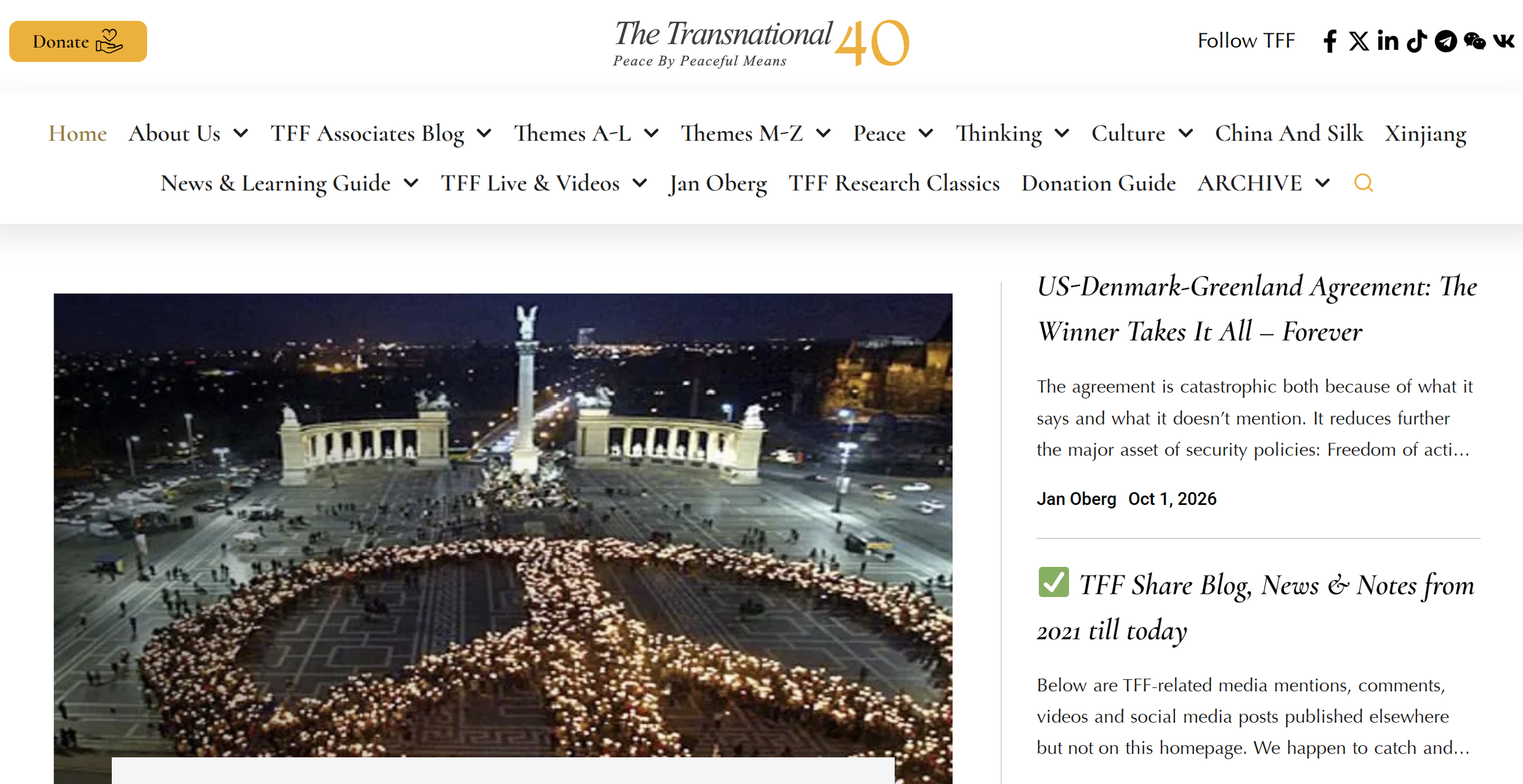
Living-Peace-Sign-Budapest-copy
Tony Robinson October 4, 2026 Violence is easy to recognise when someone is being beaten, shot or killed. It becomes more difficult when nobody is holding a weapon. Poverty, discrimination, exploitation and repression can restrict a human life just as effectively, although they do so in very different ways and with very different consequences. Simply adding more categories to an ever-growing list of forms of violence does not really solve the problem. The more interesting question is what all these different situations have in common and why it makes sense to describe them using the same word. Human beings do not simply react to what happens around them. They remember the past, imagine things that do not yet exist, make plans and undertake projects. Workers organise because they imagine different working conditions; people migrate because they imagine another life somewhere else; social movements emerge because people refuse to accept the...
b54a1f10-8c65-4f0b-9dd5-4abc0a7d04cc_2659x2659
It’s a matter of principles, courage, vision and pulling together – while the militarist world is falling apart… Peter Langille October 3, 2026 “Here, then, is the problem which we present to you, stark and dreadful and inescapable: Shall we put an end to the human race; or shall mankind renounce war?”The Bertrand Russell—Albert Einstein Manifesto, July 9, 1955 ⁕ The forecast for what’s ahead is worrisome. The sharp rise in armed conflicts over the past three years is adding to what was already the highest level in over seventy years. Genocides, which should be prevented are supported. A shared climate emergency that jeopardises survival is ignored. Diverse polls now suggest that people are war-weary, worried and interested in a more effective United Nations. And, there are viable policy options for a more secure world! Yet governments are doubling-down, betting on more war and investing heavily. If current trends persist,...
010
Johan Galtung 1930-2024October 2015 Published here on October 3, 2026 Let us focus on Civilization for conflict analysis and remedies. Major forms of disorder use violence; war is state organized violence. The most belligerent states are the United States of America and Israel, both with civilization roots. National Evangelism, the US Protestant Christian civilization– more national than evangelical–justifies US warfare as exceptionalism of a people chosen by God, with a manifest destiny to run the world. Orthodox Judaism justifies Israeli warfare to conquer and expand from Nile to Euphrates as a religious right and duty to the Eternal One. The third most belligerent country, the UK, no longer believes it is God-chosen but chosen by the USA; not quite the same but something. But the root cause of global disorder lies in the Occident–with Islam–seeing itself as the single, universal civilization valid for all at all times, all others being...
Screenshot 2026-10-02 011738
Jan ObergPhD, director, The Transnational Foundation for Peace and Future Research, TFFLund, Sweden October 2, 2026 This is my full original manuscript. The Chinese Academy of Social Science, CASS, makes two publications out if it. 1. China’s Five-year plan emphasized the capabilities of basic research and original innovation. It is regarded as the goal of the future social development, which, as required, should be significantly enhanced. Can you comment on the importance of original innovation in research and academic study? I believe it is easier to define “original innovation” in the natural sciences than in social sciences. The breaking points of what constitutes something new, or innovative, are not quite as sharp in the latter. But in both fields it is about opening up something that was closed, unseen, unexplored before – making manifest what was earlier latent. Innovations come in many forms and shapes – naming something that was not...
arctic-circle-map
The agreement is catastrophic both because of what it says and what it doesn’t mention. It reduces further the major asset of security policies: Freedom of action. Jan Oberg TFF director September 25, 2026 A couple of hours before the agreement was signed on September 22, 2026, I published the following 13 hypotheses about what it would most likely contain on TFF Substack (in English). I was wrong on only the first point. Contrary to what Trump had written on his Truth Social platform, it does not appear to come into force immediately. In fact, it turned out to be worse than even I had anticipated. After these hypotheses now come a number of reflections in light of what the agreement actually contains, and does not contain, as well as the way in which it has generally been presented by major media outlets and by the public-service broadcaster DR. My...
girl-5894831_1280
Below are TFF-related media mentions, comments, videos and social media posts published elsewhere but not on this homepage. We happen to catch and list only a fraction. Regarding video comments and debates, we recommend that you go to the TFF Video Channel on Substack where many of them are reproduced. Jan Oberg is a contributor to China Daily – 52 million daily clicks – and Global Times, CGTN and CCTV (the national television), China Investment, Xinhua News Agency and several others. Articles and videos on these media very often multiply into countless Chinese (and Western media) that re-post them from these main media. Thanks to The China Academy, his analyses, interviews and comments are frequently posted on YouTube channels such as Thinkers Forum and Wave Media. These videos are often re-posted on Bilibili (China’s YouTube), the China Content Center on TikTok, and on the Chinese edition of TikTok, Douyin.com. This means reaching hundreds of millions of viewers worldwide over a year. While there are too many to catch on all these...