
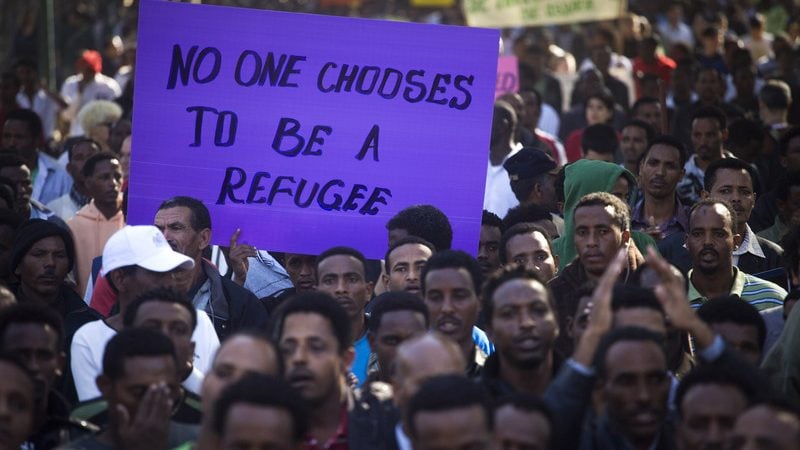
Somebody once said that courage is when you do something today you wouldn’t dare doing yesterday. That is why I decided to express my opinion whereas normally I would choose – wisely – to restrain my lips.

Have you ever had an opportunity to speak with your friends about migrants and mass immigration? Especially with your international friends living in different parts of the world and changing their residence like migrating birds? How do you explain your views if they differ from the usual, dominating or politically correct one?

Or, how do you actually explain that you are against immigration without risking being categorized as a racist?

During my latest visit to Switzerland, while conversing with a friend about many topics including politics, somehow we started discussing immigration.

My friend’s opinion was that Swiss people may seem cold and distant, but in reality they are very open-minded and friendly to other people coming to live in their country. He also noticed that many Europeans he had talked with lately with had expressed what he termed “racist opinions.”

Then I said to him “I believe that migration crisis and mixing of races is actually part of an agenda that’s been planned for years by the top elites who run international politics. And, certainly, I stand for de-globalization.

Now, when you have crossed that line and once your interlocutor has overcome the initial shock – and you realize what you said does sound racist to an innocent ear – you can start explaining what you actually mean:

What is your favorite country?
– Brazil.
– And what is something you really love about Brazil?
– Hmmm, the food.
– That is good, and what else, there must be something specific.
– Food and music.
– Excellent! Now imagine you have children and then grandchildren; imagine 30, 40 years from now your grandchildren ask you to tell them stories about Brazil and, nostalgically, you start to remember the heavenly taste of food you ate there and the music you loved listening to. Music that would give soul to that Brazil you love so much.

Then you decide to take your grandchildren to Brazil for a vacation. Then they can see for themselves. You go there but … that is no longer Brazil you used to know.

Now it is overcrowded with people from all around the world who live there and who don’t even look or act like Brazilians. You take your grandchildren to the restaurant, order your favorite Brazilian food and a person from eastern Europe is serving you. You ask for chef’s name and you find out he is Chinese.

You then try your food and it does not even taste like it used to taste, because that is no longer Brazilian food. You look around and you don’t see people who look like Brazilians. You go to the local market and the lady working there is Asian. You stroll down the streets and hear some unfamiliar beats, the music is clearly not Brazilian.

Does it resemble the country you remembered and used to like so much?
– No.
– Well that begs the questions: What has happened? What should the goal – the basic idea – be?

Should it be the long-term mixing of all the world’s races that threatens to destroy the particularity and uniqueness of each culture?

Without tradition, culture and society, people are lost like sheep in a flock.

And sheep are easy to control.

If we continue the mixing of many cultures together – the big ‘melting pot’ philosophy – we will eventually loose the original cultures and identities. They’ll be watered down.

There won’t be diversity, there won’t be nothing that makes us unique and special, we will all be the same, mixed and lost in some kind of generalised, or mass, global identity.

I have to say it, don’t I? I am not a racist.

I love all people. I love learning about different cultures and religions. I have friends all around the world. I have been on 6 continents, I’ve visited more than 30 countries. I read a lot about other countries, especially the “third world” ones.

I just happen to think that the strategy pursued by the international community if problematic or plain wrong. It needs to be challenged – also without being met with the accusation that such a challenge is backward-looking or racist. It isn’t – and I am not.

Look at how we could think and act instead! Instead of pushing the migration agenda, why don’t we focus more on helping the less developed countries so people won’t have the need to leave?

Why does the West – the US, NATO and/or the EU countries – intervene economically, politically and militarily in other countries, attack them and often start wars against them in order to impose their own agendas?

And why does the international so-called community create immigration conferences, panels, laws, policies and strategies in order to save those “poor, innocent” people without realizing that they are not saving them at all?

Why don’t we, instead, react strongly against such interventions, against such inhuman acts of violence which also contradict all international laws?

No, I’d suggest that we must learn from earlier mistakes and develop new policies so that we stop destroying other people’s countries and help them in all kinds of benevolent ways to use their potential to the maximum.

Its old hat but true: Prevention is better than cure.

If we did something like that, they wouldn’t have to leave their countries and many times their families and hearts behind.

You, my friend, migrated because of work, right? You have a degree and you are very good at what you do, so you can go wherever you want, but you are also respected wherever you go, and you can integrate easily, almost everywhere.

But when you migrate as an asylum seeker or refugee, when you flee your home trying to escape a dangerous and oppressive situation, when you travel to another country searching for asylum, sad, broken and without a penny in your pocket, you will never become an equal there.

You have examples all over Europe now. Black people are not integrating with white people, French people fear Muslims more than kids fear darkness. In Germany, a lady who cleans toilets or serves you in a bar will never be a German lady, but most probably remain a marginalised ‘Eastern European immigrant.’

In the 1990s many people fled from my country, Serbia, escaping the wars in former Yugoslavia and the bombing of Serbia and Kosovo. I don’t blame them, for sure. They probably felt they had no other choice. People don’t leave lightly what they love.

They are now all over Germany, Switzerland, Austria, Canada, Australia – and they come home for a vacation or to visit the family they left behind. Nostalgically, they enjoy those ten days of vacation and then, with empty souls, leave their hearts behind in their village or town, they go back to Germany, where they never fully integrated and they never felt at home and they were never actually happy.

I don’t know anyone who wouldn’t come permanently back if only they had economic security and stability guaranteed back home.

Why, in the first place, did the international ‘community’ first bomb my country and then have to accept to host the victims of that – criminal – policy? Making both the ‘guests’ and the ‘hosts’ unhappy forever?

Do you see the difference there, my friend? I don’t have anything against people who move to other countries. I myself don’t live in my country of origin. I have often moved – because of my big desire for knowledge and I my enormous inner passion for exploring the unknown, my hunger for new, distant places. For getting lost in new horizons.

But I am not forced to leave. Why do powerful countries create such situations where people have no choice, where they are forced to leave? It creates misery for everyone, including themselves.

My friend! Do you understand better now the difference between people who wander because they love to explore different cultures and places, or maybe because they fall in love in some of them and stay, people who move because they want to grow professionally – and all the other people who are forced to leave their countries because they are being systematically destroyed, people who wander because they are lost?

I’ve been surprised to read abut the immigration document signed on 10th and 11th of December 2018 in Marrakesh as a result of the Intergovernmental conference to adopt the global compact for safe, orderly and regular migration. On page 32, the worda “we oblige” is used 44 times, and the term “obligation” 87 times (Starcevic, 2018, p. 24).

Why are these words with such a strong connotations used so many times?

Why are countries obliged to follow the agenda of global mobility and migration-dissemination? Why not discuss, first, why it increases almost exponentially?

Why is critical thinking being censored and everyone who opposes this agenda is labeled racist?

Do we really think we can live in a happy world once when we will hardly even know where we come from, where our origins are and which language our parents or grandparents used to speak?

Do we really think a human being can be happy without her/his community, her/his society, her/his group of those similar to him. Without the tradition that nurtures the values of her/his culture?

Do we really think that by mixing it all together, creating shadows of what we use to be, creating new people who – loosing their old tradition, heritage, values and community – accepted to be slaves somewhere far away of consumerism in pursuit of a false happiness in shape of money and power?

It seems that, only when it is too late, do we realize it is not what really makes us happy.

We’ve got to re-search – and discuss much more – why millions of people are moving around and why the numbers of refugees and asylum-seekers skyrocket instead of discussing only whether we accept or like immigrants or not.

Note
Starcevic, M. Globalni migracioni pak: Strategija za porobljavanje Evrope in Geopolitika, p. 24, April 2019.


Related Posts

Johan Galtung 1930-2024October 2015 Published here on October 3, 2026 Let us focus on Civilization for conflict analysis and remedies. Major forms of disorder use violence; war is state organized violence. The most belligerent states are the United States of America and Israel, both with civilization roots. National Evangelism, the US Protestant Christian civilization– more national than evangelical–justifies US warfare as exceptionalism of a people chosen by God, with a manifest destiny to run the world. Orthodox Judaism justifies Israeli warfare to conquer and expand from Nile to Euphrates as a religious right and duty to the Eternal One. The third most belligerent country, the UK, no longer believes it is God-chosen but chosen by the USA; not quite the same but something. But the root cause of global disorder lies in the Occident–with Islam–seeing itself as the single, universal civilization valid for all at all times, all others being...
Jan ObergPhD, director, The Transnational Foundation for Peace and Future Research, TFFLund, Sweden October 2, 2026 This is my full original manuscript. The Chinese Academy of Social Science, CASS, makes two publications out if it. 1. China’s Five-year plan emphasized the capabilities of basic research and original innovation. It is regarded as the goal of the future social development, which, as required, should be significantly enhanced. Can you comment on the importance of original innovation in research and academic study? I believe it is easier to define “original innovation” in the natural sciences than in social sciences. The breaking points of what constitutes something new, or innovative, are not quite as sharp in the latter. But in both fields it is about opening up something that was closed, unseen, unexplored before – making manifest what was earlier latent. Innovations come in many forms and shapes – naming something that was not...
The agreement is catastrophic both because of what it says and what it doesn’t mention. It reduces further the major asset of security policies: Freedom of action. Jan Oberg TFF director September 25, 2026 A couple of hours before the agreement was signed on September 22, 2026, I published the following 13 hypotheses about what it would most likely contain on TFF Substack (in English). I was wrong on only the first point. Contrary to what Trump had written on his Truth Social platform, it does not appear to come into force immediately. In fact, it turned out to be worse than even I had anticipated. After these hypotheses now come a number of reflections in light of what the agreement actually contains, and does not contain, as well as the way in which it has generally been presented by major media outlets and by the public-service broadcaster DR. My...

Recent Articles

Tony Robinson October 4, 2026 Violence is easy to recognise when someone is being beaten, shot or killed. It becomes more difficult when nobody is holding a weapon. Poverty, discrimination, exploitation and repression can restrict a human life just as effectively, although they do so in very different ways and with very different consequences. Simply adding more categories to an ever-growing list of forms of violence does not really solve the problem. The more interesting question is what all these different situations have in common and why it makes sense to describe them using the same word. Human beings do not simply react to what happens around them. They remember the past, imagine things that do not yet exist, make plans and undertake projects. Workers organise because they imagine different working conditions; people migrate because they imagine another life somewhere else; social movements emerge because people refuse to accept the...
It’s a matter of principles, courage, vision and pulling together – while the militarist world is falling apart… Peter Langille October 3, 2026 “Here, then, is the problem which we present to you, stark and dreadful and inescapable: Shall we put an end to the human race; or shall mankind renounce war?”The Bertrand Russell—Albert Einstein Manifesto, July 9, 1955 ⁕ The forecast for what’s ahead is worrisome. The sharp rise in armed conflicts over the past three years is adding to what was already the highest level in over seventy years. Genocides, which should be prevented are supported. A shared climate emergency that jeopardises survival is ignored. Diverse polls now suggest that people are war-weary, worried and interested in a more effective United Nations. And, there are viable policy options for a more secure world! Yet governments are doubling-down, betting on more war and investing heavily. If current trends persist,...
Johan Galtung 1930-2024October 2015 Published here on October 3, 2026 Let us focus on Civilization for conflict analysis and remedies. Major forms of disorder use violence; war is state organized violence. The most belligerent states are the United States of America and Israel, both with civilization roots. National Evangelism, the US Protestant Christian civilization– more national than evangelical–justifies US warfare as exceptionalism of a people chosen by God, with a manifest destiny to run the world. Orthodox Judaism justifies Israeli warfare to conquer and expand from Nile to Euphrates as a religious right and duty to the Eternal One. The third most belligerent country, the UK, no longer believes it is God-chosen but chosen by the USA; not quite the same but something. But the root cause of global disorder lies in the Occident–with Islam–seeing itself as the single, universal civilization valid for all at all times, all others being...

TFF on Substack

Discover and subscribe to more peace materials on TFF Substack

Most Popular

Tony Robinson October 4, 2026 Violence is easy to recognise when someone is being beaten, shot or killed. It becomes more difficult when nobody is holding a weapon. Poverty, discrimination, exploitation and repression can restrict a human life just as effectively, although they do so in very different ways and with very different consequences. Simply adding more categories to an ever-growing list of forms of violence does not really solve the problem. The more interesting question is what all these different situations have in common and why it makes sense to describe them using the same word. Human beings do not simply react to what happens around them. They remember the past, imagine things that do not yet exist, make plans and undertake projects. Workers organise because they imagine different working conditions; people migrate because they imagine another life somewhere else; social movements emerge because people refuse to accept the...
It’s a matter of principles, courage, vision and pulling together – while the militarist world is falling apart… Peter Langille October 3, 2026 “Here, then, is the problem which we present to you, stark and dreadful and inescapable: Shall we put an end to the human race; or shall mankind renounce war?”The Bertrand Russell—Albert Einstein Manifesto, July 9, 1955 ⁕ The forecast for what’s ahead is worrisome. The sharp rise in armed conflicts over the past three years is adding to what was already the highest level in over seventy years. Genocides, which should be prevented are supported. A shared climate emergency that jeopardises survival is ignored. Diverse polls now suggest that people are war-weary, worried and interested in a more effective United Nations. And, there are viable policy options for a more secure world! Yet governments are doubling-down, betting on more war and investing heavily. If current trends persist,...
Johan Galtung 1930-2024October 2015 Published here on October 3, 2026 Let us focus on Civilization for conflict analysis and remedies. Major forms of disorder use violence; war is state organized violence. The most belligerent states are the United States of America and Israel, both with civilization roots. National Evangelism, the US Protestant Christian civilization– more national than evangelical–justifies US warfare as exceptionalism of a people chosen by God, with a manifest destiny to run the world. Orthodox Judaism justifies Israeli warfare to conquer and expand from Nile to Euphrates as a religious right and duty to the Eternal One. The third most belligerent country, the UK, no longer believes it is God-chosen but chosen by the USA; not quite the same but something. But the root cause of global disorder lies in the Occident–with Islam–seeing itself as the single, universal civilization valid for all at all times, all others being...
Read More
Living-Peace-Sign-Budapest-copy
Tony Robinson October 4, 2026 Violence is easy to recognise when someone is being beaten, shot or killed. It becomes more difficult when nobody is holding a weapon. Poverty, discrimination, exploitation and repression can restrict a human life just as effectively, although they do so in very different ways and with very different consequences. Simply adding more categories to an ever-growing list of forms of violence does not really solve the problem. The more interesting question is what all these different situations have in common and why it makes sense to describe them using the same word. Human beings do not simply react to what happens around them. They remember the past, imagine things that do not yet exist, make plans and undertake projects. Workers organise because they imagine different working conditions; people migrate because they imagine another life somewhere else; social movements emerge because people refuse to accept the...
b54a1f10-8c65-4f0b-9dd5-4abc0a7d04cc_2659x2659
It’s a matter of principles, courage, vision and pulling together – while the militarist world is falling apart… Peter Langille October 3, 2026 “Here, then, is the problem which we present to you, stark and dreadful and inescapable: Shall we put an end to the human race; or shall mankind renounce war?”The Bertrand Russell—Albert Einstein Manifesto, July 9, 1955 ⁕ The forecast for what’s ahead is worrisome. The sharp rise in armed conflicts over the past three years is adding to what was already the highest level in over seventy years. Genocides, which should be prevented are supported. A shared climate emergency that jeopardises survival is ignored. Diverse polls now suggest that people are war-weary, worried and interested in a more effective United Nations. And, there are viable policy options for a more secure world! Yet governments are doubling-down, betting on more war and investing heavily. If current trends persist,...
010
Johan Galtung 1930-2024October 2015 Published here on October 3, 2026 Let us focus on Civilization for conflict analysis and remedies. Major forms of disorder use violence; war is state organized violence. The most belligerent states are the United States of America and Israel, both with civilization roots. National Evangelism, the US Protestant Christian civilization– more national than evangelical–justifies US warfare as exceptionalism of a people chosen by God, with a manifest destiny to run the world. Orthodox Judaism justifies Israeli warfare to conquer and expand from Nile to Euphrates as a religious right and duty to the Eternal One. The third most belligerent country, the UK, no longer believes it is God-chosen but chosen by the USA; not quite the same but something. But the root cause of global disorder lies in the Occident–with Islam–seeing itself as the single, universal civilization valid for all at all times, all others being...
Screenshot 2026-10-02 011738
Jan ObergPhD, director, The Transnational Foundation for Peace and Future Research, TFFLund, Sweden October 2, 2026 This is my full original manuscript. The Chinese Academy of Social Science, CASS, makes two publications out if it. 1. China’s Five-year plan emphasized the capabilities of basic research and original innovation. It is regarded as the goal of the future social development, which, as required, should be significantly enhanced. Can you comment on the importance of original innovation in research and academic study? I believe it is easier to define “original innovation” in the natural sciences than in social sciences. The breaking points of what constitutes something new, or innovative, are not quite as sharp in the latter. But in both fields it is about opening up something that was closed, unseen, unexplored before – making manifest what was earlier latent. Innovations come in many forms and shapes – naming something that was not...
arctic-circle-map
The agreement is catastrophic both because of what it says and what it doesn’t mention. It reduces further the major asset of security policies: Freedom of action. Jan Oberg TFF director September 25, 2026 A couple of hours before the agreement was signed on September 22, 2026, I published the following 13 hypotheses about what it would most likely contain on TFF Substack (in English). I was wrong on only the first point. Contrary to what Trump had written on his Truth Social platform, it does not appear to come into force immediately. In fact, it turned out to be worse than even I had anticipated. After these hypotheses now come a number of reflections in light of what the agreement actually contains, and does not contain, as well as the way in which it has generally been presented by major media outlets and by the public-service broadcaster DR. My...
girl-5894831_1280
Below are TFF-related media mentions, comments, videos and social media posts published elsewhere but not on this homepage. We happen to catch and list only a fraction. Regarding video comments and debates, we recommend that you go to the TFF Video Channel on Substack where many of them are reproduced. Jan Oberg is a contributor to China Daily – 52 million daily clicks – and Global Times, CGTN and CCTV (the national television), China Investment, Xinhua News Agency and several others. Articles and videos on these media very often multiply into countless Chinese (and Western media) that re-post them from these main media. Thanks to The China Academy, his analyses, interviews and comments are frequently posted on YouTube channels such as Thinkers Forum and Wave Media. These videos are often re-posted on Bilibili (China’s YouTube), the China Content Center on TikTok, and on the Chinese edition of TikTok, Douyin.com. This means reaching hundreds of millions of viewers worldwide over a year. While there are too many to catch on all these...




