
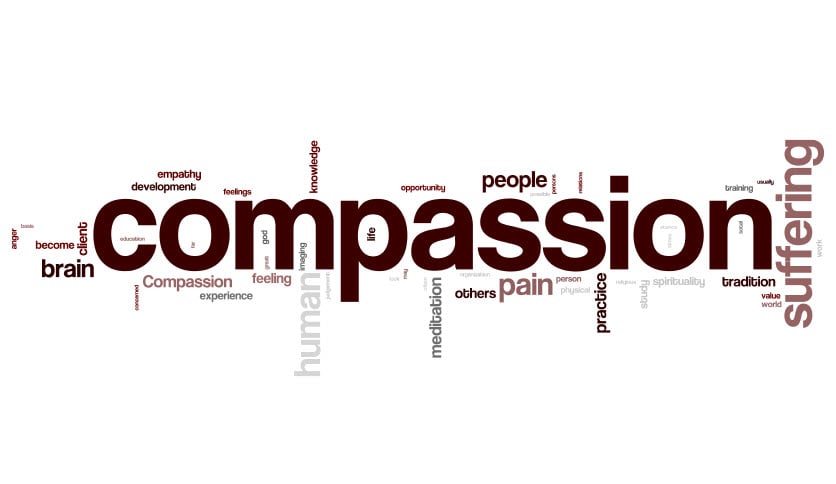
Compassion in the Media and Politics: Why the language we use matters?

I have to admit that the most unforgiving relationship I hold is the one with the media.

This may not come as a surprise as one doesn’t need to look further than a front page of any media platform to see that the media has become an increasingly hostile and contradictory arena.

We seem to be living in times of linguistic austerity and compassion depravity. We are faced with more and more undeniable evidence that the media is creating an increasing social divide and psychological crisis in our society today.

Sadly, this is not something new. If one learns from history and observes the present carefully, it is evident that the media has a critical role in perpetuating and exaggerating conflict.

For example, the media has had a single role as a dividing factor and driving force in triggering and perpetuating the Yugoslav wars in the Balkans, by using ethnic identities as a tool to push people against each other and psychologically mobilise old traumas to trigger people into fighting.

This, like many other wars, could have been avoided and prevented if the international political community and the media hadn’t got involved in so many varied, destructive and ignorant ways.

The current political and social climate is sadly triggering the same thoughts and emotions.

Now, don’t get me wrong, I am not equating the current political climate with the wars and genocide in Yugoslavia; however, what strikes me is that today’s rhetoric of division and language of hate is very much the same.

The whole atmosphere of political media debate is shifting further and further away from any constructive dialogue and desire to seek common ground towards the sole desire to prove the other wrong. The noise is getting magnified, content exaggerated and dehumanised, arguments turned more and more cruel, more polarised and less and less anchored in facts.

As media executive Mark Thompson stated in his book “Enough Said: What’s Gone Wrong with the Language of Politics?”: “All that is left is just a fight to the political death, a fight in which every linguistic weapon is fair game”.

Strategically and deliberately the media and politicians continue to use this form of language in order to capture attention, not regarding negative attention as bad; in fact the opposite.

Being sharp, engaging in controversy and perpetual disagreement is proving to be a more effective way to capture media attention.

Politicians such a Donald Trump and Nigel Farage have built their reputation on the back of such political attacks which only brought them more “success”, attention and publicity.

The result of all this is a political and social atmosphere of perpetual disagreement and conflict. It is a discourse that leaves no room for any presumption of good faith between participants.

Is shouty politics and insults all that the media can manage and give attention to?

More importantly, how does this affect the rest of us? How does the language of hate, conflict and division affect our society and us as individuals?

Why the language we use matters?

Language plays a significant role in the way we shape the world around us. In psychology, language and cognition are closely interwoven and it is believed that language shapes our way of thinking and consequently shapes our behaviour.

Just consider the impact of poetry or musical song lyrics that can elicit powerful emotions. In the same way “language of judgement and hate” can have an equally powerful impact.

Cognitive linguist and philosopher George Lakoff wrote extensively on why the language matters and how is it used to frame political debates.

In his book, “Don’t Think of an Elephant!” Lakoff states: “Frames are mental structures that shape the way we see the world. As a result, they shape the goals we seek, the plans we make, the way we act, and what counts as a good or bad outcome of our actions.”

Dr Russ Harris, a medical practitioner, consultant to the World Health Organisation, and one of the leading authorities on stress management goes as far as using the word “mind” as a metaphor for “human language”.

Other scientists have been very successful in proving a direct relationship between language and mental health.

For example, a study published by the Clinical Psychology Review conducted at the University of Arkansas demonstrates that exposure to certain words can effect treatment of people who suffer with anxiety and depression. And there is a wealth of other studies which support such and similar claims.

If we take this into account together with the fact that, at present, the world is facing a major “mental health crisis” – should it strike us, perhaps, that the media has somehow had an indirect impact on this?

The World Health Organisation (WHO) estimates that the burden of mental health conditions is on the rise globally and that depression, anxiety and loneliness are becoming a common mental condition.

On the other side, the intervention programmes proven to be most effective are those which enhance the use of positive language and patterns of positive thinking.  These interventions are proven to be highly effective within community groups or group interventions that foster mutual understanding, empathy and compassion.

With such clear evidence of the importance of positive language, social inclusion, mutual support and empathy for our well-being – it seems logical that we should pay more attention to the language we use, be mindful of our rhetoric, the way we cultivate dialogue and invest more in positive social relationships.

When it comes to the media and politics, should this be considered, regulated and taken into account?

Would it be going too far to hold the media partially accountable for the hostile world we live in as well as its mental health crisis?

We need to address the central problem here, which is the alienating tone of the media language.

Until both politicians and media begin to speak in the language that is more accepting and positive, there will be little incentive for people to engage in a more constructive and positive way.

What would happen if politicians and media alter their language dramatically and change the way they communicate? Would less aggressive debate produce a more productive debate?

What if compassion became the main driving force in politics and media rhetoric? Would that change the way we view the world and bring greater engagement of the rest of us?
Perhaps it would bring more peace and healing that we are all in need of.

The language of Compassion and Compassion in Action

Compassion is something that we are all inherently capable of and in need of. The quest for connection and compassion is universal. No one is hardwired to cynicism, judgemental and vengeful instincts.

As Theodore Roosevelt declared in his speech Citizenship in a Republic: “It’s not the critic who counts; not the man who points out how the strong man stumbles or where the doer of deeds could have done them better.”

Perhaps the key is in letting go of seeking victory or avoiding defeat but rather courageously engage with each other in compassion.

We have a responsibility to each other to do things that alleviate pain, not to perpetuate it. Equally, media has the power and responsibility to create a culture of decency in language we use and move away from using rhetoric of criticism or simply put “raw facts”.

Going back to my beginnings and my roots in the Yugoslav wars, I would say that neither political debate nor “facts” mattered.

When we were seeking shelter in a cellar while missiles were flying above our heads we were not thinking of either. The sensationalistic media told us that we were enemies and the “reasoned” raw facts were pointing to the harsh reality of war.

However, our true reality was neither.

What we felt, saw and did was not reasoned facts or media infused sensationalism.

Instead, we survived on mutual humanity, compassion and care filled with empathy and understanding. Free from shame or imposed senses of mutually exclusive ethnic identities.

Most probably we were more infused by what was “the truth” than anyone else in the western world watching the news about what was happening to us at that time. Compassion towards one another was what kept us going, what gave us strength and hope – in fact, our lives depended on it!

Many people would think of “compassion” as something naïve or as a weakness.

But what if we understand compassion as something radical and powerful?

What if instead of weakness we thought of compassion as a way to do  combat?

To me the language and behaviour of compassion is not about being “nice” – to me it’s about something more assertive than that. I believe that fighting with compassion makes you the ultimate truth fighter.

Compassion makes us stronger and makes us free. And free people are most “dangerous” people because they are not controlled by negativity, media or politics; they are not easily offended.

They focus on the solution, not the problem; they are not chained to resentment and they are not afraid to speak the truth.

And that, to me, is worth fighting for!
Related Posts

Photo above: Carl Fredrik Reuterswärd’s Non-Violence outside UN Headquarters in New York. Kirill Levin, CC BY-NC-SA 2. Jan Oberg November 3, 2026 I am happy to be published in Horizons which is produced by the Center for International Relations and Sustainable Development, CIRSD, in Belgrade. My contribution brings out a radical re-thinking of what concepts such as defence, security, deterrence – and peace – may mean if we want to create a more peaceful world. It also summarises a few things I have been working with the last few decades. Please read it here Og her er den på dansk, takket være Johnny Baltzersens lynhurtige oversættelse
UNITE-tillid, DREAM-velstand og andre konstruktive komponenter Normally we publish articles in English here. But this is a translation of a very important TFF document that should reach as many as possible in Denmark since this country’s government has been one of the most hardline in Europe and, up till now at least, has refused to use diplomacy and, instead, spent tremendous sums on arming Ukraine with the express goal of defeating Russia. Thus this – unique – article is in Danish. Vi er Johnny Baltzersen og hans Fælles Sikkerhed – Fælles Fremtid på Substack overmåde taknemmelige for at have oversat og publiceret TFF’s 2025-portfølje for fredsidéer med henblik på Ukraines fremtid. Vi håber den nu kan nå mange flere danskere – som også vil sprede den og skabe debat – nu den danske regerings og folketingspartiernes politik på dette område siden 2022 står nu – forudsigeligt – ved vejs ende....
Jan Oberg TFF director October 28, 2026 Exactly one month has now passed since I published my criticism of the introduction to the special issue on Johan Galtung published by the Journal of Global Security Studies, JoGSS, and of Tor Egil Førland’s chapter about Galtung which serves as a preview to his forthcoming biography of Galtung to be published by PRIO. See the original on The Transnational here and the same article on TFF Substack with many general and critical comments and, in particular, the people who decided to withdraw from the biography project in protest. The special issue itself was extraordinary. It was devoted to the intellectual legacy of one of the founders of peace research and contained a number of strong assessments of his personality, scholarship, intellectual trajectory, and public role. Such assessments are, of course, entirely legitimate. No scholar is beyond criticism, and neither was Johan Galtung....

Recent Articles

Photo above: Carl Fredrik Reuterswärd’s Non-Violence outside UN Headquarters in New York. Kirill Levin, CC BY-NC-SA 2. Jan Oberg November 3, 2026 I am happy to be published in Horizons which is produced by the Center for International Relations and Sustainable Development, CIRSD, in Belgrade. My contribution brings out a radical re-thinking of what concepts such as defence, security, deterrence – and peace – may mean if we want to create a more peaceful world. It also summarises a few things I have been working with the last few decades. Please read it here Og her er den på dansk, takket være Johnny Baltzersens lynhurtige oversættelse
UNITE-tillid, DREAM-velstand og andre konstruktive komponenter Normally we publish articles in English here. But this is a translation of a very important TFF document that should reach as many as possible in Denmark since this country’s government has been one of the most hardline in Europe and, up till now at least, has refused to use diplomacy and, instead, spent tremendous sums on arming Ukraine with the express goal of defeating Russia. Thus this – unique – article is in Danish. Vi er Johnny Baltzersen og hans Fælles Sikkerhed – Fælles Fremtid på Substack overmåde taknemmelige for at have oversat og publiceret TFF’s 2025-portfølje for fredsidéer med henblik på Ukraines fremtid. Vi håber den nu kan nå mange flere danskere – som også vil sprede den og skabe debat – nu den danske regerings og folketingspartiernes politik på dette område siden 2022 står nu – forudsigeligt – ved vejs ende....
Jan Oberg TFF director October 28, 2026 Exactly one month has now passed since I published my criticism of the introduction to the special issue on Johan Galtung published by the Journal of Global Security Studies, JoGSS, and of Tor Egil Førland’s chapter about Galtung which serves as a preview to his forthcoming biography of Galtung to be published by PRIO. See the original on The Transnational here and the same article on TFF Substack with many general and critical comments and, in particular, the people who decided to withdraw from the biography project in protest. The special issue itself was extraordinary. It was devoted to the intellectual legacy of one of the founders of peace research and contained a number of strong assessments of his personality, scholarship, intellectual trajectory, and public role. Such assessments are, of course, entirely legitimate. No scholar is beyond criticism, and neither was Johan Galtung....

TFF on Substack

Discover and subscribe to more peace materials on TFF Substack

Most Popular

Photo above: Carl Fredrik Reuterswärd’s Non-Violence outside UN Headquarters in New York. Kirill Levin, CC BY-NC-SA 2. Jan Oberg November 3, 2026 I am happy to be published in Horizons which is produced by the Center for International Relations and Sustainable Development, CIRSD, in Belgrade. My contribution brings out a radical re-thinking of what concepts such as defence, security, deterrence – and peace – may mean if we want to create a more peaceful world. It also summarises a few things I have been working with the last few decades. Please read it here Og her er den på dansk, takket være Johnny Baltzersens lynhurtige oversættelse
UNITE-tillid, DREAM-velstand og andre konstruktive komponenter Normally we publish articles in English here. But this is a translation of a very important TFF document that should reach as many as possible in Denmark since this country’s government has been one of the most hardline in Europe and, up till now at least, has refused to use diplomacy and, instead, spent tremendous sums on arming Ukraine with the express goal of defeating Russia. Thus this – unique – article is in Danish. Vi er Johnny Baltzersen og hans Fælles Sikkerhed – Fælles Fremtid på Substack overmåde taknemmelige for at have oversat og publiceret TFF’s 2025-portfølje for fredsidéer med henblik på Ukraines fremtid. Vi håber den nu kan nå mange flere danskere – som også vil sprede den og skabe debat – nu den danske regerings og folketingspartiernes politik på dette område siden 2022 står nu – forudsigeligt – ved vejs ende....
Jan Oberg TFF director October 28, 2026 Exactly one month has now passed since I published my criticism of the introduction to the special issue on Johan Galtung published by the Journal of Global Security Studies, JoGSS, and of Tor Egil Førland’s chapter about Galtung which serves as a preview to his forthcoming biography of Galtung to be published by PRIO. See the original on The Transnational here and the same article on TFF Substack with many general and critical comments and, in particular, the people who decided to withdraw from the biography project in protest. The special issue itself was extraordinary. It was devoted to the intellectual legacy of one of the founders of peace research and contained a number of strong assessments of his personality, scholarship, intellectual trajectory, and public role. Such assessments are, of course, entirely legitimate. No scholar is beyond criticism, and neither was Johan Galtung....
Read More
knotted gun
Photo above: Carl Fredrik Reuterswärd’s Non-Violence outside UN Headquarters in New York. Kirill Levin, CC BY-NC-SA 2. Jan Oberg November 3, 2026 I am happy to be published in Horizons which is produced by the Center for International Relations and Sustainable Development, CIRSD, in Belgrade. My contribution brings out a radical re-thinking of what concepts such as defence, security, deterrence – and peace – may mean if we want to create a more peaceful world. It also summarises a few things I have been working with the last few decades. Please read it here Og her er den på dansk, takket være Johnny Baltzersens lynhurtige oversættelse
TFFPortfolioVign
UNITE-tillid, DREAM-velstand og andre konstruktive komponenter Normally we publish articles in English here. But this is a translation of a very important TFF document that should reach as many as possible in Denmark since this country’s government has been one of the most hardline in Europe and, up till now at least, has refused to use diplomacy and, instead, spent tremendous sums on arming Ukraine with the express goal of defeating Russia. Thus this – unique – article is in Danish. Vi er Johnny Baltzersen og hans Fælles Sikkerhed – Fælles Fremtid på Substack overmåde taknemmelige for at have oversat og publiceret TFF’s 2025-portfølje for fredsidéer med henblik på Ukraines fremtid. Vi håber den nu kan nå mange flere danskere – som også vil sprede den og skabe debat – nu den danske regerings og folketingspartiernes politik på dette område siden 2022 står nu – forudsigeligt – ved vejs ende....
JoGSS-Silent
Jan Oberg TFF director October 28, 2026 Exactly one month has now passed since I published my criticism of the introduction to the special issue on Johan Galtung published by the Journal of Global Security Studies, JoGSS, and of Tor Egil Førland’s chapter about Galtung which serves as a preview to his forthcoming biography of Galtung to be published by PRIO. See the original on The Transnational here and the same article on TFF Substack with many general and critical comments and, in particular, the people who decided to withdraw from the biography project in protest. The special issue itself was extraordinary. It was devoted to the intellectual legacy of one of the founders of peace research and contained a number of strong assessments of his personality, scholarship, intellectual trajectory, and public role. Such assessments are, of course, entirely legitimate. No scholar is beyond criticism, and neither was Johan Galtung....
Screenshot 2026-10-26 115647
An aspect of Iran’s culture and civilisation you’ve probably never heard about. Don’t be surprised if the US and Israel also try to bomb them. Jan ObergTFF director October 26, 2026 Today – under the “USraeli” threat of new “annihilating” bombings – opens the 7th International Conference on Peace and Conflict Resolution at Tehran’s University. As far as I can tell, this is the only permanent, advanced peace research institution in West Asia/the Middle East. Perhaps more countries in that region could be inspired? I mean, how many military “security” institutes and military academies do they have? Many peace research institutes and university departments have been established since the 1950s in the West. They are now all under attack; some have closed down, some have gone mainstream, yet others kept the name but do nothing to research peace and disseminate results or advice; instead, they cooperate with militarism’s platforms such...
Screenshot 2026-10-15 141837
Let’s discuss using AI to create peace – in contrast to boring geopolitics devoid of creative healing and visions. Jan Oberg TFF director October 15, 2026 I asked VEED to create a short video exemplifying how peace is preferable to war, then chose the lady as a template. Simple as that. In less than a minute, it produced this video, which any peace-loving person would appreciate. The only problem is that human intelligence (HI), at least the one that exists among Western decision-makers, isn’t half as moral or smart as AI. I have used AI to dialogue about peace and peace plans, creative conflict resolution and visions of a better future for humankind. It so happens that I am having more stimulating, intelligent, creative and moral discussions with AI than I could possibly have with any EU or NATO leader today. Yes, AI has very problematic and dangerous aspects; used...
girl-5894831_1280
Below are TFF-related media mentions, comments, videos and social media posts published elsewhere but not on this homepage. We happen to catch and list only a fraction. Regarding video comments and debates, we recommend that you go to the TFF Video Channel on Substack where many of them are reproduced. Jan Oberg is a contributor to China Daily – 52 million daily clicks – and Global Times, CGTN and CCTV (the national television), China Investment, Xinhua News Agency and several others. Articles and videos on these media very often multiply into countless Chinese (and Western media) that re-post them from these main media. Thanks to The China Academy, his analyses, interviews and comments are frequently posted on YouTube channels such as Thinkers Forum and Wave Media. These videos are often re-posted on Bilibili (China’s YouTube), the China Content Center on TikTok, and on the Chinese edition of TikTok, Douyin.com. This means reaching hundreds of millions of viewers worldwide over a year. While there are too many to catch on all these...





