
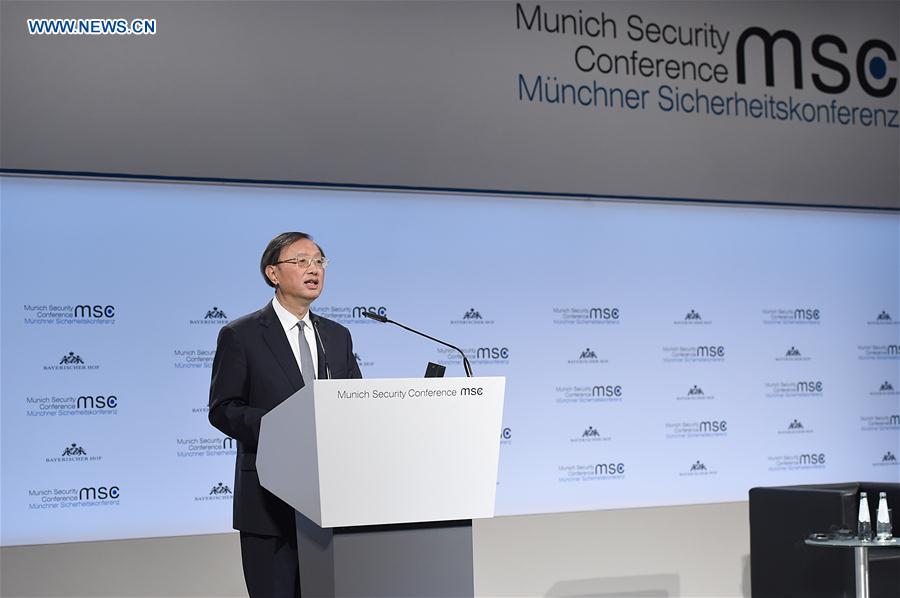
China at the Munich Security Conference 2019: A positive vision

“Working for a Community with a Shared Future for Mankind by Promoting International Cooperation and Multilateralism”

By Yang Jiechi

February 18, 2019

MUNICH, Germany, Feb. 16 (Xinhua) – Yang Jiechi, a member of the Political Bureau of the Communist Party of China (CPC) Central Committee, Director of the Office of the Central Commission for Foreign Affairs, delivered China’s keynote speech on February 16, 2019 at the 55th Munich Security Conference.

Italics added by The Transnational for pedagogical, easier-read reasons.

This is the English translated version of the speech reprinted from
China Org. cn here:


Mr. Wolfgang Ischinger, Chairman of the Munich Security Conference,

Ladies and Gentlemen,

It is my great pleasure to join you at this year’s Munich Security Conference (MSC). As a global forum on security policy, the MSC provides an important platform for people around the world to express views and share insights on major issues concerning world peace and development. This year’s focus on promoting international cooperation and multilateralism is important, timely and has much practical relevance.

Our world today is undergoing fast and profound changes with growing uncertainties and instability. Unilateralism and protectionism have been on the rise; the multilateral international order and global governance system have come under challenge.

Our world stands at a crossroads and faces a consequential choice between unilateralism and multilateralism, confrontation and dialogue, isolation and openness. As President Xi Jinping pointed out, multilateralism provides an effective way of upholding peace and promoting development, and the world needs multilateralism now more than ever.

It’s been China’s consistent view that the United Nations is the symbol of multilateralism, and the UN-centered multilateral architecture provides an overarching framework for international cooperation. The consensus of the global community on multilateralism has been enshrined in the UN Charter, which serves as the cornerstone for the modern international order.

As a founding member of the UN and a permanent member of its Security Council, China has all along supported multilateralism, followed the multilateral approach, and advocated peace, development and win-win cooperation, playing its consistent role as a promoter of world peace, contributor to global development and upholder of the international order.

To serve the common and fundamental interests of the people of China and around the world, President Xi Jinping called for the fostering of a new type of international relations featuring mutual respect, fairness, justice and win-win cooperation, and the building of a community with a shared future for mankind.

He expounded on a vision of an open, inclusive, clean and beautiful world that enjoys lasting peace, universal security and common prosperity. Such thinking and vision encapsulate the propositions and principles that China holds dear as a staunch supporter of multilateralism.

They include, first, the principle of sovereign equality, which is the most important norm governing state-to-state relations. All countries, regardless of size, strength and wealth, are equal. The right of people of all countries to independently choose their development paths should be respected. And the practice of imposing one’s will on others or interfering in others’ internal affairs should be rejected.

Second, dialogue and consultation, which is an important approach to sound global governance in today’s world. Dialogue and consultation should be pursued in the interest of peaceful resolution of differences and disputes. The willful use or threat of force, hegemony and power politics should be rejected.

Third, the rule of law, which is central to the pursuit of law-based international relations. The basic norms governing international relations centering on the purposes and principles of the UN Charter must be safeguarded. International law must apply equally to all, and double standards or selective application of international law should be rejected.

Fourth, win-win cooperation, which is essential for achieving common development. We must work together to pursue the greatest possible common interests among nations and expand areas of converging interests on the basis of mutual benefit.

To advocate and practice multilateralism is not just China’s choice, but also the preferred option of an overwhelming majority of countries. The UN-centered system of international institutions have engaged in extensive dialogue and cooperation across the political, economic, security and cultural fields and worked to address global issues and challenges.

Such efforts have advanced democracy in international relations and vigorously contributed to global peace, stability, development and prosperity. Inspired by the core principles of multilateralism, the G20, APEC, BRICS, the Shanghai Cooperation Organization, Asia-Europe Meeting and other global forums have all carried out meaningful cooperation. The EU, ASEAN, the African Union, the Arab League, the Community of Latin American and Caribbean States (CELAC) and other international organizations have contributed to peace and development by advancing regional cooperation.

All this has shown that to pursue global cooperation, multilateralism and a community with a shared future for mankind represents a momentous trend of our times and is the right way to go.

Ladies and Gentlemen,

History tells us that we can only realize our peoples’ dreams for a better life by upholding multilateralism and enhancing global cooperation. It falls to us to grasp the underlying trend of our times, respond to the call of the people, and make the right choices. China advocates a steadfast commitment to advance international cooperation, uphold and develop multilateralism, and make the international order more just and equitable.

First, we need to forge partnerships through mutual respect. Choosing dialogue over confrontation, we should work vigorously to develop partnerships that are more inclusive and constructive. This is a foundation and prerequisite for multilateralism and international cooperation.

China is committed to building a generally stable and balanced framework of major-country relations. We are ready to work with the United States to solidly implement the important common understanding reached between the two Presidents and jointly build a China-US relationship based on coordination, cooperation and stability.

Over the past few weeks, the economic teams of the two sides have engaged in intensive consultations, and important progress has been made. We hope that the two sides will continue to make concerted efforts toward a mutually beneficial and win-win agreement.

Following the strategic guidance from the top leaders, China and Russia will work to elevate their comprehensive strategic partnership of coordination to new heights. China remains a staunch supporter of European integration. We welcome a Europe that is more united, stable and prosperous, and support Europe in playing an important and constructive role in international affairs.

China follows the policy of building friendships and partnerships with neighboring countries based on amity, sincerity, mutual benefit and inclusiveness. China is committed to pursuing the greater good and shared interests and to the principle of sincerity, real results, amity and good faith. We will earnestly implement all the outcomes of the Beijing Summit of the Forum on China-Africa Cooperation (FOCAC), the meeting between leaders of China and Pacific island countries, the China-Arab States Cooperation Forum and the Forum of China and the Community of Latin American and Caribbean States, to advance the building of a community with a shared future with all other developing countries.

Second, we need to uphold universal security through mutual support. We should work toward a new vision of common, comprehensive, cooperative and sustainable security, and respect and protect the security of each and every country.

Global issues such as climate change, cyber security, terrorism and major natural disasters should be tackled through global responses, and regional and global security must be protected with common efforts. International cooperation must be intensified to safeguard the security and stability in West Asia and North Africa, and a holistic approach is required to tackle the issue of refugees and migrants at its root. A few weeks ago, Egypt, the new rotating Chair of the African Union, hosted the successful 32nd AU summit, where constructive and meaningful dialogue and cooperation were carried out in addressing the issue of refugees, migrants and displaced people in Africa.

China has been actively involved in the UN peacekeeping missions, and is the largest troop contributor among the P5 and the second largest contributor to the UN peacekeeping budget. The Chinese navy has conducted escort missions in the Gulf of Aden and the waters off the Somali coast over the past ten years, serving over 6,600 Chinese and foreign vessels.

China has been an active player in international cooperation against terrorism, supported African countries in resolving African issues in an African way, and supported the AU and other regional and subregional organizations in playing a leading role in meeting the security challenges in their region.

China is committed to facilitating the proper resolution of regional hotspots such as the Iranian nuclear issue and the Syrian, Palestinian and Afghanistan issues through dialogue and negotiation.

China supports security dialogue among the Asia-Pacific countries and efforts to explore a regional security vision and architecture that fits the reality of this region. We welcome the upcoming second meeting between the DPRK and U.S. leaders, and will continue to work with other parties concerned toward the full denuclearization of the Korean Peninsula and the establishment of a permanent peace regime on the Peninsula.

China is resolute in defending its territorial sovereignty and maritime rights and interests. We firmly oppose any activity that undermines China’s sovereignty and security interests under the pretext of freedom of navigation and overflight.

China is committed to working with ASEAN countries to fully and effectively implement the Declaration on the Conduct of Parties in the South China Sea and advance consultations on the Code of Conduct. And we hope that these efforts by the countries in the region will be respected and supported by all non-regional countries.

Third, we need to foster global development and prosperity through win-win cooperation. Given the complementarity of our strengths, there is much potential to be tapped for promoting inter-connected growth.

We need to follow the new approach of win-win and all-win cooperation, and abandon ideological prejudices and the outdated mentality of zero-sum game and winner-takes-all. We need to rise to the challenges and promote common development through closer cooperation.

We need to make economic globalization more open, inclusive, balanced and beneficial to all, and accommodate the interests of all countries, particularly emerging markets and developing countries.

The rapid advance of the new round of global technological and industrial revolution brings both opportunities and challenges for humanity. Countries should pursue the path of open, integrated and win-win development, and work together to foster an open, fair and transparent environment for international cooperation. We should reject technological hegemony and narrow the digital divide to deliver the benefits of the Fourth Industrial Revolution to people of all countries.

Following a win-win strategy of opening-up, China has introduced a host of major steps, including broadening market access, to open wider to the world and build an open economy. Last year, we held the first China International Import Expo (CIIE), which produced deals worth nearly 60 billion U.S. dollars. Going forward, China will host the International Import Expo on an annual basis to open its door further.

China is firm in upholding the multilateral trading system and advancing trade and investment liberalization and facilitation. We have deeply engaged in regional and sub-regional cooperation, and concluded 17 free trade agreements with 25 countries and regions.

China is committed to advancing regional integration with Asia-Pacific countries and building a community with a shared future in the Asia-Pacific. China-ASEAN relations have seen comprehensive and in-depth growth. In 2018, China-ASEAN trade approached 600 billion U.S. dollars, making China the largest trading partner of ASEAN for the tenth consecutive year. And mutual visits between the two sides reached about 50 million.

China supports ASEAN centrality in East Asian cooperation and encourages greater synergy among free trade arrangements and cooperation frameworks in the Asia-Pacific. We will also work with all relevant countries including India for the early conclusion of negotiations on the Regional Comprehensive Economic Partnership.

Fourth, we need to improve global governance through reform and innovation. Facing a growing number of global challenges, no country can manage them on their own, or stay immune. To strengthen global governance and reform the global governance system represents the call of the times. We need to firmly defend the central role of the UN in international affairs and uphold the rules-based multilateral trading system with the WTO at its center.

Guided by a vision of global governance featuring consultation, cooperation and benefit for all, China has actively engaged in the reform of the global governance system and taken a clear stand against unilateralism and protectionism, thus injecting stability and positive energy to a world fraught with uncertainties. We believe that the purpose of the reform is not to overturn the current system or start something new, but to improve the existing framework to reflect new realities and increase the representation and voice of emerging markets and developing countries.

In reforming the WTO, we need to uphold the core values and basic principles such as openness, inclusiveness and non-discrimination, and move forward in a gradual manner based on extensive consultation to safeguard the development interests and policy space of developing countries.

By hosting international conferences such as the G20 Hangzhou Summit and initiating the establishment of the Asian Infrastructure Investment Bank and the New Development Bank, China has made important contributions to the improvement of global economic governance.

Ladies and Gentlemen,

This year marks the 70th anniversary of the founding of the People’s Republic of China. Under the leadership of the Communist Party of China, the country has embarked on the right path, one that is suited to its national conditions and follows the trend of the times. The nation has stood up, become prosperous and grown in strength. With these historic leaps, the Chinese people are embracing the bright prospect of great national rejuvenation.

The Chinese economy has entered a new phase of transitioning from high-speed growth to high quality development, operating within a proper range and maintaining overall stability and continued progress. For years running, China has contributed nearly 30 percent to the world economic growth, more than any other country in the world.

Growing at 6.6 percent in 2018, China’s GDP exceeded RMB 90 trillion, or 13.6 trillion U.S. dollars, for the first time, and the resulting increment year-on-year surpassed the average annual increment from double-digit growth over a decade ago. Facing lackluster new drivers and mounting downward pressure in the global economic context, China has enough resilience and huge potential to keep the economy on a sound track for a long time to come.

The enormous effective demand being generated by the 1.4 billion Chinese people who are moving up the income ladder will provide the world with even more opportunities in terms of market, investment and cooperation. It is estimated that in the coming 15 years, China will import more than 30 trillion U.S. dollars and 10 trillion U.S. dollars worth of goods and services respectively, injecting new and strong impetus and dynamism into global growth.

The Belt and Road Initiative is an important international public good that China contributes to global cooperation for common development. It is also

Share

Related Posts

Photo above: Carl Fredrik Reuterswärd’s Non-Violence outside UN Headquarters in New York. Kirill Levin, CC BY-NC-SA 2. Jan Oberg November 3, 2026 I am happy to be published in Horizons which is produced by the Center for International Relations and Sustainable Development, CIRSD, in Belgrade. My contribution brings out a radical re-thinking of what concepts such as defence, security, deterrence – and peace – may mean if we want to create a more peaceful world. It also summarises a few things I have been working with the last few decades. Please read it here Og her er den på dansk, takket være Johnny Baltzersens lynhurtige oversættelse
The Quest for Humane Survival Richard Falk Professor emeritus, Princeton UniversityTFF Associate since 1986October 12, 2026 After decades of teaching and writing about international law in academic frameworks that were not institutionally situated within law school environments—at Princeton and the University of California, Santa Barbara—I found myself most receptive to the TWAIL outlook. It has been especially illuminating in clarifying the extent to which international law evolved as a dialogical critique of Europe’s efforts to legitimize its colonial undertakings. In particular, TWAIL has exposed how international law has functioned to legalize the subjugation of Third World peoples, securing conditions for exploitative investment and trade relations, the coercive enforcement of public debts, and an ideology of cultural superiority. TWAIL’s exposure of these economic legacies of colonialism has influenced my understanding of the history and development of international law, broadly conceived, as an ideological project of the Western sub-system of the world...
It’s a matter of principles, courage, vision and pulling together – while the militarist world is falling apart… Peter Langille October 3, 2026 “Here, then, is the problem which we present to you, stark and dreadful and inescapable: Shall we put an end to the human race; or shall mankind renounce war?”The Bertrand Russell—Albert Einstein Manifesto, July 9, 1955 ⁕ The forecast for what’s ahead is worrisome. The sharp rise in armed conflicts over the past three years is adding to what was already the highest level in over seventy years. Genocides, which should be prevented are supported. A shared climate emergency that jeopardises survival is ignored. Diverse polls now suggest that people are war-weary, worried and interested in a more effective United Nations. And, there are viable policy options for a more secure world! Yet governments are doubling-down, betting on more war and investing heavily. If current trends persist,...

Recent Articles

Photo above: Carl Fredrik Reuterswärd’s Non-Violence outside UN Headquarters in New York. Kirill Levin, CC BY-NC-SA 2. Jan Oberg November 3, 2026 I am happy to be published in Horizons which is produced by the Center for International Relations and Sustainable Development, CIRSD, in Belgrade. My contribution brings out a radical re-thinking of what concepts such as defence, security, deterrence – and peace – may mean if we want to create a more peaceful world. It also summarises a few things I have been working with the last few decades. Please read it here Og her er den på dansk, takket være Johnny Baltzersens lynhurtige oversættelse
UNITE-tillid, DREAM-velstand og andre konstruktive komponenter Normally we publish articles in English here. But this is a translation of a very important TFF document that should reach as many as possible in Denmark since this country’s government has been one of the most hardline in Europe and, up till now at least, has refused to use diplomacy and, instead, spent tremendous sums on arming Ukraine with the express goal of defeating Russia. Thus this – unique – article is in Danish. Vi er Johnny Baltzersen og hans Fælles Sikkerhed – Fælles Fremtid på Substack overmåde taknemmelige for at have oversat og publiceret TFF’s 2025-portfølje for fredsidéer med henblik på Ukraines fremtid. Vi håber den nu kan nå mange flere danskere – som også vil sprede den og skabe debat – nu den danske regerings og folketingspartiernes politik på dette område siden 2022 står nu – forudsigeligt – ved vejs ende....
Jan Oberg TFF director October 28, 2026 Exactly one month has now passed since I published my criticism of the introduction to the special issue on Johan Galtung published by the Journal of Global Security Studies, JoGSS, and of Tor Egil Førland’s chapter about Galtung which serves as a preview to his forthcoming biography of Galtung to be published by PRIO. See the original on The Transnational here and the same article on TFF Substack with many general and critical comments and, in particular, the people who decided to withdraw from the biography project in protest. The special issue itself was extraordinary. It was devoted to the intellectual legacy of one of the founders of peace research and contained a number of strong assessments of his personality, scholarship, intellectual trajectory, and public role. Such assessments are, of course, entirely legitimate. No scholar is beyond criticism, and neither was Johan Galtung....

TFF on Substack

Discover and subscribe to more peace materials on TFF Substack

Most Popular

Photo above: Carl Fredrik Reuterswärd’s Non-Violence outside UN Headquarters in New York. Kirill Levin, CC BY-NC-SA 2. Jan Oberg November 3, 2026 I am happy to be published in Horizons which is produced by the Center for International Relations and Sustainable Development, CIRSD, in Belgrade. My contribution brings out a radical re-thinking of what concepts such as defence, security, deterrence – and peace – may mean if we want to create a more peaceful world. It also summarises a few things I have been working with the last few decades. Please read it here Og her er den på dansk, takket være Johnny Baltzersens lynhurtige oversættelse
UNITE-tillid, DREAM-velstand og andre konstruktive komponenter Normally we publish articles in English here. But this is a translation of a very important TFF document that should reach as many as possible in Denmark since this country’s government has been one of the most hardline in Europe and, up till now at least, has refused to use diplomacy and, instead, spent tremendous sums on arming Ukraine with the express goal of defeating Russia. Thus this – unique – article is in Danish. Vi er Johnny Baltzersen og hans Fælles Sikkerhed – Fælles Fremtid på Substack overmåde taknemmelige for at have oversat og publiceret TFF’s 2025-portfølje for fredsidéer med henblik på Ukraines fremtid. Vi håber den nu kan nå mange flere danskere – som også vil sprede den og skabe debat – nu den danske regerings og folketingspartiernes politik på dette område siden 2022 står nu – forudsigeligt – ved vejs ende....
Jan Oberg TFF director October 28, 2026 Exactly one month has now passed since I published my criticism of the introduction to the special issue on Johan Galtung published by the Journal of Global Security Studies, JoGSS, and of Tor Egil Førland’s chapter about Galtung which serves as a preview to his forthcoming biography of Galtung to be published by PRIO. See the original on The Transnational here and the same article on TFF Substack with many general and critical comments and, in particular, the people who decided to withdraw from the biography project in protest. The special issue itself was extraordinary. It was devoted to the intellectual legacy of one of the founders of peace research and contained a number of strong assessments of his personality, scholarship, intellectual trajectory, and public role. Such assessments are, of course, entirely legitimate. No scholar is beyond criticism, and neither was Johan Galtung....
Read More
knotted gun
Photo above: Carl Fredrik Reuterswärd’s Non-Violence outside UN Headquarters in New York. Kirill Levin, CC BY-NC-SA 2. Jan Oberg November 3, 2026 I am happy to be published in Horizons which is produced by the Center for International Relations and Sustainable Development, CIRSD, in Belgrade. My contribution brings out a radical re-thinking of what concepts such as defence, security, deterrence – and peace – may mean if we want to create a more peaceful world. It also summarises a few things I have been working with the last few decades. Please read it here Og her er den på dansk, takket være Johnny Baltzersens lynhurtige oversættelse
TFFPortfolioVign
UNITE-tillid, DREAM-velstand og andre konstruktive komponenter Normally we publish articles in English here. But this is a translation of a very important TFF document that should reach as many as possible in Denmark since this country’s government has been one of the most hardline in Europe and, up till now at least, has refused to use diplomacy and, instead, spent tremendous sums on arming Ukraine with the express goal of defeating Russia. Thus this – unique – article is in Danish. Vi er Johnny Baltzersen og hans Fælles Sikkerhed – Fælles Fremtid på Substack overmåde taknemmelige for at have oversat og publiceret TFF’s 2025-portfølje for fredsidéer med henblik på Ukraines fremtid. Vi håber den nu kan nå mange flere danskere – som også vil sprede den og skabe debat – nu den danske regerings og folketingspartiernes politik på dette område siden 2022 står nu – forudsigeligt – ved vejs ende....
JoGSS-Silent
Jan Oberg TFF director October 28, 2026 Exactly one month has now passed since I published my criticism of the introduction to the special issue on Johan Galtung published by the Journal of Global Security Studies, JoGSS, and of Tor Egil Førland’s chapter about Galtung which serves as a preview to his forthcoming biography of Galtung to be published by PRIO. See the original on The Transnational here and the same article on TFF Substack with many general and critical comments and, in particular, the people who decided to withdraw from the biography project in protest. The special issue itself was extraordinary. It was devoted to the intellectual legacy of one of the founders of peace research and contained a number of strong assessments of his personality, scholarship, intellectual trajectory, and public role. Such assessments are, of course, entirely legitimate. No scholar is beyond criticism, and neither was Johan Galtung....
Screenshot 2026-10-26 115647
An aspect of Iran’s culture and civilisation you’ve probably never heard about. Don’t be surprised if the US and Israel also try to bomb them. Jan ObergTFF director October 26, 2026 Today – under the “USraeli” threat of new “annihilating” bombings – opens the 7th International Conference on Peace and Conflict Resolution at Tehran’s University. As far as I can tell, this is the only permanent, advanced peace research institution in West Asia/the Middle East. Perhaps more countries in that region could be inspired? I mean, how many military “security” institutes and military academies do they have? Many peace research institutes and university departments have been established since the 1950s in the West. They are now all under attack; some have closed down, some have gone mainstream, yet others kept the name but do nothing to research peace and disseminate results or advice; instead, they cooperate with militarism’s platforms such...
Screenshot 2026-10-15 141837
Let’s discuss using AI to create peace – in contrast to boring geopolitics devoid of creative healing and visions. Jan Oberg TFF director October 15, 2026 I asked VEED to create a short video exemplifying how peace is preferable to war, then chose the lady as a template. Simple as that. In less than a minute, it produced this video, which any peace-loving person would appreciate. The only problem is that human intelligence (HI), at least the one that exists among Western decision-makers, isn’t half as moral or smart as AI. I have used AI to dialogue about peace and peace plans, creative conflict resolution and visions of a better future for humankind. It so happens that I am having more stimulating, intelligent, creative and moral discussions with AI than I could possibly have with any EU or NATO leader today. Yes, AI has very problematic and dangerous aspects; used...
girl-5894831_1280
Below are TFF-related media mentions, comments, videos and social media posts published elsewhere but not on this homepage. We happen to catch and list only a fraction. Regarding video comments and debates, we recommend that you go to the TFF Video Channel on Substack where many of them are reproduced. Jan Oberg is a contributor to China Daily – 52 million daily clicks – and Global Times, CGTN and CCTV (the national television), China Investment, Xinhua News Agency and several others. Articles and videos on these media very often multiply into countless Chinese (and Western media) that re-post them from these main media. Thanks to The China Academy, his analyses, interviews and comments are frequently posted on YouTube channels such as Thinkers Forum and Wave Media. These videos are often re-posted on Bilibili (China’s YouTube), the China Content Center on TikTok, and on the Chinese edition of TikTok, Douyin.com. This means reaching hundreds of millions of viewers worldwide over a year. While there are too many to catch on all these...




