Psychology – war and peace

Category

Year

Author / Contributor

Region

Sort by

Showing 1-10 of 95 stories

johangaltung
* Today marks the 15th Anniversary of the US invasion of Iraq. Neither solid analyses, moral reasoning and decent argument nor history’s probably largest pre-war, anti-war demonstrations worldwide had any discernible impact on the Bush and Blair Administrations’ decision to go to war and do so on a false pretext. Neither could major allies like France and Germany by their opposition to the war on Iraq persuade Washington and London to first try a peaceful resolution in accordance with the UN Charter provisions. TFF was deeply engaged in preventing this war – also by being on the ground in Iraq – and wants to a) document the research we did and how we argued back then and b) contribute to this tragedy never being forgotten. We also want to place our analyses and debate articles at the disposal – in one place – of the students, researchers, concerned citizens and...
decline
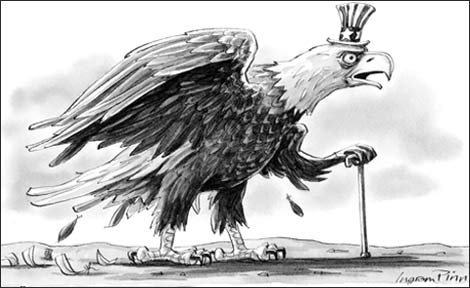
  By Richard Falk Prefatory Note With apologies for this long post, which attempts to situate the struggle for an ethically and ecologically viable political future for the United States and the world in the overheated preoccupation with Trump and Trumpism, which is itself a distraction from the species challenges confronting the whole of humanity at the present time. Many of us, and I include myself, have allowed the side show to become the main attraction, which is itself a reason for struggle against the enveloping darkness.   The Psycho-Politics of Geopolitical Depression It should not be all about Trump, although his election in 2016 as U.S. president is symptomatic of a menacing national tailspin. This downward political drift in the United States, not only imperils Americans, but threatens the world with multiple catastrophes, the most worrisome of which involves Trump’s double embrace of nuclearism and climate denialism. Unfortunately at...
NukeNPR_WordCloud
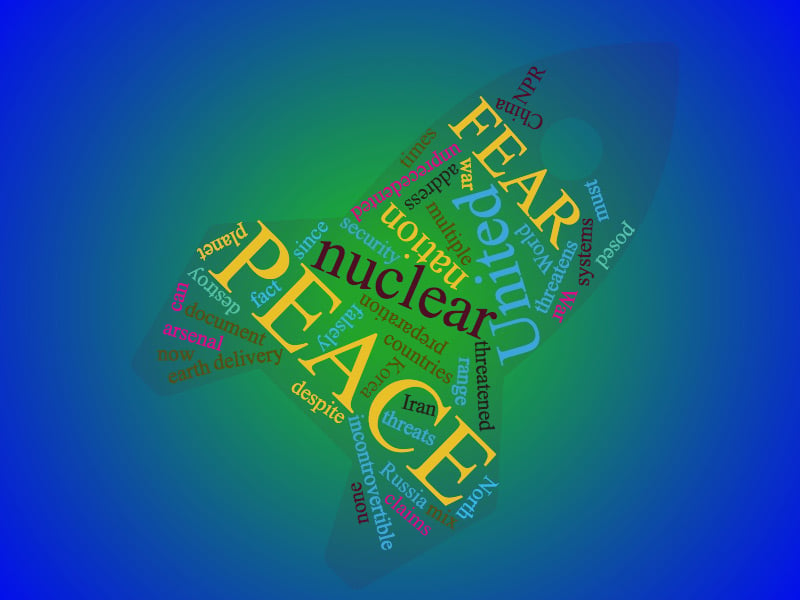
  Robert J. Burrowes February 18, 2018 • The United States Department of Defense released its latest ‘Nuclear Posture Review 2018’ (NPR) on 2 February, updating the last one issued in 2010 during the previous administration. See ‘Nuclear Posture Review 2018’. The Executive Summary of the NPR is also available, if you prefer. See ‘Nuclear Posture Review 2018 Executive Summary’. Several authors have already thoughtfully exposed a phenomenal variety of obvious lies, invented threats, strategic misconceptions and flaws – such as the fallacious thinking behind ‘deterrence’ and significantly increased risk of nuclear war given the delusional ‘thinking’ in the document – as well as the political fear-mongering in the NPR. For example, eminent scholar Professor Paul Rogers has pointed out: ‘The risk now is that we are on a slippery slope towards “small nuclear wars in far-off places”, which themselves could either escalate or at the very least break the...
NoEvidence
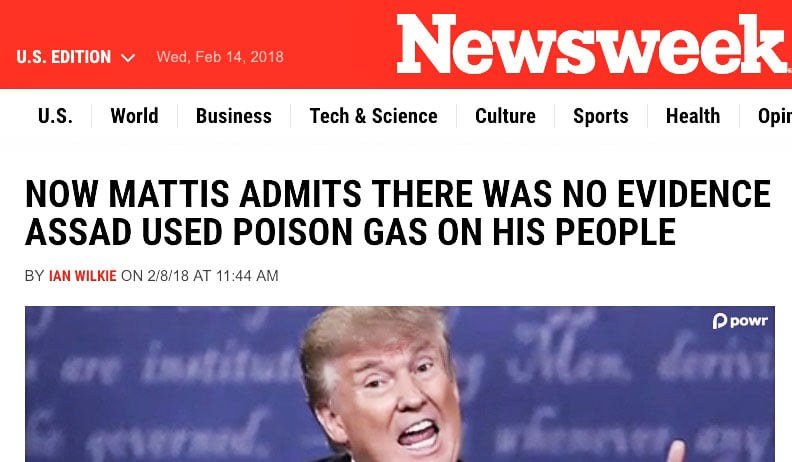
82b7f244a4b771c73a0b601ec5″>Associated Press – right out of the Secretary of Defence’s own mouth. Newsweek picked up this – breaking – story but virtually no one else. Compare that with thousands upon thousands of articles throughout the Western press just parroting American officials’ statements, including President Trump’s when he found it appropriate in April 2017 to attack Syria with cruise missiles to teach “the regime” and its “dictator” a lesson for its alleged attack on Khan Seykhoun, stating that “there can be no dispute that Syria used banned chemical weapons.” Some of us thought it was a bit too early because there could be no dispute either about another, much more important, thing – namely that, at the time, there could not have been any evidence collected or analysed. TFF and its Associates has stated a few things about the media coverage of Syria in general and the chemical attacks in particular...
images
By Robert J. Burrowes 24 Jan 2018 • As our world spirals deeper into an abyss from which it is becoming increasingly difficult to extricate ourselves, some very prominent activists have lamented the lack of human solidarity in the face of the ongoing genocide of the Rohingya. See ‘The Rohingya tragedy shows human solidarity is a lie’ and ‘Wrongs of rights activism around Rohingyas’. While I share the genuine concern of the Yemeni Nobel peace laureate Tawakkol Karman and Burmese dissident and scholar Dr Maung Zarni, and have offered my own way forward for responding powerfully to the ongoing genocide of the Rohingya – see ‘A Nonviolent Strategy to Defeat Genocide’ – in my view the lack of solidarity they mention is utterly pervasive and readily evident in our lacklustre official and personal responses to the many ongoing crises in which humanity finds itself. To mention just the most obvious:...
cropped-davidindc-1-e1516137163905
By David Swanson Remarks at Peace and Justice Studies Association Conference in Birmingham, Alabama, October 28, 2017. Thank you for inviting me. Can everyone who thinks that war is never, and can never be, justified please raise your hand. Thank you. Now if you think every war is always justified. Thank you. And finally all the moderates holding the balanced subtle middle ground: some wars are justified. Thank you. You may not be surprised to hear that this room is not typical of this country. Typical is for absolutely everyone to pile into that last group. The relationship between peace and war is clearly not understood by the U.S. public as along the lines of that between alive and dead. Peace and war are things people imagine can coexist. In Virginia, where I live, a school board member once said he would support recognizing the international day of peace as...
Imagen-thumbnail-The-Transnational
Shock. It’s a word that has come up a lot since November – for obvious reasons.I’ve spent a lot of time thinking about shock. Ten years ago, I published “The Shock Doctrine,” an investigation that spanned four decades from Pinochet’s U.S.-backed coup in 1970s Chile to Hurricane Katrina in 2005. I noticed a brutal and recurring tactic by right wing governments. After a shocking event – a war, coup, terrorist attack, market crash or natural disaster – exploit the public’s disorientation. Suspend democracy. Push through radical “free market” policies that enrich the 1 percent at the expense of the poor and middle class. The Trump administration is creating chaos. Daily. Of course many of the scandals are the result of the president’s ignorance and blunders – not some nefarious strategy. But there is also no doubt that some savvy people around Trump are using the daily shocks as cover to...
Evelin_Lindner_2017
New book by Evelin Lindner • Humankind has reached a boiling point. Violence, hatred, and terror have become deeply entangled with honor, heroism, glory, loyalty, and love. Over the past five percent of modern human history on planet Earth, roughly the past ten millennia, human activity has reached a crescendo of rapid and ruthless competition for domination, a fight for power over people and the planet, where “might” has become “right.” Within this context, a dangerous culture of honor has evolved, in which destruction is mercilessly merged with love: “It is my duty, if I love my people, to heroically destroy our enemies and secure all resources for us,” underwritten by an ominous motto: “If you want peace, prepare for war.” Humanity has haphazardly constructed an entire world-system on top of this merger, holding the whole world hostage through never-ending cycles of domination and humiliation. The consequence, today, is the...

lenin_300
• Published in Bulletin of Peace Proposals 3-1990, pp 287-298 and on TFF’s homepage at the same time   1. Four hypotheses The West has lost a close enemy, the Soviet Union and Eastern Europe. Which reactions can be discerned and what psycho-political emotions are they indicative of? How did the West cope with the first years of this new post-Cold War situation? Can we mourn the death of an enemy, can we heal ourselves after the loss? How does one learn to live a new life without a close enemy? Has the West done what it ought to do for itself and for the former enemy? “The West” of course is a term hanging loose. We employ it in this article as meaning interchangeably “NATO, the Western hemisphere, the United States and Western Europe and a few cases, Western or Occidental culture”. The first hypothesis of this essay is...
Fall-of-Jerusalem
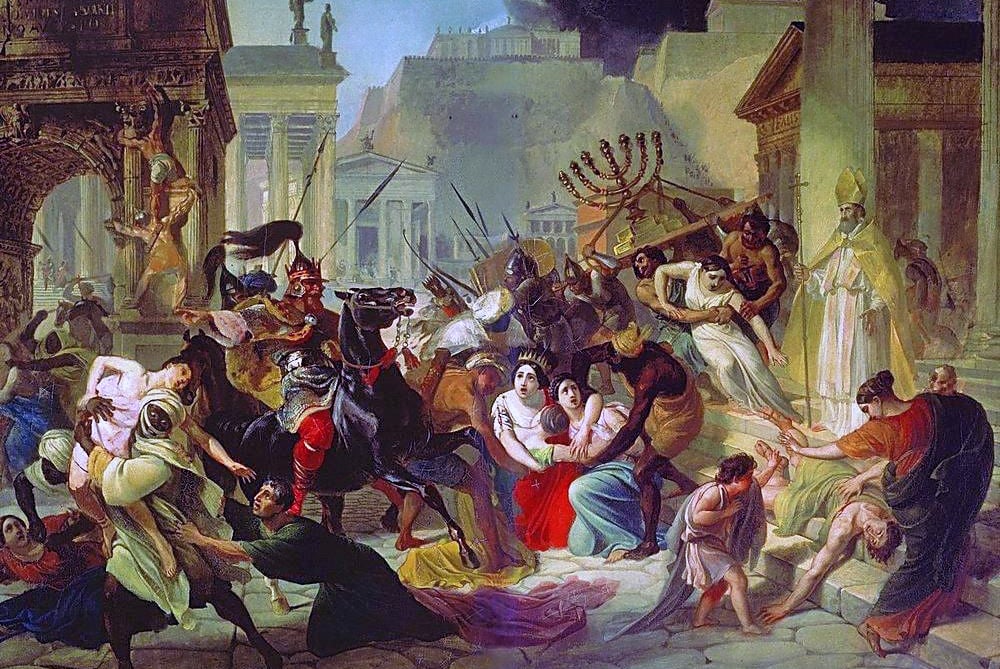
  By Brandon Marlon Neither are great civilizations built in a day, nor do they collapse all of a sudden. Deterioration is gradual, therefore noticeable. In the Land of Israel, the First Temple was destroyed due to idolatry. The Second Temple was destroyed due to baseless hatred. In the 21st century, the subtler combination of irrationality with pusillanimity constitutes the fatal concoction. Our relationship to the obvious serves as an index through which the symptoms of decline are noted. Via algemeiner.com Let all concerned for the commonwealth take caution, for here is how we sophisticated moderns lose civilization: Cognitive Dissonance – A cerebral malfunction resulting in psychological blindness. We see something perfectly well but fail to recognize what it evidently is. A mental block prevents us from acknowledging the obvious. Denial – The matter become clearer and reality loses its blur, yet we stubbornly refuse to admit what the matter...
Imagen-thumbnail-The-Transnational
  By Roberto Savio •This op-ed by Roberto Savio, IPS founder and President Emeritus is adapted from a statement he made as a panelist on Migration and Human Solidarity, A Challenge and an Opportunity for Europe and the MENA region held on 14 December at the Geneva Centre for Human Rights Advancement and Global Dialogue.   ROME, Dec 14 2017 (IPS) – The misuse of religion, of populism and xenophobia, is a sad reality, which is not clearly addressed any longer, but met with hypocrisy and not outright denunciation. Only now the British are realizing that they voted for Brexit, on the basis of a campaign of lies. But nobody has taken on publicly Johnson or Farage, the leaders of Brexit, after Great Britain accepted to pay, as one of the many costs of divorce, at least 45 billion Euro, instead of saving 20 billion Euro, as claimed by the...
Categories

Year

Author / Contributor

Region