Military

Category

Year

Author / Contributor

Region

Sort by

Showing 1-10 of 287 stories

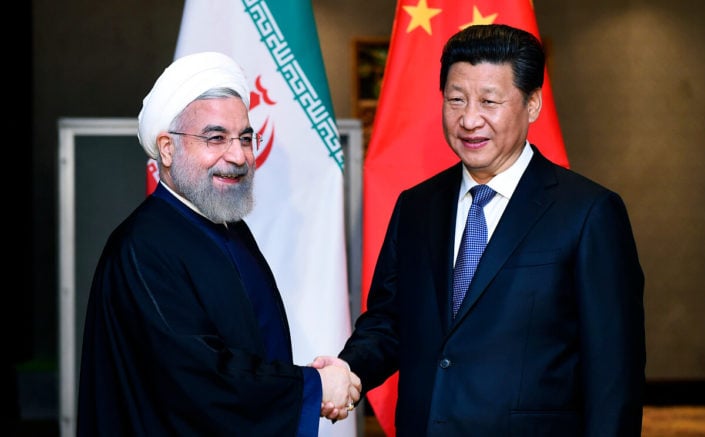
xjp-iranrowhani-705x437
By Sabena Siddiqui September 20, 2019 Facing an economic crisis in large part due to US sanctions, Iran soon may be aligning its policies toward China’s. Having recently updated the terms of a 25-year strategic partnership signed with Beijing in 2016, it looks like Tehran is indeed returning to its Look East foreign policy. Originally posted on Al-Monitor’s website September 17, 2019 here Considered an important player in Chinese President Xi Jinping’s Belt and Road Initiative (BRI) megaproject, introduced in 2013, Iran has been pursued by Beijing for its energy resources and strategic location. But when economic sanctions on Iran were lifted under the Joint Comprehensive Plan of Action (JCPOA) nuclear deal in 2015, Iran preferred to do business on a global basis. Instead of committing to an eastward-looking foreign policy at that time, Tehran tried to maintain a balance. However, since the United States withdrew from the nuclear deal in May 2018, Europe...
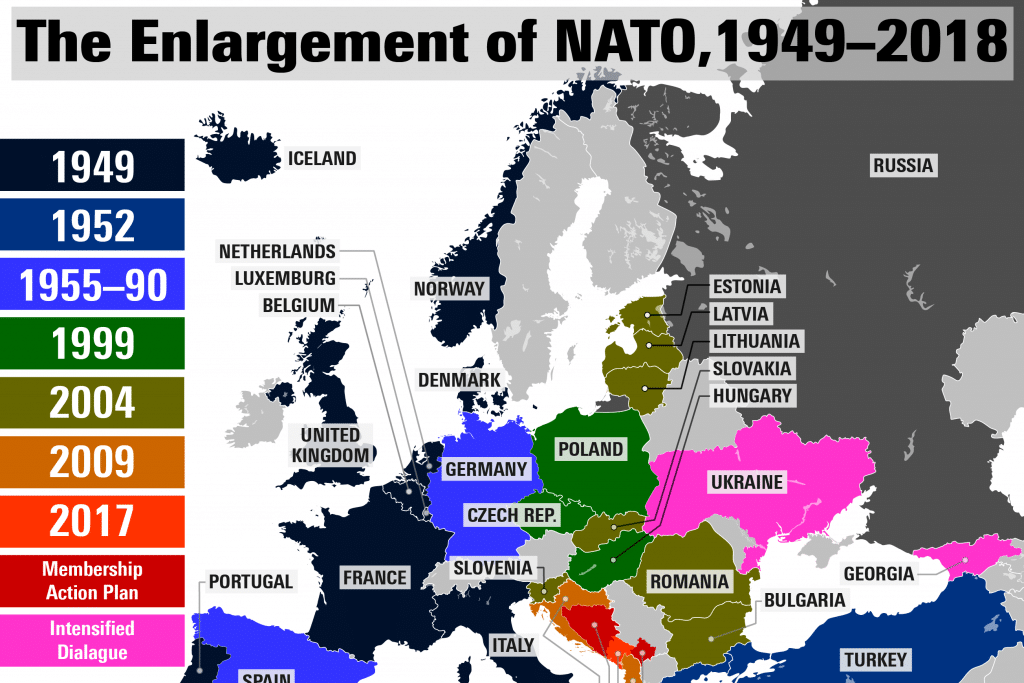
The-enlargement-of-NATO-1949-2018_cropped_3x2
By Gordon M. Hahn July 25, 2019 NATO expansion has contributed to the causal matrix of two wars: the 2008 Georgian-South Ossetiyan/Russian Five-Day War and the ongoing Donbass civil war. The West’s April 2008 promise that both Georgia and Ukraine will become NATO members encouraged Georgian nationalism and Saakashvili’s war in South Ossetiya and consequently led to Georgia’s de facto loss of its South Ossetiyan as well as Abkhaziyan territories. Originally published on Gordon M. Hahn homepage – while Poroshenko was still president. Similarly, NATO expansion encouraged the rise of ultranationalism in Ukraine, especially western Ukraine, and the ultra-nationalist-led February 2014 Maidan revolt, leading to Ukraine’s loss of Crimea and civil war in eastern Ukraine’s Donbass regions of Donetsk and Luhansk. NATO expansion now is poised to help re-start the Donbass civil war or spark a larger Ukrainian civil war (and/or similar conflicts involving Moldova and its breakaway republic of...
IMG_7593_1000_72
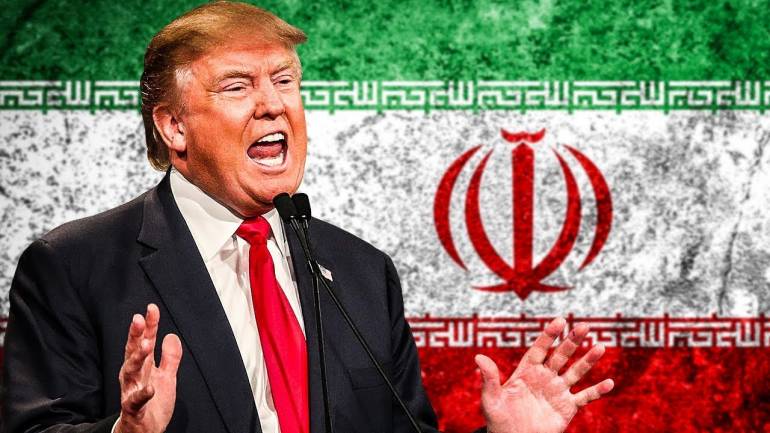
On Monday, 13 May 2019, the New York Times posted an article with the title “White House Reviews Military Plans Against Iran, in Echoes of Iraq War”. Besides the aircraft carrier and other naval forces already sent to the Persian Gulf, plans include sending as many as 120,000 US troops to the region. There is a great danger that an attack on Iran might be sparked by a Gulf-of-Tonkin-like false flag incident involving Saudi oil ships. On Sunday, 19 May, Donald Trump tweeted: “If Iran wants to fight, that will be the official end of Iran. Never threaten the United States again!”. He did not specify how or when Iran had threatened the US. Why is the possibility of a military attack on Iran especially worrying? Such a war would completely destabilize the already-unstable Middle East. In Pakistan, the unpopularity of the US-Israel-Saudi alliance, as well as the memory of...
US-sanctions
Trump’s statement amounts to a de facto declaration of war on Iran. Objectively speaking, it is a lie that Iran threatens the US. It is a lie that the US sends aircraft carriers to the region in self-defence. It’s lies as blatant as the one about Saddam’s weapons of mass destruction. You may think that this is just psychological warfare and positioning. It is not. Because: Over time, this type of statements develop its own dynamics and the US will not be able to back down from what it threatens to do without loosing face. President Trump’s statement is a blatant violation of international law, the UN Charter’s Article 2.4 which states:“All Members shall refrain in their international relations from the threat or use of force against the territorial integrity or political independence of any state, or in any other manner inconsistent with the Purposes of the United Nations.” In...
Framtiden
Av Erni & Ola FriholtTFF Associerade 6:e april 2019 2018 sände Myndigheten för samhällsskydd och beredskap (MSB) en broschyr till Sveriges invånare. Den heter ”Om krisen eller kriget kommer”, och inleds med rubriken ”Vad skulle du göra om din vardag vändes upp och ner?” På nio punkter visas akut vattenbrist, el-brist, matbrist, drivmedelsbrist, icke-fungerande data, betalkort, transporter och slutligen brist på medicinsk behandling. Och svaret på denna utmålade kris är att hamstra viktiga livsmedel, kontanter, vatten och energi. Dessutom manas vi vara vaksamma mot falsk information och terrorattentat. Och om kriget kommer manas vi att inte ge upp. Detta är de förberedelser som rekommenderas av Sveriges högsta myndighet för vårt skydd. Vi får anta att detta skydd kompletteras av och inordnas i det militära försvaret. Allt är som förut Det är inte fel att vara förberedd för hårdare tider. Men det har stor betydelse hur de befarade tiderna kan förväntas...
sipri
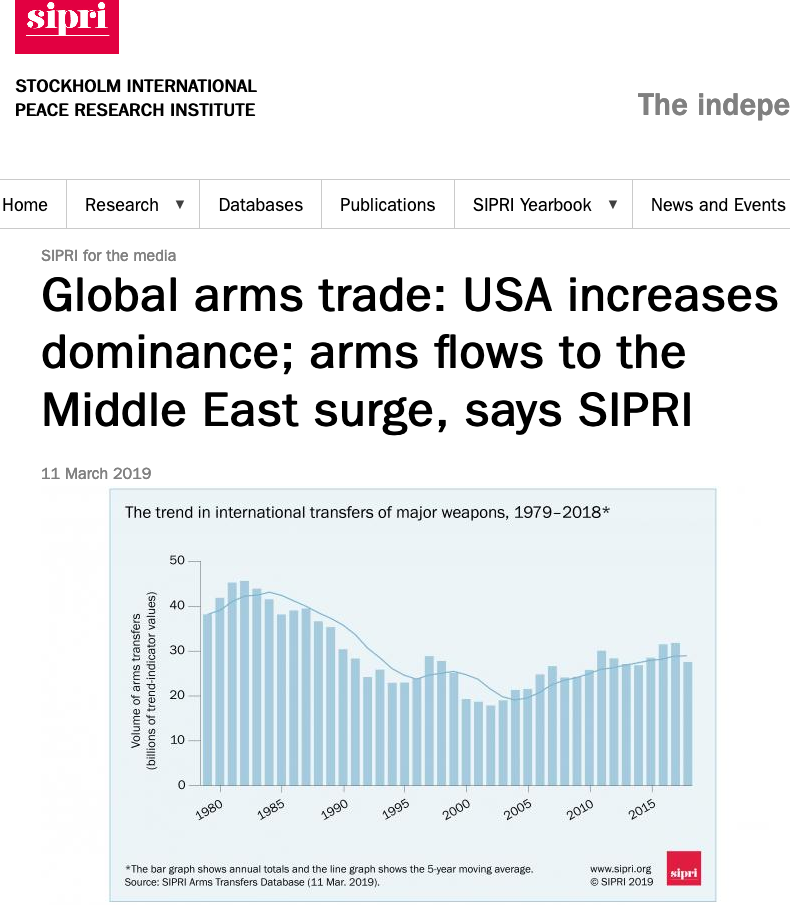
SIPRI latest analysis of the global arms trade is just out. When one reads the summary, one may ask: If not now, when is the time to criminalize the international arms trade? Weapons imported into warzones have – without exception – four major effects: a) those who buy or receive the weapons get emboldened to continue war rather than seek a negotiated solution; b) the wars last longer than they otherwise would had there been a moratorium by all external factors on these sales to conflicting paeties; c) human suffering and social costs increase because of a) and b); d) the arms trade economy and world is an integral part of global law-violating behaviour, mafiosi, terrorism, dirty money, corruption, death, drugs, trafficking – you name it. A murky community, indeed. In addition, arms trade is the most immoral of all: private and government dealers sell arms mainly to earn money....

NATO_Russia_US_800_450_80
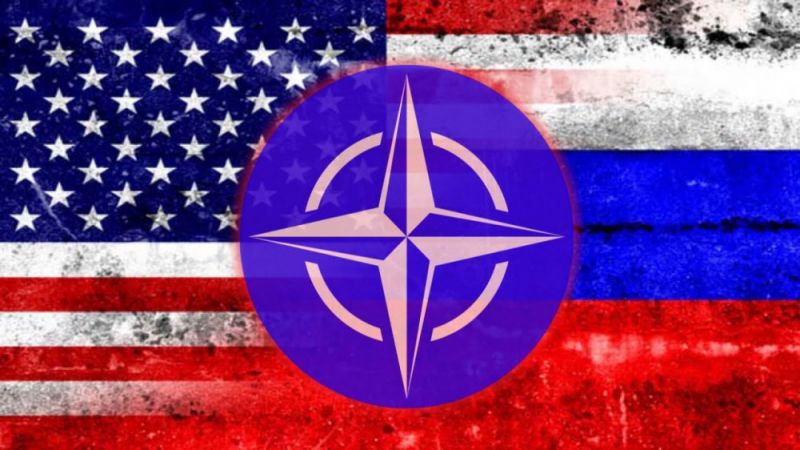
By Gordon M. Hahn January 29, 2019 The alienation of post-Cold War Russia has proceeded in waves. Each successive Western overreach for not just maintaining but expanding its global hegemony has produced a new wave of Russian alienation. What will probably be the last wave, one that might help spark a wave of ultra-nationalism afterward has begun. This new wave is alienating the West’s last base of support for Russian democratization and international cooperation: Russia’s liberals. The first wave: The alienation of Russia began with the West’s failure to significantly assist Russia during its very great depression and talk of NATO expansion in the early 1990s but was staunched somewhat by the then still unbroken Western promise not to expand NATO beyond reunited Germany. This alienated a large part of the elite. Originally published on Gordon M. Hahn’s excellent blog here The second wave of Russian alienation began with the...
Portable-War-Memorial
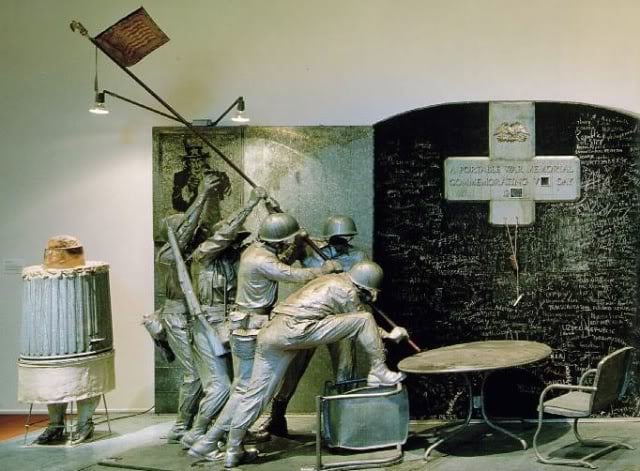
By Dragana Maksimovic January 28, 2019 The author, MA student at University of Belgrade, become a TFF Associate in 2018. More here. There is one thing about which many peace researchers disagree and constantly debate: Are we really living in the most peaceful era ever, or are we facing a dangerous era of conflicts and struggles for global supremacy – very often masked as a fight for human rights but which can lead to a global war? There are those who agree with Steven Pinker when he claims that “today we are living in a most peaceful time in our species’ existence” (1) or with Barack Obama, the 44th president of The United States, who wanted to highlight how “worth it is reminding ourselves of how lucky we are to be living in the most peaceful, most prosperous, most progressive era in human history.’’ (2) Trying to validate his claims,...
RT
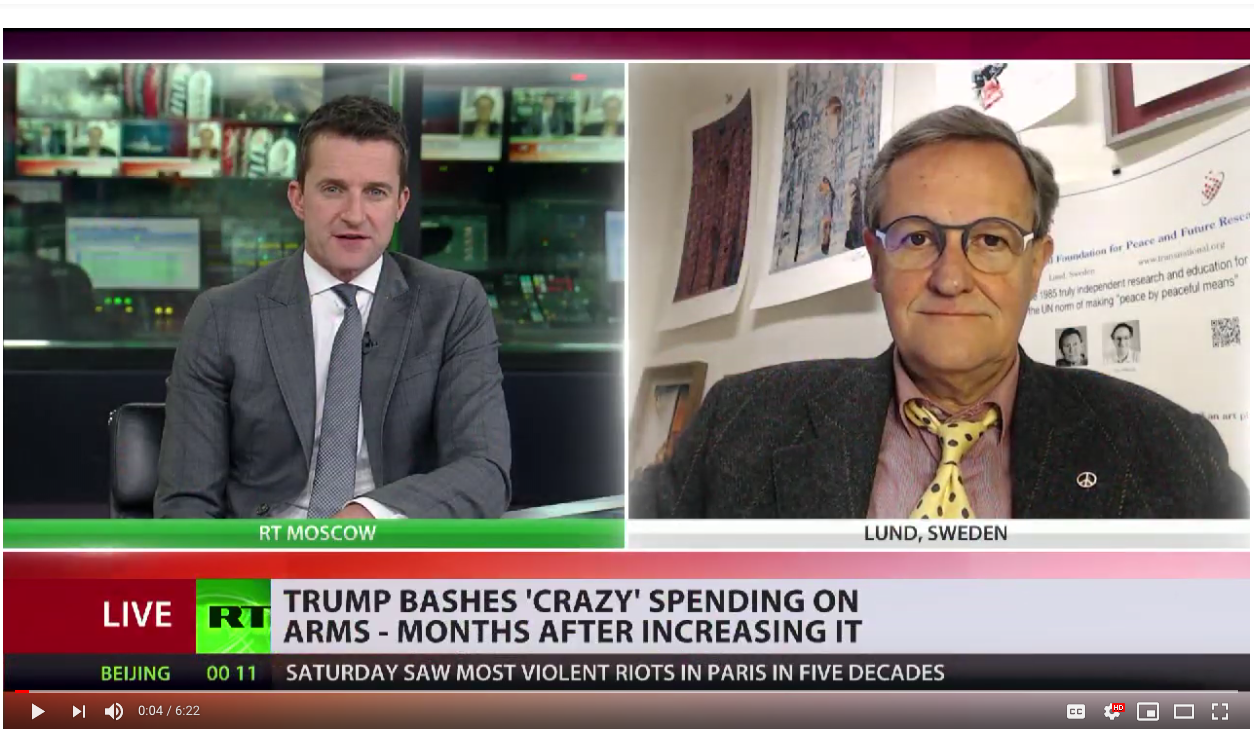
How interesting! President Trump tweets on December 3, that he believes that the present level of military expenditures are ‘crazy’ – and he wants to talk with China and Russia about reducing them. I was asked by Russia Today to comment on that and here is what I said – being granted long enough time to deliver the longer argument which is unusual in most media today. Russia Today then asked me some more questions and here are the answers:
Skaermbillede-4
Photocredit: nousnatobases.org   By Mairead Maguire, Nobel Peace Laureate and TFF Associate Presented at the International Conference against US/NATO Military Bases, 16-18 Nov 2018, Dublin, Ireland. November 27, 2018   Dear Friends, It is good to be here with you all. I would like to thank the organizers for inviting me to address the conference. Firstly I thank you all for your work for peace. It is good that we will have an opportunity in the next few days to get to know each other and together discuss what kind of a world we want to live in? There will be many different perspectives on this and the way forward, but let us agree to respect each other and to engage in deep listening and conversation no matter how hard and where the dialogue might take us! Originally published at transcend.org Let us be encouraged by the fact that we have made...
GarethPorter-e1540558470864
Eisenhower’s worst nightmare has come true, as defense mega-contractors climb into the cockpit to ensure we stay overextended   By Gareth Porter November 20, 2018 What President Dwight D. Eisenhower dubbed the “military-industrial complex” has been constantly evolving over the decades, adjusting to shifts in the economic and political system as well as international events. The result today is a “permanent-war complex,” which is now engaged in conflicts in at least eight countries across the globe, none of which are intended to be temporary. This new complex has justified its enhanced power and control over the country’s resources primarily by citing threats to U.S. security posed by Islamic terrorists. But like the old military-industrial complex, it is really rooted in the evolving relationship between the national security institutions themselves and the private arms contractors allied with them. Originally published at theamericanconservative.com The first phase of this transformation was a far-reaching privatization...
NotIranToo_FR_4_72dpi_ForNet
  Utterly destructive, self-defeating and spelling the end of the U.S. Empire   By Farhang Jahanpour September 22, 2018 In view of the macro-historical perspective on the Middle East-West relations and the concrete cases referred to in this series – Afghanistan, Iraq, Libya and Syria – it is clear that the demonization of Middle Eastern leaders as a prelude to invasion and their downfall has a long history. Such rulers are often used to serve the economic and political interests of various Western countries, in the same way that the Saudi Crown Prince Mohammed Bin Salman and the United Arab Emirates’ Crown Prince Mohammad Bin Zayed are being used at the moment to make them purchase tens of billions of dollars’ worth of US, British and French weapons. When they have outlived their usefulness, they will probably meet the same fate as that of Qadhafi or Saddam Hussein. However, despite...
Categories

Year

Author / Contributor

Region