Media

Category

Year

Author / Contributor

Region

Sort by

Showing 1-10 of 546 stories

JOSyria
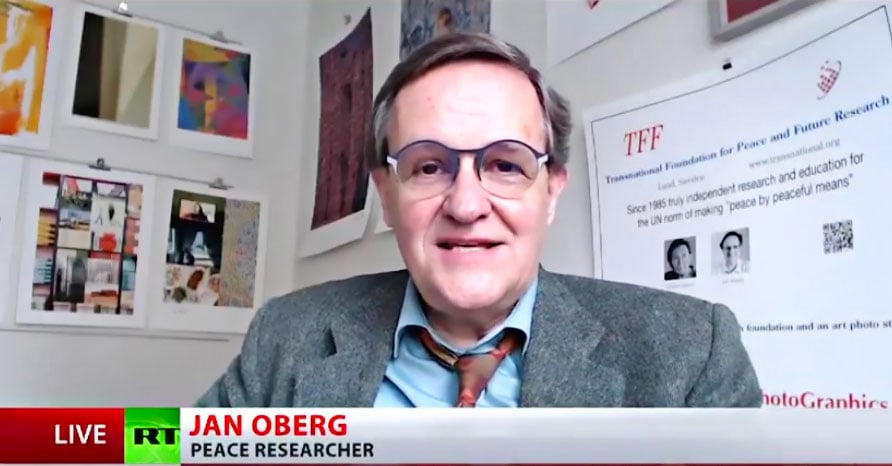
  , speaks with Russia Today and points out why this type of behaviour is totally unacceptable: It violates international law, undermines the UN and brings Syria, the region and the world further and further from peace. The people behind it and their media and other supporters must be perceived as either conflict- and peace illiterate or advocates of criminal activity. Both of which are tragic and making already dark times darker. We must say stop and argue: Peace first – The Secure the peace. In addition, contrary to the Western/NATO belief this is self-destructive and self-isolating. The international so-called community is, for the large majority, not behind this type of policy.
Screenshot
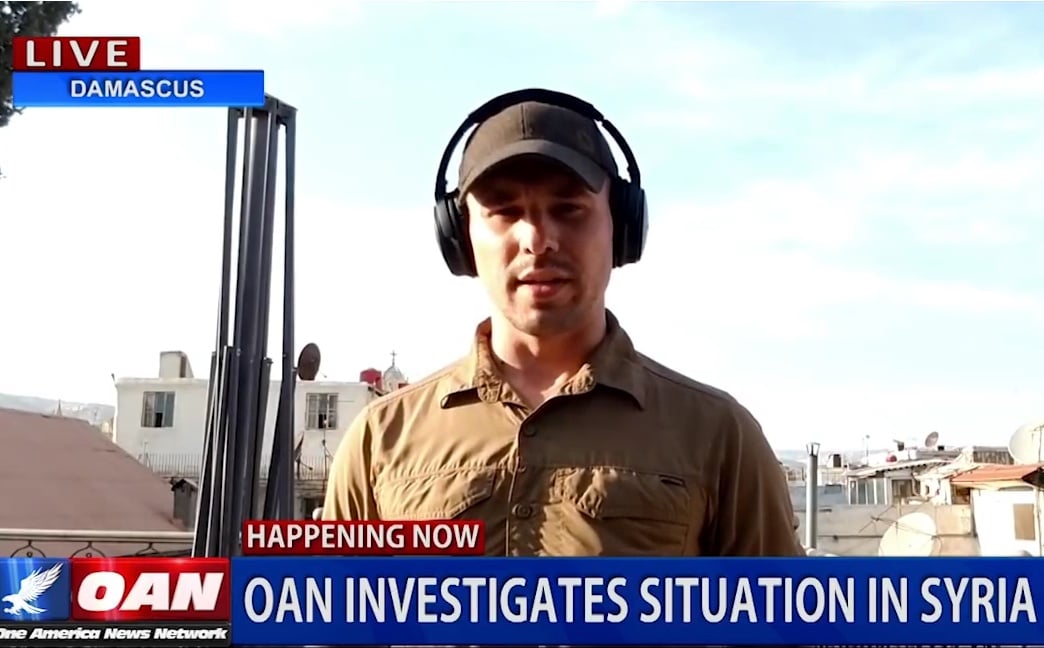
  By One American News Network April 17, 2018 This reporter, Pearson Sharp, tells you what he believes he knows and does not know. He tells you how he did his investigation and whether or not he felt free to report from this very difficult site – in Douma, Ghouta in Syria, after the alleged chemical attack on April 7, 2018 which caused the U.S., Britain and France to bomb what they believe to be chemical weapons facilities and stores in Syria on April 14, 2018. Being on the spot with that sort of quality reporting lends more credibility to this report than the far majority of reporters, editors and media that did not do their own investigations but quoted someone else – leading, as it often does, to dangerous “group think” and uniform, dependent reporting in support of an already constructed media narrative. Mainstream media in the bombing countries...
Screenshot
  By Jan Oberg At Sputnik Radio on April 15, 2018 Conversation after the US-French-British bombing of Syria in April 2018 The US, UK and France have drafted their own resolution on Syria after Russian-drafted initiative was rejected. The resolution proposed by the three nations condemns Syrian alleged chemical attacks and calls for creating an independent mechanism for investigation of similar incidents. Earlier, the United Nation Security Council rejected a Russia-drafted resolution condemning the missile strikes against Syria. The Russian mission to the UN reported that eight nations opposed the initiative, while four members abstained from voting. Radio Sputnik discussed the West’s actions against Syria from the international law perspective with Dr. Jan Oberg, the director of the Transnational Foundation for Peace and Future Research. Listen to the conversation here For more stories visit our website www.sputniknews.com
Rsr28ke0_400x400
By Tim Hayward April 8, 2018 Allegations of a chemical attack in Douma by Syria on 7 April were met by threats from President Trump to attack Syria. These were followed by Israeli missile strikes on an airfield in Homs early on 9 April. Given the pace of events and their significance for potential escalation in tensions between the Western powers and Russia, it is helpful to have timely information about questions that are under investigation by independent researchers. This post will be updated as and when insightful contributions are published, including as work in progress. Comments are open to allow for readers’ further recommendations and observations. Originally published on Tim Hayward’s blog here Tim Hayward updates this post on his blog on an almost daily basis so do go there after you’ve read these posts In the media Major-General Jonathan David Shaw CBE is interrupted by Sky News interviewer...
Logo2018-Green-1
Lund, Sweden – April 14, 2018 Statement by Associates of TFF – The Transnational Foundation for Peace and Future Research Summary The US-British-French attack is a clear and indisputable case of aggression according to international law, and to the UN Charter in particular. And it lacks, like many unilateral wars before it, a UN Security Council mandate. It comes as a consequence of interventionist impulses and militarism and lacks every element of a comprehensive conflict analysis, or diagnosis. Even if one assumes that the government and president of Syria are the main/only culprits and the worst violaters of human rights on earth, the way that the Syrian conflict has been handled by Western governments over the past seven years has been outrageously wrong and counterproductive. It’s been deliberate conflict-mismanagement combined with peace-prevention. Conspicuously, this aggression on Syria takes place before there is a shred of evidence of what chemical weapons...
cropped-david6
    By David Swanson April 9, 2018 Back in the 1890s those who believed conquering a continent was killing enough (without taking over Hawaii, the Philippines, Cuba, Puerto Rico, etc.) included Speaker of the House Thomas Reed. He clipped an article out of a newspaper about a lynching in South Carolina. He clipped a headline about “Another Outrage in Cuba.” He pasted the two together (fake news!) and gave them to a Congressman from South Carolina who was pushing for a war on Cuba. The Congressman eagerly read the article, then stopped, looked puzzled, and remarked “Why, this isn’t Cuba.” Originally published on David Swanson’s Lets’ Try Democracy here I recommend trying this trick. Clip an article about Israelis murdering Palestinians, or some outrage in a U.S. prison or a Saudi square or under the rain of humanitarian bombs in Afghanistan, Pakistan, Syria, Yemen, Somalia, Iraq, Libya, or elsewhere;...

StephenFCohen
Several factors make this US-Russian Cold War more dangerous than its predecessor – is “Russo-madness” one of them?   By Stephen F. Cohen April 4, 2018 Stephen F. Cohen, professor emeritus of Russian Studies and Politics at NYU and Princeton, and John Batchelor continue their (usually) weekly discussions of the new US-Russian Cold War. (Previous installments, now in their fourth year, are at TheNation.com.) Originally published by The Nation here   Cohen has previously explained why the new Cold War is potentially even more dangerous than was its 40-year predecessor, citing factors such as the political epicenter’s now being on Russia’s borders, lack of a mutual code of conduct, and the unprecedented demonization of the Kremlin leader. He had not much considered the role of Russophobia because he thought it had not been a large causal factor, unlike anti-Communism, in the preceding one, recalling an episode in his own family...
SPARInstaLogoNOTextShadowLogo
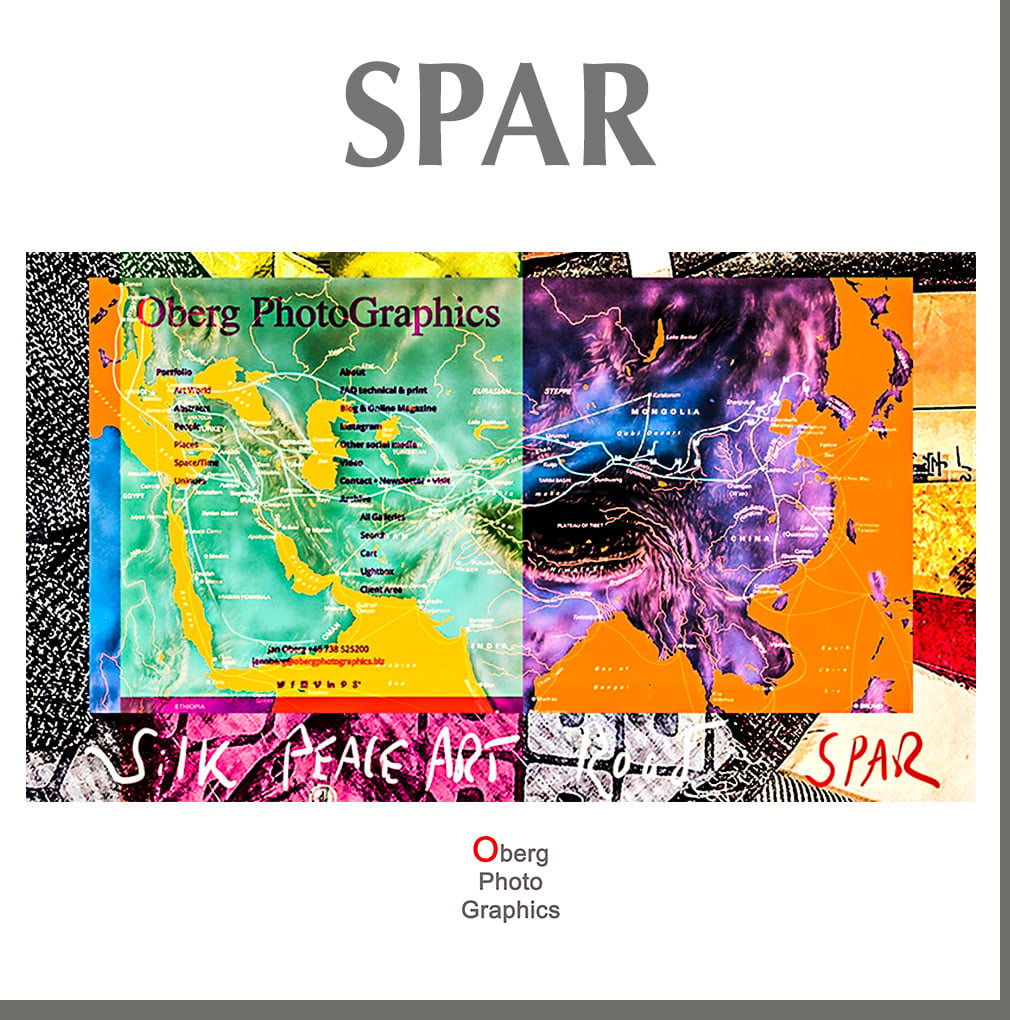
  . This exciting opportunity stimulated the development of a bigger idea that combines Oberg’s work for peace and art photography with a focus on the Chinese-initiated Silk Belt and Road Initiative, the largest and most visionary in today’s world in terms of linking people and cultures into cooperation rather than confrontation. In various ways the project – with the Road as metaphor – stretches from Shanghai over Myanmar, Kazakhstan, Georgia, Iran and Syria to Venice and seeks to promote cooperation and peace in the process. The “Silk PeaceArt Road” project is made public at this very early development stage where no funding is secured to encourage you to share co-operative ideas, contacts you may have in China and along the Silk Road or to potential partners, artists, sponsors, art institutions, etc. The project integrates peace work and art photography and it is the first cooperative endeavour by TFF and...
1-1
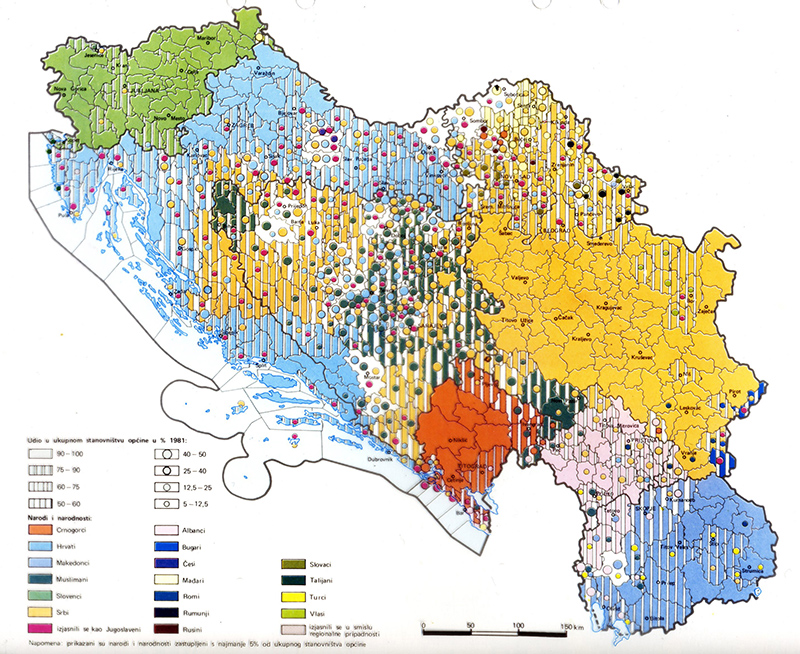
The ethnic map few understood. Should make it clear that cutting up Yugoslavia in independent republics could not be done without bloodshed. (1) Yellow = Serbs, Dark Green = Muslims, Light Blue = Croats,  Light Green = Slovenes, Orange = Montenegrins, Pink = Albanians, Darker Blue = Macedonians   , marks the 19th anniversary of NATO illegal and illegitimate bombing of Yugoslavia, Serbia and its Kosovo, province during 78 days. It has – one is tempted to say: of course – been conveniently forgotten by the West itself. It was masterminded by the United States under Bill Clinton and Secretary of State Madeleine Albright after the so-called negotiations between Serbs and Albanians in Rambouillet outside Paris (the parties never met face-to-face) While Clinton may be best remembered for his relations with Monica Lewinsky and his wife, Hillary Clinton, some of us also remember him (and Albright) for bombing Afghanistan, Sudan,...
Screenshot
    On March 17, 2018, New York Times posted “How Trump Consultants Exploited the Facebook Data of Millions.” Here is the background as covered by Washington Post. Here is an in-depth undercover investigation by Channel 4 News that reveals how Cambridge Analytica secretly campaigns in elections across the world. Bosses are filmed talking about using bribes, ex-spies, fake IDs and sex workers.     Jan Oberg comments We’ve heard a lot about Russian meddling in the US Presidential election process. We hear daily media stories of just how brilliant Russia’s performance is in the ongoing media/propaganda war. This documentary is deeply disturbing because it reveals the utter decay in business and political ethics that now influence elections processes in what was supposed to be democracies. It seems plausible to me that the pointing of fingers at Russia – which of course also use media manipulations – is a kind...
johangaltung
* Today marks the 15th Anniversary of the US invasion of Iraq. Neither solid analyses, moral reasoning and decent argument nor history’s probably largest pre-war, anti-war demonstrations worldwide had any discernible impact on the Bush and Blair Administrations’ decision to go to war and do so on a false pretext. Neither could major allies like France and Germany by their opposition to the war on Iraq persuade Washington and London to first try a peaceful resolution in accordance with the UN Charter provisions. TFF was deeply engaged in preventing this war – also by being on the ground in Iraq – and wants to a) document the research we did and how we argued back then and b) contribute to this tragedy never being forgotten. We also want to place our analyses and debate articles at the disposal – in one place – of the students, researchers, concerned citizens and...
longform-original-6525-1518215990-10
  By Charlie Warzel In mid-2016, Aviv Ovadya realized there was something fundamentally wrong with the internet — so wrong that he abandoned his work and sounded an alarm. A few weeks before the 2016 election, he presented his concerns to technologists in San Francisco’s Bay Area and warned of an impending crisis of misinformation in a presentation he titled “Infocalypse.” The web and the information ecosystem that had developed around it was wildly unhealthy, Ovadya argued. The incentives that governed its biggest platforms were calibrated to reward information that was often misleading and polarizing, or both. Platforms like Facebook, Twitter, and Google prioritized clicks, shares, ads, and money over quality of information, and Ovadya couldn’t shake the feeling that it was all building toward something bad — a kind of critical threshold of addictive and toxic misinformation. The presentation was largely ignored by employees from the Big Tech platforms...
Categories

Year

Author / Contributor

Region