Media and conflict

Category

Year

Author / Contributor

Region

Sort by

Showing 1-10 of 206 stories

untitled-news
By Helmut Scheben* July 18, 2023 Mass media are often unreliable, but hardly anyone has time to check the news. If news reports later turn out to be false, they are usually already burned into the hard drive of collective memory as “historical truth”. Originally published at Zeit-Fragen After the Gulf War of 1991, it was forbidden for the media in the US to show pictures of the coffins of American soldiers killed in combat. This prohibition was lifted only in February 2009. Filming dead or wounded US soldiers were also banned, and the ban was enforced with extreme severity, especially during the Iraq war, as cameramen reported. Once, when I was looking for such footage in the vast archives of Swiss television, I found a single sequence that lasted about three seconds. An American soldier was trying to climb out of a burning tank. Three seconds out of thousands...
CancelCulture
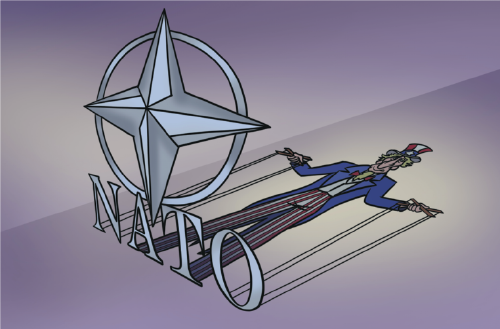
Just a little public relations for ourselves – Perspectives like these are now completely cancelled by Western mainstream media – MSM – US NATO mouthpieces. But we reach millions outside the West, and that is what matters for the future. Jan Oberg July 14, 2023 🔻 RT “CrossTalk” with Peter Lavelle, July 13, 2023NATO’s Epic Fall with Jan Oberg, Misty Winston, and Mike Jones. 🔻 Global Times, Beijing, July 13, 2023US-Nordic Summit sees NATO expansion, confusion and repetition 🔻 China’s Xinhua News Agency in English, July 12, 2023Three articles using quotes:Interview: NATO’s policies are gross violation of its own charter, int’l law, says Swedish expert.Roundup: NATO fails to give timetable for Ukraine membership at summit.NATO summit sparks global security concern, internal rifts remain 🔻 China’s national television, CCTV, July 12, 2023Jan Oberg: Three comments related to NATO’s Vilnius Summit新闻直播间]瑞典智库学者表示 北约自诩防御联盟 却持续扩张引发冲突Shared also by 163.com, CZTV.com, Jxnews.com.cn, Huanqui.com. 🔻 China Daily,...

64ab526ba310bf8a1d23b9bc
Jin Ding – China Daily Jan Oberg July 10, 2023 NATO’s next summit will take place in Vilnius, Lithuania, on July 11-12. Almost on the day 26 years ago – July 8-9, 1997 – NATO held a summit in Madrid which confirmed ”The Founding Act on Mutual Relations, Cooperation and Security Between NATO and the Russian Federation” – in other words, a permanent NATO-Russia Forum – that had been signed by Yeltsin and Clinton in Paris on May 27. M. E. Sarotte’s brilliant 550-page analysis ”Not One Inch. America, Russia, and the Making of Post-Cold War Stalemate” can be read as one long illustration of how the US – and thereby NATO – in reality, has operated on a big-brother, condescending and manipulative attitude to Russia. Russia was never meant to become an equal partner, and whatever Russian concerns were taken into account, decisions were made to promote US/NATO interests...
5izqnd1e-c9811
Ukraine war: Lessons from the textbook of journalistic error Western journalists are all but unanimous that negotiating with Russia would equal forgiving its aggression. Nothing short of a crushing victory for Ukraine is conscionable. The risk of escalation is rarely mentioned. Serge Halimi & Pierre Rimbert July 3, 2023 This is from Le Monde Diplomatique a few months ago. It’s one of the most succinct and comprehensive analyses we’ve come across of the deep malaise called Western mainstream media and their coverage/promotion of NATO wars. And a scathing critique of the larger part of the so-called Left. Jan Oberg, editor Excerpt Eulogies, hugs, gushing questions: the Western press’s veneration of this president in khaki fatigues suggests media in thrall to political leaders. But that impression is misleading. Since Donald Trump’s election in 2016, and particularly since Russia’s aggression in Ukraine, ‘journalism’ in the United States and also in Europe has...
shaunreinsmall-1024x748
And you should listen carefully to how far he is from Western media and policy-makers who know close to nothing. A Cyrus Janssen Interview July 1, 2023 0:00 – What’s China Like in 2023? 0:53 – Who is Shaun Rein? 1:58 – China is Normal and Not Normal Right Now 4:03 – Why is Consumer Spending Down in China? 5:15 – How Geopolitics Are Changing Chinese People’s Mind 6:58 – Chinese Shopping Habits Have Changed 7:38 – How International Companies Are Looking at China 10:00– Can US and China Work Together? 11:15 – Why China is Turning to Global South 12:07 – Could Trump Solve US/China Tension? 13:37 – How Americans Are Being Conditioned to Hate China 15:05 – Where Should We Criticize China? 16:44 – Do Chinese Truly Support the Chinese Government? 19:36 – The Truth About Xinjiang and Uyghur Families 21:30 – What Do You Want the World...
cia
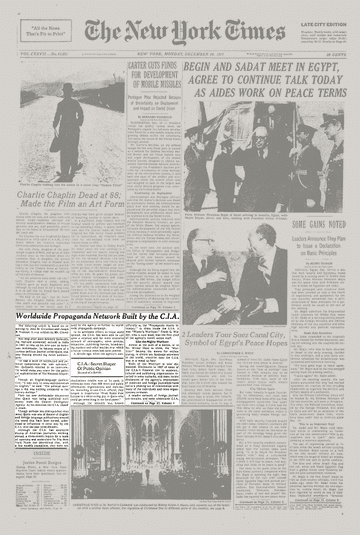
June 26, 2023 New York Times About the Archive This is a digitized version of an article from The Times’s print archive, before the start of online publication in 1996. To preserve these articles as they originally appeared, The Times does not alter, edit or update them. Occasionally the digitization process introduces transcription errors or other problems; we are continuing to work to improve these archived versions. Originally published in The New York Times on Dec. 26, 1977 Not long after John Kenneth Galbraith, the Harvard economist, arrived in India in 1961 to take up his new post as American Ambassador, he became aware of a curious political journal called Quest that was floating around the Asian subcontinent. The following oracle is bused on reporting by John M. Crewdson and Joseph B.Treaster. It was written by Mr. Crewdson. “It had a level of intellectual and political competence that was sub‐zero,”...
medium-20
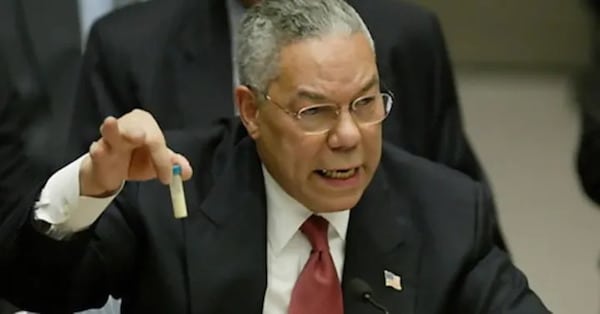
Caitlin A. Johnstone June 12, 2023 When most people in the English-speaking world hear the word “propaganda”, they tend to think of something that’s done by foreign nations who have governments that are so totalitarian they won’t even let people know what’s true or think for themselves. Others understand that propaganda is something that happens in their own nation, but think it only happens to other people in other political parties. If they think of themselves as left-leaning they see those to their right as propagandized by right wing media, and if they think of themselves as right-leaning they see those to their left as propagandized by left wing media. Originally published at Mronline, on May 28, 2023 A few understand that propaganda is administered in their own nation by their own media, and understand that it’s administered across partisan lines, but they think of it in terms of really egregious lies like weapons of...
defcnt
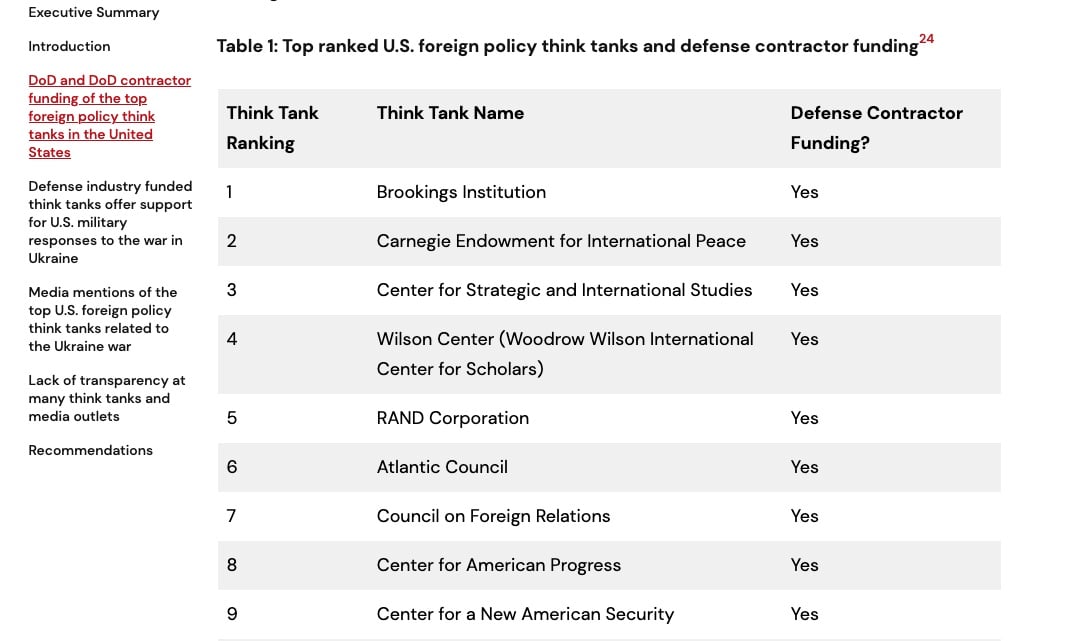
Ben Freeman, Quincy Institute for Responsible Statecraft June 5, 2023 Executive Summary (excerpts) “Think tanks in the United States are a go–to resource for media outlets seeking expert opinions on pressing public policy issues. But think tanks often have entrenched stances; a growing body of research has shown that their funders can influence their analysis and commentary. This influence can include censorship — both self-censorship and more direct censoring of work unfavorable to a funder — and outright pay–for–research agreements with funders. The result is an environment where the interests of the most generous funders can dominate think tank policy debates. One such debate concerns the appropriate level of U.S. military involvement in the Russian invasion of Ukraine… The analysis offers a number of key findings.  First, of the 27 think tanks whose donors could be identified, 21 received funding from the defense sector (77 percent). Unfortunately, because donor disclosure...
WarNoEndPaint
“Long before Trump and “deep state” became an expression, I produced one ginormous investigation — Top Secret America — for the Washington Post and I wrote a nasty book — American Coup — about the creeping fascism of homeland security.” William M. Arkin June 5, 2023 (When I wrote this open letter in January 2019, decrying NBC and the news media’s singular focus on Trump and their subsequent cheerleading for the state of perpetual war, I didn’t think that much would change, and indeed it hasn’t. When the letter went viral (thanks to Glenn Greenwald), all the news media could talk about was my attack on the news media, missing the basic point that we’d built a system of subservience and even subordination to the war machine, one that the news media fed. I wrote: “NBC and much of the rest of the news media has somehow become a defender...
a19feb55-8004-49fd-9491-7c642286e90c_12500x8333
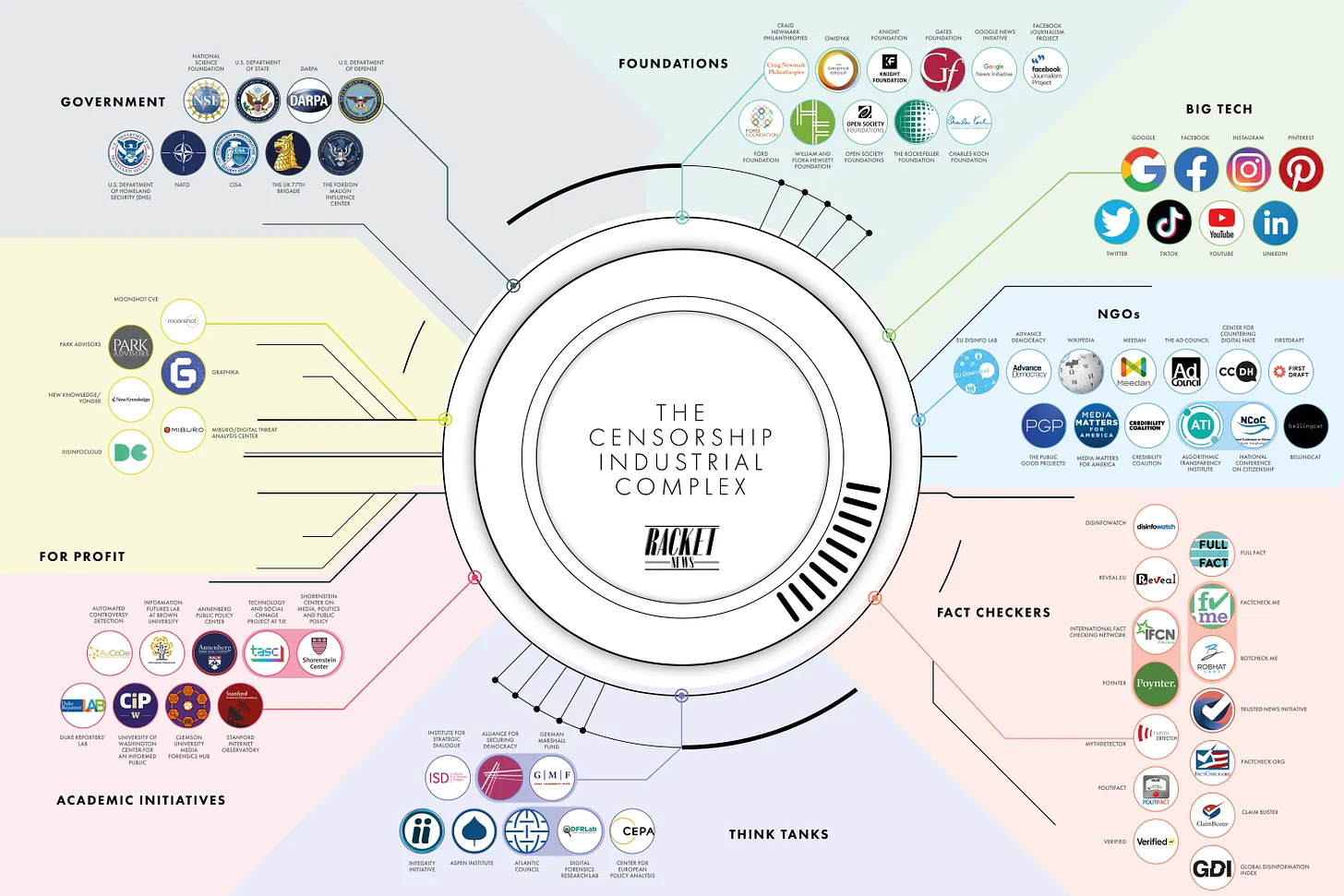
The citizen’s starter kit to understanding the new global information cartel Susan Schmidt, Andrew Lowenthal, Tom Wyatt, Techno Fog, and 4 others Originally published by Racket News on Substack on May 10, 2023 Introduction by Matt Taibbi On January 17, 1961, outgoing President and former Supreme Allied Commander Dwight D. Eisenhower gave one of the most consequential speeches in American history. Eisenhower for eight years had been a popular president, whose appeal drew upon a reputation as a person of great personal fortitude, who’d guided the United States to victory in an existential fight for survival in World War II. Nonetheless, as he prepared to vacate the Oval Office for handsome young John F. Kennedy, he warned the country it was now at the mercy of a power even he could not overcome.  Until World War II, America had no permanent arms manufacturing industry. Now it did, and this new...
NYT-Iraq-Cemetery-600x312-1
Arie Pauil, Julie Hollar and Jim Naureckas May 4, 2023 On the 20th anniversary of the US- and British-led invasion of Iraq, the New York Times continued to dedicate itself to a waffling narrative, one that writes out most of history and opts for a message of “it’s complicated” to discuss the disaster it can’t admit that it helped create. On Saturday, the Times (3/18/23) published an article on its website headlined, “20 Years After US Invasion, Iraq Is a Freer Place, but Not a Hopeful One.” The next morning, the article (under the headline “Lost Hopes Haunt Iraqis, Two Decades After Invasion”) was featured at the top-right corner of its front page—making it one of the most prominent articles in the English-speaking world that day. Originally published at FAIR on March 22, 2023 The New York Times (3/18/23) looks back on the Iraq invasion: “For many Iraqis, it is hard to appreciate the positive developments.” The article, by...
untitled-design-40
Silences filled with a consensus of propaganda contaminate almost everything we read, see and hear. War by media is now a key task of so-called mainstream journalism. John Pilger May 3, 2023 In this new essay, John Pilger recalls the ‘electric’ opposition of writers and journalists to the coming war in the 1930s and investigates why today there is ‘a silence filled by a consensus of propaganda’ as the two greatest powers draw closer to conflict. In 1935, the Congress of American Writers was held in New York City, followed by another two years later. They called on ‘the hundreds of poets, novelists, dramatists, critics, short story writers and journalists’ to discuss the ‘rapid crumbling of capitalism’ and the beckoning of another war. They were electric events which, according to one account, were attended by 3,500 members of the public with more than a thousand turned away.

 Arthur Miller, Myra Page,...
Categories

Year

Author / Contributor

Region