Cold War – Old and New

Category

Year

Author / Contributor

Region

Sort by

Showing 1-10 of 177 stories

StreetGarbage_Orig_1000-72dpi
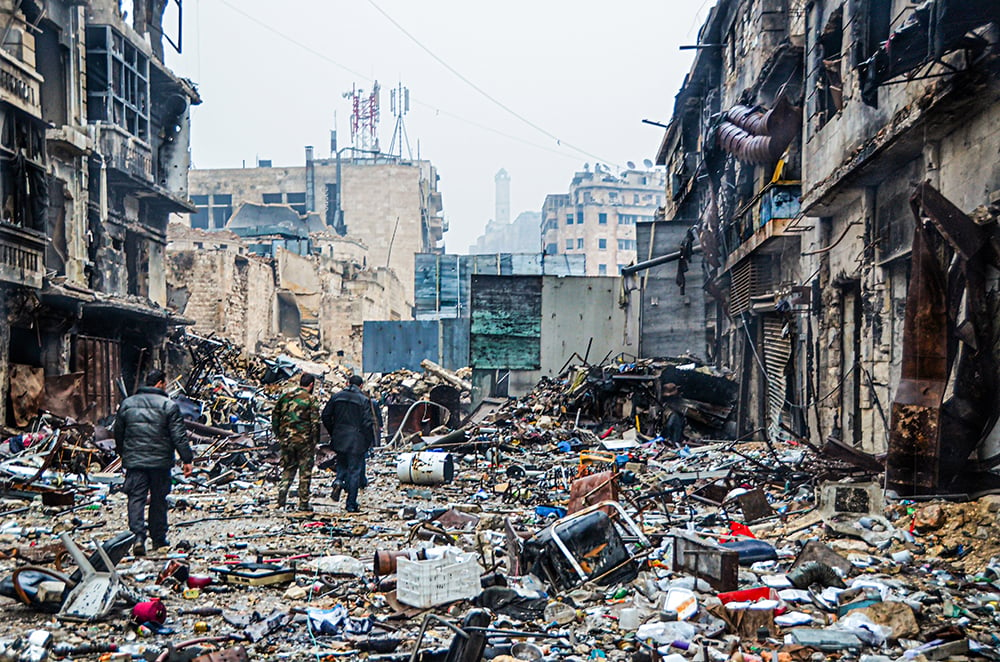
Photo – Eastern Aleppo, December 2016 – © Jan Oberg By Gordon M. Hahn January 17, 2020 If Western leaders are able to put aside the now worn-out cliches such as Russian Vladimir Putin ‘punching above his weight,’ ‘Trump handing Putin a victory on a silver plate’, not to mention ‘Trump as Putin agent’, there are serious lessons that they might still be able to draw from Putin’s looming victory in Syria.  Originally posted on Gordon M. Hahn’s personal blog on December 2, 2019 here First, the era in which the United States and/or the West (NATO) can dictate outcomes anywhere across the globe unilaterally has ended. Events in Syria are but the latest confirmation of this fact, but many in Washington and Brussels still do not see it. NATO expansion drove Russia into China’s arms, and the rest is history and the future.  Second, Washington and Brussels (NATO and...
IMG_9126
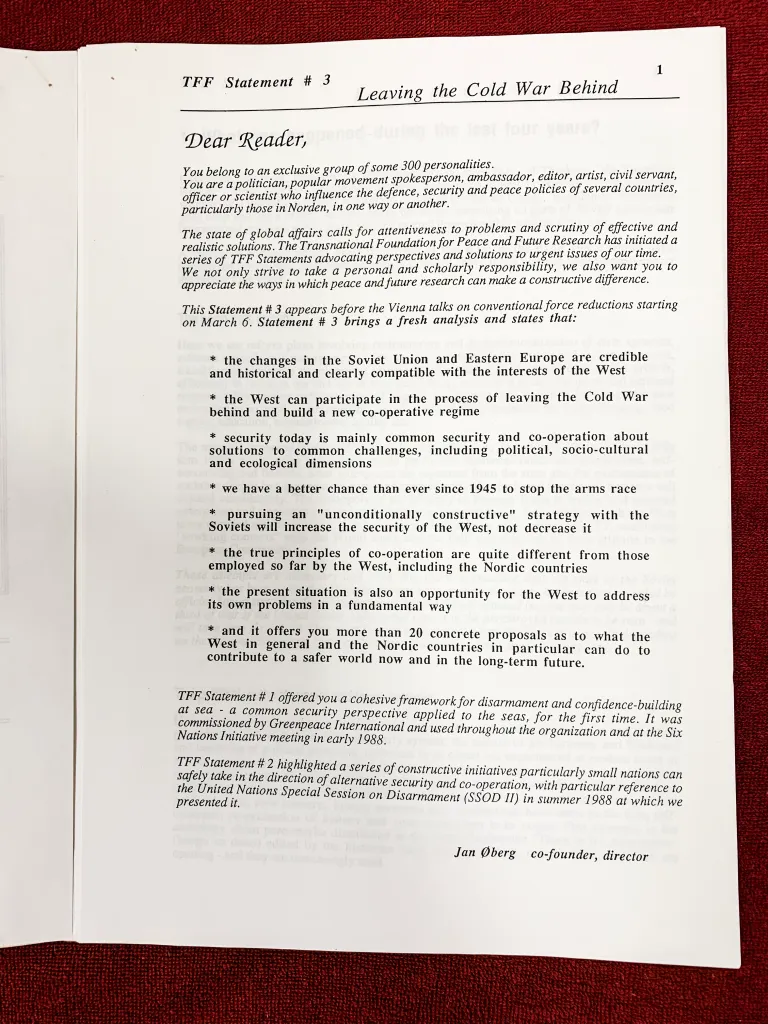
This is the digitalized version of a TFF Statement published by TFF’s Board almost 31 years ago. Could that be of any interest today? First, it reflects the situation and the issues discussed at the time as well as the hopes for a better future – now sadly lost. Secondly, it is one example of how peace researchers were thinking and made constructive political recommendations, available for anyone to take inspiration from – which virtually no one in power did. So, it’s a piece of international political as well as intellectual history. Third, it is an indicator of what the West could – and should – have done to have been in a much better situation than it is today. Admittedly, this is a contra-factual argument, but it can be defended on intellectual grounds although not empirically proven. Fourth, the authors pointed out a series of longterm priorities which match...
rsz_ussrnations
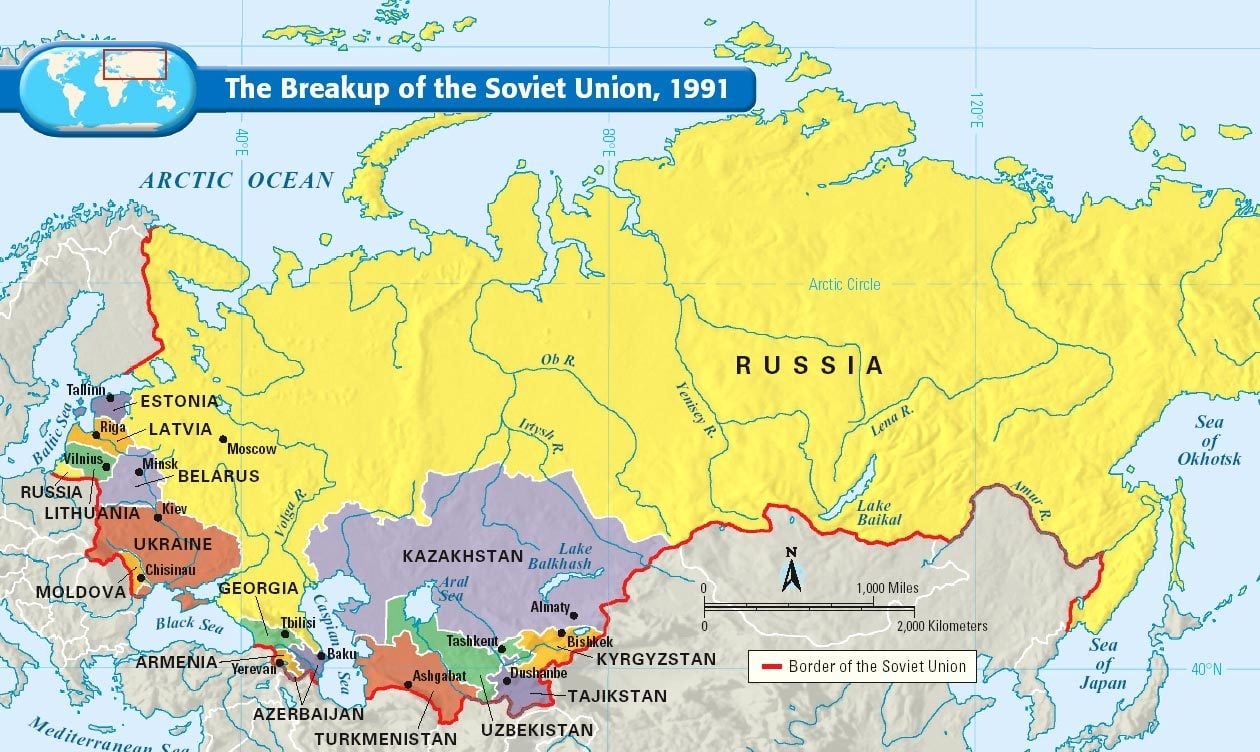
By Jan Oberg November 7, 2019 2019 Introduction The text below is 27 years old, written from 1992. It was the last chapter in a book edited by Jan Oberg, Nordic Security In the 1990s. Options In The Changing Europe (Pinter Publishers & TFF, London/Lund, 1992, 325 pages). In other words, it was written shortly after the euphoria/Europhoria created by the fall of the Berlin Wall on November 9, 1989, and the revolutionary changes in the Eastern system that ended with the dissolution of the Soviet Union on December 26, 1991. A group of international scholars had been gathered by TFF to create this project through extensive discussion and then put it all into book form. They were Håkan Wiberg, Ole Wæver, Pertti Joenniemi, Barry Buzan, Johan Galtung, Clive Archer, Jyrki Käkönen, Sverre Lodgaard and, as mentioned, Jan Oberg. You may read more about it on Goodreads – where you...

berlin-wall-fall
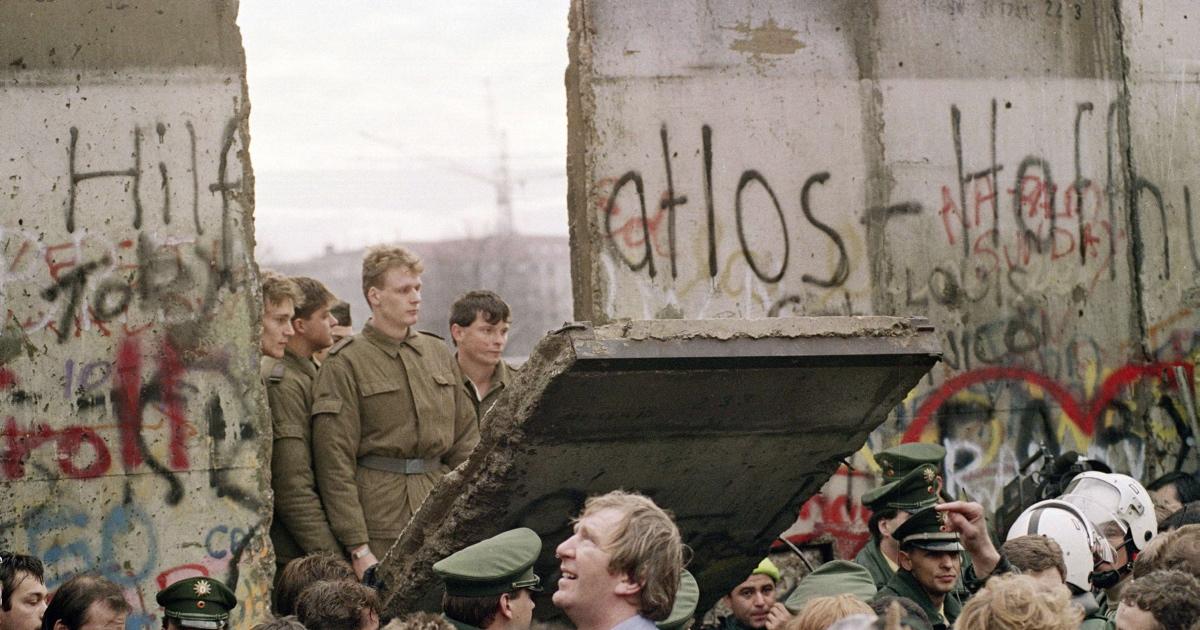
Photo: Gerard Malie/AFP/Ritzau Scanpix Posing the Question Such a question seems little more than a provocation until the effects of the interval between the fall of the Berlin Wall and the present are critically examined in relation to their principal effects. On closer inspection, I am not quite prepared, although almost so, to say that the peoples of the world lost ground as a result of the collapse of the Soviet Union and emergence of the United States as the so-called ‘sole surviving superpower.’ Generally, it was rather automatically assumed almost never challenged, that the outcome of the Cold War was a victory for liberal values, including human rights, political democracy, economic growth, and certainly world peace. There was the added popular view that since democracies supposedly do not go to war against each other, and if Communism was discredited on both ideological and materialist grounds, then democracy would spread...
ChatGPT Image 9 jun 2026, 11_11_33
It’s the most repeated maxim in all the reportage on the war in Afghanistan: “The Americans have the watches, we, the Taliban, have the time.” “Play it again, Sam” was said in “Casablanca”. It should be played, said and listened to in Kabul and Washington today. This is America’s longest war ever – 18 years and counting. It has cost over one trillion dollars and taken 2,500 American lives. President Barack Obama, blind-sided by the generals, he confided later, pumped up the numbers of troops to 100,000. Before very long, Obama came to realize that even if he did a Lyndon Johnson and sent in half a million troops it would end up as it did in Vietnam with a stalemate (still unanswered is why, after 18 years, the Afghan army isn’t trained to do the job themselves). Obama then rolled back the numbers. Three years ago President Donald Trump,...
ChatGPT Image 9 jun 2026, 11_11_33
It’s time overdue for the West to make up with Russia. The contretemps over Ukraine, now played out over five years, is too long. As the world goes it doesn’t deserve so much attention. Ukraine in landmass may be a big country but it’s population is only 44 million and its national income per head a quarter of Russia’s. The Ukrainian puppy’s tail has been wagging the West’s dog. It’s part of the West’s human rights commitment to stand up for the little man, but the Ukraine government’s behavior at the time of its great upheavals didn’t deserve the large amount of support it was given. Yes, it was bad that President Vladimir Putin sent his (disguised) troops into western and southern Ukraine. And equally wrong that Putin organized so fast a referendum in the Crimea on withdrawal from Ukraine that broke the norms of international law (the way the...
ChatGPT Image 9 jun 2026, 11_11_33
“What idiocy”, exclaims Jack Matlock on Facebook. Matlock is one of my “Facebook Friends” because I judge his knowledge of Russia as second to none, having been under President Ronald Reagan the White House’s senior advisor on the Soviet Union and, later, his ambassador to Moscow. The object of his ire is based on a Newsday article earlier this month. (The Russian, nation-wide, NTV channel carried the same story in a broadcast yesterday.) It concerns Russia’s anger following the US military’s claim that it could take down the air defences of the Kaliningrad region. They are the highly sophisticated S-300 and S-400 anti-missile systems. Moreover, it has practiced doing so earlier this year. (Kaliningrad is an internationally recognised enclave of Russia that is sandwiched between Poland and Lithuania.) General Jeff Harrigan, the commander of US Air Forces in Europe, told reporters, “If we have to go in there to take down...
Sitara-one-min
By Pressenza New York September 18, 2019 Originally posted on Pressenza New York’s website on September 09, 2019 here On this show we speak with Alice Slater about the historical process of nuclear weapon treaties and the relationship between the US and Russia. Alice is the UN NGO Representative of the Nuclear Age Peace Foundation, sits on the boards of World Beyond War, Nuclear Ban US, and the Global Network Against Weapons and Nuclear Power in Space, and is a member of the Global Council of Abolition 2000. She is on the NYC Working Group for the Nobel Prize-winning International Campaign to Abolish Nuclear Weapons (ICAN) ‘s campaign to promote the newly passed treaty to ban the bomb. Alice is a member of the NYC Bar Association and has written numerous articles and op-eds for Pressenza. Political actions you can take to ban the bomb and cut down the war...
Putin-tmagArticle
Pool photo by Alexey Druzhinin By Gordon M. Hahn September 4, 2019 From former spooks to libertarian-conservative talk show hosts to leftists and liberals various theories have been put forward as to why and how Russian President Vladimir Putin wants to ‘destroy Americans’ confidence in democracy’ and ‘sew chaos across American and the world.’ In short, Putin ultimately seeks to destroy faith in democracy and sew chaos in the United States and thereby weaken America and its ability to promote democracy abroad. The US will no longer be ‘that shining city on a hill’, as US late President Ronald Reagan eloquently put it. Originally published on Gordon M. Hahn’s official website August 30, 2019 here The same is said about Russia’s supposed support for ultra-nationalist groups, even though that ‘support’ is nothing more than a limited overlap of interests and views. Never mind that Russia has good relations with numerous...
ChatGPT Image 9 jun 2026, 11_11_33
In her famous decree in 1767 Empress Catherine the Great proclaimed Russia to be a European power. She wanted Russia to be a major player in European politics. She compelled the Europeans to accept Russia as a great power as a condition for doing business. In 1815 Russia was considered an equal in the 1815 Concert of Europe. In contrast, Imperial China at that time was self-sufficient and inward looking. It basked in its own superior culture. It did not want to open up trade relations with Europe and the emperor questioned the ability of the British who were knocking on the door to “acquire the rudiments” of Chinese civilization. Fast forward to the twenty-first century, what have we? The heart of Russia, economically, politically, scientifically, culturally and educationally is west of the Ural mountains. This part would like to be European and at one time there was talk from...
INF
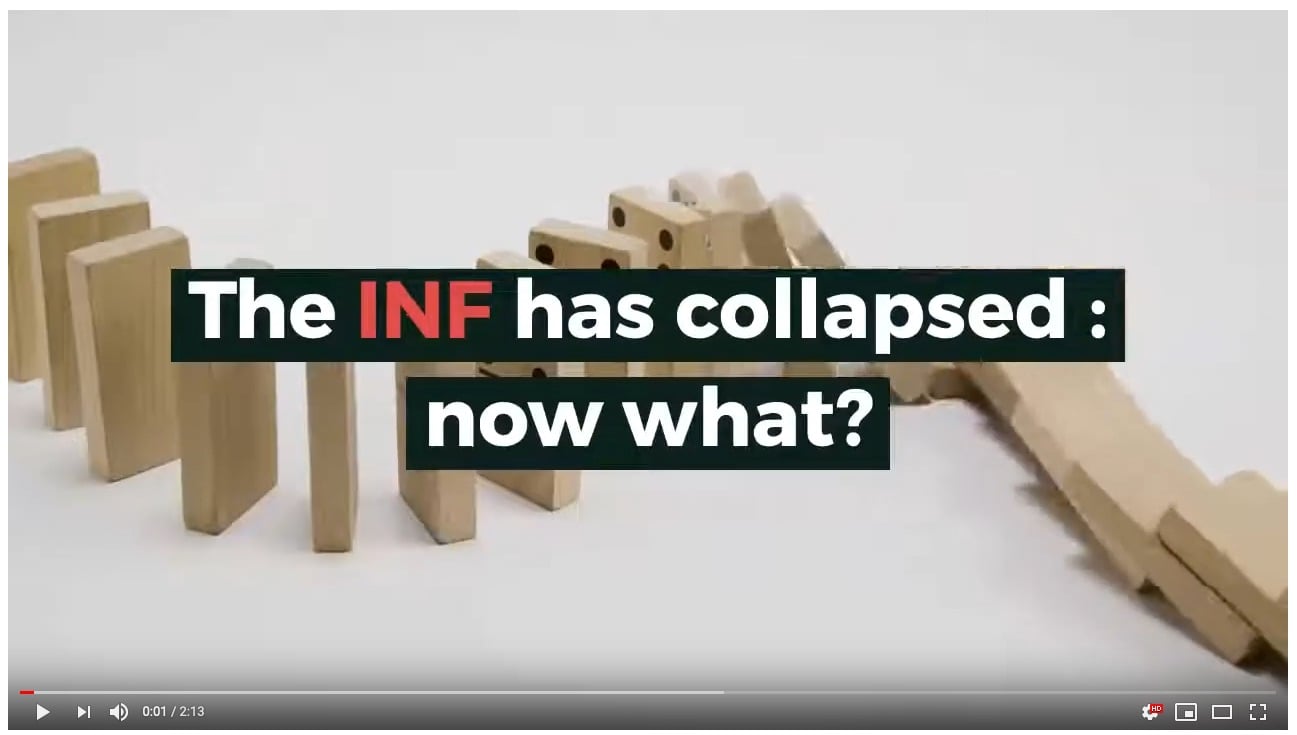
, marks for Europe. Comment Today is a tragic day for Europe, indeed for the world – but do the media highlight that fact on their front pages? Of course, they don’t. The INF Treaty has made Europe less insecure since 1987. But Russia and the US have accused each other of violating it. The bigger reasons for this tragedy are that a) there is a new Cold War in Europe and b) since other countries are now able to develop similar INF weapons – Inter-mediate range Nuclear Forces (INF) with the particular range mentioned in this movie – they want to have their hands free. And, one might almost say, as usual – the policies of the US have spearheaded today’s tragedy, particularly with the totally counterproductive and de factor offensive Ballistic Missile Defence, BMD, that Russia – legitimately – sees as a threat. Just listen to a man...
ChatGPT Image 9 jun 2026, 11_11_33
The attack on “the liberal idea” by Vladimir Putin in his long interview in the Financial Times at the end of June is still vibrating in my mind. First, I’d like to know if the Russian people share his views on immigration. In Britain and the US, despite the anti-immigrant rhetoric and actions of Prime Minister Theresa May and President Donald Trump, most people, according to polls, are more pro-immigration than they are against. Is this so in Russia? What do the electorate make of his support for Trump in trying to limit migration from Mexico? Do they agree with his statement that, “The liberal idea presupposes that nothing needs to be done, that migrants can kill, plunder and rape with impunity because their rights as migrants have to be directed”. This is pure Trump. They share the same outrageous prejudices. Putin leads off from the example of immigration to...
Categories

Year

Author / Contributor

Region