
Cameron Leckie: Ukraine – The ignominious unravelling of the West has begun

Cameron Leckie

January 29, 2023

Western powers appear to have no viable strategy to bring the Ukraine war to an end. The best they can do is keep Ukraine on life support. But, as Sun Tzu put it, tactics without strategy is the noise before defeat.

Imagine if Ukraine had capitulated three days after the Russian invasion commenced in February 2022, as some predicted. The Donetsk and Luhansk Republics would likely have gained autonomy within the Ukrainian state, and life would have carried on like normal for most Ukrainians (minus the regular shelling for the residents of the Donbas). No doubt the capitulation would have seen changes in Ukraine’s political leadership – politics is a ruthless game; whilst the casualties resulting from Russia’s incursion would have been (from a numbers perspective) insignificant compared to the mass loss of life that has since occurred.

Or even better yet, imagine if the United States and NATO had negotiated in good faith with Russia on the proposals it presented in December 2021 that sought to address Russia’s core security concerns. The war would have been avoided, Ukrainian neutrality enshrined, and the world could have got on with solving other pressing problems. But NATO had its ‘principles’ which it must stand by. As forcefully argued by Singaporean diplomat Kishore Mahbubani, the “absence of a culture of pragmatism,” meant that reaching a compromise with Russia was unacceptable to the Western powers.

Alas, these and other opportunities were missed. Russia resorted to a “military-technical” solution. The focus of the Western project in Ukraine now become an opportunity to “weaken Russia,” which when the dust settle could well be remembered as the greatest strategic miscalculation in the history of the American imperium.

Russia effectively won this war on 24 February 2022 – the day it launched its invasion. What remained uncertain then as it is now was how much territory Ukraine would lose, the extent of the death and destruction, and the geopolitical convulsions that would result.

However, the ultimate hopelessness of the Ukrainian position was not the narrative that was sold in the West. Rather we heard that Russia’s invasion was unprovoked, the Russian military incompetent, the Russian economy would collapse, Putin would be overthrown, Russia was isolated, Russia is a pariah state, Russia is running out of [insert weapon of choice here], or most farfetched of all that Ukraine was ‘winning.’

•

The result of these false narratives is that the West has reverse ‘OODA’ looped itself (see here for a primer on the OODA loop – a four-step decision-making cycle that starts with observing the situation, contextualising or orientating your thoughts to those observations before making a decision and acting). In a competitive environment such as war, the idea is that the combatant who can cycle through the OODA loop more rapidly causes the actions of the other combatant to become less and less relevant to the situation overtime until they are defeated.

The starting mindset of Western leaders, after decades of internalising anti-Russian propaganda, (best encapsulated by the infamous and empirically false claim that “Russia is but a gas tank masquerading as a country”) was an overestimation of their own strength and an underestimation of Russia’s. This resulted in a mistake for the ages, with the assumption that the imposition of the harshest possible sanctions on Russia would be such a “slam dunk” outcome that no rigorous thinking through of the implications was required.

What actually resulted, however, was that the West has entrapped itself in a positive feedback loop – continuing to escalate the war on economic (nine rounds of sanctions) and military fronts (more support and wonder weapons to Ukraine) with an ever-weakening and less effective hand. No positive feedback loop is sustainable, and as I concluded in July of last year, and is becoming increasingly clear, events in Ukraine will result in the demise of the West as a major power bloc.

Now we are at the point where the inevitable and ignominious unravelling of the Ukrainian project, both within Ukraine and its Western partners is becoming impossible to hide.

In recent weeks the apparent unity of the Kiev regime has started to splinter. First, we have the resignation of Oleksiy Arestovich, President Zelensky’s Strategic Communications Advisor, over comments he made indicating that an explosion that killed 44 civilians in Dnipro was because of Ukrainian air defence intercepting a Russian missile. We have the deaths of the Ukrainian Interior Minister and other top officials in a helicopter crash. We also have the recent acknowledgement by an aide to President Zelensky that a Ukrainian negotiator was assassinated by the SBU (Ukrainian intelligence) in March 2022. Finally, we have a purge of senior Ukrainian officials, including deputy ministers and regional governors over allegations of corruption. Whilst it is unclear exactly what is unfolding in Ukrainian internal politics, it seems safe to assume that the cracks which are forming will widen, particularly with the ever-growing number of casualties being suffered by the Ukraine.

Last December, the President of the European Commission claimed that over 100,000 Ukrainian military personnel have been killed (an average of over 350 killed per day). Colonel Douglas Macgregor’s latest estimate suggests that over 150,000 Ukrainian soldiers have been killed (an average of 450 killed per day). A recent intelligence estimate by German military intelligence suggests that Ukraine is losing hundreds of soldiers killed every day just in the battle for Bakhmut alone. It is difficult to avoid the conclusion that Ukraine is suffering horrendous casualties.

•

What is truly shocking, however, is the apparent ratio of Russian casualties to Ukrainian. Colonel Macgregor suggests a ratio of eight Ukrainian’s being killed for every one Russian. Whilst it is impossible to confirm this, it does seem plausible that Ukraine is suffering far more casualties than Russia for multiple reasons.

First and most importantly, Russia has an overwhelming advantage in firepower, particularly with artillery. Numerous figures have been provided by both Ukrainian and Western sources on this difference, with ratio’s ranging anywhere from five to nineteen to one in Russia’s favour.

Secondly, the apparent slow ‘progress’ by Russia’s forces is an indicator of their strategy. Namely to batter the Ukrainian’s senseless with its overwhelming superiority in firepower, only then risking troops in an assault once there is little resistance left. Third, Ukraine continues to reinforce locations that are supposedly “strategically unimportant” such as around Bakhmut, which actually facilitates the Russian “demilitarisation” of Ukraine.

Finally, and in stark contrast to Russia’s circumstances (where previously trained reservists have been mobilised and most provided with months of refresher training), the training being provided to Ukrainian troops is clearly insufficient to develop the individual skills and physical stamina required of a soldier let alone the collective training required at platoon, company or battalion level.

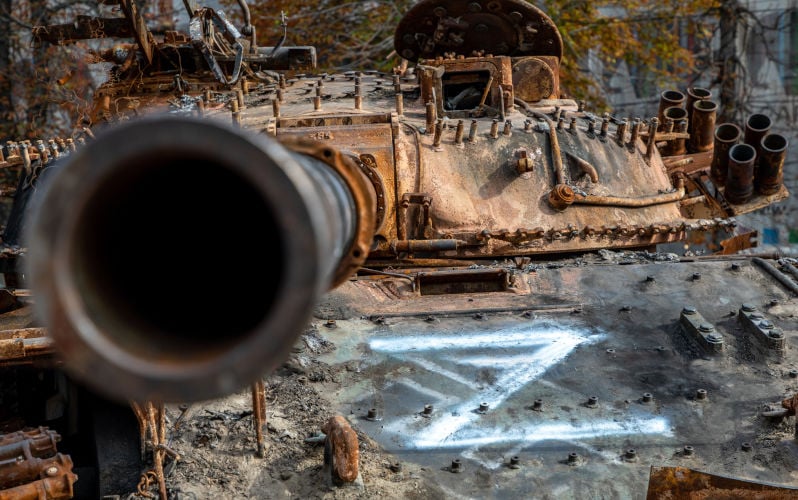
Ukraine’s casualties are high despite the mindbogglingly enormous support provided by the Western powers. Yet the limitations of this support are becoming all too clear. The provision of main battle tanks to Ukraine provides a pertinent example. Ukraine started the war with well over 2000 main battle tanks. We were then told that the Ukrainian Army had more tanks a month into the war than when they started.

Ukraine also received around 500 Soviet-era tanks from former Warsaw Pact nations. 100 or thereabouts Challenger, Leopard 2 or M1 tanks represents maybe four per cent of the tanks it already had in service or has already been provided. You don’t need to be a military expert to understand that providing a small number of tanks, with hurriedly trained crews, and the logistics burden of multiple platforms, will not make any significant difference to the outcome.

The last weeks of political theatre associated with the provision of tanks to Ukraine should be seen for what it is. A form of jockeying to prepare the ground for the blame game that will follow Ukraine’s (and NATO’s) ultimate defeat.

The same could be said of Angela Merkel’s recent comments on the Minsk II Accord, which were viewed by the leaders of Ukraine, Germany, France, and no doubt other NATO powers as a mechanism to buy time, rather than a pathway to the peaceful resolution of the crisis. There is also a change in the rhetoric emanating from various power centres, such as the Chairman of the Joint Chiefs of Staff warning that it will be “very, very difficult” to force Russia out of Ukrainian territory.

Meanwhile, there is the unresolved issue of responsibility for the Nord Stream terrorist attack. As reported in the Washington Post, numerous European officials have concluded that there “is no evidence at this point that Russia was behind the sabotage,” implying that one or more NATO countries destroyed the energy infrastructure of another.

•

As others have noted, the ideologues in control of Western countries have no reverse gear. The only way is forward, no matter the cost or how slim the chances of success. Yet again, we see the lack of pragmatism with German Foreign Minister Annalena Baerbock now claiming that the EU countries are “fighting a war against Russia.”

Meanwhile, in a brilliant must read article, retired United Kingdom diplomat Alistair Crooke gets to the nub of what is driving the United States on its Ukrainian misadventure, where he argues that the resilience of Russia to the financial armageddon that was launched upon it has shattered “the plate-glass floor to western convictions about its ability to ‘manage the world’.” The United States has boxed itself into a corner from which it cannot escape with its Ukraine project.

It is difficult to predict what will happen next. The Western powers appear to have no viable strategy to bring the war to an end. The best they can do is keep Ukraine on life support while they try to figure something out, within an environment where Russia ratchets up the pressure on the battlefield, and domestic pressures mount.

But as Sun Tzu put it, tactics without strategy is the noise before defeat.

Therefore, the best option would be for the key Western leaders, particularly President Biden, to seek immediate negotiations with President Putin without preconditions.

The worst option would be to continue the escalation cycle, which ultimately could lead to direct conflict between NATO and Russia, and potentially nuclear war.

As we stand on the brink of an unthinkable abyss, I for one, hope that pragmatism makes a return.

About the author

Cameron Leckie served as an officer in the Australian Army for 24 years. An agricultural engineer, he is currently a PhD candidate.


Originally published at John Menadue’s excellent policy journal,
Pearls And Irritations on January 28, 2023

Related Posts

The agreement is catastrophic both because of what it says and what it doesn’t mention. It reduces further the major asset of security policies: Freedom of action. Jan Oberg TFF director September 25, 2026 A couple of hours before the agreement was signed on September 22, 2026, I published the following 13 hypotheses about what it would most likely contain on TFF Substack (in English). I was wrong on only the first point. Contrary to what Trump had written on his Truth Social platform, it does not appear to come into force immediately. In fact, it turned out to be worse than even I had anticipated. After these hypotheses now come a number of reflections in light of what the agreement actually contains, and does not contain, as well as the way in which it has generally been presented by major media outlets and by the public-service broadcaster DR. My...
Below are TFF-related media mentions, comments, videos and social media posts published elsewhere but not on this homepage. We happen to catch and list only a fraction. Regarding video comments and debates, we recommend that you go to the TFF Video Channel on Substack where many of them are reproduced. Jan Oberg is a contributor to China Daily – 52 million daily clicks – and Global Times, CGTN and CCTV (the national television), China Investment, Xinhua News Agency and several others. Articles and videos on these media very often multiply into countless Chinese (and Western media) that re-post them from these main media. Thanks to The China Academy, his analyses, interviews and comments are frequently posted on YouTube channels such as Thinkers Forum and Wave Media. These videos are often re-posted on Bilibili (China’s YouTube), the China Content Center on TikTok, and on the Chinese edition of TikTok, Douyin.com. This means reaching hundreds of millions of viewers worldwide over a year. While there are too many to catch on all these...
Jan Oberg May 15, 2026 Go to this Fox News page and scroll the whole way down: President Donald Trump tells the world that his meeting with President Xi Jinping yielded a lot of very concrete political and economic results – of course, only where the Chinese side, according to him, agreed with him. He does not mention the Taiwan issue, but Secretary of State, Marco Rubio, says that it did not feature prominently in their talks and that the US policy on Taiwan has not changed. Then go to China Daily – or Global Times – and you will see that for the Chinese it is framework, principles, structure of cooperation etc. that matters – all embedded in the overall idea of “constructive bilateral relationship of strategic stability.” Nowhere is any concrete agreement or deal – all that Trump refers to – mentioned. At the general level, this gives you insights into the very different social...

Recent Articles

Tony Robinson October 4, 2026 Violence is easy to recognise when someone is being beaten, shot or killed. It becomes more difficult when nobody is holding a weapon. Poverty, discrimination, exploitation and repression can restrict a human life just as effectively, although they do so in very different ways and with very different consequences. Simply adding more categories to an ever-growing list of forms of violence does not really solve the problem. The more interesting question is what all these different situations have in common and why it makes sense to describe them using the same word. Human beings do not simply react to what happens around them. They remember the past, imagine things that do not yet exist, make plans and undertake projects. Workers organise because they imagine different working conditions; people migrate because they imagine another life somewhere else; social movements emerge because people refuse to accept the...
It’s a matter of principles, courage, vision and pulling together – while the militarist world is falling apart… Peter Langille October 3, 2026 “Here, then, is the problem which we present to you, stark and dreadful and inescapable: Shall we put an end to the human race; or shall mankind renounce war?”The Bertrand Russell—Albert Einstein Manifesto, July 9, 1955 ⁕ The forecast for what’s ahead is worrisome. The sharp rise in armed conflicts over the past three years is adding to what was already the highest level in over seventy years. Genocides, which should be prevented are supported. A shared climate emergency that jeopardises survival is ignored. Diverse polls now suggest that people are war-weary, worried and interested in a more effective United Nations. And, there are viable policy options for a more secure world! Yet governments are doubling-down, betting on more war and investing heavily. If current trends persist,...
Johan Galtung 1930-2024October 2015 Published here on October 3, 2026 Let us focus on Civilization for conflict analysis and remedies. Major forms of disorder use violence; war is state organized violence. The most belligerent states are the United States of America and Israel, both with civilization roots. National Evangelism, the US Protestant Christian civilization– more national than evangelical–justifies US warfare as exceptionalism of a people chosen by God, with a manifest destiny to run the world. Orthodox Judaism justifies Israeli warfare to conquer and expand from Nile to Euphrates as a religious right and duty to the Eternal One. The third most belligerent country, the UK, no longer believes it is God-chosen but chosen by the USA; not quite the same but something. But the root cause of global disorder lies in the Occident–with Islam–seeing itself as the single, universal civilization valid for all at all times, all others being...

TFF on Substack

Discover and subscribe to more peace materials on TFF Substack

Most Popular

Tony Robinson October 4, 2026 Violence is easy to recognise when someone is being beaten, shot or killed. It becomes more difficult when nobody is holding a weapon. Poverty, discrimination, exploitation and repression can restrict a human life just as effectively, although they do so in very different ways and with very different consequences. Simply adding more categories to an ever-growing list of forms of violence does not really solve the problem. The more interesting question is what all these different situations have in common and why it makes sense to describe them using the same word. Human beings do not simply react to what happens around them. They remember the past, imagine things that do not yet exist, make plans and undertake projects. Workers organise because they imagine different working conditions; people migrate because they imagine another life somewhere else; social movements emerge because people refuse to accept the...
It’s a matter of principles, courage, vision and pulling together – while the militarist world is falling apart… Peter Langille October 3, 2026 “Here, then, is the problem which we present to you, stark and dreadful and inescapable: Shall we put an end to the human race; or shall mankind renounce war?”The Bertrand Russell—Albert Einstein Manifesto, July 9, 1955 ⁕ The forecast for what’s ahead is worrisome. The sharp rise in armed conflicts over the past three years is adding to what was already the highest level in over seventy years. Genocides, which should be prevented are supported. A shared climate emergency that jeopardises survival is ignored. Diverse polls now suggest that people are war-weary, worried and interested in a more effective United Nations. And, there are viable policy options for a more secure world! Yet governments are doubling-down, betting on more war and investing heavily. If current trends persist,...
Johan Galtung 1930-2024October 2015 Published here on October 3, 2026 Let us focus on Civilization for conflict analysis and remedies. Major forms of disorder use violence; war is state organized violence. The most belligerent states are the United States of America and Israel, both with civilization roots. National Evangelism, the US Protestant Christian civilization– more national than evangelical–justifies US warfare as exceptionalism of a people chosen by God, with a manifest destiny to run the world. Orthodox Judaism justifies Israeli warfare to conquer and expand from Nile to Euphrates as a religious right and duty to the Eternal One. The third most belligerent country, the UK, no longer believes it is God-chosen but chosen by the USA; not quite the same but something. But the root cause of global disorder lies in the Occident–with Islam–seeing itself as the single, universal civilization valid for all at all times, all others being...
Read More
Living-Peace-Sign-Budapest-copy
Tony Robinson October 4, 2026 Violence is easy to recognise when someone is being beaten, shot or killed. It becomes more difficult when nobody is holding a weapon. Poverty, discrimination, exploitation and repression can restrict a human life just as effectively, although they do so in very different ways and with very different consequences. Simply adding more categories to an ever-growing list of forms of violence does not really solve the problem. The more interesting question is what all these different situations have in common and why it makes sense to describe them using the same word. Human beings do not simply react to what happens around them. They remember the past, imagine things that do not yet exist, make plans and undertake projects. Workers organise because they imagine different working conditions; people migrate because they imagine another life somewhere else; social movements emerge because people refuse to accept the...
b54a1f10-8c65-4f0b-9dd5-4abc0a7d04cc_2659x2659
It’s a matter of principles, courage, vision and pulling together – while the militarist world is falling apart… Peter Langille October 3, 2026 “Here, then, is the problem which we present to you, stark and dreadful and inescapable: Shall we put an end to the human race; or shall mankind renounce war?”The Bertrand Russell—Albert Einstein Manifesto, July 9, 1955 ⁕ The forecast for what’s ahead is worrisome. The sharp rise in armed conflicts over the past three years is adding to what was already the highest level in over seventy years. Genocides, which should be prevented are supported. A shared climate emergency that jeopardises survival is ignored. Diverse polls now suggest that people are war-weary, worried and interested in a more effective United Nations. And, there are viable policy options for a more secure world! Yet governments are doubling-down, betting on more war and investing heavily. If current trends persist,...
010
Johan Galtung 1930-2024October 2015 Published here on October 3, 2026 Let us focus on Civilization for conflict analysis and remedies. Major forms of disorder use violence; war is state organized violence. The most belligerent states are the United States of America and Israel, both with civilization roots. National Evangelism, the US Protestant Christian civilization– more national than evangelical–justifies US warfare as exceptionalism of a people chosen by God, with a manifest destiny to run the world. Orthodox Judaism justifies Israeli warfare to conquer and expand from Nile to Euphrates as a religious right and duty to the Eternal One. The third most belligerent country, the UK, no longer believes it is God-chosen but chosen by the USA; not quite the same but something. But the root cause of global disorder lies in the Occident–with Islam–seeing itself as the single, universal civilization valid for all at all times, all others being...
Screenshot 2026-10-02 011738
Jan ObergPhD, director, The Transnational Foundation for Peace and Future Research, TFFLund, Sweden October 2, 2026 This is my full original manuscript. The Chinese Academy of Social Science, CASS, makes two publications out if it. 1. China’s Five-year plan emphasized the capabilities of basic research and original innovation. It is regarded as the goal of the future social development, which, as required, should be significantly enhanced. Can you comment on the importance of original innovation in research and academic study? I believe it is easier to define “original innovation” in the natural sciences than in social sciences. The breaking points of what constitutes something new, or innovative, are not quite as sharp in the latter. But in both fields it is about opening up something that was closed, unseen, unexplored before – making manifest what was earlier latent. Innovations come in many forms and shapes – naming something that was not...
arctic-circle-map
The agreement is catastrophic both because of what it says and what it doesn’t mention. It reduces further the major asset of security policies: Freedom of action. Jan Oberg TFF director September 25, 2026 A couple of hours before the agreement was signed on September 22, 2026, I published the following 13 hypotheses about what it would most likely contain on TFF Substack (in English). I was wrong on only the first point. Contrary to what Trump had written on his Truth Social platform, it does not appear to come into force immediately. In fact, it turned out to be worse than even I had anticipated. After these hypotheses now come a number of reflections in light of what the agreement actually contains, and does not contain, as well as the way in which it has generally been presented by major media outlets and by the public-service broadcaster DR. My...
girl-5894831_1280
Below are TFF-related media mentions, comments, videos and social media posts published elsewhere but not on this homepage. We happen to catch and list only a fraction. Regarding video comments and debates, we recommend that you go to the TFF Video Channel on Substack where many of them are reproduced. Jan Oberg is a contributor to China Daily – 52 million daily clicks – and Global Times, CGTN and CCTV (the national television), China Investment, Xinhua News Agency and several others. Articles and videos on these media very often multiply into countless Chinese (and Western media) that re-post them from these main media. Thanks to The China Academy, his analyses, interviews and comments are frequently posted on YouTube channels such as Thinkers Forum and Wave Media. These videos are often re-posted on Bilibili (China’s YouTube), the China Content Center on TikTok, and on the Chinese edition of TikTok, Douyin.com. This means reaching hundreds of millions of viewers worldwide over a year. While there are too many to catch on all these...



