Bryce Greene: What You Should Really Know About Ukraine

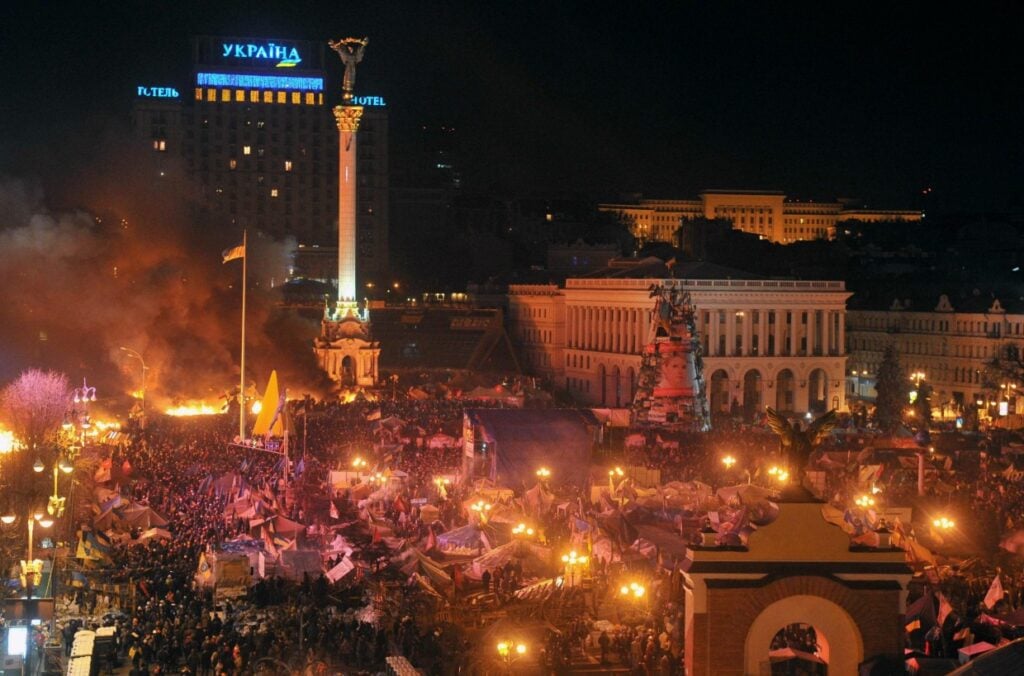
Maidan protests in 2014 in Kiev. GENYA SAVILOV / AFP – Getty Images

Bryce Greene

March 29, 2022

The history of U.S. involvement in Ukraine is rarely analyzed by corporate media. The desire to open Ukraine to finance capital, the 2014 U.S. backed coup, and the drive to expand NATO all played a role in creating the current crisis.

As tensions began to rise over Ukraine, US media produced a stream of articles attempting to explain the situation with headlines like “Ukraine Explained” (New York Times, 12/8/21 ) and “What You Need to Know About Tensions Between Ukraine and Russia” (Washington Post, 11/26/21 ). Sidebars would have notes that tried to provide context for the current headlines. But to truly understand this crisis, you would need to know much more than what these articles offered.

These “explainer” pieces are emblematic of Ukraine coverage in the rest of corporate media, which almost universally gave a pro-Western view of US/Russia relations and the history behind them. Media echoed the point of view of those who believe the US should have an active role in Ukrainian politics and enforce its perspective through military threats.

Originally published at FAIR.org

The official line goes something like this: Russia is challenging NATO and the “international rules-based order” by threatening to invade Ukraine, and the Biden administration needed to deter Russia by providing more security guarantees to the Zelensky government. The official account seizes on Russia’s 2014 annexation of Ukraine’s Crimean peninsula as a starting point for US/Russian relations, and as evidence of Putin’s goals of rebuilding Russia’s long-lost empire.

Russia’s demand that NATO cease its expansion to Russia’s borders is viewed as such an obviously impossible demand that it can only be understood as a pretext to invade Ukraine. Therefore, the US should send weapons and troops to Ukraine, and guarantee its security with military threats to Russia (FAIR.org, 1/15/22 ).

The Washington Post asked: “Why is there tension between Russia and Ukraine?” Its answer:

In March 2014, Russia annexed Crimea from Ukraine. A month later, war erupted between Russian-allied separatists and Ukraine’s military in the eastern Ukrainian region of Donbas. The United Nations human rights office estimates that more than 13,000 people have been killed.

But that account is highly misleading, because it leaves out the crucial role the US has played in escalating tensions in the region. In nearly every case we looked at, the reports omitted the US’s extensive role in the 2014 coup that preceded Russia’s annexation of Crimea. Focusing on the latter part only serves to manufacture consent for US intervention abroad.

The West Wants Investor-Friendly Policies in Ukraine

The backdrop to the 2014 coup and annexation cannot be understood without looking at the US strategy to open Ukrainian markets to foreign investors and give control of its economy to giant multinational corporations. A key tool for this has been the International Monetary Fund, which leverages aid loans to push governments to adopt policies friendly to foreign investors. The IMF is funded by and represents Western financial capital and governments and has been at the forefront of efforts to reshape economies around the world for decades, often with disastrous results. The civil war in Yemen  and the coup in Bolivia  both followed a rejection of IMF terms.

In Ukraine, the IMF had long planned to implement a series of economic reforms  to make the country more attractive to investors. These included cutting wage controls (i.e., lowering wages), “reform[ing] and reduc[ing]” health and education sectors (which made up the bulk of employment in Ukraine), and cutting natural gas subsidies to Ukrainian citizens that made energy affordable to the general public. Coup plotters like US Assistant Secretary of State Victoria Nuland  repeatedly stressed  the need for the Ukrainian government to enact the “necessary” reforms.

In 2013, after early steps to integrate with the West, Ukrainian President Viktor Yanukovych turned against these changes and ended  trade integration talks with the European Union. Months before his overthrow, he restarted economic negotiations with Russia, in a major snub to the Western economic sphere. By then, the nationalist protests were heating up that would go on to topple his government.

After the 2014 coup, the new government quickly restarted  the EU deal. After cutting heating subsidies in half, it secured  a $27 billion commitment from the IMF. The IMF’s goals still  include “reducing the role of the state and vested interests in the economy” in order to attract more foreign capital.

The IMF is one of the many global institutions whose role in maintaining global inequities often goes unreported and unnoticed by the general public. The US economic quest to open global markets to capital is a key driver of international affairs, but if the press chooses to ignore it, the public debate is incomplete and shallow.

The US Helped Overthrow Ukraine’s Elected President

During the tug of war between the US and Russia, the Americans were engaged in a destabilization campaign against the Yanukovych government. The campaign culminated with the overthrow of the elected president in the Maidan Revolution—also known as the Maidan Coup—named for the Kiev square that hosted the bulk of the protests.

As political turmoil engulfed the country in the leadup to 2014, the US was fueling anti-government sentiment through mechanisms like USAID and National Endowment for Democracy (NED), just as they had done in 2004 .

In December 2013, Nuland, assistant secretary of state for European affairs and a long-time regime change advocate , said that the US government had spent $5 billion  promoting “democracy” in Ukraine since 1991. The money went toward supporting “senior officials in the Ukraine government…[members of] the business community as well as opposition civil society” who agree with US goals.

The NED is a key organization in the network of American soft power that pours  $170 million a year into organizations dedicated to defending or installing US-friendly regimes. The Washington Post‘s David Ignatius (9/22/91 ) once wrote that the organization functions by “doing in public what the CIA used to do in private.” The NED targets governments who oppose US military or economic policy, stirring up anti-government opposition.

The NED board of directors includes Elliott Abrams , whose sordid record runs from the Iran/Contra affair  in the ’80s to the Trump administration’s effort to overthrow  the Venezuelan government. In 2013, NED president Carl Gershman wrote a piece in the Washington Post (9/26/13 ) that described Ukraine as the “biggest prize” in the East/West rivalry.  After the Obama administration, Nuland joined the NED board of directors before returning to the State Department in the Biden administration as undersecretary of state for political affairs.

One of the many recipients of NED money for projects in Ukraine was the International Republican Institute. The IRI, once chaired by Sen. John McCain, has long  had a hand in US regime change operations. During the protests that eventually brought down the government, McCain  and other US officials personally flew into Ukraine to encourage  protesters.

US Officials Were Caught Picking the New Government

On February 6, 2014, as the anti-government protests were intensifying, an anonymous party (assumed  by many to be Russia) leaked a call  between Assistant Secretary of State Nuland and US ambassador to Ukraine Geoffrey Pyatt. The two officials discussed which opposition officials would staff a prospective new government, agreeing that Arseniy Yatsenyuk—Nuland referred to him by the nickname “Yats”—should be in charge. It was also agreed that someone “high profile” be brought in to push things along. That someone was Joe Biden.

Weeks later, on February 22, after a massacre by suspicious snipers  brought tensions to a head, the Ukrainian parliament quickly removed Yanukovych from office in a constitutionally questionable  maneuver. Yanukovych then fled the country, calling the overthrow a coup. On February 27, Yatsenyuk became prime minister.

At the time the call leaked, media were quick to pounce on Nuland’s saying “Fuck the EU.” The comment dominated the headlines (Daily Beast ,  2/6/14; BuzzFeed, 2/6/14 ; Atlantic, 2/6/14;  Guardian, 2/6/14 ), while the evidence of US regime change efforts was downplayed.

With the headline “Russia Claims US Is Meddling Over Ukraine,” the New York Times (2/6/14 ) put the facts of US involvement in the mouth of an official enemy, blunting their impact on the audience. The Times (2/6/14 ) later described the two officials as benignly “talking about the political crisis in Kiev” and sharing “their views of how it might be resolved.”

The Washington Post (2/6/14 ) acknowledged that the call showed “a deep degree of US involvement in affairs that Washington officially says are Ukraine’s to resolve,” but that fact rarely factored into future coverage of the US/Ukraine/Russia relationship.

Washington Used Nazis to Help Overthrow the Government

The Washington-backed opposition that toppled the government was fueled  by far-right and openly Nazi  elements like the Right Sector. One far-right group that grew out of the protests was the Azov Battalion, a paramilitary militia of neo-Nazi extremists . Their leaders made up the vanguard of the anti-Yanukovych protests, and even spoke at opposition events in the Maidan alongside US regime change advocates like McCain and Nuland.

After the violent coup, these groups were later incorporated  into the Ukrainian armed forces—the same armed forces that the US has now given  $2.5 billion. Though Congress technically  restricted money from flowing to the Azov Battalion in 2018, trainers on the ground say there’s no mechanism  to actually enforce the provision.  Since the coup, the Ukrainian nationalist forces have been responsible for a wide variety of atrocities  in the counterinsurgency war.

Far-right influence has increased across Ukraine as a result of Washington’s actions. A recent UN Human Rights council has noted  that “fundamental freedoms in Ukraine have been squeezed” since 2014, further weakening the argument that the US is involved in the country on behalf of liberal values.

Among American neo-Nazis, there’s even a movement  aimed at encouraging right-wing extremists to join the Battalion in order to “gain actual combat experience” in preparation for a potential civil war in the US.

In a recent UN vote on “combating glorification of Nazism, neo-Nazism and other practices that contribute to fueling contemporary forms of racism,” the US and Ukraine were the only two countries  to vote no.

As FAIR (1/15/22 ) has reported, between December 6, 2021, and January 6, 2022, the New York Times ran 228 articles that refer to Ukraine, but none of them reference the pro-Nazi elements in Ukraine’s politics or government. The same can be said of the Washington Post’s 201 articles on the topic.

There’s a Lot More to the Crimean Annexation

The facts above give more context to Russian actions following the coup, and ought to counter the caricature of a Russian Empire bent on expansion. From Russia’s point of view, a longtime adversary had successfully overthrown a neighboring government using violent far-right extremists.

The Crimean peninsula, which was part of Russia until it was transferred to the Ukrainian Soviet Republic in 1954, is home to one of two Russian naval bases  with access to the Black and Mediterranean seas, one of history’s most important maritime theaters. A Crimea controlled by a US-backed Ukrainian government was a major threat to Russian naval access.

The peninsula—82% of whose households speak Russian , and only 2% mainly Ukrainian—held a plebiscite in March 2014 on whether or not they should join Russia, or remain under the new Ukrainian government. The Pro-Russia camp won with 95% of the vote. The UN General Assembly, led by the US, voted to ignore the referendum results  on the grounds that it was contrary to Ukraine’s constitution. This same constitution had been set aside to oust President Yanukovych a month earlier.

All of this is dropped from Western coverage.

The US Wants to Expand NAT

In addition to integrating Ukraine into the US-dominated economic sphere, Western planners also want to integrate Ukraine militarily. For years, the US has sought the expansion of NATO , an explicitly anti-Russian military alliance. NATO was originally billed as a counterforce to the Warsaw Pact during the Cold War, but after the demise of the Soviet Union, the US promised  the new Russia that it would not expand NATO east of Germany.

Despite this agreement, the US continued building out its military alliance, growing closer and closer to Russia’s borders and ignoring Russia’s objections.

This history is sometimes admitted but usually downplayed in corporate media. In an interview with the Washington Post (12/1/21 ), professor Mary Sarotte, author of Not One Inch: America, Russia and the Making of Post-Cold War Stalemate, recounted that after the Soviet collapse, “Washington realized that it could not only win big, but win bigger. Not one inch of territory needed to be off-limits to full NATO membership.” The US “all-or-nothing approach to expansionism…maximized conflict with Moscow,” she noted. Unfortunately, one interview does little to cut through the drumbeat of pro-NATO talking points.

In 2008, NATO members pledged to extend membership to Ukraine. The removal of the pro-Russian government in 2014 was a giant leap towards the pledge becoming a reality. Recently, NATO Secretary General Stoltenberg announced that the alliance stands by  plans to integrate Ukraine into the alliance.

Bret Stephens  in the New York Times (1/11/21 ) maintained that if Ukraine wasn’t allowed to join the organization, it would “break the spine of NATO” and “end the Western alliance as we have known it since the Atlantic Charter.”

The US Wouldn’t Tolerate What Russia Is Expected to Accept

Much has been written about the Russian buildup on the Ukraine border. Reports of the buildup have been intensified by US intelligence officials’ warnings of an attack. Media often echo the claim of an inevitable invasion. The Washington Post editorial board (1/24/22)  wrote that “Putin can—and will—use any measures the United States and its NATO allies either take or refrain from taking as a pretext for aggression.”

But Putin has been clear about a path to de-escalation. His main dema

Related Posts

The agreement is catastrophic both because of what it says and what it doesn’t mention. It reduces further the major asset of security policies: Freedom of action. Jan Oberg TFF director September 25, 2026 A couple of hours before the agreement was signed on September 22, 2026, I published the following 13 hypotheses about what it would most likely contain on TFF Substack (in English). I was wrong on only the first point. Contrary to what Trump had written on his Truth Social platform, it does not appear to come into force immediately. In fact, it turned out to be worse than even I had anticipated. After these hypotheses now come a number of reflections in light of what the agreement actually contains, and does not contain, as well as the way in which it has generally been presented by major media outlets and by the public-service broadcaster DR. My...
Below are TFF-related media mentions, comments, videos and social media posts published elsewhere but not on this homepage. We happen to catch and list only a fraction. Regarding video comments and debates, we recommend that you go to the TFF Video Channel on Substack where many of them are reproduced. Jan Oberg is a contributor to China Daily – 52 million daily clicks – and Global Times, CGTN and CCTV (the national television), China Investment, Xinhua News Agency and several others. Articles and videos on these media very often multiply into countless Chinese (and Western media) that re-post them from these main media. Thanks to The China Academy, his analyses, interviews and comments are frequently posted on YouTube channels such as Thinkers Forum and Wave Media. These videos are often re-posted on Bilibili (China’s YouTube), the China Content Center on TikTok, and on the Chinese edition of TikTok, Douyin.com. This means reaching hundreds of millions of viewers worldwide over a year. While there are too many to catch on all these...
Jan Oberg May 15, 2026 Go to this Fox News page and scroll the whole way down: President Donald Trump tells the world that his meeting with President Xi Jinping yielded a lot of very concrete political and economic results – of course, only where the Chinese side, according to him, agreed with him. He does not mention the Taiwan issue, but Secretary of State, Marco Rubio, says that it did not feature prominently in their talks and that the US policy on Taiwan has not changed. Then go to China Daily – or Global Times – and you will see that for the Chinese it is framework, principles, structure of cooperation etc. that matters – all embedded in the overall idea of “constructive bilateral relationship of strategic stability.” Nowhere is any concrete agreement or deal – all that Trump refers to – mentioned. At the general level, this gives you insights into the very different social...

Recent Articles

Tony Robinson October 4, 2026 Violence is easy to recognise when someone is being beaten, shot or killed. It becomes more difficult when nobody is holding a weapon. Poverty, discrimination, exploitation and repression can restrict a human life just as effectively, although they do so in very different ways and with very different consequences. Simply adding more categories to an ever-growing list of forms of violence does not really solve the problem. The more interesting question is what all these different situations have in common and why it makes sense to describe them using the same word. Human beings do not simply react to what happens around them. They remember the past, imagine things that do not yet exist, make plans and undertake projects. Workers organise because they imagine different working conditions; people migrate because they imagine another life somewhere else; social movements emerge because people refuse to accept the...
It’s a matter of principles, courage, vision and pulling together – while the militarist world is falling apart… Peter Langille October 3, 2026 “Here, then, is the problem which we present to you, stark and dreadful and inescapable: Shall we put an end to the human race; or shall mankind renounce war?”The Bertrand Russell—Albert Einstein Manifesto, July 9, 1955 ⁕ The forecast for what’s ahead is worrisome. The sharp rise in armed conflicts over the past three years is adding to what was already the highest level in over seventy years. Genocides, which should be prevented are supported. A shared climate emergency that jeopardises survival is ignored. Diverse polls now suggest that people are war-weary, worried and interested in a more effective United Nations. And, there are viable policy options for a more secure world! Yet governments are doubling-down, betting on more war and investing heavily. If current trends persist,...
Johan Galtung 1930-2024October 2015 Published here on October 3, 2026 Let us focus on Civilization for conflict analysis and remedies. Major forms of disorder use violence; war is state organized violence. The most belligerent states are the United States of America and Israel, both with civilization roots. National Evangelism, the US Protestant Christian civilization– more national than evangelical–justifies US warfare as exceptionalism of a people chosen by God, with a manifest destiny to run the world. Orthodox Judaism justifies Israeli warfare to conquer and expand from Nile to Euphrates as a religious right and duty to the Eternal One. The third most belligerent country, the UK, no longer believes it is God-chosen but chosen by the USA; not quite the same but something. But the root cause of global disorder lies in the Occident–with Islam–seeing itself as the single, universal civilization valid for all at all times, all others being...

TFF on Substack

Discover and subscribe to more peace materials on TFF Substack

Most Popular

Tony Robinson October 4, 2026 Violence is easy to recognise when someone is being beaten, shot or killed. It becomes more difficult when nobody is holding a weapon. Poverty, discrimination, exploitation and repression can restrict a human life just as effectively, although they do so in very different ways and with very different consequences. Simply adding more categories to an ever-growing list of forms of violence does not really solve the problem. The more interesting question is what all these different situations have in common and why it makes sense to describe them using the same word. Human beings do not simply react to what happens around them. They remember the past, imagine things that do not yet exist, make plans and undertake projects. Workers organise because they imagine different working conditions; people migrate because they imagine another life somewhere else; social movements emerge because people refuse to accept the...
It’s a matter of principles, courage, vision and pulling together – while the militarist world is falling apart… Peter Langille October 3, 2026 “Here, then, is the problem which we present to you, stark and dreadful and inescapable: Shall we put an end to the human race; or shall mankind renounce war?”The Bertrand Russell—Albert Einstein Manifesto, July 9, 1955 ⁕ The forecast for what’s ahead is worrisome. The sharp rise in armed conflicts over the past three years is adding to what was already the highest level in over seventy years. Genocides, which should be prevented are supported. A shared climate emergency that jeopardises survival is ignored. Diverse polls now suggest that people are war-weary, worried and interested in a more effective United Nations. And, there are viable policy options for a more secure world! Yet governments are doubling-down, betting on more war and investing heavily. If current trends persist,...
Johan Galtung 1930-2024October 2015 Published here on October 3, 2026 Let us focus on Civilization for conflict analysis and remedies. Major forms of disorder use violence; war is state organized violence. The most belligerent states are the United States of America and Israel, both with civilization roots. National Evangelism, the US Protestant Christian civilization– more national than evangelical–justifies US warfare as exceptionalism of a people chosen by God, with a manifest destiny to run the world. Orthodox Judaism justifies Israeli warfare to conquer and expand from Nile to Euphrates as a religious right and duty to the Eternal One. The third most belligerent country, the UK, no longer believes it is God-chosen but chosen by the USA; not quite the same but something. But the root cause of global disorder lies in the Occident–with Islam–seeing itself as the single, universal civilization valid for all at all times, all others being...
Read More
Living-Peace-Sign-Budapest-copy
Tony Robinson October 4, 2026 Violence is easy to recognise when someone is being beaten, shot or killed. It becomes more difficult when nobody is holding a weapon. Poverty, discrimination, exploitation and repression can restrict a human life just as effectively, although they do so in very different ways and with very different consequences. Simply adding more categories to an ever-growing list of forms of violence does not really solve the problem. The more interesting question is what all these different situations have in common and why it makes sense to describe them using the same word. Human beings do not simply react to what happens around them. They remember the past, imagine things that do not yet exist, make plans and undertake projects. Workers organise because they imagine different working conditions; people migrate because they imagine another life somewhere else; social movements emerge because people refuse to accept the...
b54a1f10-8c65-4f0b-9dd5-4abc0a7d04cc_2659x2659
It’s a matter of principles, courage, vision and pulling together – while the militarist world is falling apart… Peter Langille October 3, 2026 “Here, then, is the problem which we present to you, stark and dreadful and inescapable: Shall we put an end to the human race; or shall mankind renounce war?”The Bertrand Russell—Albert Einstein Manifesto, July 9, 1955 ⁕ The forecast for what’s ahead is worrisome. The sharp rise in armed conflicts over the past three years is adding to what was already the highest level in over seventy years. Genocides, which should be prevented are supported. A shared climate emergency that jeopardises survival is ignored. Diverse polls now suggest that people are war-weary, worried and interested in a more effective United Nations. And, there are viable policy options for a more secure world! Yet governments are doubling-down, betting on more war and investing heavily. If current trends persist,...
010
Johan Galtung 1930-2024October 2015 Published here on October 3, 2026 Let us focus on Civilization for conflict analysis and remedies. Major forms of disorder use violence; war is state organized violence. The most belligerent states are the United States of America and Israel, both with civilization roots. National Evangelism, the US Protestant Christian civilization– more national than evangelical–justifies US warfare as exceptionalism of a people chosen by God, with a manifest destiny to run the world. Orthodox Judaism justifies Israeli warfare to conquer and expand from Nile to Euphrates as a religious right and duty to the Eternal One. The third most belligerent country, the UK, no longer believes it is God-chosen but chosen by the USA; not quite the same but something. But the root cause of global disorder lies in the Occident–with Islam–seeing itself as the single, universal civilization valid for all at all times, all others being...
Screenshot 2026-10-02 011738
Jan ObergPhD, director, The Transnational Foundation for Peace and Future Research, TFFLund, Sweden October 2, 2026 This is my full original manuscript. The Chinese Academy of Social Science, CASS, makes two publications out if it. 1. China’s Five-year plan emphasized the capabilities of basic research and original innovation. It is regarded as the goal of the future social development, which, as required, should be significantly enhanced. Can you comment on the importance of original innovation in research and academic study? I believe it is easier to define “original innovation” in the natural sciences than in social sciences. The breaking points of what constitutes something new, or innovative, are not quite as sharp in the latter. But in both fields it is about opening up something that was closed, unseen, unexplored before – making manifest what was earlier latent. Innovations come in many forms and shapes – naming something that was not...
arctic-circle-map
The agreement is catastrophic both because of what it says and what it doesn’t mention. It reduces further the major asset of security policies: Freedom of action. Jan Oberg TFF director September 25, 2026 A couple of hours before the agreement was signed on September 22, 2026, I published the following 13 hypotheses about what it would most likely contain on TFF Substack (in English). I was wrong on only the first point. Contrary to what Trump had written on his Truth Social platform, it does not appear to come into force immediately. In fact, it turned out to be worse than even I had anticipated. After these hypotheses now come a number of reflections in light of what the agreement actually contains, and does not contain, as well as the way in which it has generally been presented by major media outlets and by the public-service broadcaster DR. My...
girl-5894831_1280
Below are TFF-related media mentions, comments, videos and social media posts published elsewhere but not on this homepage. We happen to catch and list only a fraction. Regarding video comments and debates, we recommend that you go to the TFF Video Channel on Substack where many of them are reproduced. Jan Oberg is a contributor to China Daily – 52 million daily clicks – and Global Times, CGTN and CCTV (the national television), China Investment, Xinhua News Agency and several others. Articles and videos on these media very often multiply into countless Chinese (and Western media) that re-post them from these main media. Thanks to The China Academy, his analyses, interviews and comments are frequently posted on YouTube channels such as Thinkers Forum and Wave Media. These videos are often re-posted on Bilibili (China’s YouTube), the China Content Center on TikTok, and on the Chinese edition of TikTok, Douyin.com. This means reaching hundreds of millions of viewers worldwide over a year. While there are too many to catch on all these...