
Boaventura de Sousa Santos: Europe is sleepwalking into another world war

Boaventura de Sousa Santos

April 8, 2022

Originally posted on Independent Media Institute’s homepage on April 4th, 2022

More than 100 years after World War I, Europe’s leaders are sleepwalking toward a new all-out war. In 1914, the European governments believed that the war would last three weeks; it lasted four years and resulted in more than 20 million deaths.

The same nonchalance is visible with the war in Ukraine. The dominant view is that the aggressor should be left broken and humbled. Then, the defeated power was Germany. Some dissenting voices, such as John Maynard Keynes, felt that the humbling of Germany would be a disaster. Their warnings went unheeded. Twenty-one years later, Europe was back at war, which lasted six years and killed 70 million people. History neither repeats itself nor seems to teach us anything, but it does illustrate similarities and differences.

The hundred years before 1914 offered Europe relative peace. What wars took place were of a short-lived nature. The reason for this was the Congress of Vienna (1814-15), which brought together the victors and the vanquished from the Napoleonic wars to create a lasting peace. The chair of the conference was Klemens von Metternich, who made sure that the defeated power (France) paid for its actions with territorial losses but that it signed the treaty along with Austria, England, Prussia, and Russia to secure peace with dignity.

Negotiation or Total Defeat

While the Napoleonic wars took place between European powers, today’s war is between a European (Russia) and a non-European (United States) power. It is a proxy war, with both sides using a third country (Ukraine) to achieve geostrategic goals that go well beyond the country in question and the continent to which it belongs.

Russia is at war with Ukraine because it is a war with the North Atlantic Treaty Organization (NATO), which is commanded by the United States. NATO has been at the service of U.S. geostrategic interests. Once a steadfast champion of the self-determination of peoples, Russia is now illegally sacrificing these same principles to assert its own security concerns, after failing to have them recognized through peaceful means, and out of an undisguised imperial nostalgia.

For its part, since the end of the first cold war, the U.S. has striven to deepen Russia’s defeat, a defeat which in fact was probably more self-inflicted than brought about by any superiority on the part of its opponent.

From NATO’s perspective, the goal of the war in Ukraine is to inflict an unconditional defeat on Russia, preferably one that leads to regime change in Moscow. The duration of the war depends on that goal. Where is Russia’s incentive to end the war when British Prime Minister Boris Johnson permits himself to say that sanctions against Russia will continue, no matter what Russia’s position is now?

Would it be sufficient for Russian President Vladimir Putin to be ousted (as was the case with Napoleon in 1815), or is the truth of the matter that the NATO countries insist on the ousting of Russia itself so that China’s expansion can be halted? There was also regime change in the 1918 humbling of Germany, but it all ended up leading to Hitler and an even more devastating war.

Ukrainian President Volodymyr Zelenskyy’s political greatness could be construed as being either in recognition of the brave patriot who defends his country from the invader to the last drop of blood or in recognition of the brave patriot who, faced with the imminence of so many innocent deaths and the asymmetry in military strength, successfully enlists the support of his allies to negotiate fiercely to secure a dignified peace. The fact that the former construction is now the prevalent one probably has little to do with President Zelenskyy’s personal preferences.

Where Is Europe?

During the two world wars of the 20th century, Europe was the self-proclaimed center of the world. That is why we call the two wars world wars. About 4 million of Europe’s troops were in fact African and Asian. Many thousands of non-European deaths were the price paid by the inhabitants of remote colonies of the countries involved, sacrificed in a war that did not concern them.

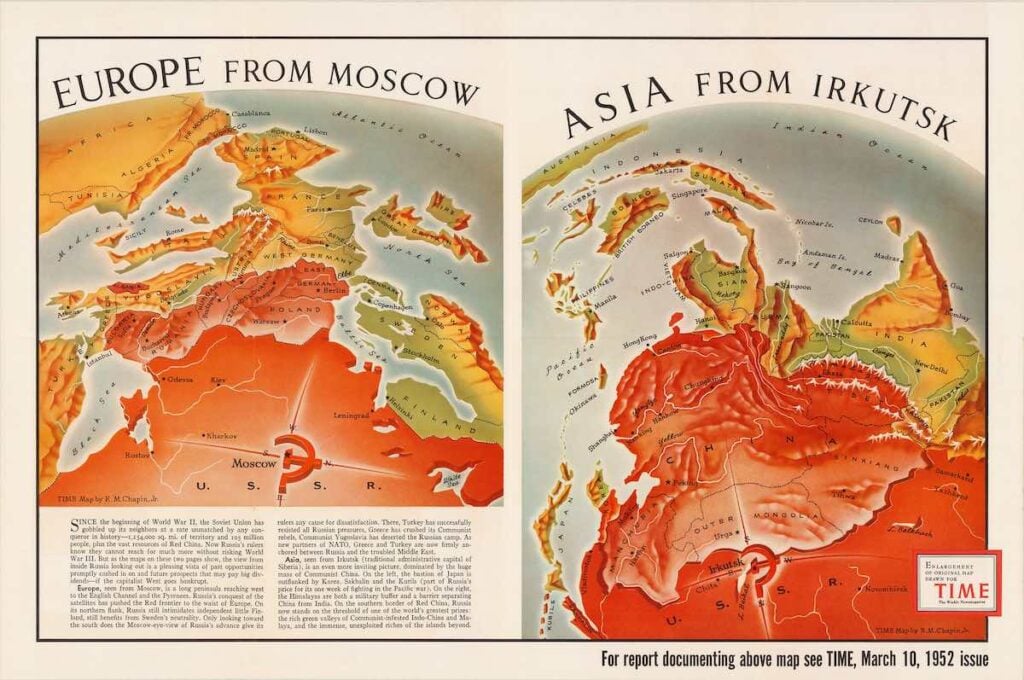
Now, Europe is but a small corner of the world, which the war in Ukraine will render even smaller. For centuries, Europe was merely the western tip of Eurasia, the huge landmass that stretched from China to the Iberian Peninsula and witnessed the exchange of knowledge, products, scientific innovations, and cultures.

Much of what was later attributed to European exceptionalism (from the scientific revolution of the 16th century to the industrial revolution in the 19th century) cannot be understood, nor would it have been possible, without those centuries-old exchanges. The war in Ukraine—especially if it goes on for too long—runs the risk not only of amputating one of Europe’s historic powers (Russia), but also of isolating it from the rest of the world, notably from China.

The world is far bigger than what you get to see through European or North American lenses. Seeing through these lenses, Europeans have never felt so strong, so close to their larger partner, so sure of standing on the right side of history, with the whole planet being run by the rules of the “liberal order,” a world finally feeling strong enough to go forth sometime soon and conquer—or at least neutralize—China, after having destroyed China’s main partner, Russia.

Seeing through non-European lenses, on the other hand, Europe and the U.S. stand haughtily all but alone, probably capable of winning one battle, but on their way to certain defeat in the war of history.

More than half of the world’s population lives in countries that have decided not to join the sanctions against Russia. Many of the United Nations member states that voted (rightly) against the illegal invasion of Ukraine did so based on their historical experience, which consisted of being invaded, not by Russia, but rather by the U.S., England, France, or Israel. Their decision was not dictated by ignorance, but by precaution.

How can they trust countries that created SWIFT—a financial transfer system aimed at protecting economic transactions against political interference—only to end up removing from that system a country on political grounds? Countries that arrogate to themselves the power to confiscate the financial and gold reserves of sovereign nations like Afghanistan, Venezuela, and now Russia?

Countries that trumpet freedom of expression as a sacrosanct universal value, but resort to censorship the moment they are exposed by it? Countries that are supposed to cherish democracy and yet have no qualms about staging a coup whenever an election goes against their interests?

Countries in whose eyes the “dictator” Nicolás Maduro becomes a trading partner overnight because the circumstances have changed?

The world is no longer a place of innocence—if it ever was.

Please help TFF post more quality articles like this and to remain truly independent by contributing if you benefited from this article
Boaventura de Sousa Santos is the emeritus professor of sociology at the University of Coimbra in Portugal. His most recent book is Decolonizing the University: The Challenge of Deep Cognitive Justice.

Related Posts

AI generated imagine on Freepik A 2-minute “appetiser” for an extended interview by China’s CGTN. More to come!
Jan Oberg February 21, 2025 How amazing! The Danish government seemed unprepared for the eventuality that President Trump, if elected, would insist once again on getting Greenland – and a few other “things.” Who was asleep – or much too occupied with hating Russia and helping Ukraine to see what was coming? Secondly, Trump – who is no peace-maker but has other motives – grabbed the phone to Russian President Putin. Why did no European leader do exactly that during the last almost three years? And why did Europe not foresee that he would do that; Trump had said time and again that he would engage in the Ukraine war and stop it. They sat there hearing and seeing nothing of what – very predictably – happened outside their European groupthink box. This interview by the China Academy and Thinkers Forum was recorded on February 12, that is, before the...
November 16, 2024 I. Introduction The initiative for the “Nordic Delegation to China, September 7-15, 2024” was taken from the Norwegian side. Journalist and former editor Arild Vollan wanted to investigate claims in the media about an ongoing genocide against the Uyghurs in the autonomous region of Xinjiang in western China. Vollan selected an independent, cross-disciplinary and cross-political delegation group consisting of people who have worked with China and who wanted to get personal impressions of the conditions described in the previous section. The delegation consisted of: • Remi Strand, lawyer. • Thore Vestby, a former member of parliament (H) and former mayor of Frogn. • Arild Vollan (head of delegation), journalist and former editor. • Jan Øberg, PhD sociology, director of the Transnational Foundation for Peace and Future Research, TFF, in Lund, Sweden. (1) The delegation itself developed the project’s mandate. Following an excursion to Xinjiang province, the delegation’s...

Recent Articles

Tony Robinson October 4, 2026 Violence is easy to recognise when someone is being beaten, shot or killed. It becomes more difficult when nobody is holding a weapon. Poverty, discrimination, exploitation and repression can restrict a human life just as effectively, although they do so in very different ways and with very different consequences. Simply adding more categories to an ever-growing list of forms of violence does not really solve the problem. The more interesting question is what all these different situations have in common and why it makes sense to describe them using the same word. Human beings do not simply react to what happens around them. They remember the past, imagine things that do not yet exist, make plans and undertake projects. Workers organise because they imagine different working conditions; people migrate because they imagine another life somewhere else; social movements emerge because people refuse to accept the...
It’s a matter of principles, courage, vision and pulling together – while the militarist world is falling apart… Peter Langille October 3, 2026 “Here, then, is the problem which we present to you, stark and dreadful and inescapable: Shall we put an end to the human race; or shall mankind renounce war?”The Bertrand Russell—Albert Einstein Manifesto, July 9, 1955 ⁕ The forecast for what’s ahead is worrisome. The sharp rise in armed conflicts over the past three years is adding to what was already the highest level in over seventy years. Genocides, which should be prevented are supported. A shared climate emergency that jeopardises survival is ignored. Diverse polls now suggest that people are war-weary, worried and interested in a more effective United Nations. And, there are viable policy options for a more secure world! Yet governments are doubling-down, betting on more war and investing heavily. If current trends persist,...
Johan Galtung 1930-2024October 2015 Published here on October 3, 2026 Let us focus on Civilization for conflict analysis and remedies. Major forms of disorder use violence; war is state organized violence. The most belligerent states are the United States of America and Israel, both with civilization roots. National Evangelism, the US Protestant Christian civilization– more national than evangelical–justifies US warfare as exceptionalism of a people chosen by God, with a manifest destiny to run the world. Orthodox Judaism justifies Israeli warfare to conquer and expand from Nile to Euphrates as a religious right and duty to the Eternal One. The third most belligerent country, the UK, no longer believes it is God-chosen but chosen by the USA; not quite the same but something. But the root cause of global disorder lies in the Occident–with Islam–seeing itself as the single, universal civilization valid for all at all times, all others being...

TFF on Substack

Discover and subscribe to more peace materials on TFF Substack

Most Popular

Tony Robinson October 4, 2026 Violence is easy to recognise when someone is being beaten, shot or killed. It becomes more difficult when nobody is holding a weapon. Poverty, discrimination, exploitation and repression can restrict a human life just as effectively, although they do so in very different ways and with very different consequences. Simply adding more categories to an ever-growing list of forms of violence does not really solve the problem. The more interesting question is what all these different situations have in common and why it makes sense to describe them using the same word. Human beings do not simply react to what happens around them. They remember the past, imagine things that do not yet exist, make plans and undertake projects. Workers organise because they imagine different working conditions; people migrate because they imagine another life somewhere else; social movements emerge because people refuse to accept the...
It’s a matter of principles, courage, vision and pulling together – while the militarist world is falling apart… Peter Langille October 3, 2026 “Here, then, is the problem which we present to you, stark and dreadful and inescapable: Shall we put an end to the human race; or shall mankind renounce war?”The Bertrand Russell—Albert Einstein Manifesto, July 9, 1955 ⁕ The forecast for what’s ahead is worrisome. The sharp rise in armed conflicts over the past three years is adding to what was already the highest level in over seventy years. Genocides, which should be prevented are supported. A shared climate emergency that jeopardises survival is ignored. Diverse polls now suggest that people are war-weary, worried and interested in a more effective United Nations. And, there are viable policy options for a more secure world! Yet governments are doubling-down, betting on more war and investing heavily. If current trends persist,...
Johan Galtung 1930-2024October 2015 Published here on October 3, 2026 Let us focus on Civilization for conflict analysis and remedies. Major forms of disorder use violence; war is state organized violence. The most belligerent states are the United States of America and Israel, both with civilization roots. National Evangelism, the US Protestant Christian civilization– more national than evangelical–justifies US warfare as exceptionalism of a people chosen by God, with a manifest destiny to run the world. Orthodox Judaism justifies Israeli warfare to conquer and expand from Nile to Euphrates as a religious right and duty to the Eternal One. The third most belligerent country, the UK, no longer believes it is God-chosen but chosen by the USA; not quite the same but something. But the root cause of global disorder lies in the Occident–with Islam–seeing itself as the single, universal civilization valid for all at all times, all others being...
Read More
Living-Peace-Sign-Budapest-copy
Tony Robinson October 4, 2026 Violence is easy to recognise when someone is being beaten, shot or killed. It becomes more difficult when nobody is holding a weapon. Poverty, discrimination, exploitation and repression can restrict a human life just as effectively, although they do so in very different ways and with very different consequences. Simply adding more categories to an ever-growing list of forms of violence does not really solve the problem. The more interesting question is what all these different situations have in common and why it makes sense to describe them using the same word. Human beings do not simply react to what happens around them. They remember the past, imagine things that do not yet exist, make plans and undertake projects. Workers organise because they imagine different working conditions; people migrate because they imagine another life somewhere else; social movements emerge because people refuse to accept the...
b54a1f10-8c65-4f0b-9dd5-4abc0a7d04cc_2659x2659
It’s a matter of principles, courage, vision and pulling together – while the militarist world is falling apart… Peter Langille October 3, 2026 “Here, then, is the problem which we present to you, stark and dreadful and inescapable: Shall we put an end to the human race; or shall mankind renounce war?”The Bertrand Russell—Albert Einstein Manifesto, July 9, 1955 ⁕ The forecast for what’s ahead is worrisome. The sharp rise in armed conflicts over the past three years is adding to what was already the highest level in over seventy years. Genocides, which should be prevented are supported. A shared climate emergency that jeopardises survival is ignored. Diverse polls now suggest that people are war-weary, worried and interested in a more effective United Nations. And, there are viable policy options for a more secure world! Yet governments are doubling-down, betting on more war and investing heavily. If current trends persist,...
010
Johan Galtung 1930-2024October 2015 Published here on October 3, 2026 Let us focus on Civilization for conflict analysis and remedies. Major forms of disorder use violence; war is state organized violence. The most belligerent states are the United States of America and Israel, both with civilization roots. National Evangelism, the US Protestant Christian civilization– more national than evangelical–justifies US warfare as exceptionalism of a people chosen by God, with a manifest destiny to run the world. Orthodox Judaism justifies Israeli warfare to conquer and expand from Nile to Euphrates as a religious right and duty to the Eternal One. The third most belligerent country, the UK, no longer believes it is God-chosen but chosen by the USA; not quite the same but something. But the root cause of global disorder lies in the Occident–with Islam–seeing itself as the single, universal civilization valid for all at all times, all others being...
Screenshot 2026-10-02 011738
Jan ObergPhD, director, The Transnational Foundation for Peace and Future Research, TFFLund, Sweden October 2, 2026 This is my full original manuscript. The Chinese Academy of Social Science, CASS, makes two publications out if it. 1. China’s Five-year plan emphasized the capabilities of basic research and original innovation. It is regarded as the goal of the future social development, which, as required, should be significantly enhanced. Can you comment on the importance of original innovation in research and academic study? I believe it is easier to define “original innovation” in the natural sciences than in social sciences. The breaking points of what constitutes something new, or innovative, are not quite as sharp in the latter. But in both fields it is about opening up something that was closed, unseen, unexplored before – making manifest what was earlier latent. Innovations come in many forms and shapes – naming something that was not...
arctic-circle-map
The agreement is catastrophic both because of what it says and what it doesn’t mention. It reduces further the major asset of security policies: Freedom of action. Jan Oberg TFF director September 25, 2026 A couple of hours before the agreement was signed on September 22, 2026, I published the following 13 hypotheses about what it would most likely contain on TFF Substack (in English). I was wrong on only the first point. Contrary to what Trump had written on his Truth Social platform, it does not appear to come into force immediately. In fact, it turned out to be worse than even I had anticipated. After these hypotheses now come a number of reflections in light of what the agreement actually contains, and does not contain, as well as the way in which it has generally been presented by major media outlets and by the public-service broadcaster DR. My...
girl-5894831_1280
Below are TFF-related media mentions, comments, videos and social media posts published elsewhere but not on this homepage. We happen to catch and list only a fraction. Regarding video comments and debates, we recommend that you go to the TFF Video Channel on Substack where many of them are reproduced. Jan Oberg is a contributor to China Daily – 52 million daily clicks – and Global Times, CGTN and CCTV (the national television), China Investment, Xinhua News Agency and several others. Articles and videos on these media very often multiply into countless Chinese (and Western media) that re-post them from these main media. Thanks to The China Academy, his analyses, interviews and comments are frequently posted on YouTube channels such as Thinkers Forum and Wave Media. These videos are often re-posted on Bilibili (China’s YouTube), the China Content Center on TikTok, and on the Chinese edition of TikTok, Douyin.com. This means reaching hundreds of millions of viewers worldwide over a year. While there are too many to catch on all these...




