
Ben Norton: The West is out of touch with the rest of world politically, EU-funded study admits

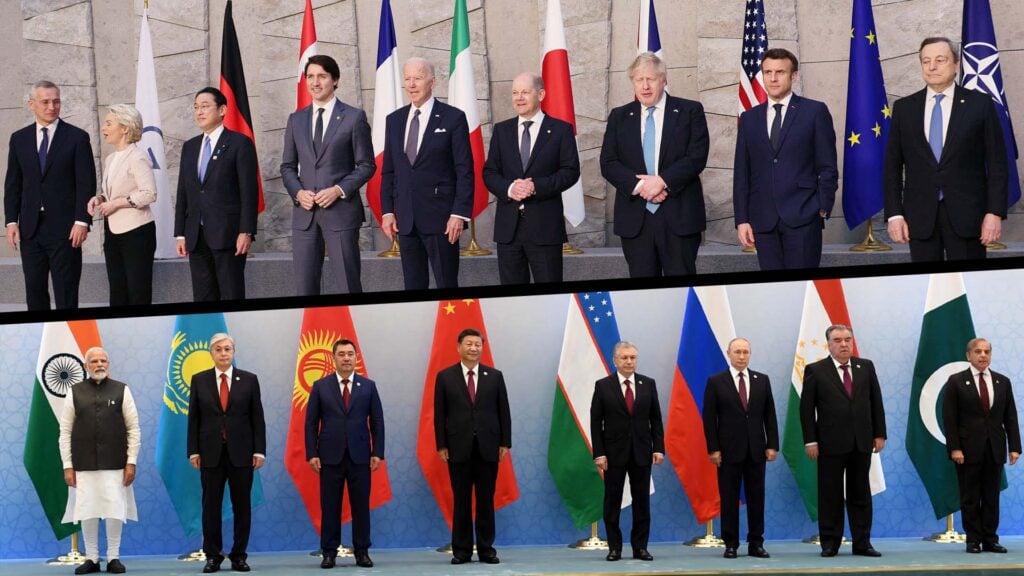
Meetings of the G7 and NATO (top) and Shanghai Cooperation Organization (bottom)

Ben Norton

March 29, 2023

A study by the elite EU-funded European Council on Foreign Relations found the West is out of touch politically with the rest of the world. Most people in China, India, and Türkiye see Russia as an important ally, and they want multipolarity, not continued “American global supremacy”.

Originally published at Geopolitical Economy on February 25, 2023

A study by an elite European government-funded think tank found that, while the United States and Europe are growing closer together, the West is increasingly out of touch politically with the rest of the world.

The report, from the EU member state-financed European Council on Foreign Relations, conceded that the system of “American global supremacy” is in rapid decline, and many people in the Global South want a new “multipolar world”.

The series of polls concluded that NATO’s proxy war in “Ukraine confirmed the renewed centrality of American power to Europe”, uniting the West under Washington’s leadership. Today, Europeans and North Americans “hold many views in common about major global questions”.

But this “consolidation of the West is taking place in an increasingly divided post-Western world”, the study acknowledged. The Global South is moving in the opposite direction.

It described “a wide gap between the West and the ‘rest’ when it comes to their desired outcomes for the war and differing understandings of why the US and Europe support Ukraine”.

The report admitted that, even if Ukraine somehow managed to win the NATO proxy war with Russia, “it is highly unlikely to restore a US-led global liberal order”, and, instead, “the West will have to live, as one pole of a multipolar world”.

The 13% of the global population in the West is out of touch with the ‘rest’ of the world

This study was conducted by the European Council on Foreign Relations (ECFR), a notoriously hawkish think tank that expresses overt anti-Russia and anti-China bias.

The ECFR is funded by the European Parliament and numerous European governments, including Germany, France, Italy, Spain, Belgium, Ireland, Norway, Denmark, Finland, and the Czech Republic, as well as key Western ally Japan.

For the report, the ECFR commissioned polling in:

  • China
  • India
  • Türkiye
  • Russia
  • United States
  • Britain

It also surveyed people in nine major European Union member states, which it referred to collectively as the EU9:

  • Denmark
  • Estonia
  • France
  • Germany
  • Italy
  • Poland
  • Portugal
  • Romania
  • Spain

The pollsters interviewed a total of 19,765 adults in late December 2022 and early January 2023.

The sample of participants in the West was representative of the general population. But the study disclosed that, in China, India, and Russia, the people surveyed in the polling only came from large cities, meaning the results may not reflect the views of those living in rural areas.

The study suffered from bias. This slant was clear when the report misleadingly referred to the NATO-Russia proxy war in Ukraine facilely as “Putin’s war” and “Russian aggression”, as if the West did not play a fundamental role in starting the conflict in the first place by sponsoring a violent coup d’etat in Kiev in 2014, repeatedly violating promises not to expand NATO east after the 1990 reunification of Germany, sabotaging the Minsk accords and peace talks, and ignoring Moscow’s 2021 request for security guarantees.

But despite the ECFR study’s many flaws, its results convey an unmistakable message: The West is out of touch with the rest of the world.

The report acknowledged this, choosing as its title: “United West, divided from the rest“.

The Western nations surveyed in the study have a combined population of nearly 1 billion – approximately 13% of the global population of 8 billion.

This is a mere fraction of the populations of China (1.41 billion), India (1.39 billion), Russia (142 million), and Türkiye (83 million).

Together, these countries have a population of just over 3 billion – making up around 38% of the total global population.

The ECFR polling shows how significantly the public opinion of the 13% in the West differs from that of the Eurasian powers.

The West’s view of the Ukraine war is not shared by the rest of the world

In its report, the European Council on Foreign Relations stated that the proxy war in “Ukraine marks both the consolidation of the West and the emergence of the long-heralded post-Western international order”.

“Many in China state that American and European support for Ukraine is driven by the desire to protect Western dominance”, the study acknowledged.

“And for the vast majority of Chinese and Turks, Western support for Ukraine is motivated by reasons other than a defence of Ukraine’s territorial integrity or of its democracy”, it added.

45% of people surveyed in China, 38% in Russia, 30% in Türkiye, and 23% in India said the US is supporting Ukraine simply in order “to defend Western dominance”.
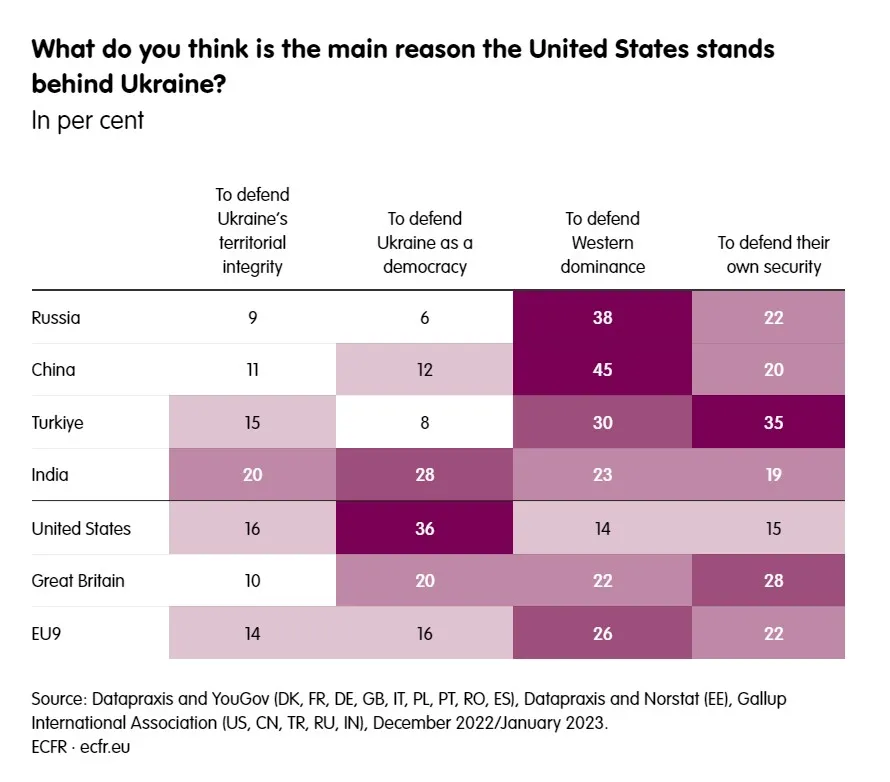
A plurality in these Eurasian nations thinks the same about Brussels.

40% of people surveyed in China, 46% in Russia, 27% in Türkiye, and 23% in India said Europe is supporting Ukraine in order “to defend Western dominance”.
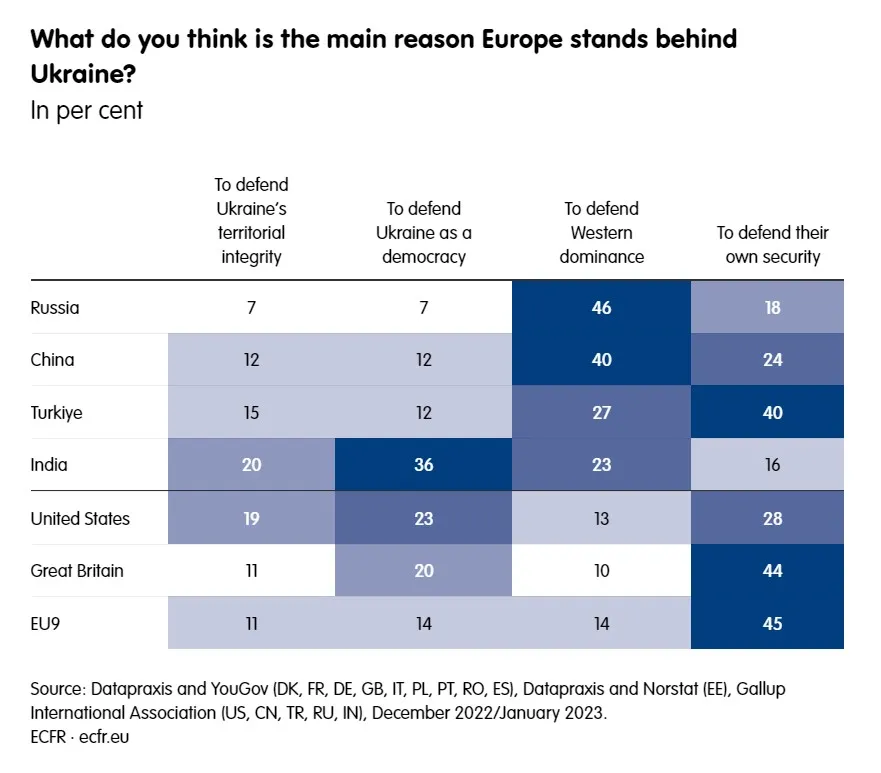
The report admitted that “people in non-Western countries possess a clear preference for the war to end now – even if it means Ukraine having to give up territory”.

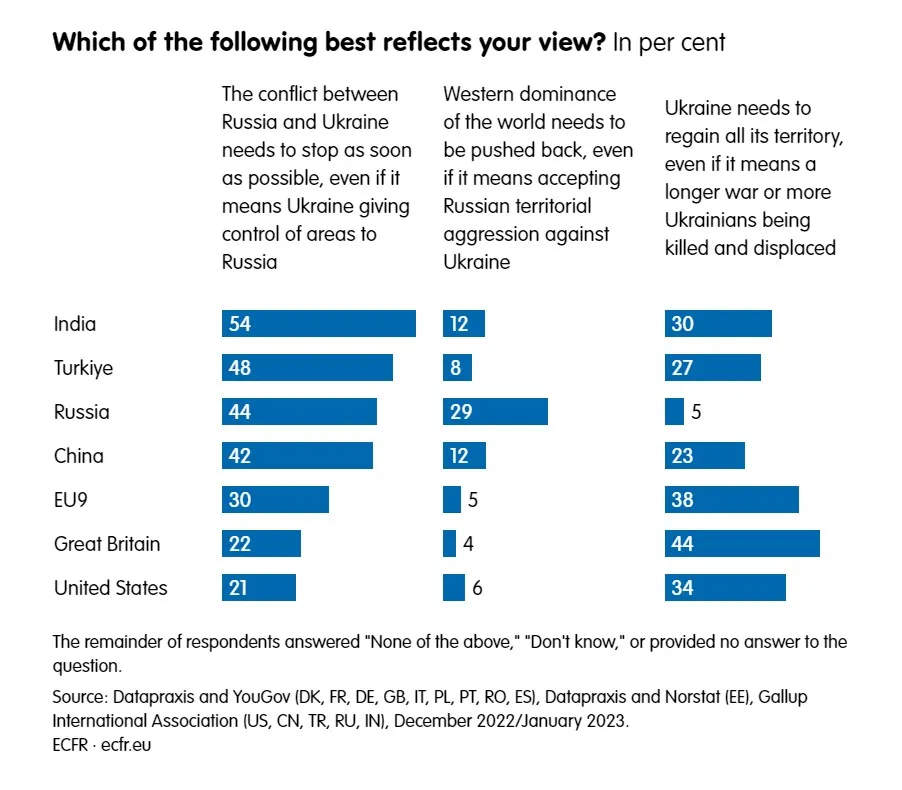
54% of people surveyed in India, 48% in Türkiye, 44% in Russia, and 42% in China think “the conflict between Russia and Ukraine needs to stop as soon as possible, even if it means Ukraine giving control of areas to Russia”.

Despite biased wording from the pollsters, an additional 12% of people in India, 8% in Türkiye, 29% in Russia, and 12% in China said “Western dominance of the world needs to be pushed back, even if it means accepting Russian territorial aggression against Ukraine”.
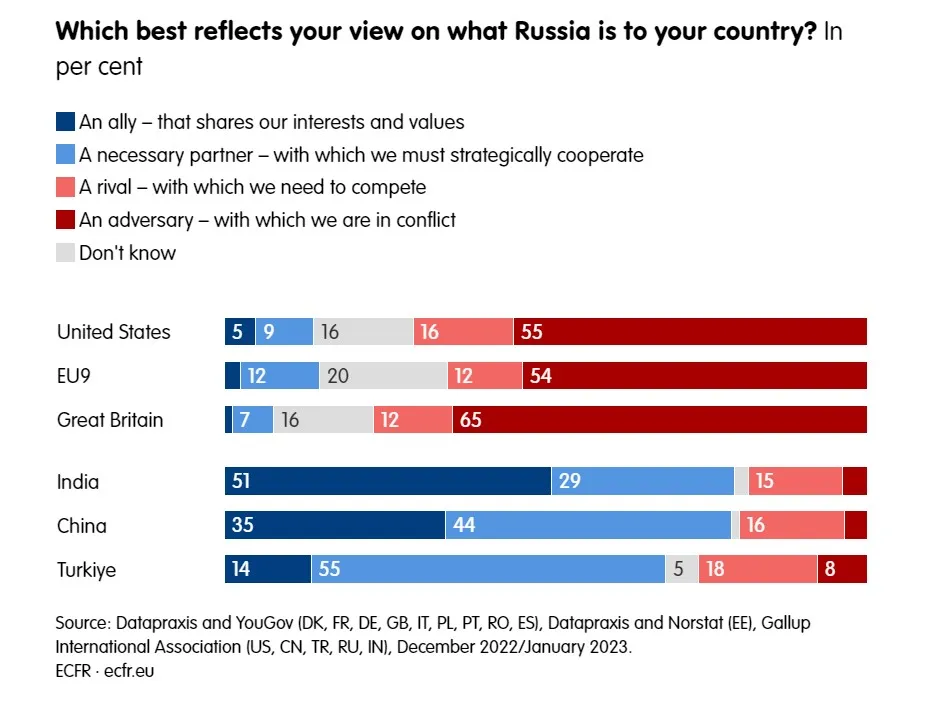
While a majority of people in the United States, Britain, and EU consider Russia to be an “adversary with which we are in conflict”, the situation is the opposite in India, China, and Türkiye.

In India, 80% of people surveyed see Russia as an ally or partner (51% as an “ally that shares our interests and values” and 29% as a “necessary partner with which we must strategically cooperate”).

In China, 79% of people surveyed see Russia as an ally or partner (35% as an ally and 44% as a necessary partner).

In Türkiye, 69% of people surveyed see Russia as an ally or partner (14% as an ally and 55% as a necessary partner).
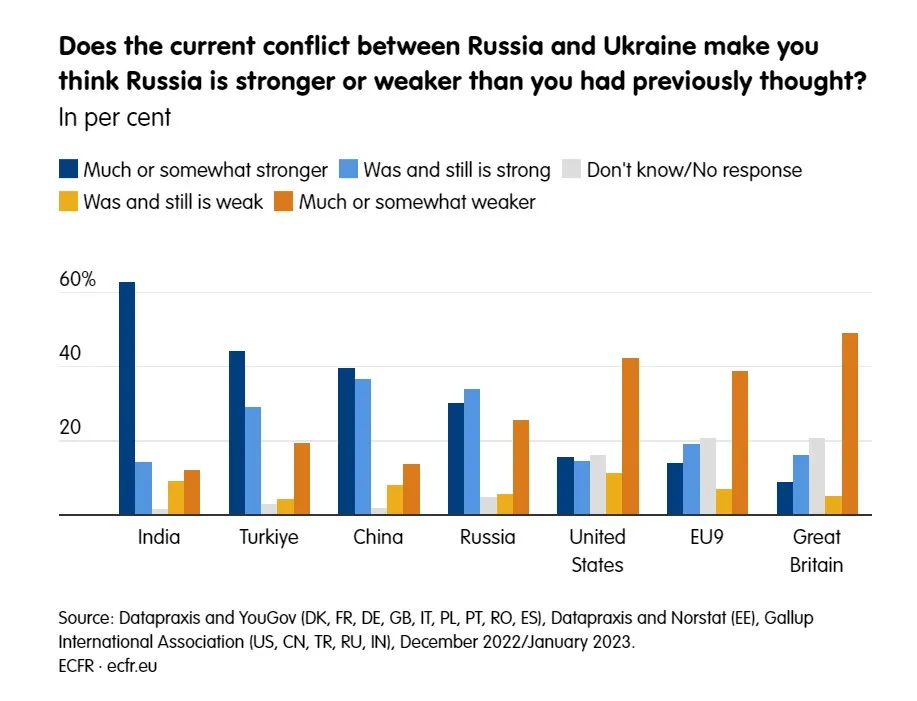
Another question in the poll showed how Western media propaganda has manipulated public opinion.

The proxy war in Ukraine has made Russia seem stronger in India, Türkiye, China, and the country itself, whereas people across the West now see Moscow as weaker.

This was another example of where Western views were the exact opposite of those in the Global South.
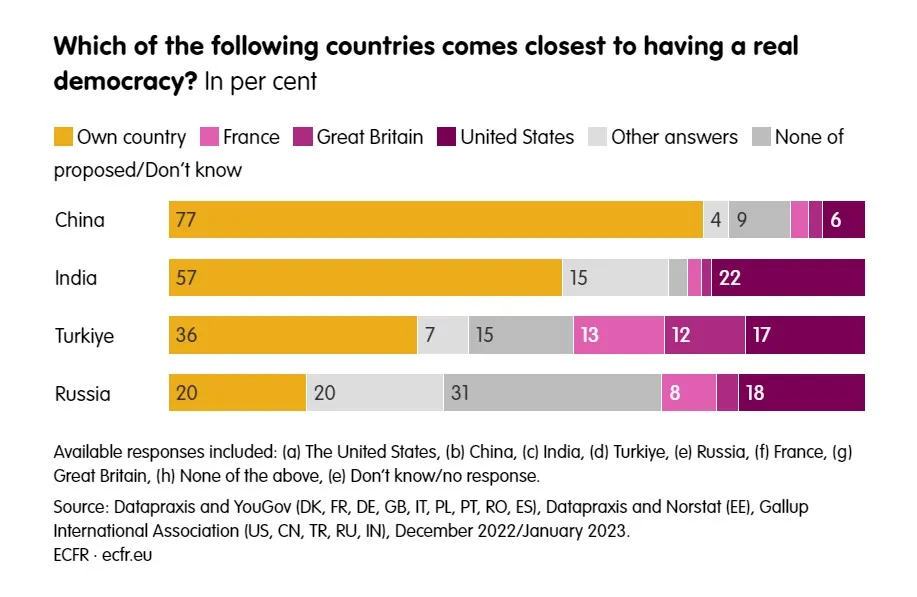
The ECFR report admitted that, while US “President Joe Biden has framed the war [in Ukraine] as a struggle between democracy and authoritarianism”, this is not how people in the Global South see it.

The pollsters asked participants which country they consider “comes closest to having a real democracy”. This question, again, reflected the bias of the study, turning the survey into a contest to see which country is supposedly the most democratic of all.

Yet despite these limitations, more than three-quarters of people surveyed in China (77%) considered their country to “come closest to having a real democracy”.

A separate study conducted in 2022 by another Western government-backed organization, the NATO-linked Alliance of Democracies Foundation, found that 83% of people in China consider their government a democracy, and 91% said they value democracy as important. (In the United States, on the other hand, just 49% of people said their government is a democracy.)
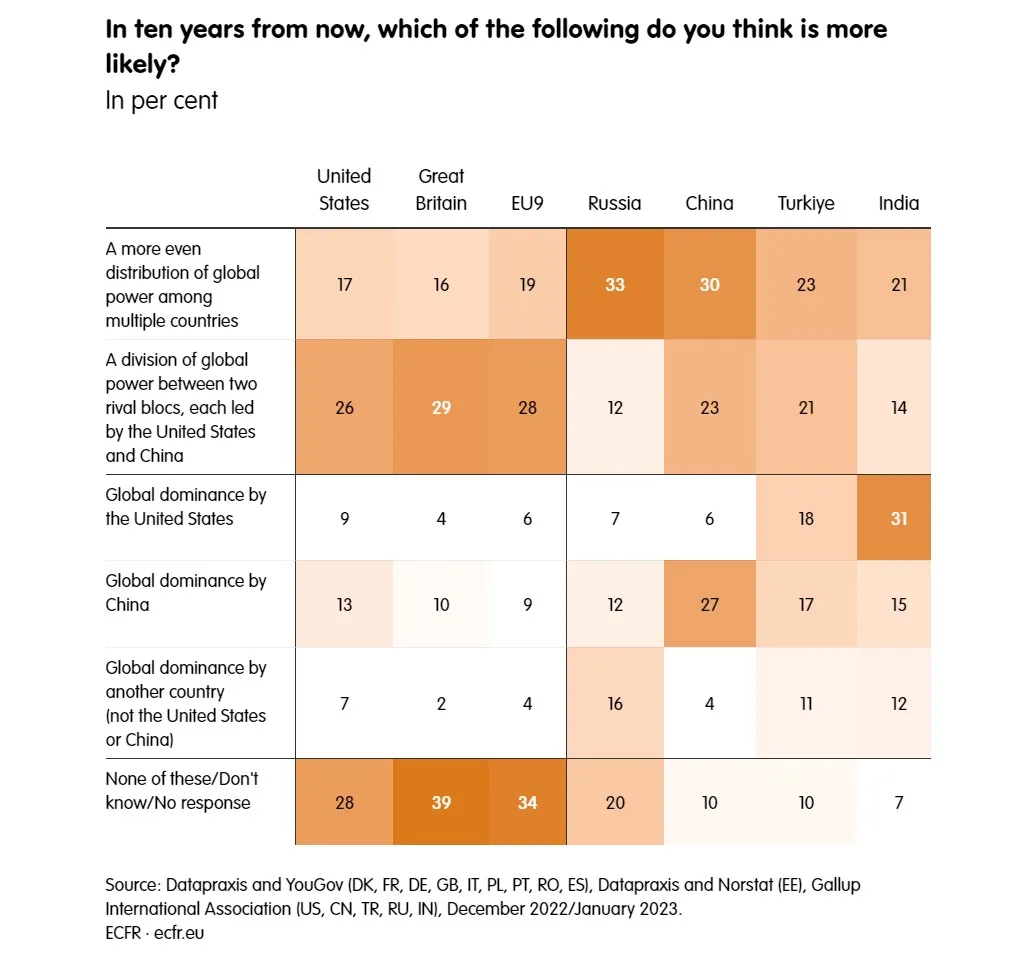
The ECFR study also acknowledged, “Most people in major non-Western countries such as China, India, Turkiye, and Russia predict the West will soon be just one global pole among several. The West may still be the strongest party but it will not be hegemonic”.

A plurality of people surveyed in China (30%) and Russia (33%) think the world will become increasingly multipolar.

This is in stark contrast to the plurality of those surveyed in Britain (29%), the EU (28%), and the US (26%), who see the world returning to a bipolar system of cold war competition between a US-led bloc and a China-led bloc.
Originally published at Geopolitical Economy on February 25, 2023

About the author

Ben Norton is an investigative journalist and analyst. He is the founder and editor of Geopolitical Economy Report and is based in Latin America. (Publicaciones en español aquí.)
Related Posts

Photo above: Carl Fredrik Reuterswärd’s Non-Violence outside UN Headquarters in New York. Kirill Levin, CC BY-NC-SA 2. Jan Oberg November 3, 2026 I am happy to be published in Horizons which is produced by the Center for International Relations and Sustainable Development, CIRSD, in Belgrade. My contribution brings out a radical re-thinking of what concepts such as defence, security, deterrence – and peace – may mean if we want to create a more peaceful world. It also summarises a few things I have been working with the last few decades. Please read it here Og her er den på dansk, takket være Johnny Baltzersens lynhurtige oversættelse
UNITE-tillid, DREAM-velstand og andre konstruktive komponenter Normally we publish articles in English here. But this is a translation of a very important TFF document that should reach as many as possible in Denmark since this country’s government has been one of the most hardline in Europe and, up till now at least, has refused to use diplomacy and, instead, spent tremendous sums on arming Ukraine with the express goal of defeating Russia. Thus this – unique – article is in Danish. Vi er Johnny Baltzersen og hans Fælles Sikkerhed – Fælles Fremtid på Substack overmåde taknemmelige for at have oversat og publiceret TFF’s 2025-portfølje for fredsidéer med henblik på Ukraines fremtid. Vi håber den nu kan nå mange flere danskere – som også vil sprede den og skabe debat – nu den danske regerings og folketingspartiernes politik på dette område siden 2022 står nu – forudsigeligt – ved vejs ende....
Johan Galtung 1930-2024October 2015 Published here on October 3, 2026 Let us focus on Civilization for conflict analysis and remedies. Major forms of disorder use violence; war is state organized violence. The most belligerent states are the United States of America and Israel, both with civilization roots. National Evangelism, the US Protestant Christian civilization– more national than evangelical–justifies US warfare as exceptionalism of a people chosen by God, with a manifest destiny to run the world. Orthodox Judaism justifies Israeli warfare to conquer and expand from Nile to Euphrates as a religious right and duty to the Eternal One. The third most belligerent country, the UK, no longer believes it is God-chosen but chosen by the USA; not quite the same but something. But the root cause of global disorder lies in the Occident–with Islam–seeing itself as the single, universal civilization valid for all at all times, all others being...

Recent Articles

Photo above: Carl Fredrik Reuterswärd’s Non-Violence outside UN Headquarters in New York. Kirill Levin, CC BY-NC-SA 2. Jan Oberg November 3, 2026 I am happy to be published in Horizons which is produced by the Center for International Relations and Sustainable Development, CIRSD, in Belgrade. My contribution brings out a radical re-thinking of what concepts such as defence, security, deterrence – and peace – may mean if we want to create a more peaceful world. It also summarises a few things I have been working with the last few decades. Please read it here Og her er den på dansk, takket være Johnny Baltzersens lynhurtige oversættelse
UNITE-tillid, DREAM-velstand og andre konstruktive komponenter Normally we publish articles in English here. But this is a translation of a very important TFF document that should reach as many as possible in Denmark since this country’s government has been one of the most hardline in Europe and, up till now at least, has refused to use diplomacy and, instead, spent tremendous sums on arming Ukraine with the express goal of defeating Russia. Thus this – unique – article is in Danish. Vi er Johnny Baltzersen og hans Fælles Sikkerhed – Fælles Fremtid på Substack overmåde taknemmelige for at have oversat og publiceret TFF’s 2025-portfølje for fredsidéer med henblik på Ukraines fremtid. Vi håber den nu kan nå mange flere danskere – som også vil sprede den og skabe debat – nu den danske regerings og folketingspartiernes politik på dette område siden 2022 står nu – forudsigeligt – ved vejs ende....
Jan Oberg TFF director October 28, 2026 Exactly one month has now passed since I published my criticism of the introduction to the special issue on Johan Galtung published by the Journal of Global Security Studies, JoGSS, and of Tor Egil Førland’s chapter about Galtung which serves as a preview to his forthcoming biography of Galtung to be published by PRIO. See the original on The Transnational here and the same article on TFF Substack with many general and critical comments and, in particular, the people who decided to withdraw from the biography project in protest. The special issue itself was extraordinary. It was devoted to the intellectual legacy of one of the founders of peace research and contained a number of strong assessments of his personality, scholarship, intellectual trajectory, and public role. Such assessments are, of course, entirely legitimate. No scholar is beyond criticism, and neither was Johan Galtung....

TFF on Substack

Discover and subscribe to more peace materials on TFF Substack

Most Popular

Photo above: Carl Fredrik Reuterswärd’s Non-Violence outside UN Headquarters in New York. Kirill Levin, CC BY-NC-SA 2. Jan Oberg November 3, 2026 I am happy to be published in Horizons which is produced by the Center for International Relations and Sustainable Development, CIRSD, in Belgrade. My contribution brings out a radical re-thinking of what concepts such as defence, security, deterrence – and peace – may mean if we want to create a more peaceful world. It also summarises a few things I have been working with the last few decades. Please read it here Og her er den på dansk, takket være Johnny Baltzersens lynhurtige oversættelse
UNITE-tillid, DREAM-velstand og andre konstruktive komponenter Normally we publish articles in English here. But this is a translation of a very important TFF document that should reach as many as possible in Denmark since this country’s government has been one of the most hardline in Europe and, up till now at least, has refused to use diplomacy and, instead, spent tremendous sums on arming Ukraine with the express goal of defeating Russia. Thus this – unique – article is in Danish. Vi er Johnny Baltzersen og hans Fælles Sikkerhed – Fælles Fremtid på Substack overmåde taknemmelige for at have oversat og publiceret TFF’s 2025-portfølje for fredsidéer med henblik på Ukraines fremtid. Vi håber den nu kan nå mange flere danskere – som også vil sprede den og skabe debat – nu den danske regerings og folketingspartiernes politik på dette område siden 2022 står nu – forudsigeligt – ved vejs ende....
Jan Oberg TFF director October 28, 2026 Exactly one month has now passed since I published my criticism of the introduction to the special issue on Johan Galtung published by the Journal of Global Security Studies, JoGSS, and of Tor Egil Førland’s chapter about Galtung which serves as a preview to his forthcoming biography of Galtung to be published by PRIO. See the original on The Transnational here and the same article on TFF Substack with many general and critical comments and, in particular, the people who decided to withdraw from the biography project in protest. The special issue itself was extraordinary. It was devoted to the intellectual legacy of one of the founders of peace research and contained a number of strong assessments of his personality, scholarship, intellectual trajectory, and public role. Such assessments are, of course, entirely legitimate. No scholar is beyond criticism, and neither was Johan Galtung....
Read More
knotted gun
Photo above: Carl Fredrik Reuterswärd’s Non-Violence outside UN Headquarters in New York. Kirill Levin, CC BY-NC-SA 2. Jan Oberg November 3, 2026 I am happy to be published in Horizons which is produced by the Center for International Relations and Sustainable Development, CIRSD, in Belgrade. My contribution brings out a radical re-thinking of what concepts such as defence, security, deterrence – and peace – may mean if we want to create a more peaceful world. It also summarises a few things I have been working with the last few decades. Please read it here Og her er den på dansk, takket være Johnny Baltzersens lynhurtige oversættelse
TFFPortfolioVign
UNITE-tillid, DREAM-velstand og andre konstruktive komponenter Normally we publish articles in English here. But this is a translation of a very important TFF document that should reach as many as possible in Denmark since this country’s government has been one of the most hardline in Europe and, up till now at least, has refused to use diplomacy and, instead, spent tremendous sums on arming Ukraine with the express goal of defeating Russia. Thus this – unique – article is in Danish. Vi er Johnny Baltzersen og hans Fælles Sikkerhed – Fælles Fremtid på Substack overmåde taknemmelige for at have oversat og publiceret TFF’s 2025-portfølje for fredsidéer med henblik på Ukraines fremtid. Vi håber den nu kan nå mange flere danskere – som også vil sprede den og skabe debat – nu den danske regerings og folketingspartiernes politik på dette område siden 2022 står nu – forudsigeligt – ved vejs ende....
JoGSS-Silent
Jan Oberg TFF director October 28, 2026 Exactly one month has now passed since I published my criticism of the introduction to the special issue on Johan Galtung published by the Journal of Global Security Studies, JoGSS, and of Tor Egil Førland’s chapter about Galtung which serves as a preview to his forthcoming biography of Galtung to be published by PRIO. See the original on The Transnational here and the same article on TFF Substack with many general and critical comments and, in particular, the people who decided to withdraw from the biography project in protest. The special issue itself was extraordinary. It was devoted to the intellectual legacy of one of the founders of peace research and contained a number of strong assessments of his personality, scholarship, intellectual trajectory, and public role. Such assessments are, of course, entirely legitimate. No scholar is beyond criticism, and neither was Johan Galtung....
Screenshot 2026-10-26 115647
An aspect of Iran’s culture and civilisation you’ve probably never heard about. Don’t be surprised if the US and Israel also try to bomb them. Jan ObergTFF director October 26, 2026 Today – under the “USraeli” threat of new “annihilating” bombings – opens the 7th International Conference on Peace and Conflict Resolution at Tehran’s University. As far as I can tell, this is the only permanent, advanced peace research institution in West Asia/the Middle East. Perhaps more countries in that region could be inspired? I mean, how many military “security” institutes and military academies do they have? Many peace research institutes and university departments have been established since the 1950s in the West. They are now all under attack; some have closed down, some have gone mainstream, yet others kept the name but do nothing to research peace and disseminate results or advice; instead, they cooperate with militarism’s platforms such...
Screenshot 2026-10-15 141837
Let’s discuss using AI to create peace – in contrast to boring geopolitics devoid of creative healing and visions. Jan Oberg TFF director October 15, 2026 I asked VEED to create a short video exemplifying how peace is preferable to war, then chose the lady as a template. Simple as that. In less than a minute, it produced this video, which any peace-loving person would appreciate. The only problem is that human intelligence (HI), at least the one that exists among Western decision-makers, isn’t half as moral or smart as AI. I have used AI to dialogue about peace and peace plans, creative conflict resolution and visions of a better future for humankind. It so happens that I am having more stimulating, intelligent, creative and moral discussions with AI than I could possibly have with any EU or NATO leader today. Yes, AI has very problematic and dangerous aspects; used...
girl-5894831_1280
Below are TFF-related media mentions, comments, videos and social media posts published elsewhere but not on this homepage. We happen to catch and list only a fraction. Regarding video comments and debates, we recommend that you go to the TFF Video Channel on Substack where many of them are reproduced. Jan Oberg is a contributor to China Daily – 52 million daily clicks – and Global Times, CGTN and CCTV (the national television), China Investment, Xinhua News Agency and several others. Articles and videos on these media very often multiply into countless Chinese (and Western media) that re-post them from these main media. Thanks to The China Academy, his analyses, interviews and comments are frequently posted on YouTube channels such as Thinkers Forum and Wave Media. These videos are often re-posted on Bilibili (China’s YouTube), the China Content Center on TikTok, and on the Chinese edition of TikTok, Douyin.com. This means reaching hundreds of millions of viewers worldwide over a year. While there are too many to catch on all these...





