
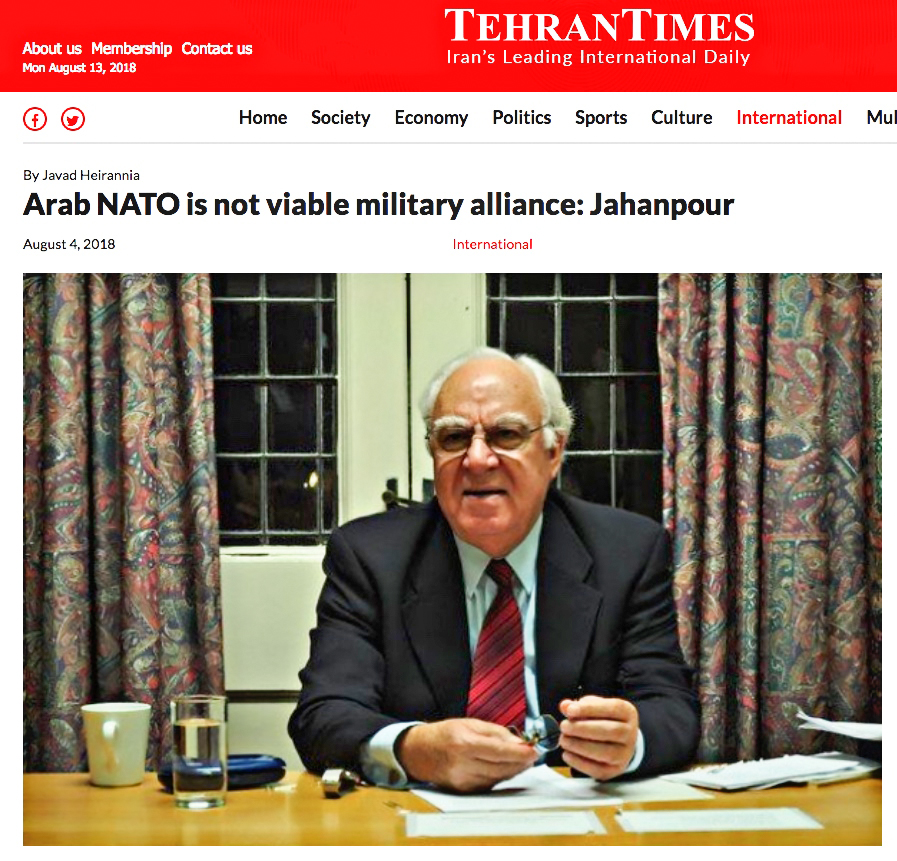
By Farhang Jahanpour, TFF Board member

August 13, 2018


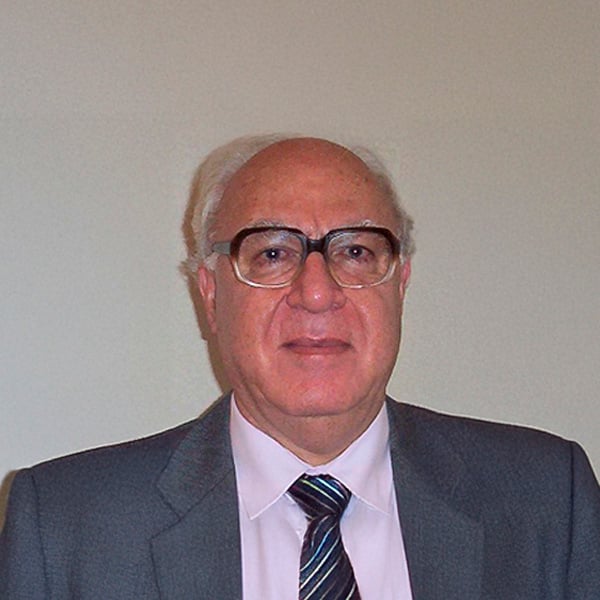
In an interview with Tehran Times, professor Farhang Jahanpour, part-time tutor on Middle Eastern affairs in the Department of Continuing Education, University of Oxford, and a member of Kellogg College says that he does not believe that Arab NATO is “a viable military alliance.”

Former Senior Research Scholar at Harvard adds that “Many earlier U.S. attempts to develop a formal alliance with Arab monarchies have failed and, at the moment, there is even less unity among various PGCC members than ever before.”

Professor Jahanpour suggests that President Trump should be invited to Iran to see the destruction wrought on her people thanks to Saddam Hussein’s Western-supported invasion of Iran and then he should visit all the other places the US has helped destroy and meet the victims there.

Following is the full text of the interview which was published by Tehran Times here.


Q: There is some talk about the formation of an alliance, dubbed Arab NATO, against Iran. How credible are those reports?

FJ: The White House has indicated that President Trump will convene a summit meeting with the leaders of the six Persian Gulf littoral states, plus Egypt and Jordan, in Washington in mid-October to counter what it calls Iran’s expansion in the region.

It is sad that instead of trying to formulate some form of regional security agreement between all the Middle Eastern countries, putting an end to decades of conflict in the region, the intense anti-Iranian feelings of some members of the Trump Administration, egged on by the right-wing Israeli Prime Minister Benjamin Netanyahu, are pushing some Arab client regimes towards more confrontation, and creating greater instability in this volatile region.

This goes against President Trump’s promises during his election campaign, when he criticized former administrations for waging unwinnable wars in the Middle East at the cost of trillions of dollars without achieving anything. In fact, during the campaign he strongly criticised Saudi Arabia for supporting the extremists and the terrorists and promised to adopt a harsher stance towards her.

It is also strange that President Trump who is not strongly in favor of multi-lateral alliances and at one point called for the break-up of NATO, now wishes to form an Arab NATO with the participation of mainly Sunni Arab dictatorships who hardly get on well together. Whatever the aim of such a military alliance is, it spells disaster for them and for the region and will drag the region towards greater upheaval and instability.


Q: Will this coalition be considered as a real coalition and a viable military alliance?

FJ: I do not believe that this is a viable military alliance. Many earlier U.S. attempts to develop a formal alliance with Arab monarchies have failed and, at the moment, there is even less unity among various PGCC members than ever before.

In June 2017, at the behest of the young and ambitious Saudi Crown Prince Mohammed bin Salman, Saudi Arabia, the United Arab Emirates, Bahrain, and Egypt severed diplomatic relations with Qatar. Just last May, the three Persian Gulf regimes blocked websites belonging to Qatar, including Al-Jazeera.

As a result, Qatar is practically out of the PGCC and is getting closer to Iran and Turkey. According to many reports, Saudi Arabia was about to invade Qatar last year, and was only prevented from doing so by the former Secretary of State Rex Tillerson.

Kuwait has been pursuing a less confrontational policy in the past, and is unlikely to want to join a SAUDI-led military alliance against Iran. Oman has always followed an independent policy and has played a very useful role as a mediator between different countries, including between Iran and the Obama administration that led to the nuclear agreement, and is unlikely to want to join that military alliance.

As regards countries outside the Persian Gulf region, Mohammad Bin Salman was putting pressure on Jordan to give the custodianship of Jerusalem to Saudi Arabia so that he could trade it with Israel in the “deal of the century” initiated by Jared Kushner, a request that was strongly rejected.

Egypt has refused to send forces to support Saudi and the UAE war against Yemen, and is unlikely to join the military pact. It has only joined the Saudi Alliance against Qatar due to its hostility towards the Muslim Brotherhood and in order to receive financial assistance from the two Persian Gulf states because of her current difficult economic conditions. Egypt also seems to be tilting towards President Bashar al-Assad in his war against Saudi-supported Sunni extremists.

Therefore, the only anti-Iranian bloc would consist of Saudi Arabia, UAE and Bahrain, which are the only countries out of the 22 Arab League members who are very hostile towards Iran.

Bahrain is already under Saudi occupation and has no option but to go along with what the Saudis demand, but there have been serious differences between the UAE and Saudi rulers in their war against Yemen, and in any case not all UAE leaders are as hostile to Iran as Abu Dhabi’s crown prince.

The total population of Saudi Arabia, UAE and Bahrain is just about 22 million, compared to Iran’s 80 million. Therefore, the so-called Arab NATO should not be taken very seriously even if it is formed.


Q: How should Iran react to this real or imaginary military alliance?

A: Iran should not just remain a passive observer of what is going on. These are some ways by which Iran can respond to this folly.

First, President Trump has expressed a willingness to meet with Iranian leaders without any preconditions. He should be invited to Tehran and should be taken to see some of the devastation that was caused by Saddam Hussein’s invasion of Iran, including the use of chemical weapons, which America supported to the end.

President Trump should meet some of the victims of the chemical attacks to see the price that they continue to pay some 30 years after the end of the war when the world closed its eyes to Saddam’s criminal use of these prohibited weapons.

During that eight-year war, close to a million Iranians were killed and wounded and the country sustained hundreds of billions worth of damage. He will see that the majority of Iranians are not in favor of another war, and this is why they extended a hand of friendship to the West and negotiated a nuclear deal with all the permanent members of the Security Council plus Germany, and are abiding by the terms of the deal.

Then, he should be taken to Iraq to see the result of America’s 2003 invasion, which killed hundreds of thousands of innocent Iraqis and shattered the country.

He should be taken to Mosul to see with his own eyes the consequences of the activities of Sunni extremists, which according to his own assertion were supported by some Persian Gulf states.

He should also go to Raqqa and Aleppo and see the devastation caused by ISIS before they were driven out by U.S. and Russian aerial operations and Iranian and Syrian forces on the ground.

Then he should be taken to Yemen to see the Saudi and UAE war against that poor country, which has killed more than 10,000 people, left around two-thirds of the population of 27 million relying on aid, and 8.4 million wondering where their next meal will come from and on the brink of starvation.

This week marks the 28th anniversary of Saddam’s invasion of Kuwait (launched on 2 August 1990). That event should provide a lesson both to the United States and to local rulers.

After having devastated Iran, while receiving at least US$60 billlion of assistance from Persian Gulf states, including about US$30 billion from Kuwait, to finance the war he turned against his former allies and invaded Kuwait. His invasion of Kuwait cost tens of thousands of casualties, and cost about U$676 billion to the region.

Arming ambitious bullies with the aim of dominating their neighbors will have similar consequences and will backfire on smaller countries that support this ill-fated alliance.

I am sure that if President Trump sees all this for himself he would give up the idea of forming a military pact with a number of dictatorial and militant rulers.

The next thing that Iran should do is to take some positive steps towards peace.

Iran, Turkey and Egypt are the three largest and most powerful countries in the region with a long history of culture and civilization, representing the Persians, the Turks and the Arabs.

They should act like the adults in the room and should get together to form an alliance to sort out the mess in the Middle East.

The election of Imran Khan in Pakistan has also opened new avenues of cooperation in the region. Iran should take the first step to bring India, Pakistan and Afghanistan together and help them to put an end to their hostilities, and to form an alliance with other states in the Middle East and Central Asia that can rival the EU.

The time for forming military alliances against other countries has long past and it will only result in failure and misery. The nations in the region should take the initiative and move towards unity – or at least coexistence – instead of hostility and military confrontation. This will be in the best interests of all regional states.



Related Posts

Photo above: Carl Fredrik Reuterswärd’s Non-Violence outside UN Headquarters in New York. Kirill Levin, CC BY-NC-SA 2. Jan Oberg November 3, 2026 I am happy to be published in Horizons which is produced by the Center for International Relations and Sustainable Development, CIRSD, in Belgrade. My contribution brings out a radical re-thinking of what concepts such as defence, security, deterrence – and peace – may mean if we want to create a more peaceful world. It also summarises a few things I have been working with the last few decades. Please read it here Og her er den på dansk, takket være Johnny Baltzersens lynhurtige oversættelse
UNITE-tillid, DREAM-velstand og andre konstruktive komponenter Normally we publish articles in English here. But this is a translation of a very important TFF document that should reach as many as possible in Denmark since this country’s government has been one of the most hardline in Europe and, up till now at least, has refused to use diplomacy and, instead, spent tremendous sums on arming Ukraine with the express goal of defeating Russia. Thus this – unique – article is in Danish. Vi er Johnny Baltzersen og hans Fælles Sikkerhed – Fælles Fremtid på Substack overmåde taknemmelige for at have oversat og publiceret TFF’s 2025-portfølje for fredsidéer med henblik på Ukraines fremtid. Vi håber den nu kan nå mange flere danskere – som også vil sprede den og skabe debat – nu den danske regerings og folketingspartiernes politik på dette område siden 2022 står nu – forudsigeligt – ved vejs ende....
Jan Oberg TFF director October 28, 2026 Exactly one month has now passed since I published my criticism of the introduction to the special issue on Johan Galtung published by the Journal of Global Security Studies, JoGSS, and of Tor Egil Førland’s chapter about Galtung which serves as a preview to his forthcoming biography of Galtung to be published by PRIO. See the original on The Transnational here and the same article on TFF Substack with many general and critical comments and, in particular, the people who decided to withdraw from the biography project in protest. The special issue itself was extraordinary. It was devoted to the intellectual legacy of one of the founders of peace research and contained a number of strong assessments of his personality, scholarship, intellectual trajectory, and public role. Such assessments are, of course, entirely legitimate. No scholar is beyond criticism, and neither was Johan Galtung....

Recent Articles

Photo above: Carl Fredrik Reuterswärd’s Non-Violence outside UN Headquarters in New York. Kirill Levin, CC BY-NC-SA 2. Jan Oberg November 3, 2026 I am happy to be published in Horizons which is produced by the Center for International Relations and Sustainable Development, CIRSD, in Belgrade. My contribution brings out a radical re-thinking of what concepts such as defence, security, deterrence – and peace – may mean if we want to create a more peaceful world. It also summarises a few things I have been working with the last few decades. Please read it here Og her er den på dansk, takket være Johnny Baltzersens lynhurtige oversættelse
UNITE-tillid, DREAM-velstand og andre konstruktive komponenter Normally we publish articles in English here. But this is a translation of a very important TFF document that should reach as many as possible in Denmark since this country’s government has been one of the most hardline in Europe and, up till now at least, has refused to use diplomacy and, instead, spent tremendous sums on arming Ukraine with the express goal of defeating Russia. Thus this – unique – article is in Danish. Vi er Johnny Baltzersen og hans Fælles Sikkerhed – Fælles Fremtid på Substack overmåde taknemmelige for at have oversat og publiceret TFF’s 2025-portfølje for fredsidéer med henblik på Ukraines fremtid. Vi håber den nu kan nå mange flere danskere – som også vil sprede den og skabe debat – nu den danske regerings og folketingspartiernes politik på dette område siden 2022 står nu – forudsigeligt – ved vejs ende....
Jan Oberg TFF director October 28, 2026 Exactly one month has now passed since I published my criticism of the introduction to the special issue on Johan Galtung published by the Journal of Global Security Studies, JoGSS, and of Tor Egil Førland’s chapter about Galtung which serves as a preview to his forthcoming biography of Galtung to be published by PRIO. See the original on The Transnational here and the same article on TFF Substack with many general and critical comments and, in particular, the people who decided to withdraw from the biography project in protest. The special issue itself was extraordinary. It was devoted to the intellectual legacy of one of the founders of peace research and contained a number of strong assessments of his personality, scholarship, intellectual trajectory, and public role. Such assessments are, of course, entirely legitimate. No scholar is beyond criticism, and neither was Johan Galtung....

TFF on Substack

Discover and subscribe to more peace materials on TFF Substack

Most Popular

Photo above: Carl Fredrik Reuterswärd’s Non-Violence outside UN Headquarters in New York. Kirill Levin, CC BY-NC-SA 2. Jan Oberg November 3, 2026 I am happy to be published in Horizons which is produced by the Center for International Relations and Sustainable Development, CIRSD, in Belgrade. My contribution brings out a radical re-thinking of what concepts such as defence, security, deterrence – and peace – may mean if we want to create a more peaceful world. It also summarises a few things I have been working with the last few decades. Please read it here Og her er den på dansk, takket være Johnny Baltzersens lynhurtige oversættelse
UNITE-tillid, DREAM-velstand og andre konstruktive komponenter Normally we publish articles in English here. But this is a translation of a very important TFF document that should reach as many as possible in Denmark since this country’s government has been one of the most hardline in Europe and, up till now at least, has refused to use diplomacy and, instead, spent tremendous sums on arming Ukraine with the express goal of defeating Russia. Thus this – unique – article is in Danish. Vi er Johnny Baltzersen og hans Fælles Sikkerhed – Fælles Fremtid på Substack overmåde taknemmelige for at have oversat og publiceret TFF’s 2025-portfølje for fredsidéer med henblik på Ukraines fremtid. Vi håber den nu kan nå mange flere danskere – som også vil sprede den og skabe debat – nu den danske regerings og folketingspartiernes politik på dette område siden 2022 står nu – forudsigeligt – ved vejs ende....
Jan Oberg TFF director October 28, 2026 Exactly one month has now passed since I published my criticism of the introduction to the special issue on Johan Galtung published by the Journal of Global Security Studies, JoGSS, and of Tor Egil Førland’s chapter about Galtung which serves as a preview to his forthcoming biography of Galtung to be published by PRIO. See the original on The Transnational here and the same article on TFF Substack with many general and critical comments and, in particular, the people who decided to withdraw from the biography project in protest. The special issue itself was extraordinary. It was devoted to the intellectual legacy of one of the founders of peace research and contained a number of strong assessments of his personality, scholarship, intellectual trajectory, and public role. Such assessments are, of course, entirely legitimate. No scholar is beyond criticism, and neither was Johan Galtung....
Read More
knotted gun
Photo above: Carl Fredrik Reuterswärd’s Non-Violence outside UN Headquarters in New York. Kirill Levin, CC BY-NC-SA 2. Jan Oberg November 3, 2026 I am happy to be published in Horizons which is produced by the Center for International Relations and Sustainable Development, CIRSD, in Belgrade. My contribution brings out a radical re-thinking of what concepts such as defence, security, deterrence – and peace – may mean if we want to create a more peaceful world. It also summarises a few things I have been working with the last few decades. Please read it here Og her er den på dansk, takket være Johnny Baltzersens lynhurtige oversættelse
TFFPortfolioVign
UNITE-tillid, DREAM-velstand og andre konstruktive komponenter Normally we publish articles in English here. But this is a translation of a very important TFF document that should reach as many as possible in Denmark since this country’s government has been one of the most hardline in Europe and, up till now at least, has refused to use diplomacy and, instead, spent tremendous sums on arming Ukraine with the express goal of defeating Russia. Thus this – unique – article is in Danish. Vi er Johnny Baltzersen og hans Fælles Sikkerhed – Fælles Fremtid på Substack overmåde taknemmelige for at have oversat og publiceret TFF’s 2025-portfølje for fredsidéer med henblik på Ukraines fremtid. Vi håber den nu kan nå mange flere danskere – som også vil sprede den og skabe debat – nu den danske regerings og folketingspartiernes politik på dette område siden 2022 står nu – forudsigeligt – ved vejs ende....
JoGSS-Silent
Jan Oberg TFF director October 28, 2026 Exactly one month has now passed since I published my criticism of the introduction to the special issue on Johan Galtung published by the Journal of Global Security Studies, JoGSS, and of Tor Egil Førland’s chapter about Galtung which serves as a preview to his forthcoming biography of Galtung to be published by PRIO. See the original on The Transnational here and the same article on TFF Substack with many general and critical comments and, in particular, the people who decided to withdraw from the biography project in protest. The special issue itself was extraordinary. It was devoted to the intellectual legacy of one of the founders of peace research and contained a number of strong assessments of his personality, scholarship, intellectual trajectory, and public role. Such assessments are, of course, entirely legitimate. No scholar is beyond criticism, and neither was Johan Galtung....
Screenshot 2026-10-26 115647
An aspect of Iran’s culture and civilisation you’ve probably never heard about. Don’t be surprised if the US and Israel also try to bomb them. Jan ObergTFF director October 26, 2026 Today – under the “USraeli” threat of new “annihilating” bombings – opens the 7th International Conference on Peace and Conflict Resolution at Tehran’s University. As far as I can tell, this is the only permanent, advanced peace research institution in West Asia/the Middle East. Perhaps more countries in that region could be inspired? I mean, how many military “security” institutes and military academies do they have? Many peace research institutes and university departments have been established since the 1950s in the West. They are now all under attack; some have closed down, some have gone mainstream, yet others kept the name but do nothing to research peace and disseminate results or advice; instead, they cooperate with militarism’s platforms such...
Screenshot 2026-10-15 141837
Let’s discuss using AI to create peace – in contrast to boring geopolitics devoid of creative healing and visions. Jan Oberg TFF director October 15, 2026 I asked VEED to create a short video exemplifying how peace is preferable to war, then chose the lady as a template. Simple as that. In less than a minute, it produced this video, which any peace-loving person would appreciate. The only problem is that human intelligence (HI), at least the one that exists among Western decision-makers, isn’t half as moral or smart as AI. I have used AI to dialogue about peace and peace plans, creative conflict resolution and visions of a better future for humankind. It so happens that I am having more stimulating, intelligent, creative and moral discussions with AI than I could possibly have with any EU or NATO leader today. Yes, AI has very problematic and dangerous aspects; used...
girl-5894831_1280
Below are TFF-related media mentions, comments, videos and social media posts published elsewhere but not on this homepage. We happen to catch and list only a fraction. Regarding video comments and debates, we recommend that you go to the TFF Video Channel on Substack where many of them are reproduced. Jan Oberg is a contributor to China Daily – 52 million daily clicks – and Global Times, CGTN and CCTV (the national television), China Investment, Xinhua News Agency and several others. Articles and videos on these media very often multiply into countless Chinese (and Western media) that re-post them from these main media. Thanks to The China Academy, his analyses, interviews and comments are frequently posted on YouTube channels such as Thinkers Forum and Wave Media. These videos are often re-posted on Bilibili (China’s YouTube), the China Content Center on TikTok, and on the Chinese edition of TikTok, Douyin.com. This means reaching hundreds of millions of viewers worldwide over a year. While there are too many to catch on all these...




