By Richard Falk
July 28, 2014

Prefatory Note
Posted here is a Joint Declaration of 142 (as of now) international law experts from around the world who are listed below as endorsers. I am among the endorsers, and the text was initially drafted by Chantal Meloni who has served as rapporteur.
We welcome additional signatures that can be sent to me at falk@global.ucsb.edu with affiliation noted for identification, and names will be periodically added to the text.
I view this as an important expression of professional judgment and individual conscience relating to Israeli behavior in Gaza commencing on 8 July that has already taken so many innocent lives and caused such widespread devastation. Please join us and spread the word!
The International Community Must End Israel’s Collective Punishment of the Civilian Population in the Gaza Strip
As international and criminal law scholars, human rights defenders, legal experts and individuals who firmly believe in the rule of law and in the necessity for its respect in times of peace and more so in times of war, we feel the intellectual and moral duty to denounce the grave violations, mystification and disrespect of the most basic principles of the laws of armed conflict and of the fundamental human rights of the entire Palestinian population committed during the ongoing Israeli offensive on the Gaza Strip. We also condemn the launch of rockets from the Gaza Strip, as every indiscriminate attack against civilians, regardless of the identity of the perpetrators, is not only illegal under international law but also morally intolerable. However, as also implicitly noted by the UN Human Rights Council in its Resolution of the 23th July 2014, the two parties to the conflict cannot be considered equal, and their actions – once again – appear to be of incomparable magnitude.
Once again it is the unarmed civilian population, the ‘protected persons’ under International humanitarian law (IHL), who is in the eye of the storm. Gaza’s civilian population has been victimized in the name of a falsely construed right to self-defence, in the midst of an escalation of violence provoked in the face of the entire international community. The so-called Operation Protective Edge erupted during an ongoing armed conflict, in the context of a prolonged belligerent occupation that commenced in 1967. In the course of this ongoing conflict thousands of Palestinians have been killed and injured in the Gaza Strip during recurrent and ostensible ‘ceasefire’ periods since 2005, after Israel’s unilateral ‘disengagement’ from the Gaza Strip. The deaths caused by Israel’s provocative actions in the Gaza Strip prior to the latest escalation of hostilities must not be ignored as well.
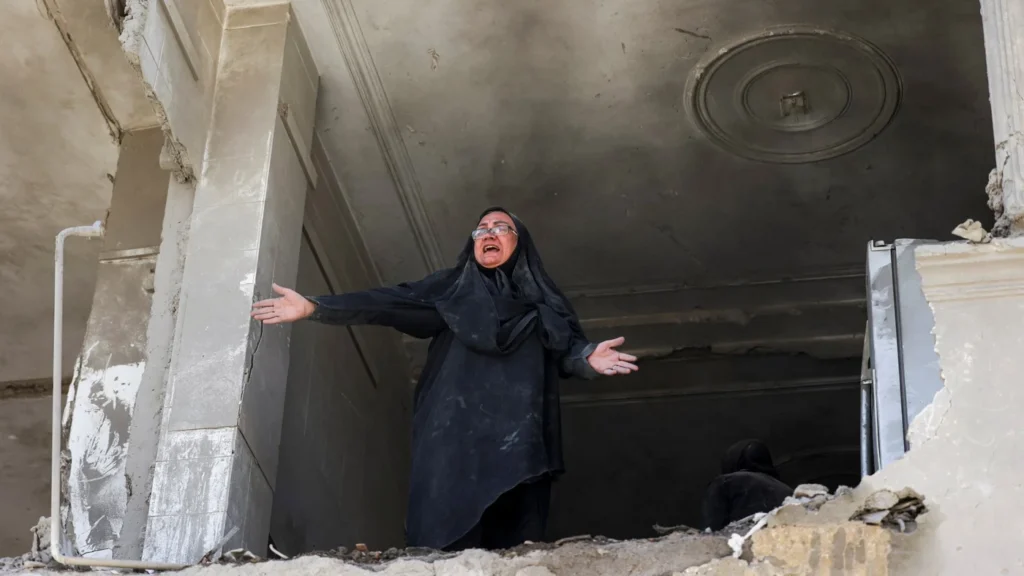
According to UN sources, over the last two weeks, nearly 800 Palestinians in Gaza have been killed and more than 4,000 injured, of whom the vast majority were civilians. Several independent sources indicate that only 15 per cent of the casualties were combatants. Entire families have been murdered. Hospitals, clinics, as well as a rehabilitation centre for disabled persons have been targeted and severely damaged. During one single day, on Sunday 20th July, more than 100 Palestinian civilians were killed in Shuga’iya, a residential neighbourhood of Gaza City. This was one of the bloodiest and most aggressive operations ever conducted by Israel in the Gaza Strip, a form of urban violence constituting a total disrespect of civilian innocence. Sadly, this was followed only a couple of days later by an equally destructive attack on Khuza’a, East of Khan Younis.
Additionally, the offensive has already caused widespread destruction of buildings and infrastructure: according to the UN Office for the Coordination of Humanitarian Affairs, over 3,300 houses have been targeted resulting in their destruction or severe damage.
As denounced by the UN Fact-Finding Mission (FFM) on the Gaza conflict in the aftermath of Israel’s ‘Operation Cast Lead’ in 2008-2009: “While the Israeli Government has sought to portray its operations as essentially a response to rocket attacks in the exercise of its right to self defence, the Mission considers the plan to have been directed, at least in part, at a different target: The people of Gaza as a whole” (A/HRC/12/48, par. 1680). The same can be said for the current Israeli offensive.
The civilian population in the Gaza Strip is under direct attack and many are forced to leave their homes. What was already a refugee and humanitarian crisis has worsened with a new wave of mass displacement of civilians: the number of IDPs has reached nearly 150,000, many of whom have obtained shelter in overcrowded UNRWA schools, which unfortunately are no safe areas as demonstrated by the repeated attacks on the UNRWA school in Beit Hanoun. Everyone in Gaza is traumatized and living in a state of constant terror. This result is intentional, as Israel is again relying on the ‘Dahiya doctrine’, which deliberately has recourse to disproportionate force to inflict suffering on the civilian population in order to achieve political (to exert pressure on the Hamas Government) rather than military goals.
In so doing, Israel is repeatedly and flagrantly violating the law of armed conflict, which establishes that combatants and military objectives may be targeted, i.e. ‘those objects which by their nature, location, purpose or use make an effective contribution to military action and whose total or partial destruction, capture or neutralization, in the circumstances ruling at the time, offers a definite military advantage.’ Most of the recent heavy bombings in Gaza lack an acceptable military justification and, instead, appear to be designed to terrorize the civilian population. As the ICRC clarifies, deliberately causing terror is unequivocally illegal under customary international law.
In its Advisory Opinion in the Nuclear Weapons case, the ICJ stated that the principle of distinction, which requires belligerent States to distinguish between civilian and combatants, is one of the “cardinal principles” of international humanitarian law and one of the “intransgressible principles of international customary law”.
The principle of distinction is codified in Articles 48, 51(2) and 52(2) of the Additional Protocol I of 1977 to the 1949 Geneva Conventions, to which no reservations have been made. According to Additional Protocol I, “attacks” refer to “acts of violence against the adversary, whether in offence or in defence” (Article 49). Under both customary international law and treaty law, the prohibition on directing attacks against the civilian population or civilian objects is absolute. There is no discretion available to invoke military necessity as a justification.
Contrary to Israel’s claims, mistakes resulting in civilian casualties cannot be justified: in case of doubt as to the nature of the target, the law clearly establishes that an object which is normally dedicated to civilian purposes (such as schools, houses, places of worship and medical facilities), are presumed as not being used for military purposes. During these past weeks, UN officials and representatives have repeatedly called on Israel to strictly abide by the principle of precaution in carrying out attacks in the Gaza Strip, where risks are greatly aggravated by the very high population density, and maximum restraint must be exercised to avoid civilian casualties. HRW has noted that these rules exist to minimize mistakes “when such mistakes are repeated, it raises the concern of whether the rules are being disregarded.”
Moreover, even when targeting clear military objectives, Israel consistently violates the principle of proportionality: this is particularly evident with regard to the hundreds of civilian houses destroyed by the Israeli army during the current military operation in Gaza. With the declared intention to target a single member of Hamas, Israeli forces have bombed and destroyed houses although occupied as residencies by dozens of civilians, including women, children, and entire families.
It is inherently illegal under customary international law to intentionally target civilian objects, and the violation of such a fundamental tenet of law can amount to a war crime. Issuing a ‘warning’ – such as Israel’s so-called roof knocking technique, or sending an SMS five minutes before the attack – does not mitigate this: it remains illegal to wilfully attack a civilian home without a demonstration of military necessity as it amounts to a violation of the principle of proportionality. Moreover, not only are these ‘warnings’ generally ineffective, and can even result in further fatalities, they appear to be a pre-fabricated excuse by Israel to portray people who remain in their homes as ‘human shields’.
The indiscriminate and disproportionate attacks, the targeting of objectives providing no effective military advantage, and the intentional targeting of civilians and civilian houses have been persistent features of Israel’s long-standing policy of punishing the entire population of the Gaza Strip, which, for over seven years, has been virtually imprisoned by Israeli imposed closure. Such a regime amounts to a form of collective punishment, which violates the unconditional prohibition set forth in Article 33 of the Fourth Geneva Convention and has been internationally condemned for its illegality. However, far from being effectively opposed international actors, Israel’s illegal policy of absolute closure imposed on the Gaza Strip has relentlessly continued, under the complicit gaze of the international community of States.
***
As affirmed in 2009 by the UN Fact Finding Mission on the Gaza Conflict: “Justice and respect for the rule of law are the indispensable basis for peace. The prolonged situation has created a justice crisis in the Occupied Palestinian Territory that warrants action” (A/HRC/12/48, para. 1958) Indeed: “long-standing impunity has been a key factor in the perpetuation of violence in the region and in the reoccurrence of violations, as well as in the erosion of confidence among Palestinians and many Israelis concerning prospects for justice and a peaceful solution to the conflict”. (A/HRC/12/48, para. 1964)
Therefore…
We welcome the Resolution adopted on 23 July 2014 by the UN Human Rights Council, in which an independent, international commission of inquiry was established to investigate all violations of international humanitarian law and international human rights law in the Occupied Palestinian Territory.
We call upon the United Nations, the Arab League, the European Union, individual States, in particular the United States of America, and the international community in its entirety and with its collective power to take action in the spirit of the utmost urgency to put an end to the escalation of violence against the civilian population of the Gaza Strip, and to activate procedures to hold accountable all those responsible for violations of international law, including political leaders and military commanders. In particular:
All regional and international actors should support the immediate conclusion of a durable, comprehensive, and mutually agreed ceasefire agreement, which must secure the rapid facilitation and access of humanitarian aid and the opening of borders to and from Gaza;
All High Contracting Parties to the Geneva Conventions must be urgently and unconditionally called upon to comply with their fundamental obligations, binding at all times, and to act under common Article 1, to take all measures necessary for the suppression of grave breaches, as clearly imposed by Article 146 and Article 147 of the Fourth Geneva Convention; these rules are applicable by all interested parties as well;
Moreover, we denounce the shameful political pressures exerted by several UN Member States and the UN on President Mahmoud Abbas, to discourage recourse to the International Criminal Court (ICC), and we urge the Governmental leaders of Palestine to invoke the jurisdiction of the ICC, by ratifying the ICC treaty and in the interim by resubmitting the declaration under Article 12(3) of the Rome Statute, in order to investigate and prosecute the serious international crimes committed on the Palestinian territory by all parties to the conflict; and
The UN Security Council must finally exercise its responsibilities in relation to peace and justice by referring the situation in Palestine to the Prosecutor of the ICC.
***
Please note that institutional affiliations are for identification purposes only.
John Dugard, Former UN Special Rapporteur on human rights situation in the Occupied Palestinian Territory
Richard Falk, Former UN Special Rapporteur on human rights situation in the Occupied Palestinian Territory
Alain Pellet, Professor of Public International Law, University Paris Ouest, former Member of the United Nations International Law Commission, France
Georges Abi-Saab, Emeritus Professor of International Law, Graduate Institute of International and Development Studies, Geneva, Former Judge on the ICTY
Vera Gowlland-Debbas, Emeritus Professor of International Law, Graduate Institute of International and Development Studies, Geneva, Switzerland
Chantal Meloni, Adjunct Professor of International Criminal Law, University of Milan, Italy (Rapporteur, Joint Declaration)
Roy Abbott, Consultant in International Humanitarian Law and International Human Rights Law, Australia
Lama Abu-Odeh, Law Professor, Georgetown University Law Center, USA
Susan M. Akram, Clinical Professor and supervising attorney, International Human rights Program, Boston University School of Law, USA
Taris Ahmad, Solicitor at Jones Day, London, UK
Maria Anagnostaki, PhD candidate, Law School University of Athens, Greece
Antony Anghie, Professor of Law, University of Utah, USA
Nizar Ayoub, Director, Al-Marsad, Arab Human Rights Centre in Golan Heights
Valentina Azarov, Lecturer in Human Rights and International Law, Al Quds Bard College, Palestine
Ammar Bajboj, Lecturer in Law, University of Damascus, Syria
Samia Bano, SOAS School of Law, London, UK
Asli Ü Bali, Professor of Law, UCLA School of Law, USA
Jakub Michał Baranowski, Phd Candidate, Universita’ degli Studi Roma Tre, Italy
Frank Barat, Russell Tribunal on Palestine
Emma Bell, Coordinator of the European Group for the Study of Deviance and Social Control, Université de Savoie, France
Barbara Giovanna Bello, Post-doc Fellow, University of Milan, Italy
Brenna Bhandar, Senior lecturer in Law, SOAS School of Law, London, UK
George Bisharat, Professor of Law, UC Hastings College of Law, USA
Barbara Blok, LLM Candidate, University of Essex, UK
John Braithwaite, Professor of Criminology, Australian National University, Australia
Michelle Burgis-Kasthala, lecturer in international law, University of Edinburgh, UK
Eddie Bruce-Jones, Lecturer in Law, University of London, Birkbeck College, UK
Sandy Camlann, LLM Candidate, Université Paris Ouest Nanterre La Défense, France
Grazia Careccia, Human Rights Advocate, London, UK
Baris Cayli, Impact Fellow, University of Stirling, UK
Antonio Cavaliere, Professor of Criminal Law, University Federico II, Naples, Italy
Kathleen Cavanaugh, Senior Lecturer, Irish Center for Human Rights, National University of Ireland, Galway, Ireland
Elizabeth Chadwick, Reader in International Law, Nottingham, UK
Donna R. Cline, Attorney at Law, USA
Karen Corteen, Senior Lecturer in Criminology, University of Chester, UK
Andrew Dahdal, Lecturer, Faculty of Business and Economics, Macquarie University, Sydney, Australia
Teresa Dagenhardt, Reader in Criminology, Queen’s University Belfast, Northern Ireland
Luigi Daniele, PhD candidate in Law, Italy
Alessandro De Giorgi, Professor of Justice Studies, San Josè State University, USA
Paul de Waart, Professor Emeritus of International Law, VU University, Amsterdam, The Netherlands
Gabriele della Morte, Senior Lecturer in International Law, University Cattolica, Milan, Italy
Max du Plessis, Professor of Law, University of Kwazulu-Natal, and Barrister, South Africa and London, UK
Noura Erakat, Georgetown University, USA
Mohammad Fadel, Associate Professor of Law, University of Toronto Faculty of Law, Canada
Mireille Fanon-Mendés France, Independent Expert UNO, Frantz Fanon Foundation, France
Michelle Farrell, lecturer in law, School of Law and Social Justice, University of Liverpool, UK
Daniel Feierstein, Professor and President International Association of Genocide Scholars (IAGS), Argentina
Eleonor Fernández Muñoz, Costa Rica
Tenny Fernando, Attorney at Law, Sri Lanka
Amelia Festa, LLM Candidate, University of Naples Federico II, Italy
Katherine Franke, Professor of Law, Columbia Law School, USA
Jacques Gaillot, Bishop in partibus of Patenia
Katherine Gallagher, Vice President FIDH, senior attorney, Centre for Constitutional Rights (CCR), New York, USA
Avo Sevag Garabet, LLM, University of Groningen, the Netherlands
Jose Garcia Anon, Professor of Law, Human Rights Institute, University of Valencia, Valencia, Spain
Irene Gasparini, PhD candidate, Universitá Cattolica, Milan, Italy
Stratos Georgoulas, Assistant Professor, University of the Aegean, Greece
Haluk Gerger, Professor, Turkey
Hedda Giersten, Professor, Universitet I Oslo, Norway
Javier Giraldo, Director Banco de Datos CINEP, Colombia
Carmen G. Gonzales, Professor of Law, Seattle University School of Law, USA
Penny Green, Professor of Law and Criminology, Director of the State Crime Initiative, King’s College London, UK
Katy Hayward, Senior Lecturer in Sociology, Queen’s University Belfast, Northern Ireland
Andrew Henley, PhD candidate, Keele University, UK
Christiane Hessel, Paris, France
Paddy Hillyard, Professor Emeritus, Queen’s University Belfast, Northern Ireland
Ata Hindi, Institute of Law, Birzeit University, Palestine
Francois Houtart, Professor, National Institute of Higher Studies, Quito, Ecuador
Deena R. Hurwitz, Professor, General Faculty, Director International Human Rights Law Clinic, University of Virginia School of Law, USA
Perfecto Andrés Ibánes, Magistrado Tribunal Supremo de Espagna, Spain
Franco Ippolito, President of the Permanent People’s Tribunal, Italy
Ruth Jamieson, Honorary Lecturer, School of Law, Queen’s University, Belfast, Northern Ireland
Helen Jarvis, former member Extraordinary Chambers in the Courts of Cambodia (ECCC), member of IAGS, Cambodia
Ioannis Kalpouzos, Lecturer in Law, City Law School, London, UK
Victor Kattan, post-doctoral fellow, Law Faculty, National University of Singapore
Michael Kearney, PhD, Lecturer in Law, University of Sussex, UK
Yousuf Syed Khan, USA
Tarik Kochi, Senior Lecturer in Law, School of Law, Politics and Sociology, University of Sussex, UK
Anna Koppel, MSt Candidate in International Human Rights Law, University of Oxford, UK
Karim Lahidji, President of the International Federation for Human Rights (FIDH) and lawyer
Giulia Lanza, PhD Candidate, Università degli Studi di Verona, Italy
Daniel Machover, solicitor, Hickman & Rose, London, UK
Tayyab Mahmud, Professor of Law, Director of the Centre for Global Justice, Seattle University School of Law, USA
Maria C. LaHood, Senior Staff Attorney, CCR, New York, USA
Louise Mallinder, Reader in Human Rights and International Law, University of Ulster, UK
Triestino Mariniello, Lecturer in International Criminal Law, Edge Hill University, UK
Mazen Masri, Lecturer in Law, The City Law School, City University, London, UK
Siobhan McAlister, School of Sociology, Queen’s University Belfast, Northern Ireland
Liam McCann, Principal Lecturer in Criminology, University of Lincoln, UK
Jude McCulloch, Professor of Criminology, Monash University, Melbourne, Australia
Yvonne McDermott Rees, Lecturer in Law, University of Bangor, UK
Cahal McLaughlin, Professor, School of Creative Arts, Queen’s University Belfast, Northern Ireland
Araks Melkonyan, LLM Candidate, University of Essex, UK
Antonio Menna, PhD Candidate, Second University of Naples, Caserta, Italy
Naomi Mezey, Professor of Law, Georgetown University Law Center, USA
Michele Miravalle, PhD candidate, University of Torino, Italy
Sergio Moccia, Professor of Criminal Law, University Federico II, Naples, Italy
Kerry Moore, Lecturer, Cardiff University
Giuseppe Mosconi, Professor of Sociology, University of Padova, Italy
Usha Natarajan, Assistant Professor, Department of Law & Centre for Migration and Refugee Studies, The American University in Cairo, Egypt
Miren Odriozola Gurrutxaga, PhD Candidate, University of the Basque Country, Donostia – San Sebastián, Spain
Georgios Papanicolaou, Reader in Criminology, Teesside University, UK
Marco Pertile, Senior Lecturer in International Law,
Faculty of Law, University of Trento, Italy
Andreas Philippopoulos-Mihalopoulos, Professor of Law and Theory, LLM, The Westminster Law and Theory Centre, UK
Antoni Pigrau Solé, Universitat Rovira i Virgili de Tarragona, Spain
Joseph Powderly, Assistant Professor of Public International Law, Leiden University, The Netherlands
Tony Platt, Visiting Professor of Justice Studies, San Jose State University, USA
Scott Poynting, Professor in Criminology, University of Auckland, New Zeeland
Chris Powell, Professor of Criminology, University S.Maine, USA
Bill Quigley, Professor, Loyola University, New Orleans College of Law, USA
John Quigley, Professor of Law, Ohio State University
Zouhair Racheha, PhD Candidate, University Jean Moulin Lyon 3, France
Laura Raymond, International Human Rights Advocacy Program Manager, CCR, New York, USA
Véronique Rocheleau-Brosseau, LLM candidate, Laval University, Canada
David Rodríguez Goyes, Lecturer, Antonio Nariño and Santo Tomás Universities, Colombia
Alessandro Rosanò, PhD Candidate, Università degli Studi di Padova, Italy
Jamil Salem, Director Institute of Law, Birzeit University, Palestine
Mahmood Salimi, LLM Candidate, Moofid University, Iran
Nahed Samour, doctoral fellow, Humboldt University, Faculty of Law, Berlin, Germany
Iain GM Scobbie, Professor of Public International Law, University of Manchester, UK
David Scott, Senior Lecturer in Criminology, Liverpool John Moores University, UK
Phil Scraton, Professor of Criminology, Belfast, Ireland
Rachel Seoighe, PhD Candidate, Legal Consultant, King’s College London, UK
Tanya Serisier, School of Sociology, Queen’s University Belfast, Northern Ireland
Mohammad Shahabuddin, PdD, Visiting researcher, Graduate School of International Social Sciences, Yokohama National University, Japan
Dean Spade, Seattle University School of Law, USA
Per Stadig, lawyer, Sweden
Chantal Thomas, Professor of Law, Cornell University, USA
Kendall Thomas, Nash Professor of Law, Columbia University, USA
Gianni Tognoni, Lelio Basso Foundation, Rome, Italy
Steve Tombs, Professor of Criminology, The Open University, UK
Paul Troop, Barrister, Garden Court Chambers, UK
Valeria Verdolini, Reader in Sociology, University of Milan, Italy
Francesca Vianello, University of Padova, Italy
Aimilia Voulvouli, Assistant Professor of Sociology, Fatih University, Turkey
Namita Wahi, Fellow, Centre for Policy Research, Dharma Marg, Chanakyapuri, New Delhi, India
Sharon Weill, PhD, Science Po, Paris/ CERAH, Geneva, Switzerland
Peter Weiss, Vice President of Centre for Constitutional Rights (CCR), New York, USA
David Whyte, Reader in Sociology, University of Liverpool, UK
Jeanne M. Woods, Henry F. Bonura, Jr. Distinguished Professor of Law, Loyola University College of Law, New Orleans, USA
William Thomas Worster, Lecturer, International Law, The Hague University of Applied Sciences, The Netherlands
Maung Zarni, Judge, PPT on Sri Lanka and Visiting Fellow, London School of Economics and Political Science