
Kulturskribent Sommelius i Sydamerika Hopp och lugn i Bolivia – Peru mot vänster?

Hoppets och lugnets tid i Bolivia

Är Evo hemma? Ett fönster står på glänt på andra våningen i Palazio Quemado, presidentens formella villa 1875, då rebeller satte eld på huset för att störta presidenten i en av Bolivias 180 kupper och motkupper sedan självständigheten 1825.

Bor Evo Morales överhuvud där, Bolivias förste indianske president, som sänkt sin lön och föredrar att gå klädd i traditionell aymaraindiansk tjocktröja framför kostym och slips? Förmodligen inte.

Evo Morales valdes till president den 18 december 2005 med överväldigande majoritet, 54 procent i den första valomgången. Morales leder partiet MAS, “Moviemento al Socialismo”.

Alla jag möter talar om Evo, inte om president Morales. Stora förhoppningar förknippas med honom. I Bolivia råder dessa första månader 2006 en hoppets och lugnets tid efter decennier av kaos.

Men Morales svårigheter är enorma. Om han sviker de folkliga förväntningarna får han snabbt folket emot sig. Om han “uppfyller” förväntningarna kommer USA, de multinationella företagen och den europeiskättade eliten inte att sitta stillatigande.

Få länder har en lika dramatisk och turbulent historia som det lilla bergslandet utan kust, vars huvudstad på 3.500 meters höjd är världens högst belägna. Landets stora naturtillgångar har historiskt plundrats och aldrig kommit folket till godo. Bolivia är ett av Sydamerikas fattigaste länder, därtill ett av världens mest ojämlika. Den indianska majoriteten drömmer nu om att till slut få del av landets rikedomar. 64 procent av landets nio miljoner lever under fattigdomsgränsen. 30 procent är quechuaindianer, lika många mestiser, 25 procent aymaraindianer och 15 procent europeiskättade.* * *

La Paz är en märklig stad i en bergsskreva. Huvudgatan El Prado följer en före detta flodfåra. Öster om Pradon ligger på en brant sluttning de gamla koloniala kvarteren kring maktens centrum vid Murilloplatsen, med presidentpalatset och parlamentet. På Pradons andra sida ligger i branta backar det som från början var de inföddas kvarter.

I La Paz är klassamhället också en fråga om geografi. Längst ner på bergssluttningen finns Zona Sur, på “bara” 3.000 meters höjd, de välbärgades kvarter med nästintill Medelhavsklimat. Bortom Zona Sur är det som på månen i Valle de la Luna, ett torrt, dramatiskt landskap.

Högst upp i Stor-La Paz bor de fattigaste, i El Alto på 4.000 meter, en egen stad. Med bortåt en miljon invånare är El Alto lika stor som huvudstaden och kallas ofta Latinamerikas största helt indianska stad. I det starkt politiserade El Alto talar man gärna om La Paz som “hålet”. Här uppe är det bistert kallt. En högsommardag i februari är det frostrisk på natten.

Världens megastäder växer genom inflyttning till förorternas slum. Till El Alto kommer många från altiplano, från högslättens byar, med hopp om ett bättre liv. Många är bönder eller före detta gruvarbetare, inställda på att kämpa för sina rättigheter. Ofta handlar det om det allra mest grundläggande, som om vatten.* * *

Amerikanska Bechtel privatiserade vatten- och avlopp i Cochabamba, landets tredje största stad. Efter våldsamma protester fick bolaget ge upp planerna. Det “andra vattenkriget” utspelade sig för drygt ett år sedan här i El Alto. Suez, ett franskt transnationellt bolag hade privatiserat vatten- och avlopp i tvillingstäderna. Priserna höjdes snabbt. Hundratusentals människor blev utan bra vatten. Vid protesterna i El Alto dödades 60 personer. I båda fallen tvingades regimen dra tillbaka privatiseringen, vilket fått de multinationella jättarna att kräva stora skadestånd.

Boliva har stora oljefyndigheter och Sydamerikas största naturgaskällor efter Venezuela. 2003 var Evo Morales en av ledarna i “gaskriget”, folkliga protester mot att landets regim för en spottstyver sålt ut naturgasen till multinationella bolag. De som valt Evo Morales väntar nu otåligt på att gasen ska nationaliseras, så som beslutats i en folkomröstning för två år sedan.

Konflikterna har fått politiska konsekvenser. Efter gaskriget 2003 avgick den extremt nyliberale president Sanchez de Lozada och flydde till USA. Han efterträddes av vicepresidenten Carlos Mesa, som avgick efter demonstrationerna förra sommaren.* * *

Evo Morales har ett förflutet som facklig ordförande för cocaarbetarna i Bolivia. Cocaodlingen har en flertusenårig tradition i landet. Cocabladen är en del av landets kultur, antingen de tuggas, används medicinskt eller till te eller tuggummin – eller för den delen som smakingrediens i Coca-Cola. Men cocalöven är också råvara för framställning av kokain. USA använder väldiga belopp årligen för att tvinga Bolivias cocabönder att byta grödor.

Många anser att USA använder “kriget mot droger” som en ursäkt för att utöva militärt inflytande över landet.

USA:s regering ser Evo Morales som en fiende i samma kategori som Kubas Fidel Castro och Venezuelas Hugo Chavez. I juli 2005 sände Bush 500 man ur Special Forces till Bolivias grannland Paraguay för att träna landets armé i “kampen mot terrorism och droghandel”. I augusti invigdes en amerikanska bas som också är Paraguays största flygplats, Mariscal Estigarribia, där tunga plan som B-52, C-130 Hercules och C-5 Galaxy kan landa. Flygplatsen, 25 mil från gränsen till Bolivia, ligger “idealiskt för en intervention i Bolivia”, skrev nyligen Maurice Lemoine i franska Le Monde Diplomatique (2/2006).

I oktober 2005, då Morales kommande seger var uppenbar, gav den amerikanska ambassaden instruktioner till den bolivianska armén att förstöra 29 kinesisktillverkade missiler, vilka fullföljdes. När det skedda blev offentligt vållade det en storm av protester.* * *

Bolivia hör till världens mest plundrade länder. Här ligger Potosi, med den silvergruva som en gång gav enorma rikedomar åt det spanska imperiet. Något liknande gällde de rika tenngruvorna som gjorde sina ägare förmögna under 1900-talet. Men 1985 sjönk världsmarknadspriset på tenn. De flesta tenngruvor stängdes. 25.000 gruvarbetare blev utan jobb. Många av dem började i stället odla coca för att överleva.

Nu gäller det gasen. Kommer Evo Morales att lyckas med att nationalisera gasen?* * *

En februarilördag kommer jag till Oruro, som en gång var centrum i Bolivias område med tenngruvor. Sedan 20 år är Oruro stagnation och fattigdom – utom en förgylld vecka varje år. Karnevalen i Oruro inleds den här lördagen, den karneval som är en nationell stolthet och räknas som Latinamerikas näst största efter den i Rio. Halva året förbereds den veckolånga festen av maskmakare, kostymsömmerskor, dansare och orkestrar.

En karneval ska upplevas med alla sinnen, inte reduceras till ord och trycksvärta. Dansarnas färgprakt, deras dräkter, varje danstrupps gestaltande av en folklig myt, allt är överdådigt, storslaget och hänförande.

Och Evo är där, Evo presente!
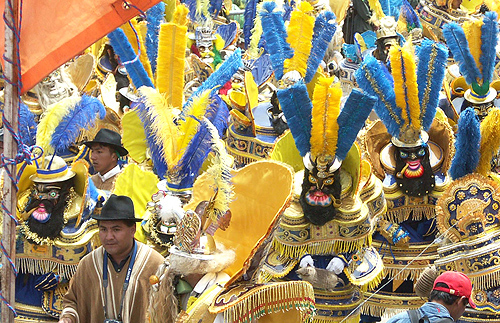
Karnevalen i Oruro @ Sören Sommelius 2006

Men det ser jag först dagen efter på TV. Våt om kläderna, omgiven av dansande och sjungande karnevalsbesökare står han där, våt därför att i karnevalsyran ingår att alla sprutar eller slänger vatten eller lödder på varandra, det här är ingen plats för torrbollar.

Jag sitter på en läktare i tio timmar innan jag vacklar till bussen som tar mig åter till La Paz. Då har bara halva processionen passerat. Allt fortsätter i stegrad yra och utlevelse tills fyra på morgonen.

Mellan de olika trupperna passerar bilar fantasifullt dekorerade med andinska vävnader och med de vackraste tennfat, som anspelar på Oruros förflutna som tennets huvudstad.* * *

Karnevalen i La Paz följer några dagar senare, mindre och folkligare. Som utlänning och “gringo” går jag inte säker någonstans. Ballonger fyllda med vatten prickar mig. Småkillar duschar mig med vattenpistoler utbyggda till meterlånga vattenkastare.

Jag flyr andfådd uppför de branta backarna. Från fönstret på mitt ombonade tiodollarhotell ser jag ner över en grönsaksmarknad. Stadiga indiankvinnor packar i sena kvällen samman det man inte har sålt, en orkester kommer vandrande och ännu vid midnatt har de karnevalsdansande tagit över gatan.

Det här landet är deras, det borde vara deras.
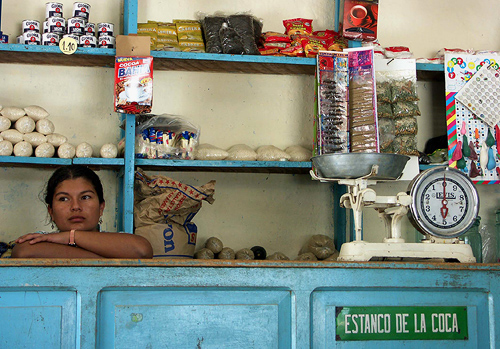
Kvinna i Oruro @ Sören Sommelius 2006

Når Sydamerikas vänstervåg också Peru?

En demonstration passerar Plaza de Armas i Puno, den peruanska staden vid Titicacasjön, på 3.900 meters höjd. Bastanta indiankvinnor bär banderoller. Någon skanderar i megafon “Un pueblo unido …”, “Ett enat folk kan aldrig besegras”. De demonstrerande är anhängare till Ollanta Humala, ledare för vänsterpartiet PNUP, som i slutet av mars tagit en knapp ledning i opinionsmätningarna inför det peruanska presidentvalets första omgång den 9 april, då också val till parlamentet genomförtes.

Presidentvalet kommer troligen att avgöras den 7 maj i en andra omgång mellan Humala och kristdemokraternas Lourdes Flores, som kan bli landets första kvinnliga president.

Mitt huvud är fullt av exotiska bilder från uroindianernas byar. I kanske tusen år har urofolket levt på de flytande vassöarna i Titicacasjön. Luften är tunn att andas. Inte kan jag sova i Punos kalla nätter. När jag strövar runt i Punos backar svartnar det för ögonen de första dagarna. Jag köper lite cocablad och tuggar, det hjälper mot höjdsjuka.

Här på torget framför katedralen är det minst av allt exotiskt. Jag ser människor som kräver rättvisa och bättre villkor.* * *

Det har varit många svåra år i Peru. Gerillan Sendero Luminoso, “Den skinande stigen”, drev en väpnad kamp ända in på 90-talet. Men det gick snett. De fattigbönder man sa sig kämpa för blev offer för både gerillans våld och regimens motvåld. Många flydde till Limas slumområden. Alberto Fujimori, president 1990 – 2000 och son till japanska invandrare, krossade gerillan – bara för att sluta sin ämbetstid i japansk landsflykt efter vidlyftiga ekonomiska skandaler.

43 procent av Perus invånare är indianer (37 procent är mestiser och 15 procent av europeiskt ursprung). Efter Fujimori valdes Alejandro Toledo 2001 till landets förste indianske president. Men de förhoppningar som knöts till honom infriades inte. Hans opinionssiffror har rasat i botten efter en rad korruptionsskandaler, trots att Peru ekonomiskt fått starka tillväxtsiffror.

Utvecklingen har inte varit för alla. Fortfarande lever 54 procent av Perus befolkning under fattigdomsgränsen. Vad innebär valet för dem?* * *

En stor vänstervåg har omvandlat Sydamerika dramatiskt under senare tid. De fascistiska juntornas tid på 70- och 80-talen tillhör kontinentens dystra men längesedan avslutade historia. I land efter land har nu vänsterregimer tagit över, med fokus på minskade sociala orättvisor och minskat beroende av USA och de multinationella företagen, men med pragmatisk hållning till marknadsekonomin.

I det oljerika Venezuela är den färgstarke och orädde Hugo Chavez president. USA:s försvarsminister Donald Rumsfeld jämförde nyligen Hugo Chavez med Adolf Hitler i hotfulla ordalag, som också riktade sig mot Bolivias nyvalde förste indianske president Evo Morales. (AFP 2.2.06). Tidigare i år valdes Michelle Bachelet till Chiles första kvinnliga president i spetsen för en vänsterregim. Brasilien styrs av förre fackföreningsledaren Lula, Argentina av Néstor Kirchner och Uruguay av Tabaré Vazquez. Till Paraguay har inte förändringens vindar nått, inte heller till Ecuador och Colombia.

Mycket har hänt sedan de brutala militärdiktaturernas tid i Latinamerika. Finns det risk för bakslag nu, liksom på Salvador Allendes tid, frågar många sig.

Demonstranterna tågar runt torget i Puno. Oro uppstår, en rad eleganta turistbussar stör demonstrationen, tror jag, tills jag ser att bussarna är tomma och hör hur chaufförerna tutar rytmiskt, deras fackförening stöder Humala. Framför katedralen ställer man upp en minibuss. På dess tak talar man med megafon till de församlade. Ett tusental personer har kommit för att lyssna. Knutna nävar far i luften. Poliser med kravallsköldar och hjälmar står beredda att gripa in. Men inget händer. “Un pueblo unido …”, skanderar man.

Ollanta Humala får sitt stöd framförallt från ursprungsbefolkningen och från de fattiga i storstädernas slumområden, de så kallade pueblos jovenes.

Kvällarna i Puno är bistert kalla, också under sommarmånaden februari. På restaurangerna lockar man med tända brasor. Mitt hotell, El Presidente på Jiron Tacna, har sett bättre dagar. Utanför ingången sitter två väl påklädda stickande indiankvinnor och säljer mössor, vantar och fingerdockor. Det drar isande kallt genom de enkla fönstren. Men i sängen finns fyra värmande filtar.

Från fönstret ser jag samma dag ännu en demonstration utanför Presidente på Tacnagatan. Det är anhängare till Lourdes Flores som tågar förbi med banderoller och rungande slagord. Bland Ollantas anhängare fanns många traditionellt klädda indianska kvinnor. Det finns det också bland kristdemokraterna här.

Lika kyliga som kvällarna i Puno är, lika hett verkar det politiska klimatet vara. Kan engagemanget leda till förändring?* * *

Tio kvarter från Plaza de Armas ligger Punos hamnkvarter och den sägenomspunna Titicacasjön, 3.810 meter över havet, 19 mil lång och 65 km bred i genomsnitt. Vattnet är bara elva grader plus. På andra sidan sjön anar jag snöklädda berg i Bolivia.

Om Lourdes Flores vinner valet innebär det antagligen ingen större förändring mot nu. Ollanta Humala har som vänsterradikal militär stora likheter med Hugo Chavez, som också gett honom sitt stöd. Skulle han vinna innebär det nya regionala allianser med grannländerna, riktade mot USA:s dominans och förmodligen nationaliseringar av landets naturtillgångar, som naturgas och ädelmetaller.

I Peru liksom i Bolivia spelar odlingen av coca en stor roll. Med kampen mot cocaodlarna – och mot kokainet som framställs ur bladen – som förevändning kan USA komma att ingripa vid någon kritisk punkt.

sosommelius@hd.se

* Fd chef för kulturredaktionen på Helsingborgs Dagblad
Related Posts

LONDON – So far so good, at least on the wider level. While internally Iraq seems on the edge of chaos, the much heralded clash of civilizations between the Muslim and Judaeo-Christian worlds has yet to become apparent. We have anger and despair aplenty in the Arab and Muslim worlds. But very little rushing to the standard and there was no great pilgrimage of warriors to join the fight, as happened when the Soviet Union invaded Afghanistan twenty years ago, and then, having driven the Red Army out, were left to ferment in that mountainous redoubt. With the armaments supplied by the CIA the mujahidin were transformed into Al Qaeda that became, for a relatively brief moment as these things go, ‘the greatest threat to the homeland that America has ever known.’ Nevertheless a ‘Cold War’ between much of the Muslim world and the West is certainly in full swing. Winston...
The Challenge of Nuclear Weaponsin the Twenty-first CenturyA Path Forward The peoples and governments of the world face an urgent challenge relating to weaponry of mass destruction and particularly to nuclear weaponry.  At the crossroads of technology, terrorism, geopolitical ambition, and policies of preemption are new and potent dangers for humanity. Despite ending the nuclear standoff of the Cold War era, nuclear weaponry is again menacing the peoples of the world with catastrophic possibilities.  We recognize the need for any government to pursue its security interests in accordance with international law; and further, we recognize that distinctive threats to these interests now exist as a result of an active international terrorist network having declared war on the United States and its allies. Nonetheless, we reject the assessment of the current US administration that upgrading a reliance on nuclear weapons is in any sense justified as a response. We find it...
By Karin Wegestal MP, the Social Democratic Partyon behalf of the Swedish Committee for Solidarity with the Yugoslav People During the last decade, the Federal Republic of Yugoslavia has received more than 500,000 refugees from Croatia and Bosnia, and another 300,000 internally displaced persons, mainly from the province Kosovo and Metohia. For a country with about ten million inhabitants, such an influx of homeless people is obviously a very heavy burden – even under peaceful conditions. But in addition to that, the Federal Republic of Yugoslavia has been the subject to sanctions from the western powers for close to ten years and its infrastructure was badly hurt through Nato’s intense bombardment during 78 days in 1999. The result of all this is that Yugoslavia, once the most developed industrial country in Eastern Europe, is today the poorest country in Europe. In Serbia excluding Kosovo, with about ten million inhabitants and...

Recent Articles

Tony Robinson October 4, 2026 Violence is easy to recognise when someone is being beaten, shot or killed. It becomes more difficult when nobody is holding a weapon. Poverty, discrimination, exploitation and repression can restrict a human life just as effectively, although they do so in very different ways and with very different consequences. Simply adding more categories to an ever-growing list of forms of violence does not really solve the problem. The more interesting question is what all these different situations have in common and why it makes sense to describe them using the same word. Human beings do not simply react to what happens around them. They remember the past, imagine things that do not yet exist, make plans and undertake projects. Workers organise because they imagine different working conditions; people migrate because they imagine another life somewhere else; social movements emerge because people refuse to accept the...
It’s a matter of principles, courage, vision and pulling together – while the militarist world is falling apart… Peter Langille October 3, 2026 “Here, then, is the problem which we present to you, stark and dreadful and inescapable: Shall we put an end to the human race; or shall mankind renounce war?”The Bertrand Russell—Albert Einstein Manifesto, July 9, 1955 ⁕ The forecast for what’s ahead is worrisome. The sharp rise in armed conflicts over the past three years is adding to what was already the highest level in over seventy years. Genocides, which should be prevented are supported. A shared climate emergency that jeopardises survival is ignored. Diverse polls now suggest that people are war-weary, worried and interested in a more effective United Nations. And, there are viable policy options for a more secure world! Yet governments are doubling-down, betting on more war and investing heavily. If current trends persist,...
Johan Galtung 1930-2024October 2015 Published here on October 3, 2026 Let us focus on Civilization for conflict analysis and remedies. Major forms of disorder use violence; war is state organized violence. The most belligerent states are the United States of America and Israel, both with civilization roots. National Evangelism, the US Protestant Christian civilization– more national than evangelical–justifies US warfare as exceptionalism of a people chosen by God, with a manifest destiny to run the world. Orthodox Judaism justifies Israeli warfare to conquer and expand from Nile to Euphrates as a religious right and duty to the Eternal One. The third most belligerent country, the UK, no longer believes it is God-chosen but chosen by the USA; not quite the same but something. But the root cause of global disorder lies in the Occident–with Islam–seeing itself as the single, universal civilization valid for all at all times, all others being...

TFF on Substack

Discover and subscribe to more peace materials on TFF Substack

Most Popular

Tony Robinson October 4, 2026 Violence is easy to recognise when someone is being beaten, shot or killed. It becomes more difficult when nobody is holding a weapon. Poverty, discrimination, exploitation and repression can restrict a human life just as effectively, although they do so in very different ways and with very different consequences. Simply adding more categories to an ever-growing list of forms of violence does not really solve the problem. The more interesting question is what all these different situations have in common and why it makes sense to describe them using the same word. Human beings do not simply react to what happens around them. They remember the past, imagine things that do not yet exist, make plans and undertake projects. Workers organise because they imagine different working conditions; people migrate because they imagine another life somewhere else; social movements emerge because people refuse to accept the...
It’s a matter of principles, courage, vision and pulling together – while the militarist world is falling apart… Peter Langille October 3, 2026 “Here, then, is the problem which we present to you, stark and dreadful and inescapable: Shall we put an end to the human race; or shall mankind renounce war?”The Bertrand Russell—Albert Einstein Manifesto, July 9, 1955 ⁕ The forecast for what’s ahead is worrisome. The sharp rise in armed conflicts over the past three years is adding to what was already the highest level in over seventy years. Genocides, which should be prevented are supported. A shared climate emergency that jeopardises survival is ignored. Diverse polls now suggest that people are war-weary, worried and interested in a more effective United Nations. And, there are viable policy options for a more secure world! Yet governments are doubling-down, betting on more war and investing heavily. If current trends persist,...
Johan Galtung 1930-2024October 2015 Published here on October 3, 2026 Let us focus on Civilization for conflict analysis and remedies. Major forms of disorder use violence; war is state organized violence. The most belligerent states are the United States of America and Israel, both with civilization roots. National Evangelism, the US Protestant Christian civilization– more national than evangelical–justifies US warfare as exceptionalism of a people chosen by God, with a manifest destiny to run the world. Orthodox Judaism justifies Israeli warfare to conquer and expand from Nile to Euphrates as a religious right and duty to the Eternal One. The third most belligerent country, the UK, no longer believes it is God-chosen but chosen by the USA; not quite the same but something. But the root cause of global disorder lies in the Occident–with Islam–seeing itself as the single, universal civilization valid for all at all times, all others being...
Read More
Living-Peace-Sign-Budapest-copy
Tony Robinson October 4, 2026 Violence is easy to recognise when someone is being beaten, shot or killed. It becomes more difficult when nobody is holding a weapon. Poverty, discrimination, exploitation and repression can restrict a human life just as effectively, although they do so in very different ways and with very different consequences. Simply adding more categories to an ever-growing list of forms of violence does not really solve the problem. The more interesting question is what all these different situations have in common and why it makes sense to describe them using the same word. Human beings do not simply react to what happens around them. They remember the past, imagine things that do not yet exist, make plans and undertake projects. Workers organise because they imagine different working conditions; people migrate because they imagine another life somewhere else; social movements emerge because people refuse to accept the...
b54a1f10-8c65-4f0b-9dd5-4abc0a7d04cc_2659x2659
It’s a matter of principles, courage, vision and pulling together – while the militarist world is falling apart… Peter Langille October 3, 2026 “Here, then, is the problem which we present to you, stark and dreadful and inescapable: Shall we put an end to the human race; or shall mankind renounce war?”The Bertrand Russell—Albert Einstein Manifesto, July 9, 1955 ⁕ The forecast for what’s ahead is worrisome. The sharp rise in armed conflicts over the past three years is adding to what was already the highest level in over seventy years. Genocides, which should be prevented are supported. A shared climate emergency that jeopardises survival is ignored. Diverse polls now suggest that people are war-weary, worried and interested in a more effective United Nations. And, there are viable policy options for a more secure world! Yet governments are doubling-down, betting on more war and investing heavily. If current trends persist,...
010
Johan Galtung 1930-2024October 2015 Published here on October 3, 2026 Let us focus on Civilization for conflict analysis and remedies. Major forms of disorder use violence; war is state organized violence. The most belligerent states are the United States of America and Israel, both with civilization roots. National Evangelism, the US Protestant Christian civilization– more national than evangelical–justifies US warfare as exceptionalism of a people chosen by God, with a manifest destiny to run the world. Orthodox Judaism justifies Israeli warfare to conquer and expand from Nile to Euphrates as a religious right and duty to the Eternal One. The third most belligerent country, the UK, no longer believes it is God-chosen but chosen by the USA; not quite the same but something. But the root cause of global disorder lies in the Occident–with Islam–seeing itself as the single, universal civilization valid for all at all times, all others being...
Screenshot 2026-10-02 011738
Jan ObergPhD, director, The Transnational Foundation for Peace and Future Research, TFFLund, Sweden October 2, 2026 This is my full original manuscript. The Chinese Academy of Social Science, CASS, makes two publications out if it. 1. China’s Five-year plan emphasized the capabilities of basic research and original innovation. It is regarded as the goal of the future social development, which, as required, should be significantly enhanced. Can you comment on the importance of original innovation in research and academic study? I believe it is easier to define “original innovation” in the natural sciences than in social sciences. The breaking points of what constitutes something new, or innovative, are not quite as sharp in the latter. But in both fields it is about opening up something that was closed, unseen, unexplored before – making manifest what was earlier latent. Innovations come in many forms and shapes – naming something that was not...
arctic-circle-map
The agreement is catastrophic both because of what it says and what it doesn’t mention. It reduces further the major asset of security policies: Freedom of action. Jan Oberg TFF director September 25, 2026 A couple of hours before the agreement was signed on September 22, 2026, I published the following 13 hypotheses about what it would most likely contain on TFF Substack (in English). I was wrong on only the first point. Contrary to what Trump had written on his Truth Social platform, it does not appear to come into force immediately. In fact, it turned out to be worse than even I had anticipated. After these hypotheses now come a number of reflections in light of what the agreement actually contains, and does not contain, as well as the way in which it has generally been presented by major media outlets and by the public-service broadcaster DR. My...
girl-5894831_1280
Below are TFF-related media mentions, comments, videos and social media posts published elsewhere but not on this homepage. We happen to catch and list only a fraction. Regarding video comments and debates, we recommend that you go to the TFF Video Channel on Substack where many of them are reproduced. Jan Oberg is a contributor to China Daily – 52 million daily clicks – and Global Times, CGTN and CCTV (the national television), China Investment, Xinhua News Agency and several others. Articles and videos on these media very often multiply into countless Chinese (and Western media) that re-post them from these main media. Thanks to The China Academy, his analyses, interviews and comments are frequently posted on YouTube channels such as Thinkers Forum and Wave Media. These videos are often re-posted on Bilibili (China’s YouTube), the China Content Center on TikTok, and on the Chinese edition of TikTok, Douyin.com. This means reaching hundreds of millions of viewers worldwide over a year. While there are too many to catch on all these...





