with global criticism of the US Ballistic Missile Defence plans
In the world of nuclear deterrence theory, beliefs are everything. What the leaders of a country perceive and believe is far more important than the reality. Nuclear deterrence is a seemingly simple proposition: Country A tells country B that if B does X, A will attack it with nuclear weapons. The theory is that country B will be deterred from doing X by fear of nuclear attack by country A. For deterrence to work, the leaders of country B must also believe that country A has nuclear weapons and will use them. Nuclear deterrence theory holds that even if country A might not have nuclear weapons, so long as the leaders of country B believed that it did they would be deterred.
The theory goes on to hold that country A can generally rely upon nuclear deterrence with any country except one that also has nuclear weapons or one that is protected by another country with nuclear weapons. If country B also has nuclear weapons and the leaders of country A know this, then A, according to theory, will be deterred from a nuclear attack on country B. This situation will result in a standoff. The same is true if country C does not have nuclear weapons, but is under the “umbrella” of country B that does have nuclear weapons. Country A will not retaliate against country C for fear of itself being retaliated against by country B.
Thus, if country A has nuclear weapons and no other country has nuclear weapons, country A has freedom — within the limits of its moral code, pressures of public opinion, and its willingness to flout international humanitarian law — to threaten or use nuclear weapons without fear of retaliation in kind. For a short time the United States was the only country with nuclear weapons. It used these weapons twice on a nearly defeated enemy. Deterrence played no part. The United States never said to Japan, don’t do this or we will attack you with nuclear weapons. Prior to using the nuclear weapons, these weapons were a closely guarded secret.
From 1945 to the early 1950s, US strategic thinking saw free-fall nuclear weapons simply extending conventional bombing capabilities. The United States never said that it would attack another country with nuclear weapons if it did X, but this was implied by the recognized existence of US nuclear weapons, the previously demonstrated willingness of the US to use them, and the continued public testing of these weapons by the US in the Pacific.
The Dangerous Game of Deterrence
After the Soviet Union tested its first nuclear weapon in 1949, the dangerous game of nuclear deterrence began. Both the US and USSR warned that if attacked by nuclear weapons, they would retaliate in kind massively. They also extended their respective so-called nuclear deterrence “umbrellas” to particular countries within their orbits. As the arsenals of each country grew, they developed policies of Mutual Assured Destruction. Each country had enough weapons to completely destroy the other. Britain and France also developed nuclear arsenals because they did not want to rely upon the US nuclear umbrella, and to try to preserve their status as great powers. They worried that in a crisis the US might not come to their aid if it meant that the US risked annihilation by the USSR for doing so. China also developed a nuclear arsenal because it felt threatened by both the US and USSR. Israel, India, Pakistan and South Africa also developed nuclear arsenals, although South Africa eventually dismantled its small nuclear arsenal.
Nuclear deterrence took different shapes with different countries. The US and USSR relied upon massive retaliation from their large arsenals of tens of thousands of nuclear weapons. The UK, France and China maintained smaller deterrent forces of a few hundred nuclear weapons each. India and Pakistan tested nuclear weapons and missile delivery systems, but it is uncertain whether they have yet deployed nuclear weapons. Israel, known to have some 200 nuclear weapons, offers only the ambiguous official statement that it will not be the first to introduce nuclear weapons into the Middle East.
One obvious way that nuclear deterrence could fail is if one side could destroy the other side’s nuclear forces in a first strike. To prevent this from happening, nuclear armed states have tried to make their nuclear forces invulnerable to being wiped out by a first strike attack. One way of doing this was to put the weapons underground, in the air and in the oceans. Many of the weapons on land were put in hardened silos, while those in the oceans were put on submarines that were difficult to locate underwater. For decades the strategic bombers of the US and USSR carrying nuclear weapons were kept constantly on alert with many in the air at any given moment.
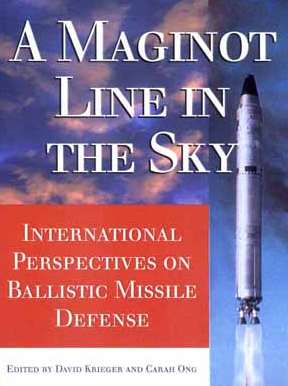
edited by the author with Carah Ong
See below
Nuclear deterrence became a game of sorts &endash; a dangerous and potentially tragic one and also deeply selfish, irresponsible and lawless, risking all humanity and the planet. Countries had to protect their deterrence forces at all costs and not allow themselves to become vulnerable to a first strike attack on their nuclear forces. In a strange and perverse way, nuclear-armed countries became more committed to protecting their nuclear forces than they were to protecting their citizens. While they hardened their land-based missile silos and placed their submarines in the deep oceans, their citizens remained constantly vulnerable to nuclear attack.
The game of nuclear deterrence required that no country become so powerful that it might believe that it could get away with a first strike attempt. It was this concern that drove the nuclear arms race between the US and USSR until the USSR was finally worn down by the economic burden of the struggle. It also ensured a high level of hostility between rival nuclear-armed countries, with great danger of misunderstandings &endash; witness, for example, the Cuban missile crisis and many other less well-known scares. Mutual Assured Destruction lacked credibility, requiring the development of policies of “Flexible Response,” which lowered the nuclear threshold, encouraged the belief that nuclear weapons could be used for war-fighting, increased the risk of escalation to all-out nuclear war, and stimulated more arms racing.
Notice that a first strike doesn’t require that one country actually have the force to overcome its opponent’s nuclear forces. The leaders of the country only have to believe that it can do so. If the leaders of country A believe that country B is planning a first strike attack, country A may decide to initiate a preemptive strike. If the leaders of country A believe that the leaders of country B would not initiate a nuclear attack against them if they did X, then they might well be tempted to do X. They might be mistaken. This led to the “launch-on-warning” hair-trigger alert status between the US and Russia. More than ten years after the end of the Cold War, each country still has some 2,250 strategic warheads ready to be fired on a few moments’ notice. Nuclear deterrence operates with high degrees of uncertainty, and this uncertainty increases, as does the possibility of irrationality, in times of crisis.
Ballistic Missile Defenses
President George W. Bush cites as his primary reason for wanting a ballistic missile defense system for the US his lack of faith that nuclear deterrence would work against so-called “rogue” states. Yet, the uncertainty in nuclear deterrence increases when ballistic missile defenses are introduced. If country A believes that it has a perfect defense against country B, then country B may also believe that it has lost its deterrent capability against country A. Ballistic missile defenses, therefore, will probably trigger new arms races. If countries A and B each have 500 nuclear warheads capable of attacking the other, both are likely to believe the other side will be deterred from an attack. If country A attempts to introduce a defensive system with 1,000 anti-ballistic missile interceptors, country B may believe that its nuclear-armed ballistic missile force will be made impotent and decide to increase its arsenal of deliverable warheads from 500 to 2,000 in order to restore its deterrent capability in the face of B’s 1,000 defensive interceptors. Or, country B may decide to attack country A before its defensive force becomes operational.
If country A plans to introduce a defensive system with only 100 interceptors, country B might believe that its nuclear force could still prevail with 500 deliverable nuclear weapons. But country B must also think that country A’s interceptors would give A an advantage if A decides to launch a first strike attack against B’s nuclear forces. If country A is able to destroy 400 or more of country B’s nuclear weapons, then A would have enough interceptors (if they all worked perfectly) to believe that it could block any retaliatory action by B. Thus, any defensive system introduced by any country would increase instability and uncertainty in the system, making deterrence more precarious. Worse, this introduces a fear that ballistic missile defense has little to do with defense, and far more to do with an offensive “shield” behind which a country could believe that it could coerce the rest of the world with impunity.
It was concern for the growing instability of nuclear deterrence to the point where it might break down that led the US and USSR to agree in 1972 to place limits on defensive missile forces in the Anti-Ballistic Missile (ABM) Treaty. In this treaty each side agreed to limit its defensive forces to no more than two sites of 100 interceptors each. These sites could not provide protection to the entire country. It is this treaty that the United States is now seeking to amend or unilaterally abrogate in order to build a national ballistic missile defense. It claims this defense is needed to protect itself against so-called “rogue” states such as North Korea, Iran or Iraq. At present, however, none of these countries is even expected to be able to produce nuclear weapons or a missile delivery system capable of reaching the United States before 2010 at the earliest
Russia and China have both expressed strong opposition to the US proceeding with ballistic missile defense plans. Russia wants to maintain the ABM Treaty for the reasons the treaty was initially created, and is aghast at comments from the US such as those of Secretary of Defense Rumsfeld calling the treaty “ancient history.” Russia is also seeking to reduce the size of its nuclear arsenal for economic reasons and its leaders fear the instabilities that a US national ballistic missile defense system would create. Russian leaders have said that such a system that abrogated the ABM Treaty could result in Russia withdrawing from other arms control treaties including the START II and the Comprehensive Test Ban Treaty.
China has a nuclear force a fraction of that of Russia or the US. It has some 400 nuclear weapons, but only some 20 long-range missiles capable of reaching the US. If the US sets up a system of some 100 to 200 interceptors, China would have to assume that its nuclear deterrent capability had been eliminated. Chinese leaders have called for the US not to go ahead with a ballistic missile defense system that would force China to develop a stronger nuclear deterrent force. Were China to do so, this would inevitably provoke India to expand its nuclear capability, which in turn would lead Pakistan to do the same.
Increasing Instabilities
At a time when major progress toward nuclear disarmament is possible and even promised by the nuclear weapons states, the US desire to build a ballistic missile defense system to protect it against small nuclear forces is introducing new uncertainties into the structure of global nuclear deterrence and increasing the instability in the system. Nuclear deterrence has never been a stable system. One country’s nuclear strategies have both predictable and unpredictable consequences in other countries.
Security built upon nuclear arms cannot endure. US nuclear weapons led to the development of the USSR and UK nuclear arsenals. These led to the development of the French and Chinese nuclear forces. The Chinese nuclear forces led to the development of Indian nuclear forces. India’s nuclear forces led to the development of Pakistani nuclear forces. Israel decided to develop nuclear forces to give it a deterrent among hostile Middle East neighbors. No doubt this provoked Saddam Hussein &endash; and gave him the pretext &endash; to develop Iraq’s nuclear capability, and is driving Iran to follow suit.
Now the US is seeking to introduce national and theater ballistic missile defenses that will provide further impetus to nuclear arms development and proliferation. The world is far more complicated than country A deterring country B by threat of nuclear retaliation. As more countries develop nuclear arsenals, more uncertainties enter the system. As more defenses are set in place, further uncertainties enter the system. While the US seeks to make itself invulnerable against threats that do not yet even exist, it is further destabilizing the existing system of global nuclear deterrence to the point where it could collapse &endash; especially when the President demonstrates his belief that the system can no longer be relied upon.
The full consequences of US missile defense plans are not predictable. What is predictable is that the introduction of more effective defenses by the US will change the system and put greater stress on the global system of security built upon nuclear deterrence. The system is already showing signs of strain. With new uncertainties will come new temptations for a country to use nuclear forces before they are used against it. Nuclear deterrence is not sustainable in the long run, and we simply don’t know what stresses or combination of perceptions and/or misperceptions might make it fail.
Nuclear deterrence cannot guarantee security. It undermines it. The only possibility of security from nuclear attack lies in the elimination of nuclear weapons as has already been agreed to in the Non-Proliferation Treaty and reiterated in the 2000 Review Conference of that treaty. Ballistic missile defenses, which increase instability, move the world in the wrong direction. For its own security, the US should abandon its plans to deploy ballistic missile defenses that would abrogate the Anti-Ballistic Missile Treaty, and instead provide leadership in immediately negotiating a Nuclear Weapons Convention leading to the phased and verifiable elimination of all nuclear weapons, like the widely-acclaimed enforceable global treaty banning chemical weapons.
David Krieger is president of the Nuclear Age Peace Foundation. He can be contacted at dkrieger@napf.org.
More articles by him and information on this subject can be found at www.wagingpeace.org.
The author would like to thank Commander Robert Green for his helpful suggestions on this paper.
A Maginot Line in the Sky:
International Perspectives on Ballistic Missile Defense
$14.95* + S/H fee per copy. Please call for bulk pricing.
“I think no reasonable person can read these essays without concluding that the missile defense project menaces our national security and erodes our reputation as a global leader.”
Richard Falk
J.S.D. Milbank Professor of International Law and Practice, Princeton University and TFF associate
This book brings together the views of eighteen contributors of different nationalities, including Americans,
on the proposed US Ballistic Missile Defense plans. These perspectives should be included in any intelligent
discussion of whether or not the US should proceed with development and deployment of missile defense
systems.“This volume is a treasury of lucid
cogent views which will enlighten
and inform the decision makers and
decision molders concerning aspects
of a missile defense system which
heretofore have been largely ignored
and glossed over.”
Rear Admiral Gene R. La Rocque, USN (Ret.), Chairman Emeritus, Center for Defense Information
Table of Contents
Foreword
Richard Falk
National Missile Defense: Why Should We Care?
Admiral Eugene Carroll
A Russian Perspective on American National Missile Defense
Alla Yaroshinskaya
China’s Concern Over National Missile Defense
Dingli Shen
Theater Missile Defense: A Confidence Destructive Measure in East Asia
Hiro Umebayashi
Missile Defense and the Korean Peninsula
Samsung Lee
Ballistic Missile Defense: Consequences for South Asia
Achin Vanaik
Missile Defense: An Indian Perspective
Rajesh M. Basrur
Ballistic Missile Defense and Alternatives for the Middle East
Bahig Nassar
Kwajalein Atoll and the New Arms Race
Nic Maclellan
Canada Is Not Impotent in the Missile Defense Crisis
Senator Douglas Roche
Ballistic Missile Defense: The View from the Cheap Seats
Michael Wallace
Pretext for Missile Defense is Absurd
Sir Joseph Rotblat
Globalization and the New Arms Race
Andrew Lichterman and Jacqueline Cabasso
Make Missile Defenses Obsolete: The Case for Ballistic Missile Disarmament
Jurgen Scheffran
We Must Keep Space for Peace
Bruce K. Gagnon
The National Missile Defense Mentality in Our Classrooms
Leah Wells
Appendices
A. National Missile Defense Act of 1999, H.R. 4
B. Conclusions of the Commission to Assess the Ballistic Missile Threat to the United States (The Rumsfeld Commission)
C. Statement of Russian President Putin on Strategic Reductions and Preservation of the ABM Treaty
D. Joint Statement of the Prime Minister of Canada and the President of the Russian Federation on Cooperation in the Sphere of Strategic Stability
E. Joint Statement by the Presidents of the People’s Republic of China and the Russian Federation on Anti-Missile Defense
Glossary of Acronyms
Resources
Non-governmental Organization Contact Information
Authors
How to order
Nuclear Age Peace Foundation • PMB 121, 1187 Coast Village Rd., Ste. 1 Santa Barbara, CA 93108-2794 USA
Tel: +1 (805) 965-3443 • Fax: +1 (805) 568-0466 • Email: wagingpeace@napf.org
$14.95 each, California Residents please add 7.5% sales tax. Shipping and Handling (S/H) Fee ($4.00 US/$7.00 International) $