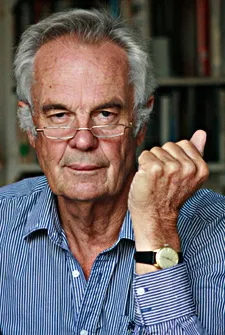
he penned an article in Foreign Affairs which caused almost as much shock as his previous “The Clash of Civilizations”. “In the past few years the U.S. has attempted unilaterally to do the following: prevent other countries from acquiring military capabilities that could counter American conventional superiority; enforce American law extra territorially in other societies; grade countries according to American standards on human rights, drugs, terrorism, nuclear proliferation and religious freedom; apply sanctions against countries that do not meet American standards on these issues; promote American corporate interests under the slogans of free trade and open markets; shape World Bank and International Monetary Fund policies to serve the same corporate interests; intervene in local conflicts in which it has relatively little direct interest; bludgeon other countries to adopt economic and social policies that will benefit American economic interests; promote American arms sales abroad; expand NATO; and categorize certain countries as “rogue states””.
He finishes off this massive indictment by saying that in the eyes of many countries it is America that is becoming “the rogue superpower.” Perhaps the best way to sum up Huntington’s thesis is that America is a master of “Do as I say, not as I do”.
Phew! If Huntington was an instinctive conservative what should those, more on the left, say, especially after eight years of President George W. Bush?
One of the more surprising books of the last two years is “Dangerous Nation” authored by Robert Kagan who made his international reputation with his book, “Paradise and Power” in which he said America was like Mars and, more scathingly, Europe was like Venus, unwilling to take on its international responsibilities and leaving America to police the world. The whole of this new book is a history of the violent, imperialistic tendencies that have governed U.S. white rule since its inception. He concludes by saying that the Declaration of Independence “reflected Americans’ view of themselves as the advance guard of civilization” and that this has continued to be so every since- the words of another formidable conservative writer.
It may be true, as Zbigniew Brzezinski has said, that the U.S. “will be the first, the last, and only super power”. But this certainly doesn’t mean that it will make much progress in the world by seeing itself in unipolar terms. In history only the classical world under Rome and, at times, East Asia under China, approximated this model.
During the Cold War the global structure of power was bipolar. Now it is multipolar with several powers of either equal strength or coming up to it. The European Union economically is certainly a potential equal. Right now the euro is beginning to overtake the dollar as the currency investors like to hold. Already there are more euros in circulation than dollars. As Huntington observed, “Virtually all major regional powers are increasingly asserting themselves to promote their own distinct interests, which often conflict with those of the U.S.” – look at how French President Nicolas Sarkozy recently led the European Union to settle the Georgia/Russian war on its own terms with minimal consultation with Washington. Today it is trying to do the same with the gas dispute, although this time it is floundering more since the EU leadership has passed to the less hefty Czech Republic.
Despite previous rhetoric, it seems that President Barack Obama has grasped the nature of our changing world. Whether Hillary Clinton has, or other high officials, who may find locating easily Kosovo, Burundi or Turkmenistan on a map a bit difficult, is a good question.
Obama will have to turn round a whole mentality, one holding a place deep in the American psyche, in quick short time. This week he starts.