PressInfo #173 – Sanktionerna – vårt moraliska problem

For many decision-makers it is convenient to focus on the brutality of the Iraqi regime under Saddam Hussein and leave the deeply inhuman consequences of our sanctions over the last 12 years untold. But, in the eyes of a visitor to Iraq, the moral high ground of the West has crumbled. Before going to Iraq, we too were quite ignorant about the facts and complexities; we were shocked by the reality.

During our fact-finding missions we collected statistics from international organisations, interviewed virtually all the heads of missions of the United Nations and humanitarian organisations. We met with Iraqi officials and visited hospitals.

Playing down the effects of our sanctions – without evidence

Governments that have no embassies and no independent fact-finding in Iraq can hardly know much. They must base their policies on what is politically correct and convenient for their policies in relation to other issues and other countries.

Thus, for instance, the Swedish minister of foreign affairs, Ms. Anna Lindh, has repeatedly stated that the people of Iraq suffer because of Saddam Hussein’s wrong priorities and not because of the sanctions. She asserts that a) the elite have received advanced medical technology to treat cancer, but not the people; and b) that since the oil export ceiling was lifted in 1999, Iraq now exports more oil than ever. This presumably implies that there is enough money to care for people’s needs. Other politicians have used similar arguments, and the media willingly forwards them without research or further questions asked.

Unfortunately, statements like these are not backed up by evidence. And they do not cover even a fraction of the comprehensive truth about the situation in Iraq.
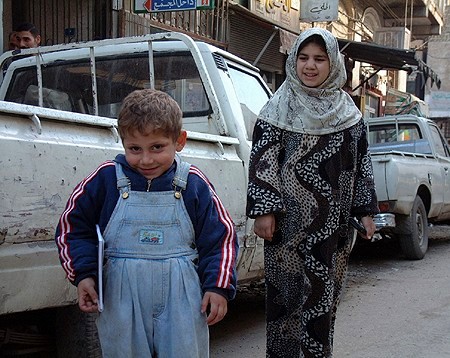
Children in the bazaar area, Baghdad 2003

The basic facts

We have collected basic statistics concerning the lives of the Iraqis from recent, open United Nations reports that we obtained in Iraq in January 2003. (Thus, they could have been collected by any scholar, journalist and parliamentary delegation who wanted to know).

The data covers the changes that have taken place since the late 1980s and early 1990s, i.e. a period in which the regime has not conducted any wars. When discussing the effects of the sanctions, it is not enough to compare the situation in 1996 when the Oil for Food Programme began to be implemented with today. It is true that several improvements have taken place during that period. The essential fact is that all statistical indicators dropped in the preceding period between 1991 to 1995; Iraq wanted to care for its own people in spite of the sanctions, and the government – like the international community – had no idea that sanctions would last more than a decade and cripple society to the extent they did.

Second, the statistics compare the present situation with the time when the Iran-Iraq war, the Kuwait invasion and the allied war on Iraq had already reduced the quality of life in the country. For instance, you will see that today’s GNP per capita is 15 per cent of what it was after these terrible events.


DEMOGRAPHY

Iraqi population: roughly 24 million in 2000. Some 45% of the total population is under 14 years of age, only 4% is over 65.

CHILD HEALTH

– Infant mortality: 47/1000 in late 1980s, 107 now.

– Under-five child mortality: 56/1000 ten years ago, today 131.

– Child death causes: 70% due to diarrhoea, dehydration and acute respiratory infections.

– Malnutrition: Acute 8%, underweight 20%, chronic 30%

– Water: 5 million without safe water. Between 1990 and 2000, the daily per capita amount of potable water in both urban and rural areas decreased by more than 50%.

– People attending outpatient clinics for mental/psychological disorders: 200,000 in 1990 and 510,000 in 1998.

SCHOOLING

– No longer attending primary school: 31% girls, 18% boys

– No longer attending secondary school: 50% boys and 60% girls

– Teacher salary: US $ 3-5; shifts, classes of up to 60 pupils, outdated curriculum

5,100 new school buildings need to be built, 70% of existing schools need rehabilitation

– Literacy rate 1998: 58%, used to be much higher in the 1980s due to literacy campaigns; thus, adult literacy rate was 72% in 1987.

– Female illiteracy has increased from 8% in 1985 to 45% in 1995.

POVERTY & DEVELOPMENT

– GNP per capita/year down almost 7-fold since 1990 to US$700

– Value of Dinar: 0,33 to the dollar in 1990, 20,000 to the dollar in 2002; devaluation 6000%

– Oil revenue: 35 billion dollars between 1996 and November 2002

– Since 1991, Iraq’s rank on UNDP’s Human Development Index fell from 96 to 127, out of 174. No other country has fallen so far, so fast. In 1990, Iraq ranked three places above Jordan; by 2000, it ranked 34 places below.

– Pre-Gulf War debts US$ 130 to 180 billion, 25% of oil income given away for war reparations (to Kuwait).

FOOD

Roughly 3.7 million families currently receive an average of 2,470 kcal per person per day from the food ration. Food ration is distributed by the Iraqi government through 40,000 shops.

*Statistics from various UN organisations’ publications obtained by TFF in Baghdad 2003.
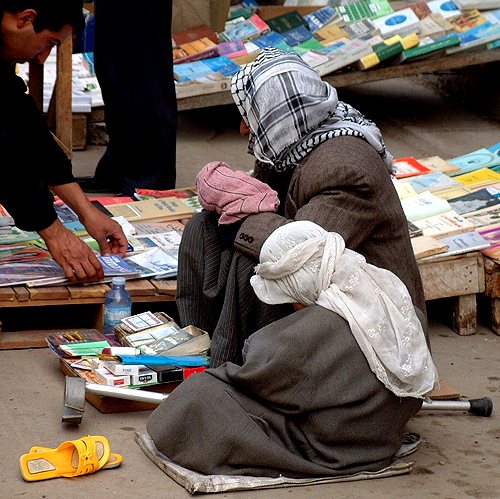

Father and son selling their books, Baghdad 2003

Other things you may not know about the sanctions

A few other facts should be added:

a) There is no cash component for central and southern Iraq.

Iraq as such does not receive cash for the oil it exports. Through the Oil for Food Programme, it receives food rations, medicine and goods (such as spare parts, trucks, etc.) that must first be approved by the UN Sanctions Committee. Nothing can enter the country legally unless decided by that committee. If an item is considered “dual use”, i.e. can also be used for military purposes, Iraq will not be allowed to import it. Only northern Iraq gets cash and special programmes (see b); central and southern gets no cash for the oil. Since the cash component philosophy is based on a series of conditions, among them that the international community must control the country and secure that the cash can’t be diverted for the “wrong” purposes, it has been unacceptable to Baghdad .

b) Iraq finances all “humanitarian aid” through its oil export.

For the value of its oil export, Iraq receives:

59% in humanitarian supplies for the centre and south covering food, health, medicine, transport and food handling, water and sanitation, housing, electricity, education, irrigation, agriculture, telecommunication, etc.

25% goes to a compensation fund, e.g. payments to Kuwait for the war.

13% goes to humanitarian programmes in the north (Dahuk, Erbil, Suleimaniyah).

2.2% goes to cover operations costs such as distribution and monitoring, bank-related charges, oil and customs inspections, experts assisting the Sanctions Committee, etc.

0.8% to the administration of the UN weapons inspection programme.

So, at best 71% of the oil money comes back, in goods. Only the northern, mainly Kurdish, minority enjoys preferential treatment and cash. The cash that enters Iraq is brought in through “secret” oil export, smuggling, petty traders and the Mafia.

c) The items are distributed through the Iraqi government system.

Iraqi families are registered in a local shop where they pick up their monthly ration. There are about 40,000 such shops, supplied by the government. It’s the largest food distribution project in a single country in the history of the United Nations. According to all international sources we have spoken with, this functions effectively given the overall socio-economic situation. This means that the people are extremely dependent on the present government. Should a new war destroy the food distribution system and/or topple the government, destroy roads, buildings, etc., UN mission assess that there could be mass famine in Iraq within 6-8 weeks. In addition, people who flee from their present homes will not get rations elsewhere, only where they are registered today.

d) The food rations are not sufficient.

The monthly food baskets cover no more than the needs of about 25 days. Even so, about 40 per cent of the families have to sell items to get enough cash to buy clothes or other necessities. The main reason, of course, is that after three wars and twelve years of sanctions, very few beyond the Mafia, the elite around the leadership and the extremely wealthy have anything left. They have long ago sold their jewellery, books, art, porcelain, furniture, etc. – all of which foreigners can now buy in “antique” shops in Baghdad.
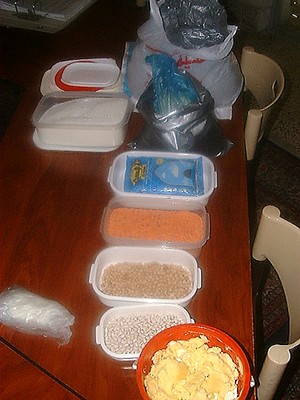
Items from the food ration

e) Iraq’s oil export revenue is far from enough to finance development.

Between December 1996 and the end of 2002, Iraq exported oil to the value of US $ 61 billion. Oil industry experts stated in 1998 that the country’s oil industry was in a “lamentable state”. It exported fewer barrels in 2001 and 2002 than it did in 1999 and 2000, according to UN statistics of January 2003. While oil revenues for 2000 were roughly US$ 18 billion, they were roughly 11 billion in 2001 and 11 billion in 2002.

f) Sanctions kill innocent Iraqis and suffocate Iraqi society.

The sanctions have killed an estimated 500,000 to 1 million innocent Iraqis since 1991. The estimates have been done by different UN agencies, among them UNICEF. They are not Iraqi propaganda. The deaths took place particularly before 1996 when the Oil for Food Programme began to be implemented. A typical expression among internationals in Baghdad is that the sanctions are the main contributors to the fact that a whole generation of young Iraqis have been lost. That’s what the health and schooling statistics above confirm. And the young were supposed to be those who reconstruct and democratise Iraq. But how?

Inhuman and counterproductive sanctions – the two cages

So, what have we done since the “international community” decided to punish Iraq for the invasion of Kuwait back in 1991?

In the name of the United Nations, too, we have caused a genocide. We have deprived millions of people of the human right to health, education and welfare, something that was an integral part of the Baath Party and Saddam Hussein’s development policy. We have caused de-development throughout Iraqi society, the largest and fastest fall in human development ever registered.

In the process, we have – unwisely – crushed the educated middle class that existed there; Iraq is now a mass of deprived people and a small elite of very wealthy people. This means that we have also made the people dependent, even for their daily food, upon the leader we allegedly wanted to punish, weaken and topple. We have crushed the social forces that could have pushed for democracy, rule of law, human rights and freedom in Iraq. We have caused many to leave Iraq.
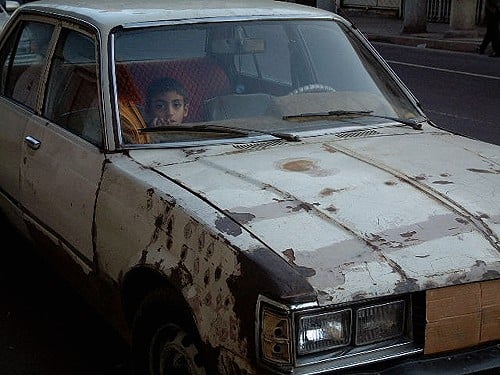
Boy in car in Rasheed Street, Baghdad

We, the authors, would not be surprised if the Iraqi political and military leaders get what they need – and more. The Swedish minister of foreign affairs may well be right here. But are we really to believe that the consumption and life style of these few thousands explain why the remaining 23-point-something million people suffer the terrible way they do?

The people of Iraq were not responsible for the invasion of Kuwait. But they, not Saddam, have been punished, put in prison for 12 years. They have lost hope. They live inside the inner cage of the regime and the outer cage of our sanctions. They know very well who has insisted on keeping the sanctions in place, and it would be wise to ask whether they are likely to receive foreign occupiers as liberators?

Stop the three wars on Iraq and heal Iraq together with its people

Finally, there is much talk about a new military war these days. But a war is already on; bombing raids have been conducted by the U.S. and U.K. in the no-fly zones for years and are now being stepped up. Foreign “special forces” already operate in Iraq. In addition, the citizens of central and southern Iraq have been victims of economic warfare every day since 1991. They are also objects of propaganda warfare. Their voices have seldom been heard, and documentaries about their situation are not exactly flooding our television screens. The media show pictures only of Saddam with his rifles and swords. We shall remember that Iraq is one bad guy and not 24 million fellow citizens in deep need of our sympathy, empathy and compassion. We even let them pay for the humanitarian aid that became necessary to keep them alive in a living hell.

A tiny minority of governments may soon bomb, invade, occupy and control Iraq, or try to. Even if conventional, the firepower will be mass-destructive to the people. The United States and the United Kingdom plan to use nuclear weapons “if necessary.” How can they even think of doing that against a country in which half of the people are children and youth who have lived all their life in misery? Where is the Swedish and other governments’ diplomatic protests at the callous idea that nuclear – and chemical – weapons could be used against Iraq?
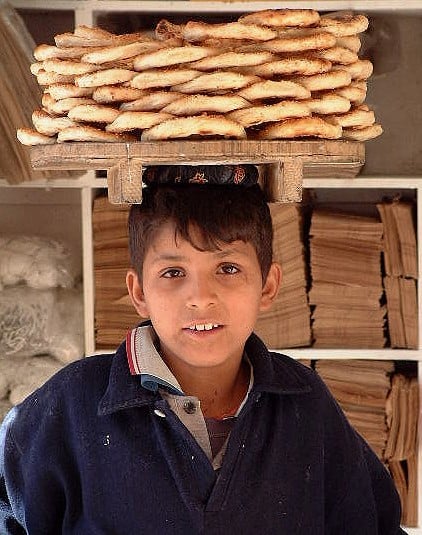
When will our policies take youth into account?

Sanctions are our mass-destructive weapon. Since 1991, simple facts tell us that sanctions have killed and harmed more people and destroyed more of society’s qualities than Saddam presumably ever did. And now a new war? Shall there be no end to our ignorance and cruelty?

These are dark and increasingly mad times. The West seems so morally weak that we cannot take an open discussion about the deeply inhuman consequences of our own morally bankrupt policies. It’s easier to blame everything on Saddam, “the Evil”, and insist that we are only doing good. Reality is that we stand on the top of a Mount Everest of propaganda, ignorance, and lies. All wars require such – convenient – ignorance and lies.

Instead of war, we ought to lift the sanctions, apologise to the Iraqi people, beg their forgiveness and help them get back to normal, sooner rather than later. If we did, they could then take action to decide their own future. We certainly have no right to do it for them.

PressInfo 176 explains why the sanctions will never be lifted by the Security Council.

© TFF 2003
Related Posts

The agreement is catastrophic both because of what it says and what it doesn’t mention. It reduces further the major asset of security policies: Freedom of action. Jan Oberg TFF director September 25, 2026 A couple of hours before the agreement was signed on September 22, 2026, I published the following 13 hypotheses about what it would most likely contain on TFF Substack (in English). I was wrong on only the first point. Contrary to what Trump had written on his Truth Social platform, it does not appear to come into force immediately. In fact, it turned out to be worse than even I had anticipated. After these hypotheses now come a number of reflections in light of what the agreement actually contains, and does not contain, as well as the way in which it has generally been presented by major media outlets and by the public-service broadcaster DR. My...
Below are TFF-related media mentions, comments, videos and social media posts published elsewhere but not on this homepage. We happen to catch and list only a fraction. Regarding video comments and debates, we recommend that you go to the TFF Video Channel on Substack where many of them are reproduced. Jan Oberg is a contributor to China Daily – 52 million daily clicks – and Global Times, CGTN and CCTV (the national television), China Investment, Xinhua News Agency and several others. Articles and videos on these media very often multiply into countless Chinese (and Western media) that re-post them from these main media. Thanks to The China Academy, his analyses, interviews and comments are frequently posted on YouTube channels such as Thinkers Forum and Wave Media. These videos are often re-posted on Bilibili (China’s YouTube), the China Content Center on TikTok, and on the Chinese edition of TikTok, Douyin.com. This means reaching hundreds of millions of viewers worldwide over a year. While there are too many to catch on all these...
Jan Oberg May 15, 2026 Go to this Fox News page and scroll the whole way down: President Donald Trump tells the world that his meeting with President Xi Jinping yielded a lot of very concrete political and economic results – of course, only where the Chinese side, according to him, agreed with him. He does not mention the Taiwan issue, but Secretary of State, Marco Rubio, says that it did not feature prominently in their talks and that the US policy on Taiwan has not changed. Then go to China Daily – or Global Times – and you will see that for the Chinese it is framework, principles, structure of cooperation etc. that matters – all embedded in the overall idea of “constructive bilateral relationship of strategic stability.” Nowhere is any concrete agreement or deal – all that Trump refers to – mentioned. At the general level, this gives you insights into the very different social...

Recent Articles

Tony Robinson October 4, 2026 Violence is easy to recognise when someone is being beaten, shot or killed. It becomes more difficult when nobody is holding a weapon. Poverty, discrimination, exploitation and repression can restrict a human life just as effectively, although they do so in very different ways and with very different consequences. Simply adding more categories to an ever-growing list of forms of violence does not really solve the problem. The more interesting question is what all these different situations have in common and why it makes sense to describe them using the same word. Human beings do not simply react to what happens around them. They remember the past, imagine things that do not yet exist, make plans and undertake projects. Workers organise because they imagine different working conditions; people migrate because they imagine another life somewhere else; social movements emerge because people refuse to accept the...
It’s a matter of principles, courage, vision and pulling together – while the militarist world is falling apart… Peter Langille October 3, 2026 “Here, then, is the problem which we present to you, stark and dreadful and inescapable: Shall we put an end to the human race; or shall mankind renounce war?”The Bertrand Russell—Albert Einstein Manifesto, July 9, 1955 ⁕ The forecast for what’s ahead is worrisome. The sharp rise in armed conflicts over the past three years is adding to what was already the highest level in over seventy years. Genocides, which should be prevented are supported. A shared climate emergency that jeopardises survival is ignored. Diverse polls now suggest that people are war-weary, worried and interested in a more effective United Nations. And, there are viable policy options for a more secure world! Yet governments are doubling-down, betting on more war and investing heavily. If current trends persist,...
Johan Galtung 1930-2024October 2015 Published here on October 3, 2026 Let us focus on Civilization for conflict analysis and remedies. Major forms of disorder use violence; war is state organized violence. The most belligerent states are the United States of America and Israel, both with civilization roots. National Evangelism, the US Protestant Christian civilization– more national than evangelical–justifies US warfare as exceptionalism of a people chosen by God, with a manifest destiny to run the world. Orthodox Judaism justifies Israeli warfare to conquer and expand from Nile to Euphrates as a religious right and duty to the Eternal One. The third most belligerent country, the UK, no longer believes it is God-chosen but chosen by the USA; not quite the same but something. But the root cause of global disorder lies in the Occident–with Islam–seeing itself as the single, universal civilization valid for all at all times, all others being...

TFF on Substack

Discover and subscribe to more peace materials on TFF Substack

Most Popular

Tony Robinson October 4, 2026 Violence is easy to recognise when someone is being beaten, shot or killed. It becomes more difficult when nobody is holding a weapon. Poverty, discrimination, exploitation and repression can restrict a human life just as effectively, although they do so in very different ways and with very different consequences. Simply adding more categories to an ever-growing list of forms of violence does not really solve the problem. The more interesting question is what all these different situations have in common and why it makes sense to describe them using the same word. Human beings do not simply react to what happens around them. They remember the past, imagine things that do not yet exist, make plans and undertake projects. Workers organise because they imagine different working conditions; people migrate because they imagine another life somewhere else; social movements emerge because people refuse to accept the...
It’s a matter of principles, courage, vision and pulling together – while the militarist world is falling apart… Peter Langille October 3, 2026 “Here, then, is the problem which we present to you, stark and dreadful and inescapable: Shall we put an end to the human race; or shall mankind renounce war?”The Bertrand Russell—Albert Einstein Manifesto, July 9, 1955 ⁕ The forecast for what’s ahead is worrisome. The sharp rise in armed conflicts over the past three years is adding to what was already the highest level in over seventy years. Genocides, which should be prevented are supported. A shared climate emergency that jeopardises survival is ignored. Diverse polls now suggest that people are war-weary, worried and interested in a more effective United Nations. And, there are viable policy options for a more secure world! Yet governments are doubling-down, betting on more war and investing heavily. If current trends persist,...
Johan Galtung 1930-2024October 2015 Published here on October 3, 2026 Let us focus on Civilization for conflict analysis and remedies. Major forms of disorder use violence; war is state organized violence. The most belligerent states are the United States of America and Israel, both with civilization roots. National Evangelism, the US Protestant Christian civilization– more national than evangelical–justifies US warfare as exceptionalism of a people chosen by God, with a manifest destiny to run the world. Orthodox Judaism justifies Israeli warfare to conquer and expand from Nile to Euphrates as a religious right and duty to the Eternal One. The third most belligerent country, the UK, no longer believes it is God-chosen but chosen by the USA; not quite the same but something. But the root cause of global disorder lies in the Occident–with Islam–seeing itself as the single, universal civilization valid for all at all times, all others being...
Read More
Living-Peace-Sign-Budapest-copy
Tony Robinson October 4, 2026 Violence is easy to recognise when someone is being beaten, shot or killed. It becomes more difficult when nobody is holding a weapon. Poverty, discrimination, exploitation and repression can restrict a human life just as effectively, although they do so in very different ways and with very different consequences. Simply adding more categories to an ever-growing list of forms of violence does not really solve the problem. The more interesting question is what all these different situations have in common and why it makes sense to describe them using the same word. Human beings do not simply react to what happens around them. They remember the past, imagine things that do not yet exist, make plans and undertake projects. Workers organise because they imagine different working conditions; people migrate because they imagine another life somewhere else; social movements emerge because people refuse to accept the...
b54a1f10-8c65-4f0b-9dd5-4abc0a7d04cc_2659x2659
It’s a matter of principles, courage, vision and pulling together – while the militarist world is falling apart… Peter Langille October 3, 2026 “Here, then, is the problem which we present to you, stark and dreadful and inescapable: Shall we put an end to the human race; or shall mankind renounce war?”The Bertrand Russell—Albert Einstein Manifesto, July 9, 1955 ⁕ The forecast for what’s ahead is worrisome. The sharp rise in armed conflicts over the past three years is adding to what was already the highest level in over seventy years. Genocides, which should be prevented are supported. A shared climate emergency that jeopardises survival is ignored. Diverse polls now suggest that people are war-weary, worried and interested in a more effective United Nations. And, there are viable policy options for a more secure world! Yet governments are doubling-down, betting on more war and investing heavily. If current trends persist,...
010
Johan Galtung 1930-2024October 2015 Published here on October 3, 2026 Let us focus on Civilization for conflict analysis and remedies. Major forms of disorder use violence; war is state organized violence. The most belligerent states are the United States of America and Israel, both with civilization roots. National Evangelism, the US Protestant Christian civilization– more national than evangelical–justifies US warfare as exceptionalism of a people chosen by God, with a manifest destiny to run the world. Orthodox Judaism justifies Israeli warfare to conquer and expand from Nile to Euphrates as a religious right and duty to the Eternal One. The third most belligerent country, the UK, no longer believes it is God-chosen but chosen by the USA; not quite the same but something. But the root cause of global disorder lies in the Occident–with Islam–seeing itself as the single, universal civilization valid for all at all times, all others being...
Screenshot 2026-10-02 011738
Jan ObergPhD, director, The Transnational Foundation for Peace and Future Research, TFFLund, Sweden October 2, 2026 This is my full original manuscript. The Chinese Academy of Social Science, CASS, makes two publications out if it. 1. China’s Five-year plan emphasized the capabilities of basic research and original innovation. It is regarded as the goal of the future social development, which, as required, should be significantly enhanced. Can you comment on the importance of original innovation in research and academic study? I believe it is easier to define “original innovation” in the natural sciences than in social sciences. The breaking points of what constitutes something new, or innovative, are not quite as sharp in the latter. But in both fields it is about opening up something that was closed, unseen, unexplored before – making manifest what was earlier latent. Innovations come in many forms and shapes – naming something that was not...
arctic-circle-map
The agreement is catastrophic both because of what it says and what it doesn’t mention. It reduces further the major asset of security policies: Freedom of action. Jan Oberg TFF director September 25, 2026 A couple of hours before the agreement was signed on September 22, 2026, I published the following 13 hypotheses about what it would most likely contain on TFF Substack (in English). I was wrong on only the first point. Contrary to what Trump had written on his Truth Social platform, it does not appear to come into force immediately. In fact, it turned out to be worse than even I had anticipated. After these hypotheses now come a number of reflections in light of what the agreement actually contains, and does not contain, as well as the way in which it has generally been presented by major media outlets and by the public-service broadcaster DR. My...
girl-5894831_1280
Below are TFF-related media mentions, comments, videos and social media posts published elsewhere but not on this homepage. We happen to catch and list only a fraction. Regarding video comments and debates, we recommend that you go to the TFF Video Channel on Substack where many of them are reproduced. Jan Oberg is a contributor to China Daily – 52 million daily clicks – and Global Times, CGTN and CCTV (the national television), China Investment, Xinhua News Agency and several others. Articles and videos on these media very often multiply into countless Chinese (and Western media) that re-post them from these main media. Thanks to The China Academy, his analyses, interviews and comments are frequently posted on YouTube channels such as Thinkers Forum and Wave Media. These videos are often re-posted on Bilibili (China’s YouTube), the China Content Center on TikTok, and on the Chinese edition of TikTok, Douyin.com. This means reaching hundreds of millions of viewers worldwide over a year. While there are too many to catch on all these...