The United Nations continues to be criticized by governments and citizens alike for being ineffectual, dogged by geo-political power politics and never-ending bureaucracy.
However, beyond the 6 main organs of the UN, namely, the General Assembly, the Security Council, the Economic and Social Council, the Trusteeship Council, the Secretariat and the International Court of Justice, there are also 12 “specialised agencies”, which are autonomous organizations joined to the United Nations through special agreements.
What of the work of these UN agencies in the field?Find out through Vicky Rossi’s conversation with Rajiah Abu Swai who is Mental Health Training & Community Development Officer, World Health Organisation (WHO) in Jerusalem. The interview was done in May 2007.
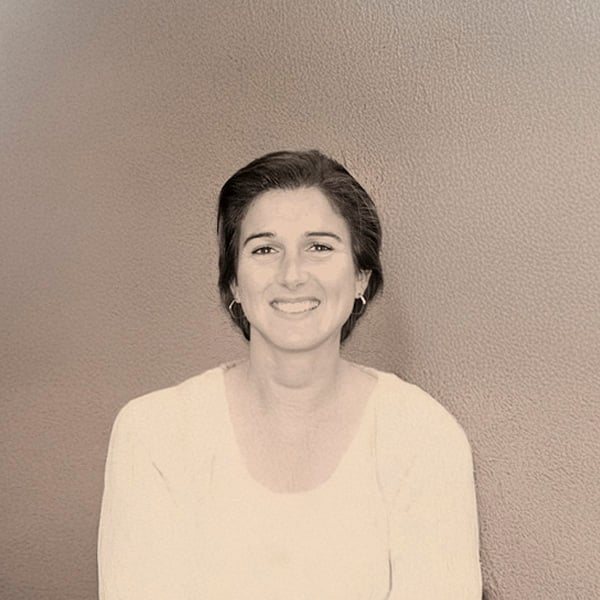
Phto © Vicky RossiRajiah Abu Swai
“Mental Health is much more than the absence of a diagnosable mental illness. It is a state of emotional and psychological well-being allowing for the realization of a person’s potential and optimal functioning in daily life. It is a capacity to interact with others and the environment with a sense of well-being.”
“Key determinants of mental health include physical security, social support networks, employment, access to education and healthcare and to opportunities for self-actualisation.”
WHO, World Health Report 2001
Vicky Rossi: In which ways are the causes of mental illness in the Occupied Palestinian Territories (oPt) the same or different to the causes of mental illness in a European country like the UK, for example, or another Arab country such as Lebanon?
Rajiah Abu Swai: On the whole, the causes of mental illness are the same in every country in the world. What is different here in Palestine, and what creates a potential for higher levels of mental illness, is the particularly stressful situation people find themselves in. The Palestinian Territory under the Israeli Occupation is characterized by a lack of freedom of movement, continuous shelling, isolation and a poor economic situation, which has led to feelings of insecurity and hopelessness amongst the people. Palestinians feel that they are not in control of their own lives. These are the kinds of things which can trigger mental illness in people who are susceptible to this condition, which in turn leads to higher levels of mental illness in society as a whole. Furthermore, research studies have shown that trauma and chronically stressful living conditions can trigger mental illness even in people who would otherwise not suffer it.
Vicky Rossi: Does mental illness manifest in a different way according to a person’s age? That is to say, are the current manifestations of mental illness the same amongst Palestinian children and adolescents as they are amongst Palestinian adults?
Rajiah Abu Swai: Children are more vulnerable. It is particularly important for children to be able to grow up in a situation in which they can feel secure and in which they do not experience fear. It is essential that they can sense that their parents are protecting them and this is what is lacking here in the oPt. Especially when the 2nd Intifada (1) started in 2001, there were many incursions [by the Israeli Defence Forces], shelling and bombings in the West Bank and in Gaza. In parallel, there were more recorded instances of violence in schools as well as aggression, nightmares and bedwetting at home. This is normal because when a child sees that his parents are as scared as he/she is and are unable to control or stop a negative situation, he/she will become even more frightened and anxious.
Vicky Rossi: The oPt has a very young population with approximately three quarters of Palestinians under the age of 30. If a large sector of these young people is traumatized – as appears to be the case – the long-term impact of mental illness on the Palestinian society has the potential to become very serious. When all is said and done, these youngsters will grow up to be the future leaders of the country. They will also have children of their own whose attitudes and behaviour they will influence as a result of their own experiences and beliefs.
Rajiah Abu Swai: Exactly. Given the particular vulnerability of children and adolescents and the fact that they will grow up to become the future adults of Palestinian society, it is especially important to focus on this group and to work on their security, empowerment and psycho-social well being. WHO conducted a Quality of Life survey in 2006 which showed that 1 in 4 Palestinians are experiencing anxiety, loss of hope and a sense of being fed up with life. It is very much a “red light” for any country when the community begins to feel this way.
Vicky Rossi: The Wall is not talked about very much any more in mainstream Western media and yet its construction is going on a pace. Has the building of this Security Fence had any particular, noticeable impact on the mental wellbeing of the Palestinian population?
Rajiah Abu Swai: The Wall around the towns in the West Bank affects the life and feelings of the Palestinian people in the first place by making them feel isolated from the rest of the world. In 2006 the Palestinian Counseling Center conducted a study in Qalqiliya, a city in the north of Palestine whose population is largely made up of peasants who depend on agriculture. The Wall has been built in such a way that it has taken away much of their land, which has affected their economic well being. The study showed that 100% of the population was feeling extremely stressed and 90% felt there was no hope and no future.
Vicky Rossi: You mention the poor economic climate as one of the main instigating factors in the decline in the state of mental health in the oPt. Is this due to factors intrinsic to Palestinian society or is it a repercussion of the Occupation and Intifada?
Rajiah Abu Swai: Well, as a Palestinian I think the causes of the economic decline are very well known, but maybe other people do not understand what is happening here. The main reason is the Occupation. When there is an occupation, the people no longer have control over their country, their economy or their business. At the end of the day, all this is controlled by the occupier. When you have an occupation, you always have to be ready for the unexpected. People in the oPt try to live their lives as if they were living in normal circumstances but the conditions here are not normal. People have no consistency in their lives.
With regard the economy in Palestine, because Palestine is not an independent State, the Palestinian economy is very much dependent on Israel. Since the start of the 2nd Intifada, there has been a huge rise in unemployment in the oPt. There used to be a large percentage of people who worked in Israel; however, since the start of the 2nd Intifada, the Israelis have set up a system of closures and checkpoints and they are no longer issuing as many permits to Palestinians to allow them to work in Israel. The result has been an increase in unemployment in the oPt and a decrease in the Palestinian labour force in Israel.
After Hamas was elected into office, the international community decided to boycott the Palestinian Authority (PA)(2). Since then Israel has also withheld tax revenues it owes to the PA. As a result, public sector employees have not received their salaries for months and there has been an increase in the levels of poverty.
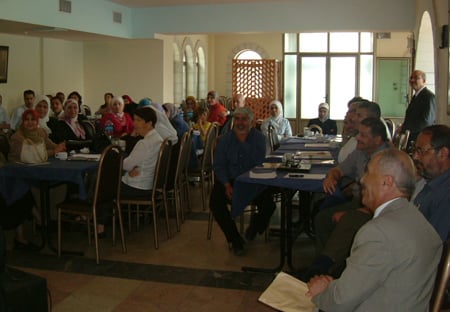
Photo © Vicky Rossi
Mental Health Day conference
Vicky Rossi: Let’s turn now to look more specifically at the community mental health development project being implemented by the World Health Organisation (WHO). If many Palestinians are experiencing trauma as a direct or indirect consequence of the two Intifadas and the Israeli Occupation, why then has WHO decided not to deal with this aspect of mental illness separately but rather to integrate it within the Palestinian mental health system as a whole?
Rajiah Abu Swai: Our project deals both with long-term and short-term issues. Trauma is a short-term problem – it is more of an emergency issue – but it needs to be incorporated within the whole mental health system in Palestine in order to provide the necessary follow-up.
Since there are lots of NGOs [non-governmental organizations] working with trauma and many funders, seduced by the concept of trauma, are channeling their money in that direction, the most important mandate for WHO is the Palestinian Ministry of Health (MoH). The MoH is currently very weak in the area of mental health. It needs to strengthen its policies, services and human resources. WHO has decided to work to strengthen and consolidate the MoH so that it covers all aspects of mental health; trauma can be part of that, but it is not necessarily the main issue.
Vicky Rossi: Since 2004, WHO has been implementing projects in collaboration with the MoH in the areas you mention, namely, policy, services and human resources. Can you give me some examples of the activities you are carrying out?
Rajiah Abu Swai: Worldwide, not just in Palestine, mental health has not yet become a priority within the general health system so before we started this project there was no mental health policy within the MoH. In 2002 we conducted an assessment and analysis of the mental health situation in the oPt. The results were incorporated into a global WHO study, which lead to the organisation issuing a global warning that mental health must become a priority because it risks becoming one of the most burdensome illnesses in society.
Our 2002 assessment and analysis highlighted the lack of mental health policy in the oPt so since then we have been working in this area. In 2004 we signed a policy with the MoH whose main objective is to strengthen and improve both the mental health services and the existing human resources.
Vicky Rossi: By human resources you mean therapists specialized in mental health?
Rajiah Abu Swai: Yes. Currently, there is a lack of human resources in the mental health sector in the oPt. For example for 3,600,000 Palestinians in the West Bank and Gaza there are only 34 psychiatrists, some of which work in private clinics and not in the public sector; there are 36 psychologists – but psychologists here are not qualified and trained like those in the UK, for example, they only have BA degrees not Masters or PhDs; we have 24 social workers and 8 occupational therapists; we have 125 nurses – but they are not specialized in psychiatric nursing, they have only studied basic nursing and yet they work in the psychiatric hospitals.
Vicky Rossi: WHO activities, then, include providing specialized, vocational training to these existing mental health professionals?
Rajiah Abu Swai: Yes. We have 5 main components in our project which meet the needs of the MoH in the mental health sector. One of these is providing training and education for mental health professionals, including in-service training, skills-based training, primary health care training and specialist training.
A second component is the Family Associations, which is an initiative that was begun here by WHO in collaboration with the MoH. It is the first such initiative in the oPt – in fact it is the first such initiative in the whole of the Middle East.
Vicky Rossi: Are these Family Associations support groups? Namely, for the families who have members suffering from mental illness?
Rajiah Abu Swai: The Family Associations started as support groups but now some of them have begun advocacy activities to fight for the rights of their children. Before our project, there was no professional contact with the families of mentally ill patients. WHO has considered it very important to have them on-board because with community mental health services a patient attends a center to receive medication, psycho-therapy, etc. but then he/she goes home to his/her family. As such, it is important to educate families on the causes of mental illness and the treatments available. Families also need to receive support themselves because they might experience mental illness as a heavy burden.
Vicky Rossi: Just to underline a point, this WHO project is very much focused on promoting community-based mental health services as opposed to institutionalized services which confine people in psychiatric hospitals.
Rajiah Abu Swai: Yes, this is the most important, underlying factor in all WHO mental health service projects worldwide, namely, that we are adopting a community based approach rather than an institutionalized approach. This improves the quality of services, the quality of life of patients and their families and it is more cost effective. Hospitals tend to be more expensive. Here in the oPt we have 2 psychiatric hospitals, one in Bethlehem and one in Gaza, where there are around 300 patients, which is not a particularly high number and yet these hospitals receive 73% of the entire Ministry of Health mental health service budget.
In comparison, community mental health services only receive 2.5% of the MoH budget. By working with the patients and their families within the community, we can use the resources of the community. This has a two-fold advantage: firstly it makes services less expensive; and secondly, it does not subject a patient to isolation in a hospital where he/she cannot interact with the community. When the institutionalization approach is adopted, the patient feels outcast and becomes even more aware of his/her illness because he/she is isolated from the rest of the community. Any psychiatric or mental patient needs to feel he/she is a part of the community and to feel supported by the community. He/she needs to feel that he/she is a normal person, that he/she can interact, work and be a member of the family.
Vicky Rossi: Returning to the 5 components of your project. So far we have looked at 2 of these: vocational training and Family Associations. Which are the other components?
Rajiah Abu Swai: We are working with public education in the form of an anti-stigma campaign, which we have been addressing through brochures and posters, inserts in local newspapers, radio programs, and even a TV documentary. All these activities are just a start. We realize that we have to continue working in this area through a more organized campaign involving NGOs and other ministries – not only the Ministry of Health – because mental health is an issue that concerns the whole community.
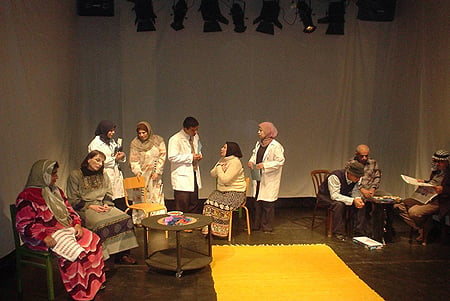
We have also started a very innovative drama group in the psychiatric hospital in Bethlehem. This group consists of patients and staff (psychiatrists, occupational therapists) who, after receiving 6 months of training from a professional, began performing a play on mental health and mental illness. This kind of theatre is called the Theatre of the Oppressed. It is an inter-active theatre i.e. at the end of the play the actors interact with the audience, who have to suggest ways of solving the problems presented in the play.
Vicky Rossi: This kind of inter-active theatre reminds me that we can always learn from each other. It is never only a one way channel i.e. the teacher can always learn from the student as well as the student learning from the teacher.
Rajiah Abu Swai: Yes. This inter-active theatre is very effective. They have already performed in front of families, other hospital staff and NGOs. Now we are planning to perform the theatre in schools and universities.
Another component of our project is capacity-building. Within the MoH, mental health is not a department; it currently comes under primary health care. However, we feel that there is a need to create a Directorate of Mental Health because currently the mental health sector is fragmented: the psychiatric hospitals come under the General Hospital Directorate whereas the community services come under the Primary Health Care Directorate. Psychiatric hospitals and community health care services should be integrated in one unit. Through capacity-building, we plan to advocate for one Directorate that is responsible for all mental health services in Palestine. Under this Directorate, one person would be responsible for training, one for legislation, one for management, etc. Not having a Directorate causes the mental health sector to be very weak both within society and within the Ministry of Health, where it is not given a priority status. The mental health sector needs a stronger management system in order to give it a stronger voice
Vicky Rossi: It is perhaps worth pointing out that the Ministry of Health is quite a young ministry. When was it formed? And who was responsible for the mental health sector in Palestine before that?
Rajiah Abu Swai: It was formed in 1994 after the Oslo Accords. Before that there were lots of NGOs working to provide mental health services. Now, although these NGOs still exist, it is the MoH that provides most of the mental health services to the population and national insurance ensures that people have access to mental health services free of charge.
The 5th and final component of our project is research. We have chosen to focus on mental health research because it is almost totally lacking here in Palestine; neither the NGOs nor the government nor universities are dealing with it systematically. This research needs to be focused on all aspects of mental health: the causes, the treatments and the associated problems. To date, in Palestine, there have only been some small scale research programmes, which have not been inclusive and comprehensive enough to give a really good picture of what is happening in the mental health sector. Until now, we have not had the quantitative studies that could help us to understand more about the mental health phenomena in Palestine. In response to this situation, WHO is planning to carry out extensive research in the coming years.
Vicky Rossi: There are always challenges to the implementation of projects. What kinds of challenges has WHO faced with regard the practical implementation of this community mental health development project either in terms of the level of existing infrastructure/resources within the Palestinian society or the restrictions resulting from the Israeli Occupation?
Rajiah Abu Swai: Let’s speak first about the restrictions on movement imposed by the Occupation. If the mental health professionals need to travel from one city to another, they have to pass checkpoints which can take hours and is totally exhausting. We used to do all our workshops and trainings in Ramallah because it is in the centre of the West Bank but due to the checkpoints and the humiliation that many Palestinians experience there, it was either difficult for people to reach Ramallah or people preferred not to come. To deal with this situation, we have started holding trainings in different districts, for example, in Hebron where we can hold workshops for people from Hebron and Bethlehem, both of which are in the south of the West Bank; in Ramallah for people from Ramallah, Jericho and Salfit; in Nablus for people from Nablus, Qalqiliya and Tulkarm. By grouping the workshops in this way, it is easier for people to move and to reach the training venue.
In the West Bank we have been able to do a lot of in-service training and we have also, for example, brought over consultants from the UK to share their expertise; but in Gaza that hasn’t been possible. Due to UN security restrictions we cannot send international consultants to Gaza because the UN currently considers it to be a Phase 4 emergency zone. So the mental health professionals in Gaza have not been able to receive the same amount of training as those in the West Bank, which has restricted the implementation of our project.
Photo © Vicky Rossi
Theatre related to community and mental health
Vicky Rossi: Just to clarify – as some readers of this interview might not be aware of the circumstances in the oPt – Palestinians from Gaza are forbidden under the Israeli Occupation to travel to the West Bank and vice versa.
Rajiah Abu Swai: Yes, that’s right. In the implementation of our project, these restrictions on the movement of people have been the biggest challenge.
Challenges from within Palestinian society have included a lack of understanding vis-à-vis mental health from within the Ministry of Health and from society in general. We have had to educate the MoH about the importance of mental health for the well being of Palestinian society as a whole. Three years ago it was really hard going. Nowadays, officials in the MoH have seen that WHO is committed to this project and they have begun to realize the importance of the mental health sector so they are more supportive of our activities.
Vicky Rossi: When we are hurt physically, it is easy to see that something is wrong and at what point the person gets better – the broken bone mends or the cut heals; however, with emotional and mental wounds, it is much more difficult to quantify the hurt and to calculate when healing has taken place. Can you explain to me your understanding of what constitutes “recovery” from mental illness? Is recovery possible when the instigating causes of the mental illness – in this case the Intifada and the Occupation – are still present?
Rajiah Abu Swai: With mental illness and mental disorders it is not easy to get fast results. Treatments tend to be more long term than with physical disorders that can perhaps be dealt with reasonably quickly using medication or surgery. With some mental illness it is not possible to remove the cause of the stress, for example, in the case of schizophrenia but that doesn’t mean the person cannot live a reasonably normal life. A person suffering from schizophrenia can get married and can work. He/she can achieve a certain level of recovery by learning to control the illness, preventing the illness from controlling him/her. That is the big issue when it comes to recovery from mental illness and it is important for the mental health professional to understand. There is a link here with stigma and stereotypes about mental illness.
In our vocational training, we emphasize that there are different ways of dealing with mental illness, that it is not only a question of skills but also of attitude i.e. for a patient to recover, it is essential that the mental health professional treating that person believes that recovery is possible. For a long term and comprehensive approach to mental illness there is a need to work with the policy-makers, the community and the families as well as with the mental health professionals so as to put an end to the stigmatization of the mentally ill and to engender the belief that the mentally ill can recover and can become normal members of society.
Vicky Rossi: It is true that how other people perceive you has an impact on your own opinion of yourself. If somebody praises you, you feel good about yourself – your own self-confidence and self-belief grow. If, however, somebody makes you feel as if you are not living up to their expectations, it can be devastating to your morale and end up causing you to perform even worse.
Rajiah Abu Swai: When we have spoken to social workers and psychologists working in the community mental health sector of the MoH, they have described the procedures they are implementing and technically they are 100% right in what they are doing, but most of them have not been relaying the message to the patient that they trust him/her and that they believe recovery is possible, and of course the patient feels this. The most important thing for the patient is not that the therapist is skilled in psychology and psychotherapy theories; what is important is the relationship between patient and therapist. For this reason, WHO has been working a lot with therapists on their attitudes and perceptions.
Vicky Rossi: In which ways have traditional Palestinian healing practices or socialstructures (like the concept of the extended family) helped to mitigate the mental stress experienced by the population?
Rajiah Abu Swai: Family ties are still very strong in Palestine, which is why we are working with family groups, who show high levels of commitment to their children. These groups are now advocating on behalf of their children’s rights within the different ministries, for example, they have gone to the Labour Ministry to ask that their children be given equal opportunities for employment. They have also gone to the Mosques and asked that mental illness be considered every week at Friday prayers.
Nevertheless, here in Palestine as elsewhere in the world, stigma and stereotypes continue to play a negative role. For example, if a family has a daughter who is suffering from mental illness, they might be afraid that because of the stigma attached to this, their other daughters will not be able to get married so they might hide the child away.
When it comes to mental illness, it is still more acceptable in Palestinian society for a person to go to a traditional healer than to a therapist or to a psychiatric hospital. In the latter instance, the patient could be totally stigmatized and called crazy with all the ramifications for his/her families. This is why in our public education campaigns we are trying to show that mental illness is a normal problem and that it can be treated by going to a professional therapist.
Some of the traditional healers are not genuine; they just take people’s money and sometimes they even abuse the patient. Other traditional healers use readings from the Koran and Islamic prayers to ease the patient’s condition. This can be a good thing although it only brings about a temporary relief and doesn’t solve the problem.
Vicky Rossi: Returning to the role of the extended family in Palestine. I have to admit that I am surprised that there is so little vandalism and other crimes when in certain towns like Bethlehem the rate of unemployment is as high as 60%.
Rajiah Abu Swai: With mental illness, Palestinian families might be afraid of being stigmatized; however, when it comes to the political situation e.g. the Israelis confiscating Palestinian land, somebody being killed or sent to prison, then the solidarity that exists between family members is very evident. Support comes also from other people within the community.
It is this strong solidarity between Palestinian people that has enabled them to keep on surviving in these difficult times. Over the last 2 years unemployment has increased dramatically and for almost 12 months now public sector employees haven’t been paid their salaries because the tax revenues for the Palestinian Authority have been withheld by the Israelis. Despite all of this, people are surviving because of solidarity – those who have give to those who have nothing. A good example of this came this year when, as a result of the European/American boycott of the PA and the Israeli closures, peasants in Jenin, Tulkarm and Qalqiliya – in the north of the West Bank – could not sell their vegetables so they gave them away at no cost to the people who had not received their salaries. This is how people survive despite all the stress.
Vicky Rossi: To end this interview, I would like to address a procedural issue by asking you to what extent local ownership of UN projects is considered important? By this I mean, when a UN agency implements a project in the field, to what extent are local organisations (NGO or governmental) responsible for the formulation and implementation of the project? To what extent do foreign nationals steer the implementation of the project? To what extent is the project dictated by the donor community?
Rajiah Abu Swai: Let me speak specifically about our mental health project. For WHO the most important mandate is the Palestinian Ministry of Health with which we work at all times. We started our project in cooperation with 2 other donors – the French Cooperation and the Italian Cooperation – with a view to empowering and strengthening the services of the MoH. Concerning NGOs and UNRWA (3) – because UNRWA is 2nd biggest provider of health services in the Palestinian society after the Ministry of Health – we always try to coordinate with them in order to avoid duplication of projects and to ensure that we reach as many service users as possible. This cooperation is essential to enable us to work together to develop the needed services within the MoH.
Vicky Rossi: Are the NGOs you work with both international and national organizations?
Rajiah Abu Swai: Yes, international and national. Within the policy plan that WHO has signed with the Ministry of Health, we plan to monitor all the mental health projects that are being implemented in the oPt. The “problem” is that Palestine is a very attractive place for donors, so there are a lot of funders and international NGOs working in different sectors, implementing different projects, for example in trauma and crisis intervention. In the end, nobody knows who is doing what.
WHO is trying to change this situation by working with the MoH to monitor which projects are being implemented in the field so that users can access quality services as well as to avoid any duplication of activities. We would like to see all the organizations working in the mental health sector in Palestine coordinating their activities with the MoH by advising the Ministry of their projects, their activities, their target groups, their beneficiaries, etc. In order to do this, there is a need also for coordination between the Ministry of Health and the Ministry of Planning so as to see where all the money coming into Palestine is going.
*This transcript represents an accurate but non-verbatim representation of the original interview.
For further information, please contact:
Rajiah Abu Sway
Mental Health Training & Community Development Officer
World Health Organisation (WHO)
WB & Gaza Office
P.O Box 54812
Jerusalem
Tel: +972(0)2-540-0595
Mobile: +972(0)54-645-9100
Fax: +972(0)2-581-0193
E-mail: ras@who-health.org
Website: http://www.emro.who.int/Palestine
Footnotes
1. “Intifada” means “Uprising”
2. The Palestinian Authority (PA): the Palestinian government currently headed by the Hamas political party.
3. UNRWA: the United Nations Relief and Works Agency