
Have militarist ‘culture,’ enemy images, and threats of war become the unifying force in our society?

Today is 9 April. It marks the 80th Anniversary of Hitler’s invasion of Denmark.

Denmark’s Radio reports today on how the country’s war museums have become ‘attractions’ where people queue to get in and go on guided tours, and ticket sales are booming.

Of course, it never occurs to anyone to ask why Denmark and so many other countries are so preoccupied with war – monuments, anniversaries, museums, have so many bookshops with lots of books about war, war history, weapons, uniforms – use military-inspired fashion or drive city jeeps and other modern cars that look like armoured vehicles. Not to mention why there aren’t the same peace-inspired things – peace monuments, peace museums, bookshops with peace books…

The answer is simple enough. The West as a culture, as a social cosmology and a collective way of thinking and behaving, is a terrible violence-based apparatus of world wars, armament, colonialism, imperialism, occupations, genocide, nuclear weapons, global bases and intercontinental missiles – you name it.

It is a ‘civilisation’ so steeped in violence – political, economic, structural, gender, cultural, entertainment, psychological, racial – that most people take it for granted and don’t even realise the extent to which we are a culture of violence and not peace.

If the Danish government and parliament had been in favour of peace, in such a culture, they would have caused an outcry and heated public debate. But in a culture of war, they are completely politically correct – and Danes don’t see alternatives because politics, the media and research/experts are on the same war line. The same deadly groupthink – a concept that involves not thinking but following the herd in the delusional mood that you are right – simply cannot be wrong – and that everyone else is wrong.

Denmark does not have a MIMAK – a Military-Industrial-Media-Academic Complex. Denmark is a MIMAK, and it must be sold to taxpayers in every possible – and ethically impossible – way. Danish businesses are now tasked with streamlining and designing the militarism of the future, just look at how the world-renowned A. P. Møller Maersk is leading the way. Moller Maersk is heading a ministerial committee to make the Danish military – I refuse to call it ‘defence’ – ‘well-run.’

Interestingly, only one member of that committee has any relevant expertise; the rest – one must assume – know nothing special about international politics, defence theories, doctrines, security theories, threat analysis, etc., and I am quite sure that none of them can spell the word ‘peace.’

Nor do they need to. Today’s “peace” equals the ability to deter, to hate, to see threats around every corner, to arm without a target or purpose but as a percentage of GDP, to wage war – verbally (diplomacy no longer exists) and physically. We have Danish PM Mette Frederiksen’s word that peace can be more dangerous than war.

Yesterday – 8 April – Swedish Television, SVT, reports that Prime Minister Kristersson will call all the Swedish parliamentary parties for talks next week. The reason is this – ‘The government is now calling for new party leader talks on the continued rearmament of the Swedish defence. The background is the proposal for a loan-financed rearmament of SEK 300 billion, which the government and the Sweden Democrats have announced.’

They want to borrow SEK 300 billion – US$ 30 bn – to finance Sweden’s future rearmament, which comes on top of a rearmament that saw Sweden spend SEK 45 billion on its ‘defence’ ten years ago and today spending SEK 143 billion, an increase of 318%. More details on the Government Chancellery page – showing this development:
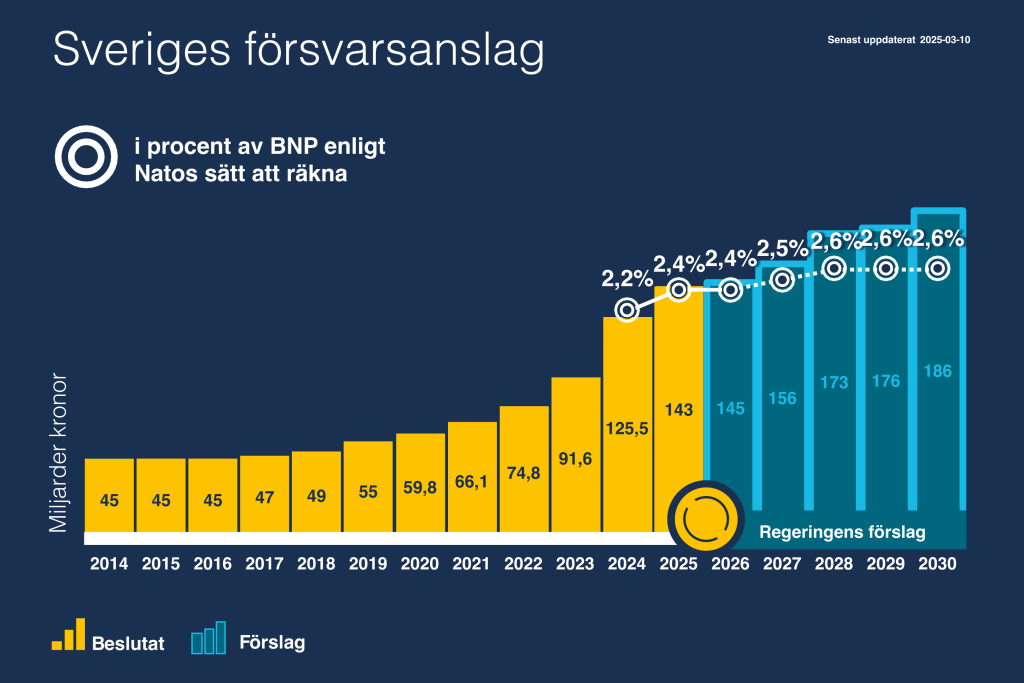
Sweden must rearm to satisfy the absurd, anti-intellectual and irrelevant yardstick: military spending as a percentage of GDP, which I have criticised to no end here. The planned rearmament has no – no – relation to any serious, qualified analysis of likely civil and military threats to Sweden in the coming decades. It suffices these days to state that Putin is the cause of all problems, that he is evil or that he is this or that personality and, therefore, to maintain out of the blue that he aims to take most of Europe. No one asks a question, because critical journalism has also disappeared, at least in this field.

This is how you lie and how you install and increase fear in the population. Fear – fearology – is known to be extremely effective in getting people to believe or do anything. Because ‘we’ are threatened!

But apart from this kakistocratic mindset, one should note that Swedish Prime Minister Kristersson is quoted as saying this:

‘In serious times, it’s important that we stick together as a country, says Prime Minister Ulf Kristersson.’

Is he afraid that Sweden will not stay together as a country? Is he afraid that the propaganda that ‘the Russians are coming’ will be seen through? Is he afraid that Sweden will not hold together when Swedes realise how destructive this insane militarisation – and borrowing for it – is for Swedes in the future? Is he afraid that at some point he’ll be seen as a peacetime traitor because his government is apparently more loyal to NATO and the US (even under the Trump regime!) than to the people who elected him?

I wonder if there’s something – deeper – in the thought I express in the headline of this article?

I fear that there is – and that this is a convincing sign of the West’s decay from within – while legitimising the chaos of inner emptiness by looking mad at external non-existent threats. Psychologists call this kind of psychology ‘projection’ – ‘projecting your own dark sides onto your opponent.’ I would call it psycho-political projection.

We – Western societies – simply have no vision of the future to rally around, so the illusory and self-created war must become the thing that makes us stand together and gives us meaning.

PS Much more can certainly be said about this hypothesis – militarism as filling the void of modern Western society, offering a meaning and cohesion, albeit absurd and dangerous. I intend to think more and write more about this, so any views you, dear reader, may have on this relationship, please drop them below. Thanks!


Peace & future researcher + ‌Art Photographer

Related Posts

Tony Robinson October 4, 2026 Violence is easy to recognise when someone is being beaten, shot or killed. It becomes more difficult when nobody is holding a weapon. Poverty, discrimination, exploitation and repression can restrict a human life just as effectively, although they do so in very different ways and with very different consequences. Simply adding more categories to an ever-growing list of forms of violence does not really solve the problem. The more interesting question is what all these different situations have in common and why it makes sense to describe them using the same word. Human beings do not simply react to what happens around them. They remember the past, imagine things that do not yet exist, make plans and undertake projects. Workers organise because they imagine different working conditions; people migrate because they imagine another life somewhere else; social movements emerge because people refuse to accept the...
Johan Galtung 1930-2024October 2015 Published here on October 3, 2026 Let us focus on Civilization for conflict analysis and remedies. Major forms of disorder use violence; war is state organized violence. The most belligerent states are the United States of America and Israel, both with civilization roots. National Evangelism, the US Protestant Christian civilization– more national than evangelical–justifies US warfare as exceptionalism of a people chosen by God, with a manifest destiny to run the world. Orthodox Judaism justifies Israeli warfare to conquer and expand from Nile to Euphrates as a religious right and duty to the Eternal One. The third most belligerent country, the UK, no longer believes it is God-chosen but chosen by the USA; not quite the same but something. But the root cause of global disorder lies in the Occident–with Islam–seeing itself as the single, universal civilization valid for all at all times, all others being...
Jan ObergPhD, director, The Transnational Foundation for Peace and Future Research, TFFLund, Sweden October 2, 2026 This is my full original manuscript. The Chinese Academy of Social Science, CASS, makes two publications out if it. 1. China’s Five-year plan emphasized the capabilities of basic research and original innovation. It is regarded as the goal of the future social development, which, as required, should be significantly enhanced. Can you comment on the importance of original innovation in research and academic study? I believe it is easier to define “original innovation” in the natural sciences than in social sciences. The breaking points of what constitutes something new, or innovative, are not quite as sharp in the latter. But in both fields it is about opening up something that was closed, unseen, unexplored before – making manifest what was earlier latent. Innovations come in many forms and shapes – naming something that was not...

Recent Articles

Tony Robinson October 4, 2026 Violence is easy to recognise when someone is being beaten, shot or killed. It becomes more difficult when nobody is holding a weapon. Poverty, discrimination, exploitation and repression can restrict a human life just as effectively, although they do so in very different ways and with very different consequences. Simply adding more categories to an ever-growing list of forms of violence does not really solve the problem. The more interesting question is what all these different situations have in common and why it makes sense to describe them using the same word. Human beings do not simply react to what happens around them. They remember the past, imagine things that do not yet exist, make plans and undertake projects. Workers organise because they imagine different working conditions; people migrate because they imagine another life somewhere else; social movements emerge because people refuse to accept the...
It’s a matter of principles, courage, vision and pulling together – while the militarist world is falling apart… Peter Langille October 3, 2026 “Here, then, is the problem which we present to you, stark and dreadful and inescapable: Shall we put an end to the human race; or shall mankind renounce war?”The Bertrand Russell—Albert Einstein Manifesto, July 9, 1955 ⁕ The forecast for what’s ahead is worrisome. The sharp rise in armed conflicts over the past three years is adding to what was already the highest level in over seventy years. Genocides, which should be prevented are supported. A shared climate emergency that jeopardises survival is ignored. Diverse polls now suggest that people are war-weary, worried and interested in a more effective United Nations. And, there are viable policy options for a more secure world! Yet governments are doubling-down, betting on more war and investing heavily. If current trends persist,...
Johan Galtung 1930-2024October 2015 Published here on October 3, 2026 Let us focus on Civilization for conflict analysis and remedies. Major forms of disorder use violence; war is state organized violence. The most belligerent states are the United States of America and Israel, both with civilization roots. National Evangelism, the US Protestant Christian civilization– more national than evangelical–justifies US warfare as exceptionalism of a people chosen by God, with a manifest destiny to run the world. Orthodox Judaism justifies Israeli warfare to conquer and expand from Nile to Euphrates as a religious right and duty to the Eternal One. The third most belligerent country, the UK, no longer believes it is God-chosen but chosen by the USA; not quite the same but something. But the root cause of global disorder lies in the Occident–with Islam–seeing itself as the single, universal civilization valid for all at all times, all others being...

TFF on Substack

Discover and subscribe to more peace materials on TFF Substack

Most Popular

Tony Robinson October 4, 2026 Violence is easy to recognise when someone is being beaten, shot or killed. It becomes more difficult when nobody is holding a weapon. Poverty, discrimination, exploitation and repression can restrict a human life just as effectively, although they do so in very different ways and with very different consequences. Simply adding more categories to an ever-growing list of forms of violence does not really solve the problem. The more interesting question is what all these different situations have in common and why it makes sense to describe them using the same word. Human beings do not simply react to what happens around them. They remember the past, imagine things that do not yet exist, make plans and undertake projects. Workers organise because they imagine different working conditions; people migrate because they imagine another life somewhere else; social movements emerge because people refuse to accept the...
It’s a matter of principles, courage, vision and pulling together – while the militarist world is falling apart… Peter Langille October 3, 2026 “Here, then, is the problem which we present to you, stark and dreadful and inescapable: Shall we put an end to the human race; or shall mankind renounce war?”The Bertrand Russell—Albert Einstein Manifesto, July 9, 1955 ⁕ The forecast for what’s ahead is worrisome. The sharp rise in armed conflicts over the past three years is adding to what was already the highest level in over seventy years. Genocides, which should be prevented are supported. A shared climate emergency that jeopardises survival is ignored. Diverse polls now suggest that people are war-weary, worried and interested in a more effective United Nations. And, there are viable policy options for a more secure world! Yet governments are doubling-down, betting on more war and investing heavily. If current trends persist,...
Johan Galtung 1930-2024October 2015 Published here on October 3, 2026 Let us focus on Civilization for conflict analysis and remedies. Major forms of disorder use violence; war is state organized violence. The most belligerent states are the United States of America and Israel, both with civilization roots. National Evangelism, the US Protestant Christian civilization– more national than evangelical–justifies US warfare as exceptionalism of a people chosen by God, with a manifest destiny to run the world. Orthodox Judaism justifies Israeli warfare to conquer and expand from Nile to Euphrates as a religious right and duty to the Eternal One. The third most belligerent country, the UK, no longer believes it is God-chosen but chosen by the USA; not quite the same but something. But the root cause of global disorder lies in the Occident–with Islam–seeing itself as the single, universal civilization valid for all at all times, all others being...
Read More
Living-Peace-Sign-Budapest-copy
Tony Robinson October 4, 2026 Violence is easy to recognise when someone is being beaten, shot or killed. It becomes more difficult when nobody is holding a weapon. Poverty, discrimination, exploitation and repression can restrict a human life just as effectively, although they do so in very different ways and with very different consequences. Simply adding more categories to an ever-growing list of forms of violence does not really solve the problem. The more interesting question is what all these different situations have in common and why it makes sense to describe them using the same word. Human beings do not simply react to what happens around them. They remember the past, imagine things that do not yet exist, make plans and undertake projects. Workers organise because they imagine different working conditions; people migrate because they imagine another life somewhere else; social movements emerge because people refuse to accept the...
b54a1f10-8c65-4f0b-9dd5-4abc0a7d04cc_2659x2659
It’s a matter of principles, courage, vision and pulling together – while the militarist world is falling apart… Peter Langille October 3, 2026 “Here, then, is the problem which we present to you, stark and dreadful and inescapable: Shall we put an end to the human race; or shall mankind renounce war?”The Bertrand Russell—Albert Einstein Manifesto, July 9, 1955 ⁕ The forecast for what’s ahead is worrisome. The sharp rise in armed conflicts over the past three years is adding to what was already the highest level in over seventy years. Genocides, which should be prevented are supported. A shared climate emergency that jeopardises survival is ignored. Diverse polls now suggest that people are war-weary, worried and interested in a more effective United Nations. And, there are viable policy options for a more secure world! Yet governments are doubling-down, betting on more war and investing heavily. If current trends persist,...
010
Johan Galtung 1930-2024October 2015 Published here on October 3, 2026 Let us focus on Civilization for conflict analysis and remedies. Major forms of disorder use violence; war is state organized violence. The most belligerent states are the United States of America and Israel, both with civilization roots. National Evangelism, the US Protestant Christian civilization– more national than evangelical–justifies US warfare as exceptionalism of a people chosen by God, with a manifest destiny to run the world. Orthodox Judaism justifies Israeli warfare to conquer and expand from Nile to Euphrates as a religious right and duty to the Eternal One. The third most belligerent country, the UK, no longer believes it is God-chosen but chosen by the USA; not quite the same but something. But the root cause of global disorder lies in the Occident–with Islam–seeing itself as the single, universal civilization valid for all at all times, all others being...
Screenshot 2026-10-02 011738
Jan ObergPhD, director, The Transnational Foundation for Peace and Future Research, TFFLund, Sweden October 2, 2026 This is my full original manuscript. The Chinese Academy of Social Science, CASS, makes two publications out if it. 1. China’s Five-year plan emphasized the capabilities of basic research and original innovation. It is regarded as the goal of the future social development, which, as required, should be significantly enhanced. Can you comment on the importance of original innovation in research and academic study? I believe it is easier to define “original innovation” in the natural sciences than in social sciences. The breaking points of what constitutes something new, or innovative, are not quite as sharp in the latter. But in both fields it is about opening up something that was closed, unseen, unexplored before – making manifest what was earlier latent. Innovations come in many forms and shapes – naming something that was not...
arctic-circle-map
The agreement is catastrophic both because of what it says and what it doesn’t mention. It reduces further the major asset of security policies: Freedom of action. Jan Oberg TFF director September 25, 2026 A couple of hours before the agreement was signed on September 22, 2026, I published the following 13 hypotheses about what it would most likely contain on TFF Substack (in English). I was wrong on only the first point. Contrary to what Trump had written on his Truth Social platform, it does not appear to come into force immediately. In fact, it turned out to be worse than even I had anticipated. After these hypotheses now come a number of reflections in light of what the agreement actually contains, and does not contain, as well as the way in which it has generally been presented by major media outlets and by the public-service broadcaster DR. My...
girl-5894831_1280
Below are TFF-related media mentions, comments, videos and social media posts published elsewhere but not on this homepage. We happen to catch and list only a fraction. Regarding video comments and debates, we recommend that you go to the TFF Video Channel on Substack where many of them are reproduced. Jan Oberg is a contributor to China Daily – 52 million daily clicks – and Global Times, CGTN and CCTV (the national television), China Investment, Xinhua News Agency and several others. Articles and videos on these media very often multiply into countless Chinese (and Western media) that re-post them from these main media. Thanks to The China Academy, his analyses, interviews and comments are frequently posted on YouTube channels such as Thinkers Forum and Wave Media. These videos are often re-posted on Bilibili (China’s YouTube), the China Content Center on TikTok, and on the Chinese edition of TikTok, Douyin.com. This means reaching hundreds of millions of viewers worldwide over a year. While there are too many to catch on all these...




