This is a chapter in a TFF anthology in the making
“If You Want To Understand China.”
Foreword, Introduction, Authors and Table of Content here.
Cultural bias
Before looking at concrete patterns of manipulation, it is necessary to point at the cultural bias that is partly driving the manipulation. Not only the regulations and protocols of most international organizations like the UN, WTO, NATO, etc., are culturally biased, the very idea of a ‘rules-based world’ as the ultimate goal of humanity is rooted in Western cultural values that are not supported by most non-Western nations. In fact, the basic idea behind TFF’s Smokescreen Report cannot be fully understood without taking the cultural bias into account.
Dimensions of culture
This section uses the 7-Dimension (7-D) model of national culture developed by Fons Trompenaars and Charles Hampden-Turner. These two management consultants identified the seven dimensions of culture, and the model was published in their 1997 book, “Riding the Waves of Culture.” They developed the model after spending ten years researching the preferences and values of people in dozens of cultures around the world, asking a huge number of people from various cultures to complete a questionnaire.
They found that people from different cultures are not just randomly different from one another; they differ in very specific, even predictable, ways. This is because each culture has its own way of thinking, based on its own set of values and beliefs.
Recently, Trompenaars and Hampden-Turner and their network of scholars, have started applying the model to realms other than business. This author who is a TFF Associate, has worked with Fons Trompenaars for more than two decades and has lectured and published on the application of the model in the field of human rights. You can find articles by me on the TFF site.
In 2021, Hampden-Turner, Peverelli and Trompenaars published a comprehensive analysis of Chinese culture using this model: Has China Devised a Superior Path to Wealth Creation? The Role of Secular Values. This chapter will cite liberally from that book.
Extremism
Thinking about culture in terms of dimensions helps understand the nature of (many forms of) extremism. Cultures that occupy a position close to one of the ends of a dimension can easily lose sight of other ways of understanding the world. One dimension is Individualist – Communitarian. Chinese culture is rather Communitarian, while most Western nations are strongly individualist. The Chinese Cultural Revolution can be regarded as a period in which collectivism became so extreme, that the individual was left with too little to develop. This explains why it did not last very long and has left no permanent imprint on Chinese cultural values.
Universalist – Particularist
This dimension measures whether people in a culture are more oriented to universal laws or exceptional circumstances. Respondents are asked to imagine that they are a passenger in a car driven by a best friend who is breaking the speed limit when striking and injuring a pedestrian. The friend is taken to court where the respondent is the sole witness. Were the respondent not to disclose that the friend was speeding, the friend would likely get off. What right or reason does the friend have to expect the respondent’s help? This dilemma pits the value of a universal law requiring truthful witness in a court of law against friendship and exceptional obligation to a particular friend. Which side of this dilemma do you choose? Here are the scores of selected nations. The top nations opt for upholding the low, while the lower ones give priority to friendship.
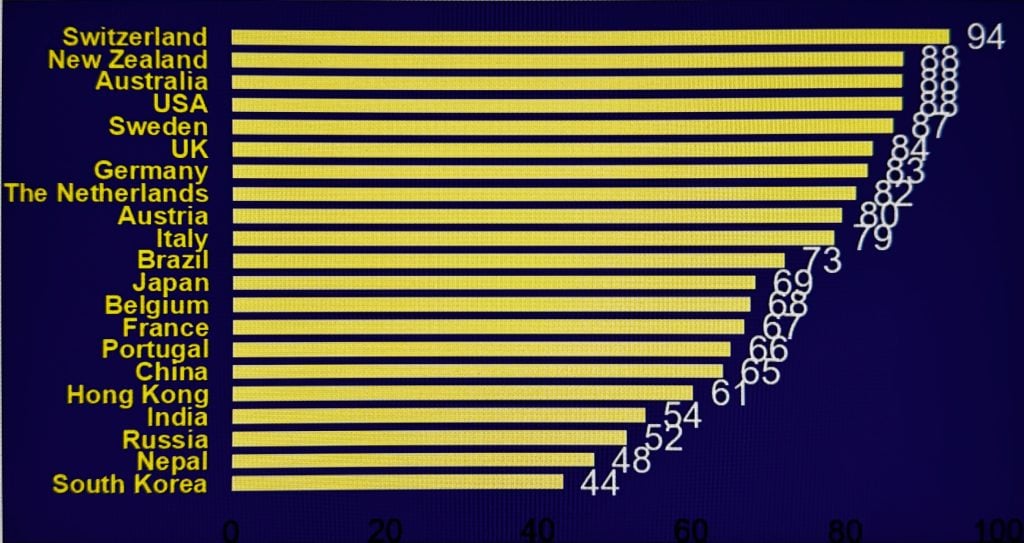
Only two of the nations in this picture have scores below 50%, but the range is still huge.
However, it is more interesting to group the nations on the left into those belonging to the Western block. There is no fixed definition for ‘Western’, but we can take membership of the EU and/or NATO as a working definition. We then clearly see that Western nations tend to be in the upper section.
The U-P score is not determined by this single dilemma. The following picture shows the global projection of this dimension. It is a screenshot of the current Trompenaars & Hampden-Turner homepage.
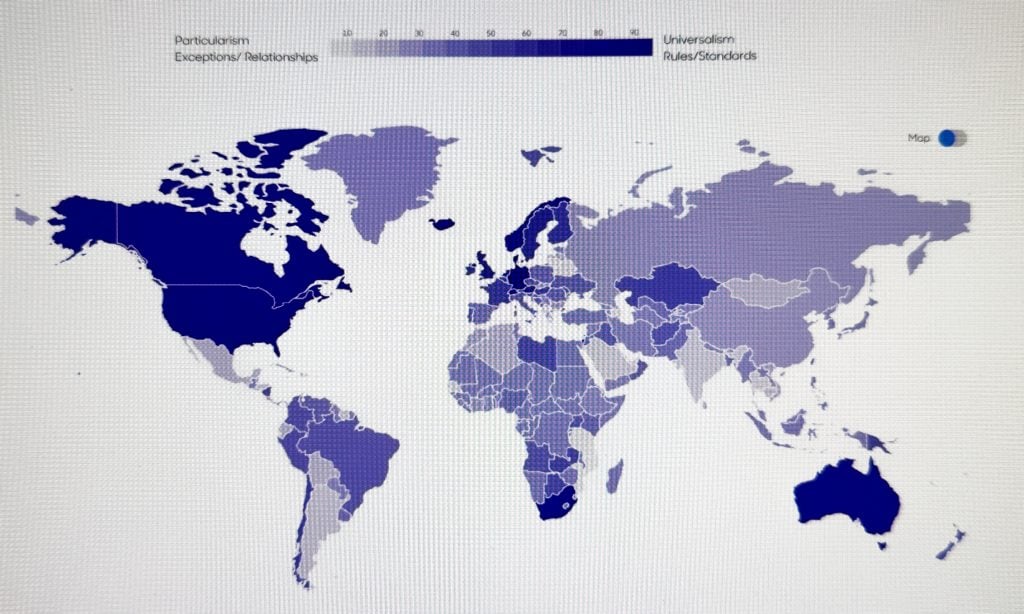
The darker the colour, the more Universalist the nation.
The consequences of this cultural dimension alone are huge. Compare this world map with the map that shows all nations that support the sanctions against Russia.
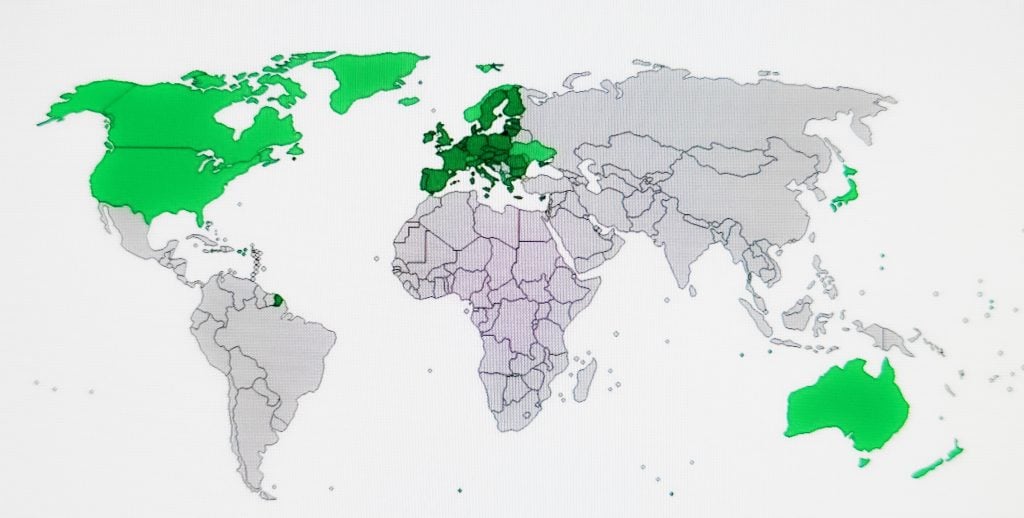
The green nations are the supporters and the link to Universalist culture is evident. We have discussed this earlier on the TFF site.
Rules-based versus multipolar world order
Equipped with this insight, we can see that the idea that a ‘rules-based world’ is where humanity should be heading is a Western concept rooted in universalist cultural values. It is supported by more or less the same group of nations as those that support the sanctions against Russia.
Moreover, the media, international organisations, and NGOs that participate in the China-bashing are also located in these nations. Indeed, these findings place a big question mark about the global nature of even the UN and all its subsidiaries. For example, the never-ending battles between Western and non-Western nations about violations of WTO rules are a result of the difference in the perception of rules between Universalist and Particularist nations. These battles cannot be settled through court, but need to be reconciled each time through negotiations.
The alternative to a rules-based world – a multipolar world – can also be better defined using the 7-D model. Cultural values, expressed as percentages of a nation (or a group of nations) on each dimension, should be the basis for nation-building. Different sets of values will result in different ways of organising a nation, different perceptions of right and wrong, rights and duties, etc. In fact, a pole in this concept is a set of cultural values.
Propensity towards reification
Strong universalist cultures have a propensity towards reification. Once a certain level of consensus has been reached about a particular topic, Universalists tend to proclaim the discussions as closed and the communis opinio as the single universal truth.
The genocide against the Uyghurs is a typical example of such a process. The idea was launched, and once it was accepted by a critical mass, it became a fact that does no need to be confirmed and even should not be re-discussed. This explains why editors of major newspapers and news services do not give space for such discussions. Launching the smokescreen was a deliberate political act, but the process of accepting and fixing (reifying) it was (partly) a cultural process.
Pattern 1: Choice of words
Regime
In the Western press, China does not have a government, but a regime. The use of these terms is so well established that hardly anyone thinks about them anymore. We forget that this term refers to a government that has not come about through elections like those in Western nations. Electing parliaments and governments have been made into a ‘rule’ and has ever since been enforced on a global scale as the benchmark of ‘democracy’.
The term regime is, therefore, a symbol of Western arrogance and neo-colonialism. By arrogance, we mean the idea that the Western way of state-building is the only proper one and that deviating ways of nation-building are less good or bad. This is becoming a hot topic, as the Chinese government has incorporated the pursuit of a multipolar world into foreign policy.
The fact is that there are more ways to establish a democracy, each with its own advantages and disadvantages. Nations must make their own choice based on their own culture, historical and geographical background, etc. China is also a democracy; in its own way (see Chapter 9 of the Hampden-Turner-Peverelli-Trompenaars book on the TFF site). So China just has a government.
The use of that word does not preclude critical discussion of the situation in China.
Power
Power is an elusive concept. One definition is: “Power is the influence that a person, company or organisation has on others. When someone has power, other people do what they are told.” With this concept in the context of China, the media mainly refer to the power of the state which is thought to be much greater there than in the Western nations. The Communist Party is also bestowed with almost absolute power in our media (see the next item).
In the daily conversations between the citizens of our countries about the power of our governments, you get a different impression. Adam Smith coined the term ‘the invisible hand’ for the government’s indirect manipulation. Applied to the multipolar world, we can say that this invisible (in practice, ‘less visible’ would be better) hand is used in the Western world and that in most non-Western nations the hand of the state is much more visible. The concept of the (in)visible hand is not the same as power, but apparently, that is a step too far for most Western journalists.
Downright irritating is the use of the term power in the reporting on current President Xi Jinping. Media like CNN are regularly reporting that “Xi now holds all power.” However, that doesn’t stop the same journalist from reporting a couple of days later that “Xi has grabbed even more power.” This only makes sense, if someone in China had created more power.
Party
Talking about elusiveness, the Communist Party of China, or simply the Party, features in almost every media article about China. Unfortunately, these articles hardly add to the understanding of the nature and the role of the Party. The basic reason for this perception is that Westerners again take their own petrified concept of the right way to organize politics as the global benchmark: A Western political party represents a section of citizens with similar ideas about a small set of political issues. Through regular elections, citizens try to maximise their influence in society through seats in parliament, municipal councils, etc.
The inability to see other possible ways to organize politics causes Western media to keep referring to China as a one-party state, implying that only one group of citizens have an opportunity to enforce its ideas.
Distance
Cultural diversity is the core of our concept of the multipolar world. A major bonus of the 7-D model is that we can literally calculate the distance between any set of cultures. However, in our perception, various sets of cultural values are different but equivalent. Western media report on the political situation in any non-Western country in terms of distance from the Western benchmark. This leads to expressions that a country like China ‘still has a long way to go’ in whatever field. This phrasing is problematic in two ways: it takes one particular set of values as the benchmark, and it expresses the belief that cultural values can be imposed.
The first has been explained above: the poles (cultures) in a multipolar world are equivalent. As for the second, cultures do change, but extremely slowly. It usually takes several generations to start seeing small changes. It is impossible to make a nation switch basic values overnight. Recent Chinese history has proven that: the Cultural Revolution failed in changing Chinese culture.
Dependent
A concept that also continues to amaze is the perceived ‘dependence’ of Western states or enterprises on China. Already in the mid-1980s, Michael Porter pointed to the competitive advantage of nations. Countries excel at a particular industry, on the basis of a combination of circumstances, and as soon as an advantage is reached, it starts to act as leverage, prolonging and often even growing the leading position.
When the Chinese economy started to grow rapidly, everyone here was happy with the new sales opportunities for Western products. After roughly 2010, joy turned to horror, as China took the lead in more and more realms. The media started writing that we should be careful not to become dependent on China, e.g. in the field of solar panels. The number of products that have been warned about in this way in the press is enormous. No newspaper or network wants to be seen lagging behind, but they also need to be original, so journalists keep hunting for ever more far-fetched examples like, say, parts for wind turbines.
Democracies
This plural noun is used as a synonym for the Western block, in particular West-Europe, the Anglo-American nations and Japan. For instance, the 2023 G7 summit in Japan was announced by CNN as ‘leaders of seven of the world’s most powerful democracies gather in Japan’. Another CNN report spoke of the ‘Group of Seven advanced economies’.
The Edelman Trust Barometer announces the fact that the trust in the own government is decreasing in many Western nations as: ‘Trust falls in democracies’, without explaining the scope of that term, indicating that the compilers believe that readers all know that scope. India and China are the big risers in those statistics, so the report suggests that those countries are not part of the ‘democracies’.
This is a classic example of a Western value being given the status of a global benchmark. In a multipolar world, (blocks of) nations build their political-economic system on their own cultural values. As long as there is a cultural fit, the resulting system is democratic in the sense that citizens will experience their living space as congenial.
Economic train
A common trick to implant a negative image of China among readers/listeners/viewers is the use of negative terms when describing the Chinese economy. Journalists do not immediately say that: ‘the economy is in bad shape’, because then they also have to explain that statement and that is difficult when things are going well.
Instead, the metaphor of the rails is a common alternative. You can often read that China is trying to ‘get the economy back on track’. That is the moment that serious readers should ask themselves, ‘Was that economy derailed?’ Indeed, growth may be less than expected, as elsewhere in the world. But China’s economy is still going strong. Journalists know that too, of course, but apparently do not want or are not allowed to write it.
Pattern 2: Superfluous words
Another trick is to add words, in particular adjectives, to a text that are not really necessary to convey whatever the journalist is trying to say, but is useful to guide the attention or interpretation of the reader
I will give a few examples from recent texts on CNN’s homepage:
“I met model Maoist peasant Yu Kexin and ate lunch at his modest home.”
This is part of a description of the visit to a rural commune in the 1970s. Maoist is a Western term not used in China. It is de facto void of real meaning, but conveys a feeling that you should not take this person, or even the visit, serious.
“China’s model of authoritarian capitalism as the basis for a new global system could prove attractive to some states around the world.”
The adjective authoritarian is probably one of the most frequently used words in this category. A similar term is draconian.
Pattern 3: Omitting facts
This pattern is used so overwhelmingly, that we need to narrow it down in this report. Here is an example of what we should be aware of under this method. Although the interest in Xinjiang now seems to decrease, the reports about what is happening in that region are numerous and always negative.
Very few of the media reports mention the heavy investments by the Chinese government in that region, and if they do, it is usually presented negatively – as a means to suppress the cultural identity of the ethnic minorities. Likewise, the support from many Islamic nations for the Chinese government is seldom reported and only in a negative way.
Now a recent example of a very sly omission of a fact that I am referring to for this section. The main Dutch TV news program (the eight o’clock news) reported that the conflicting parties in Yemen now seem to be willing to negotiate peace. The reason given was that the nations that were supporting the conflicting sides, Saudi Arabia and Iran, had recently started normalising their relations.
So far so good, but the report stopped short of giving China credit for mediating that normalisation. This should have been mentioned, as this particular report is about a significant spin-off of that peace process.
Pattern 4: Creating facts
This pattern is the opposite of Pattern 3. It is about adding China in texts that are not at all about China, with the only purpose of placing the nation in a negative context. In a Dutch newspaper, we recently read about a proposition to put a moratorium on the development of artificial intelligence (6 months) to develop proper legislation to avoid abuse. Again, so far so good.
However, out of the blue came a short section with a header ‘China’ that only stated that half a year was probably not enough for China to get ahead of the West. This section could have been written in a more general way not mentioning a specific nation. It was obviously meant as yet another opportunity for the journalist to score points in China-bashing.
Pattern 5: Institutional backup
In the previous sections, we have hinted a number of times that it does not seem to be the journalists who make these choices. It looks as if they are structural acts made in interaction with editors. Moreover, since columnists are joining reporters as well, editors-in-chief seem to be part of the organizational structure as well.
However, there are indications that, at least in some countries, national institutions are supporting the manipulation of reporting about China as well. When the Cross-Cultural Human Rights Centre (CCHRC), located in The Netherlands, was ‘exposed’ as being financed by China, the TV journalists added comments from two academics, one of whom was presented as a Sinologist.
One of the employees of the CCHRC mentioned by name in the report was also a Sinologist, but this fact was omitted by the journalists. When asked, the journalists replied that they were aware of that employee being a Sinologist but that that information was not relevant to the case.
When we turned to the Media Ombudsman in the Netherlands with a complaint that the journalists had deliberately put the audience on the wrong foot, she confirmed that the journalist had acted correctly. In conclusion, the entire media world, journalists, editors(-in-chief) and the main supervising government authority, have institutionalised distorting facts to reach a goal, in this case putting everything related to China in a negative perspective.
In their ongoing interaction about China and how to report about China, these individuals and institutions have, in their universalist cultural tradition, come to a conclusion about China and about how to report on this. Since that moment, virtually all media follow those ‘rules’. One of the employees of the CCHRC received an email from a journalist asking why he ‘was making statements about China that countered the ‘general view’ on China’. This is a perfect example of how extreme universalist thinking can make people stop thinking.
We can categorise this as a form of cultural extremism. Especially the Anglo-Saxon countries are so close to the Universalist end of the dimension that they no longer have an eye for the Particularist view.