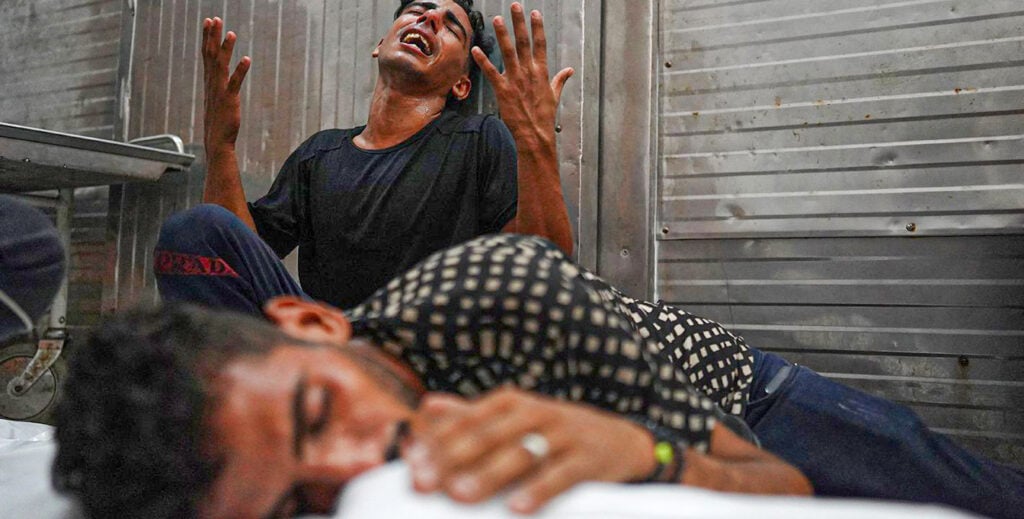
Source: Getty Images

Michael Young*

August 20, 2024

On August 5, Israel’s Finance Minister Bezalel Smotrich declared that starving 2 million Palestinians in Gaza “to death” might be the “right and moral” thing to do until Israeli hostages held in Gaza are released, but that the “world won’t let us.”

It took several days for countries to react to Smotrich’s effort to transform a genocidal impulse into a morally justified action. The U.S. State Department spokesman said his government was “appalled by these comments and reiterate[s] that this rhetoric is harmful and disturbing.” Under the circumstances, the rebuke was rather tame. Calling for the mass starvation of an entire civilian population should qualify as more than just “harmful and disturbing.”

But perhaps the State Department was unwilling to go too far in condemning a senior minister in the government of a man, Benjamin Netanyahu, who was recently given over 50 standing ovations by members of Congress. Ironically, one of those who came across as more sensible in his reaction to Smotrich’s depraved remarks was Hezbollah’s secretary general, Hassan Nasrallah, who, in a speech shortly before condemnation of Smotrich was ramped up in the West, expressed surprise that no one had yet taken Smotrich to task. 

Initially published in Diwan, Carnegie Middle East Center on August 14, 2024.

At the heart of the Gaza conflict is the matter of Israel’s morality. For those who support Israel, there is no question the country is morally superior to its enemies. This has been one reason why Western elites have continued to look the other way on Israel’s horrific campaign in Gaza, even as its impact has been visible for months thanks to Arab satellite television channels and social media outlets that governments have been unable to control. The pollyannaish bias was set early on by German Chancellor Olaf Scholz, who stated in October 2023 that “Israel is a democratic state guided by very humanitarian principles, so we can be certain that the Israeli army will respect the rules that arise from international law in everything it does.” 

Scholz would come to regret his words as reports mounted almost immediately of Israel’s efforts to engage in the ethnic cleansing of the Palestinian population in Gaza; as its forces destroyed hospitals, schools, homes, and infrastructure; as it withheld food and medicine to the Palestinians under siege; as it allowed multiple diseases to spread, including scabies and polio; and, more generally, as it shamelessly and indiscriminately engaged in mass murder.    

Yet this did not prevent members of the U.S. Congress from applauding and guffawing when Netanyahu came before them and denounced fellow American citizens as “useful idiots” of Iran because they were engaging in their constitutional right to protest Israeli actions. Not one of those who celebrated his words—at least none that I’ve seen—rebuked Smotrich for his yearning that Israel starve all Palestinians in Gaza to free its hostages.

The issue of morality is important for two main reasons. First, it allows the United States to justify its continued supply of weapons to Israel, which have been used in most if not all of Israel’s multiple massacres in Gaza, most recently that at the Tabaain school in Gaza City, in which over 100 people were killed, many of them children. The Israelis, as is their habit, claimed that Hamas members were operating from the school, which Hamas denied. When the Israeli military posted photographs of the alleged Hamas militants killed, a Palestinian professor involved in human rights work, who knew several of the men, published a post on X denying any such affiliation.

The second reason is that for as long as Israel is perceived as a moral actor in the West, when everyone can plainly see the contrary, the rift will grow between Western countries and those around the world who will sense that a double standard is being applied. And this may have major geopolitical repercussions, as many of these states, especially in the Global South, will see no compelling reason to accept Western narratives about the need to defend democracy and human rights. Already, we have seen such rejection over Ukraine, and Gaza has carried the displeasure with U.S. hypocrisy further, a situation that China has exploited very skilfully.

This attitude toward Israeli morality is tied to a mainly Western perception that Israel was founded by the victims of what is perhaps the greatest crime in history, the Holocaust, or Shoah. Someone who touched on this in a superb essay last March in the London Review of Books is the Indian author Pankaj Mishra. Mishra traces how the Israeli establishment over time came “to produce and disseminate a very particular version of the Shoah that could be used to legitimise a militant and expansionist Zionism. Yet it’s the Shoah that has also fed a belief among many supporters of Israel that the country is somehow immune from moral reckoning. Mishra quotes the Israeli columnist Boaz Evron, who described how the “tactic of conflating Palestinians with Nazis and shouting that another Shoah is imminent” was “liberating ordinary Israelis from ‘any moral restrictions, since one who is in danger of annihilation sees himself exempted from any moral considerations which might restrict his efforts to save himself.’”

The observation should not detract from the fact that there is an increasing number of Jews, many of them demonstrating alongside Netanyahu’s “useful idiots,” for whom the essence of their religion is to retain a moral compass in the midst of battle.

Mishra’s conclusion is a powerful one: By engaging in vast crimes in Gaza, “Israel today is dynamiting the edifice of global norms built after 1945.” That is why “[t]he profound rupture we feel today between the past and the present is a rupture in the moral history of the world since the ground zero of 1945—the history in which the Shoah has been for many years the central event and universal reference.” In light of this, “it seems that only those jolted into consciousness by the calamity of Gaza can rescue the Shoah from Netanyahu, [President Joe] Biden, Scholz and [former British prime minister Rishi] Sunak and re-universalise its moral significance.”

Mishra’s views have dawned on many people in the world, but have apparently not penetrated the formidable mental fortress of the United States’ political establishment and its appendages. American politicians who marinate in the language of moral righteousness have ignored, consciously or not, the direction in which Netanyahu is taking Israel and the United States, as he pursues Israel’s destruction of Gaza, undermines a ceasefire agreement, and seeks to widen the war by provoking an armed confrontation between America and Iran—a fantasy Israel’s friends in Washington have enthusiastically relayed to the general public. If this is not aiding and abetting a militant and expansionist form of Zionism, then what is?

More generally, what is the moral worth of an Israeli political establishment, apparently supported by a majority in society, that believes that Israel can indefinitely control millions of Palestinians under illegal occupation, deny them self-determination, keep them economically backward, prevent them from enjoying the most basic rights, and expel them frequently from their villages so that Jewish extremists can steal their property? Is this a defensible plan? Does it in any way entitle Israel to portray itself as a moral paragon?

Mishra is right that as this outrage continues, the tragic value of the Shoah, its universal reference, will dissipate. The past suffering of the Jews will be overwhelmed by memories of Israel’s immorality today, much as Israel’s carnage in Gaza has made many forget October 7. But beyond that, Western elites should be aware of how this affects their own power and influence. If they are serious about defending liberal values in a changing world, Israel cannot be exempted.

The author

Michael Young is a senior editor at the Malcolm H. Kerr Carnegie Middle East Center in Beirut and editor of Diwan, Carnegie’s Middle East blog. More about him and the Center here.

Related Posts

Jan Oberg, TFF director April 28, 2026 In this third TFF Peace Pulse, I make the important distinction between the violence and the conflict that violence is a symptom of. If you want peace, focus on the underlying conflict because that is the key to resolution, peacemaking, and a better future for the parties. The West is obsessed with violence, just look around you – and 90+ per cent of the public debate is about military issues and other violence – totally wasted for peace. These Peace Pulses will only be published here a few times. You will also not find them on YouTube and Vimeo because both platforms have blocked TFF and me; you know, peace is dangerous these days. Most TFF’s videos since 2007 are now on Rumble.
In contrast to most, we’ll bring alternatives, solutions, hope and strategies for a better future. Times are dangerous, yes, but that only intensifies the need for constructive thinking and action! Jan Oberg, TFF director April 13, 2026 The new TFF Peace Pulse uses video messages in a new way: Max 3-5-minute-long comments, ideas or perhaps mini-lectures, all about peace – positive peace. We launch them today on April 13, 2026 with a carefully crafted visual aesthetic fitting the content. We hope to publish them regularly from now on. We launch Peace Pulse (PP) – for a number of reasons. The world is in chaos, and there are countless reasons to feel concerned, frustrated, even angry. The atmosphere is saturated with doom and gloom, with negative energy and rear‑mirror thinking, while vision, imagination, alternatives, strategies and genuine future‑mindedness remain in short supply. And without them, we simply can’t save the world. Looking at problems from a hundred angles will...
Jan Oberg, TFF director April 9, 2026 I was recently invited to have a good, long talk about the world – and, of course, about peace too – with Boris Malagurski on his Weight of Chains Channel on YouTube. It was a real joy and seems to have been greatly appreciated by the viewers too. Mr Malagurski and I shall of course be grateful if you share this conversation in your circles – of course, only if you like what you see and hear 😉☮️ And remember that this one – like hundreds of others with TFF Associates – can be enjoyed at our TFF Video Collection.

Recent Articles

Tony Robinson October 4, 2026 Violence is easy to recognise when someone is being beaten, shot or killed. It becomes more difficult when nobody is holding a weapon. Poverty, discrimination, exploitation and repression can restrict a human life just as effectively, although they do so in very different ways and with very different consequences. Simply adding more categories to an ever-growing list of forms of violence does not really solve the problem. The more interesting question is what all these different situations have in common and why it makes sense to describe them using the same word. Human beings do not simply react to what happens around them. They remember the past, imagine things that do not yet exist, make plans and undertake projects. Workers organise because they imagine different working conditions; people migrate because they imagine another life somewhere else; social movements emerge because people refuse to accept the...
It’s a matter of principles, courage, vision and pulling together – while the militarist world is falling apart… Peter Langille October 3, 2026 “Here, then, is the problem which we present to you, stark and dreadful and inescapable: Shall we put an end to the human race; or shall mankind renounce war?”The Bertrand Russell—Albert Einstein Manifesto, July 9, 1955 ⁕ The forecast for what’s ahead is worrisome. The sharp rise in armed conflicts over the past three years is adding to what was already the highest level in over seventy years. Genocides, which should be prevented are supported. A shared climate emergency that jeopardises survival is ignored. Diverse polls now suggest that people are war-weary, worried and interested in a more effective United Nations. And, there are viable policy options for a more secure world! Yet governments are doubling-down, betting on more war and investing heavily. If current trends persist,...
Johan Galtung 1930-2024October 2015 Published here on October 3, 2026 Let us focus on Civilization for conflict analysis and remedies. Major forms of disorder use violence; war is state organized violence. The most belligerent states are the United States of America and Israel, both with civilization roots. National Evangelism, the US Protestant Christian civilization– more national than evangelical–justifies US warfare as exceptionalism of a people chosen by God, with a manifest destiny to run the world. Orthodox Judaism justifies Israeli warfare to conquer and expand from Nile to Euphrates as a religious right and duty to the Eternal One. The third most belligerent country, the UK, no longer believes it is God-chosen but chosen by the USA; not quite the same but something. But the root cause of global disorder lies in the Occident–with Islam–seeing itself as the single, universal civilization valid for all at all times, all others being...

TFF on Substack

Discover and subscribe to more peace materials on TFF Substack

Most Popular

Tony Robinson October 4, 2026 Violence is easy to recognise when someone is being beaten, shot or killed. It becomes more difficult when nobody is holding a weapon. Poverty, discrimination, exploitation and repression can restrict a human life just as effectively, although they do so in very different ways and with very different consequences. Simply adding more categories to an ever-growing list of forms of violence does not really solve the problem. The more interesting question is what all these different situations have in common and why it makes sense to describe them using the same word. Human beings do not simply react to what happens around them. They remember the past, imagine things that do not yet exist, make plans and undertake projects. Workers organise because they imagine different working conditions; people migrate because they imagine another life somewhere else; social movements emerge because people refuse to accept the...
It’s a matter of principles, courage, vision and pulling together – while the militarist world is falling apart… Peter Langille October 3, 2026 “Here, then, is the problem which we present to you, stark and dreadful and inescapable: Shall we put an end to the human race; or shall mankind renounce war?”The Bertrand Russell—Albert Einstein Manifesto, July 9, 1955 ⁕ The forecast for what’s ahead is worrisome. The sharp rise in armed conflicts over the past three years is adding to what was already the highest level in over seventy years. Genocides, which should be prevented are supported. A shared climate emergency that jeopardises survival is ignored. Diverse polls now suggest that people are war-weary, worried and interested in a more effective United Nations. And, there are viable policy options for a more secure world! Yet governments are doubling-down, betting on more war and investing heavily. If current trends persist,...
Johan Galtung 1930-2024October 2015 Published here on October 3, 2026 Let us focus on Civilization for conflict analysis and remedies. Major forms of disorder use violence; war is state organized violence. The most belligerent states are the United States of America and Israel, both with civilization roots. National Evangelism, the US Protestant Christian civilization– more national than evangelical–justifies US warfare as exceptionalism of a people chosen by God, with a manifest destiny to run the world. Orthodox Judaism justifies Israeli warfare to conquer and expand from Nile to Euphrates as a religious right and duty to the Eternal One. The third most belligerent country, the UK, no longer believes it is God-chosen but chosen by the USA; not quite the same but something. But the root cause of global disorder lies in the Occident–with Islam–seeing itself as the single, universal civilization valid for all at all times, all others being...
Read More
Living-Peace-Sign-Budapest-copy
Tony Robinson October 4, 2026 Violence is easy to recognise when someone is being beaten, shot or killed. It becomes more difficult when nobody is holding a weapon. Poverty, discrimination, exploitation and repression can restrict a human life just as effectively, although they do so in very different ways and with very different consequences. Simply adding more categories to an ever-growing list of forms of violence does not really solve the problem. The more interesting question is what all these different situations have in common and why it makes sense to describe them using the same word. Human beings do not simply react to what happens around them. They remember the past, imagine things that do not yet exist, make plans and undertake projects. Workers organise because they imagine different working conditions; people migrate because they imagine another life somewhere else; social movements emerge because people refuse to accept the...
b54a1f10-8c65-4f0b-9dd5-4abc0a7d04cc_2659x2659
It’s a matter of principles, courage, vision and pulling together – while the militarist world is falling apart… Peter Langille October 3, 2026 “Here, then, is the problem which we present to you, stark and dreadful and inescapable: Shall we put an end to the human race; or shall mankind renounce war?”The Bertrand Russell—Albert Einstein Manifesto, July 9, 1955 ⁕ The forecast for what’s ahead is worrisome. The sharp rise in armed conflicts over the past three years is adding to what was already the highest level in over seventy years. Genocides, which should be prevented are supported. A shared climate emergency that jeopardises survival is ignored. Diverse polls now suggest that people are war-weary, worried and interested in a more effective United Nations. And, there are viable policy options for a more secure world! Yet governments are doubling-down, betting on more war and investing heavily. If current trends persist,...
010
Johan Galtung 1930-2024October 2015 Published here on October 3, 2026 Let us focus on Civilization for conflict analysis and remedies. Major forms of disorder use violence; war is state organized violence. The most belligerent states are the United States of America and Israel, both with civilization roots. National Evangelism, the US Protestant Christian civilization– more national than evangelical–justifies US warfare as exceptionalism of a people chosen by God, with a manifest destiny to run the world. Orthodox Judaism justifies Israeli warfare to conquer and expand from Nile to Euphrates as a religious right and duty to the Eternal One. The third most belligerent country, the UK, no longer believes it is God-chosen but chosen by the USA; not quite the same but something. But the root cause of global disorder lies in the Occident–with Islam–seeing itself as the single, universal civilization valid for all at all times, all others being...
Screenshot 2026-10-02 011738
Jan ObergPhD, director, The Transnational Foundation for Peace and Future Research, TFFLund, Sweden October 2, 2026 This is my full original manuscript. The Chinese Academy of Social Science, CASS, makes two publications out if it. 1. China’s Five-year plan emphasized the capabilities of basic research and original innovation. It is regarded as the goal of the future social development, which, as required, should be significantly enhanced. Can you comment on the importance of original innovation in research and academic study? I believe it is easier to define “original innovation” in the natural sciences than in social sciences. The breaking points of what constitutes something new, or innovative, are not quite as sharp in the latter. But in both fields it is about opening up something that was closed, unseen, unexplored before – making manifest what was earlier latent. Innovations come in many forms and shapes – naming something that was not...
arctic-circle-map
The agreement is catastrophic both because of what it says and what it doesn’t mention. It reduces further the major asset of security policies: Freedom of action. Jan Oberg TFF director September 25, 2026 A couple of hours before the agreement was signed on September 22, 2026, I published the following 13 hypotheses about what it would most likely contain on TFF Substack (in English). I was wrong on only the first point. Contrary to what Trump had written on his Truth Social platform, it does not appear to come into force immediately. In fact, it turned out to be worse than even I had anticipated. After these hypotheses now come a number of reflections in light of what the agreement actually contains, and does not contain, as well as the way in which it has generally been presented by major media outlets and by the public-service broadcaster DR. My...
girl-5894831_1280
Below are TFF-related media mentions, comments, videos and social media posts published elsewhere but not on this homepage. We happen to catch and list only a fraction. Regarding video comments and debates, we recommend that you go to the TFF Video Channel on Substack where many of them are reproduced. Jan Oberg is a contributor to China Daily – 52 million daily clicks – and Global Times, CGTN and CCTV (the national television), China Investment, Xinhua News Agency and several others. Articles and videos on these media very often multiply into countless Chinese (and Western media) that re-post them from these main media. Thanks to The China Academy, his analyses, interviews and comments are frequently posted on YouTube channels such as Thinkers Forum and Wave Media. These videos are often re-posted on Bilibili (China’s YouTube), the China Content Center on TikTok, and on the Chinese edition of TikTok, Douyin.com. This means reaching hundreds of millions of viewers worldwide over a year. While there are too many to catch on all these...