
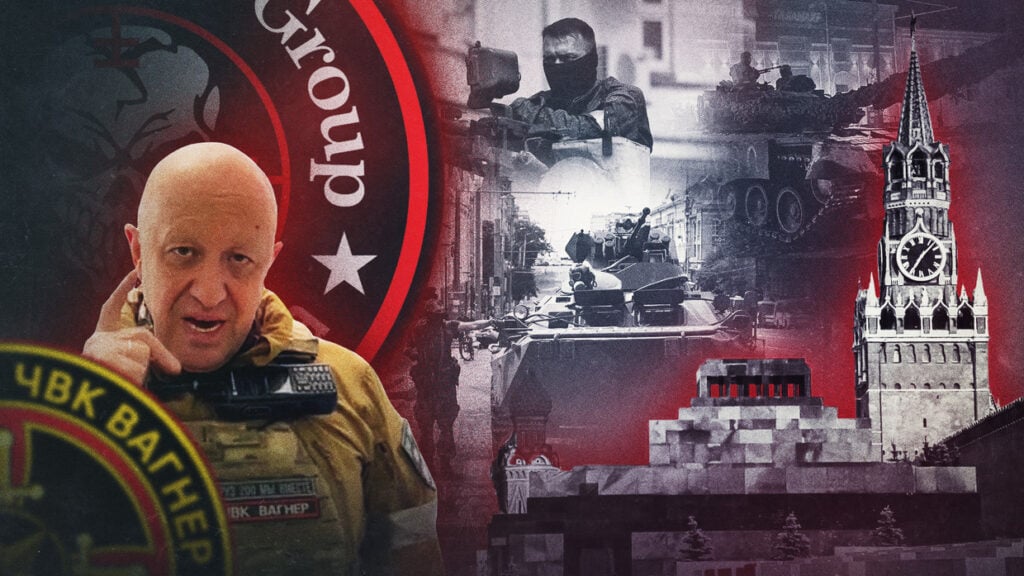
From Kaliningrad to Vladivostok, and farther afield, all eyes were on what looked like a march to Moscow. Was it a one-off or an ominous portent?
Christina Sizova for RT
June 27, 2023
Editor’s introduction
Normally, we do not publish articles from dailies about current events. However, we make an exception because this particular event is significant in and of itself and also for an understanding of the NATO-Russia conflict that plays out so tragically in Ukraine.
Furthermore, unless people in the West use a proxy server/VPN, they cannot access RT (formerly Russia Today)and see for themselves how this Russian flagship media covers the war and international affairs. The purpose, of course, is part of the media war – that NATO citizens are told not what Russia actually says but how so-called experts in the NATO countries interpret things – carefully selected anti-Russian and pro-NATO.
Thus, they are grossly deceived by continuous media propaganda that there are no critical perspectives in Russian media since they are all mouthpieces of President Putin. Here you’ll see how a series of Russian experts freely deliver a harsh criticism of the fact that this could all happen and of the war the war has been conducted. Finally, this text enables you to easily see the differences between the general Western media coverage of this event and that of informed Russian experts.
This article was originally published by RT on June 26, 2023, here.
Jan Oberg
The Russian Wagner private military company (PMC) – which became known around the world after it captured the Donbass town of Soledar at the beginning of the year and then helped win the long, difficult battle of Artemovsk (Bakhmut) – attempted a mutiny on the night of June 24 following a disagreement with the country’s military leadership. The events were preceded by a statement from the outfit’s founder Yevgeny Prigozhin who claimed that Russia’s Ministry of Defense had attacked a Wagner camp. Officials denied these allegations and called them “misinformation.”
On Saturday morning, Prigozhin announced that Wagner fighters had blocked the city of Rostov-on-Don [home to over 1.1 million people] and seized control of its military facilities. According to Prigozhin, he was on his way to Moscow to “get a hold of” Defense Minister Sergei Shoigu and the Chief of the General Staff Valery Gerasimov. A criminal case was opened against Prigozhin on a charge of organizing an armed rebellion. President Vladimir Putin made an emergency address to the nation, promising to do everything to prevent a repeat of the events of 1917 and preserve the Russian state.
Wagner’s so-called “march of justice” lasted somewhat less than 24 hours from the moment it was announced by Prigozhin. The column of PMC Wagner fighters finally stopped 200 km (about 125 miles) away from Moscow. The press service of the President Alexander Lukashenko of Belarus reported that he had held talks with Prigozhin throughout the day and eventually convinced him to turn the Wagner column around and get his fighters back to their field camps. Based on the agreements, the criminal case against the Wagner founder was to be discontinued and the participants of the attempted coup would not be prosecuted “taking into account their efforts on the frontlines.” Meanwhile, Russia – and the rest of the world – was thrown into confusion trying to understand what exactly was happening.
Wake-up call or a bad omen?
Dmitry Trenin, a research professor at the Higher School of Economics and a lead research fellow at the Institute of World Economy and International Relations:
The Prigozhin mutiny was an extraordinary event. Military coups and revolts are rare in modern Russian history (General Kornilov’s attempt to stop the country from slipping into chaos in August 1917 is what most often comes to mind), but Prigozhin’s was different even from those. June 23-24 saw a revolt not by an army unit or a royal guard, but by a well-armed private military company that has no legal status in the country and has been operating on some opaque and private understanding.
While the conflict between Prigozhin and the Defense Ministry had been evolving for some time for everyone to see, the mutiny itself, curiously, appeared to have surprised the Kremlin, the MOD, and the security services. Prigozhin’s move into Rostov-on-Don and his march towards Moscow were neither prevented nor opposed.
Yevgeny Prigozhin (C) speaking with Lieutenant General Vladimir Alekseev (R) and Russian Defense Deputy Minister Yunus-Bek Evkurov (L) inside the headquarters of the Russian southern military district in the city of Rostov-on-Don. © Handout / TELEGRAM / @razgruzka_vagnera / AFP
The mutiny could not have come at a more difficult moment for Russia, exposing its internal divisions and giving plenty of opportunities for the enemy to exploit. The bloodshed to which the mutiny was headed could have thrown the country into chaos. The agreement to end the rebellion, when it came on Saturday night, looked like a miracle, and probably was one.
Little is known publicly at this stage about the conditions that made it possible to avert disaster. This is not the place to speculate on them, It makes much more sense to focus on the lessons to be learned from what has just happened.
One is that independently-run military organizations, particularly in a country like Russia, represent a clear potential threat to political stability. The state’s monopoly on armed force and the use of violence ought not to be diluted even one iota.
The second is that playing games with semi-independent actors that are partially controlled (think Frankenstein) carries the risk of things suddenly getting out of hand at a most inopportune moment. For all the glaring differences between them, Prigozhin’s case reminds one of that of Alexey Navalny, a few years back.
Thirdly, and most importantly, whereas the Prigozhin mutiny cannot be justified in any way, the issues which fueled it are real and serious. So, this needs to be treated as a wake-up call and the underlying problems must be acted upon. Otherwise, the Wagner revolt may be a bad omen of things to come.
The time for military action is limited
Vladimir Bruter, expert at the International Institute of Humanitarian and Political Studies
I don’t believe that, inside Russia, the consequences will be significant. Generally speaking, the incident has been settled. But in the international sense, this situation has demonstrated to the world that there are deep contradictions both within the Russian leadership and among those who are responsible for the ongoing military operation. This is undoubtedly how the collective West will see it. And the situation will be exploited. However, the question is not what they are going to do, but rather what we are going to do about it. It’s not about them, it’s about us. We should force our agenda on them instead of waiting to see what they offer us.
I don’t think we can count on the Wagner Group anymore, even though they have performed quite an important role. All internal conflicts benefit the enemy, but yesterday’s conflict ended very quickly and didn’t spread to law enforcement agencies. Moreover, I suspect that these agencies have become more united, since they now consider Prigozhin as a pariah.
Members of the Wagner Group private military company leave the area of the Southern Military District headquarters and the nearby territory in Rostov-on-Don, Russia. © Sputnik / Sergey Pivovarov
The biggest question now is whether Russia’s military leadership can implement a single consistent plan to achieve the goals of the military operation. The key lesson of this conflict is that we can’t say that Russia has unlimited time for military action. Objectively speaking, the situation at the front looks frozen.
Saying that we are going to wait and the enemy will eventually get tired and then we’ll win is too optimistic. The past year and a half has shown us that this doesn’t work. Moreover, there’s no indication that the Ukrainians are growing tired. Yes, they’re suffering great losses, which even forced the US State Department to issue an official statement, saying that an offensive always comes with casualties. But for Washington, the Ukrainians are not a drag. And the loss of military equipment is only a financial hit, which they can print dollars to replace when they ship new equipment to Ukraine.
‘Staggering’: How Western media responded to Wagner’s coup attempt
The events were synced with Ukraine
Alexander Khramchikhin, Deputy Director of the Institute for Political and Military Analysis:
Given that the mutiny is already over, we can say that it is unlikely to affect either the situation inside Russia or the country’s status in the world. The same applies to the situation at the front, and the power of the army and its morale. However, at the very least, these events have shown that it is time to pass a law on the status of private military companies.
Based on how this story ended, it is difficult to say who benefited from it. But I suspect that what happened was synchronized with Ukraine. And if things had gone differently, Kiev would have definitely profited. Of course, over there, they expected everything inside Russia to collapse, so then they could achieve their goals.
It wasn’t Lukashenko who saved Russia
Andrey Suzdaltsev, Political expert, Associate Professor of the Faculty of World Economy and World Politics of the Higher School of Economics:
These events are a blow to Russia’s image. The world will discuss them and our enemies will say that our country and itsstate structures is unstable. Yes, there is a war going on, and such things can happen –and similar scandals can occur – in many armies. But this is a conflict between a state military structure – the army – and a private military company. The two can’t work together. This should have been evident beforehand. Therefore, this situation clearly did not work in our favor. In the course of combat, there are always sides that are discontent and offended. In such cases, we have to rely on counterintelligence and other structures that solve these issues.
For the army, this is a serious problem. This situation has affected the morale of soldiers on the frontlines, because it’s a question of trust. When you are fighting and you feel like you’re being betrayed – moreover, betrayed by those with whom you shared the same battlefield – it is a major issue.
Russian Defense Minister Sergei Shoigu and Chief of the General Staff of the Armed Forces of the Russian Federation, First Deputy Defense Minister Valery Gerasimov. © Sputnik / Michael Metzel
Internally, the situation can’t be seen as positive. The government and the state apparatus have survived the blow, but some have been unable to cope with the tension. Fortunately, a large-scale betrayal didn’t happen, our country passed the test. But the rebellion demonstrated that our society is divided. Moreover, it’s not that the military campaign is splitting our society, but the manner in which it is being carried out. I believe that everyone will draw their own conclusions from this situation.
Many sides have profited from these events. In Moscow, there are some people who strongly oppose our government. They are ready to accept any government, whether it would be led by Prigozhin or even the Ukrainians. So of course, they were supportive of Prigozhin. However, I don’t believe we’re talking about any sort of conspiracy. The West was also counting on Prigozhin. Meanwhile, people in Kiev were hysterically joyful, they believed that Putin would be overthrown and that would be the end of it all. But the Ukrainians always get emotional when Russia faces any kind of problems. It was like that even before the start of hostilities. When working with Ukrainian sources, I was always astonished by their incredible, irrational hatred towards us.
As for Lukashenko’s efforts in resolving this issue, our leadership carefully hinted that he did not play the key role, even though it was made to look like that was the case. Of course, everyone is grateful that he acted as an intermediary, because there was a problem establishing contact with Prigozhin. He picked up the phone call from Lukashenko, but all the other negotiations were conducted by generals and the people who are authorized by the Russian government and the President of Russia. Lukashenko has taken the plaudits, and this is not the first time he’s done so. Now, news is spreading about how he saved Russia. Of course, this is not even close to the truth of what really happened.
The situation demands a legislative response
Sergey Oznobishchev, Director of the Institute for Strategic Assessments
The withdrawal of the Wagner Group from the frontlines has significantly weakened the Russian military. Even though they are now returning to their camps, it is quite obvious that the army’s positions have already been weakened. Just imagine what happens when so many fighters with weapons and equipment leave the front.
There is no rational explanation for these events. Even if you try to stand in Prigozhin’s shoes, it is impossible to explain why it all happened and why it ended like it did. It is unclear why Wagner marched towards Rostov-on-Don, Voronezh, and Moscow. I believe that even in many years, we may not find out who profited from this situation. Even those who participated in the events may interpret them differently.
Russian Putin delivers a televised address to the nation after Yevgeny Prigozhin, the owner of the Wagner Group military company, called for armed rebellion and reached the southern city of Rostov-on-Don with his troops, in Moscow, Russia. © Sputnik / Pavel Bednyakov
The fact that we have survived this test should calm the world down. It is important that the situation was quickly halted, which is definitely to the credit of our authorities.
However, from a legal point of view, it doesn’t look quite right that the criminal case against Prigozhin was initiated and terminated within less than 24 hours. This raises certain questions. Therefore, it is important to provide a lawful response to these actions. In matters of negative conduct against the authorities, our legislation operates quickly – within one day, a bill may be passed in all three readings. I believe that the State Duma will soon adopt measures in response to these events.
The rebels did not receive mass support
Sergey Poletaev, co-founder and editor of the Vatfor project:
Apparently, the situation with Prigozhin spun out of control and the authorities were aware of it for a long time. For this reason, the Wagner Group was silently moved away from the frontlines somewhat earlier. If the rebel column had marched out directly from the front (and not from their camps in the rear), the problems would have been a lot more severe.
The authorities tried to internally resolve the conflict and offered Wagner a deal with the Ministry of Defense. But, as we’ve seen, the stand-off could not be dealt with quietly.
The rebels’ march on Moscow could have ended in success only in one scenario – if a “fifth column” had met them in the capital and sabotaged the efforts of the resistance. Either things didn’t work out with this fifth column or it didn’t exist, so the rebels hoped to organize a public uprising, which didn’t happen either. One way or another, we managed to escape the worst.
Lukashenko’s mediation shouldn’t be laughed at. Most likely, he made the options clear to Prigozhin: either you die in disgrace, accompanied by the triumphant posts of [disgraced 1990s oligarch Mikhail] Khodorkovsky and the Ukrainian authorities, or you, and your people, get a second chance. It’s good that everything happened behind closed doors.
There’s still a lot of work ahead, but the state survived a major threat. That is the most important thing.
By Christina Sizova, a Moscow-based reporter focused on politics, sociology and international relations





