
Japan soft-selling its remilitarization to the world

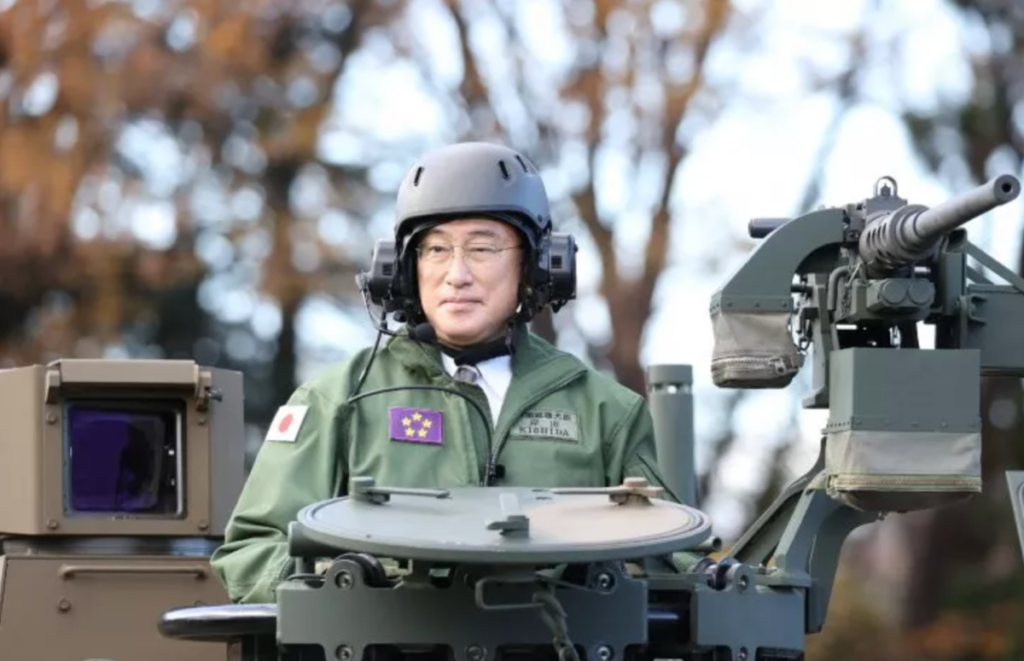
Japanese Prime Minister Fumio Kishida rides on a Japan Ground Self-Defense Force Type 10 tank during a review
at JGSDF Camp Asaka in Tokyo on November 27, 2021. Photo: JiJi

Richard Javad Heydarian

February 5th, 2023

Prime Minister Kishida goes on a diplomatic offensive in the West as Tokyo cranks up defense spending to counter China

Originally posted on Asia Time on January 23, 2023 here

MANILA – Japanese Prime Minister Fumio Kishida kicked off the new year with a series of high-profile visits across key Western allied nations, including the United States.

In Washington, he held “very productive” talks with US President Joe Biden on strengthening bilateral cooperation in critical industries, particularly semiconductors, as the West contemplates decoupling from its decades-long dependence on China. 

Earlier, the Japanese leader also met counterparts in Europe where he signed new defense agreements to augment military interoperability and joint exercises in the Indo-Pacific. Together with the United Kingdom and Italy, Japan hopes to produce next-generation fighter jets under the Global Combat Air Program (GCAP).

Kishida’s diplomatic offensive comes amid a historic defense build-up at home, with Japan aiming to double its defense spending as a share of its gross domestic product (GDP), the third largest in the world, over the next five years.

By allocating a whopping US$315 billion (43 trillion yen), Japan aims to modernize its defense capabilities and close its military gap with rival powers.

Notwithstanding international concerns over Japan’s potential return to militarism, the country’s new defense posture, best encapsulated by its new National Security Strategy (NSS), enjoys significant public support at home, according to recent surveys.

During a speech at the Johns Hopkins School of Advanced International Studies (SAIS) in Washington this month, the Japanese leader called for a united stance vis-à-vis Beijing, arguing “[i]n managing relations with China, it is absolutely necessary for Japan, the US and Europe to work together as one.”

The Kishida administration’s latest moves suggest that Japan is seeking to both enhance cooperation with Western allies faced with a rising China as well as strengthen its own defensive capabilities as an increasingly autonomous power in the Indo-Pacific. 

Over the past two decades, various Japanese leaders, most prominently the late prime minister Shinzo Abe, made a concerted effort to revisit the country’s post-war pacifist constitution.
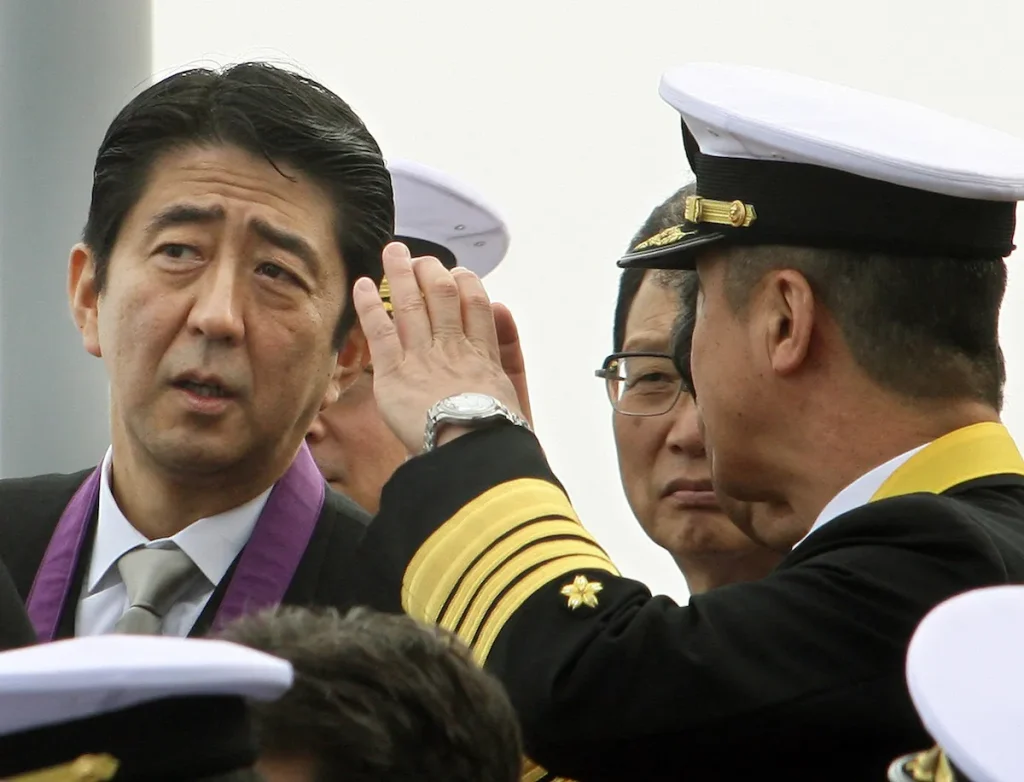
Then-prime minister Shinzo Abe (L) chats with an officer of the Maritime Self Defense Force during a fleet review at Sagami Bay off Kanagawa Prefecture in 2006. Photo: AFP / Kazuhiro Nogi

Perturbed by China’s growing military capabilities and rising assertiveness in adjacent waters, including close to the Japanese-administered Senkaku islands, Abe, Japan’s longest-serving post-war leader, systematically relaxed constitutional and political restrictions on the country’s ability to project power beyond its immediate borders.

Under the vaguely-defined doctrine of “collective self-defense”, the Abe administration reinterpreted Article 9, or the “peace clause”, of Japan’s Constitution in order to enable Japanese Self-Defense Forces (SDF) to join US military operations overseas in the event of a major contingency.

The former Japanese leader also oversaw a significant increase in the country’s defense spending as part of broader efforts to enhance the SDF’s ability to engage in modern warfare. Soon, Japan also deployed, for the first time since the end of World War II, armored vehicles to overseas military drills between US and regional allies.

Under Abe’s watch, Japan also engaged in unprecedented efforts to share defense technology and collaborate on the development of new weapons systems in tandem with like-minded powers such as India.

Japan also expanded its maritime security aid, thus paving the way for deepened institutionalized defense dialogue with key Southeast Asian countries such as the Philippines, Indonesia and Vietnam, which have been at the forefront of resisting China’s expanding maritime footprint across the South China Sea basin.

Nevertheless, Abe always fell short of fully revising the country’s pacifist constitution, a task that has been passed onto his proteges, including Kishida, whose ruling coalition now enjoys a significant majority in the Japanese legislature.

Although intra-coalition disagreements have hobbled a concerted push to overhaul the country’s post-war constitution, public support for such a move has been steadily on the rise in recent years amid growing fears about China and its rising assertiveness.

Against a seismic shift in the country’s domestic politics and public attitudes, Japan released a landmark  NSS document last month, which warned of the “most severe and complex security environment since the end of World War II” due to efforts of revisionist powers “seeking to unilaterally change the status quo by force.”

“China has intensified coercive military activities around Taiwan, and concerns about peace and stability in the Taiwan Strait are rapidly increasing not only in the Indo-Pacific region, including in Japan, but also with the entire international community,” the NSS says.

Although Japan’s ruling Liberal Democratic Party pushed for labeling China as a “threat” in the NSS, the eventual document, in a nod to the more pacifist members of the ruling coalition (i.e. Komeito), instead settled for less confrontational language that characterized the Asian powerhouse as “the greatest strategic challenge that Japan has ever faced.”
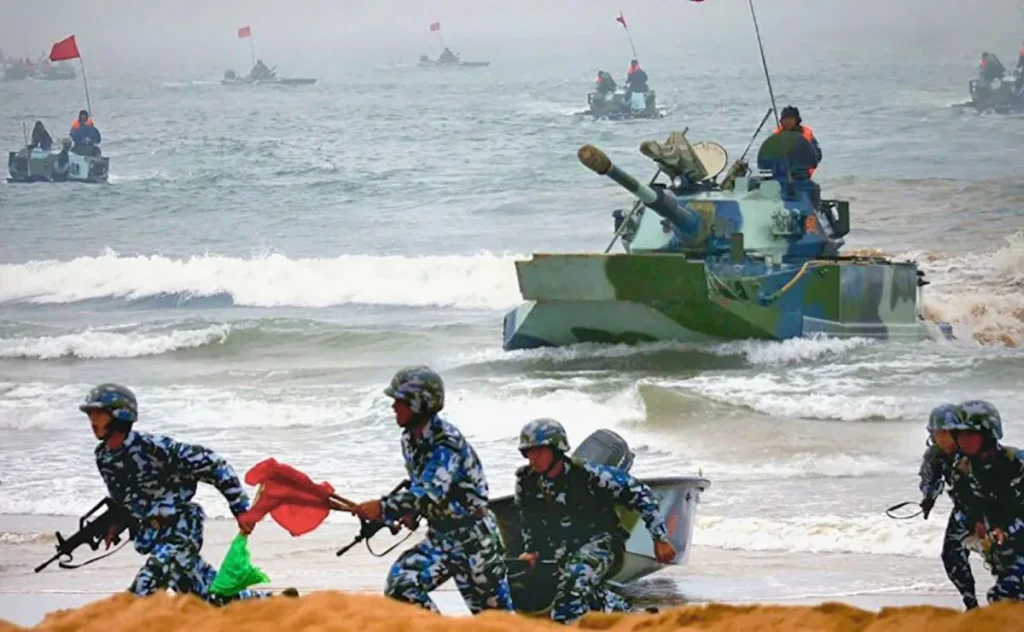
A simulated Chinese invasion of Taiwan. Japan would be quickly dragged into a conflict between the US and China over the nearby self-governing island. Image: Facebook

A notable element of the NSS is the emphasis on the need for Japan to develop a “counter-strike capability”, namely allowing the SDF to target bases and command-and-control centers of enemy states in the event of a contingency.

Accordingly, Japan is expected to augment its network of missile defense systems, especially Type-12 standoff missiles coupled with US-made Tomahawk cruise missiles with a range of about 1,600 kilometers, over the next half a decade.

Describing China’s and North Korea’s growing military capabilities as “a real threat,” the NSS maintains that its “counter-strike capability” is a purely deterrent measure that will only be applied “in light of individual and specific circumstances” and that “there is no change in the fact that pre-emptive strikes … are not permitted” per the country’s pacifist constitution.

In particular, the Japanese government maintains that developing new military capabilities will have to strictly meet three preconditions, namely (i) that an armed attack has occurred or is imminent, (ii) that there is no other way to halt an attack, and that (iii) the use of force is limited to the minimum necessary.

At a press conference shortly after the new NSS’ approval, Kishida warned that the region is “at a historical crossroads” and that his country’s “new security policy is a major shift from the postwar security policy.”

Nevertheless, the Japanese leader maintained that the country’s defensive buildup and new strategic orientation is “within the scope of the Constitution” and that “Japan’s path as a peaceful nation will remain unchanged.”

Given Japan’s World War II atrocities in the region, its recent military build-up, with defense spending increasing by a whopping 20% this year, is bound to face criticism overseas, especially in neighboring South Korea and China. Kishida was thus intent on securing, support from major allies across the world during his five-country trip.

His tour of fellow Group of Seven (G7) countries this month saw Kishida meeting and discussing ways to enhance bilateral defense cooperation with French President Emmanuel Macron, Italian prime minister Giorgia Meloni, and UK Prime Minister Rishi Sunak.

In the UK, Kishida secured a new Reciprocal Access Agreement (RCA), which would further enhance military interoperability between the two nations. Along with Italy, the two countries are also working on a sixth-generation fighter jet, which will enhance their combat capabilities in the succeeding decades.
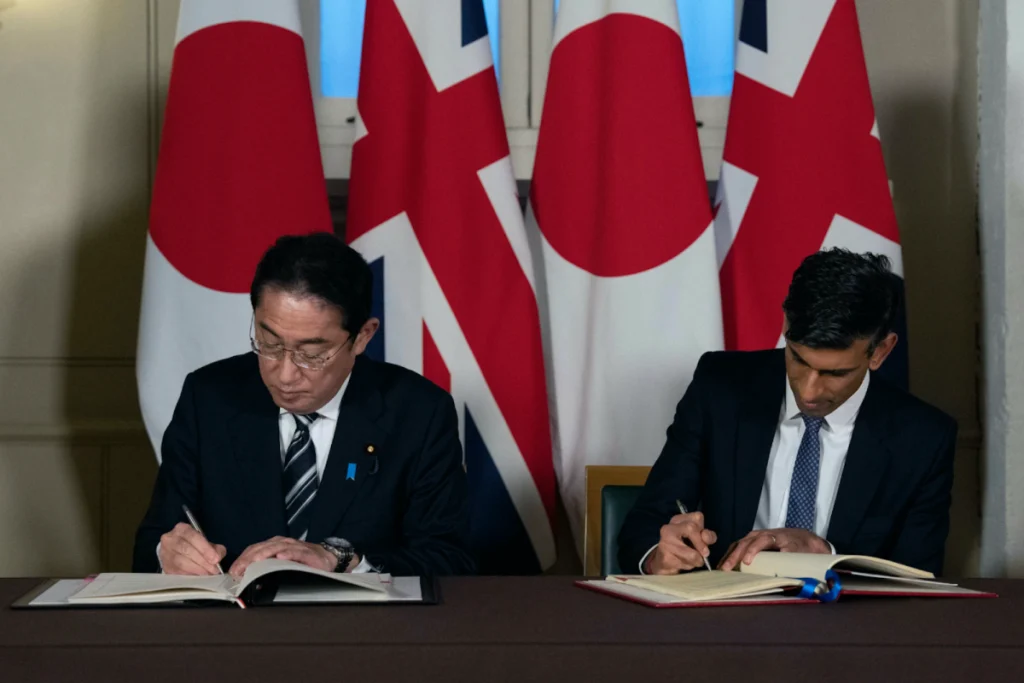
Britain’s Prime Minister Rishi Sunak (R) and Japan’s Prime Minister Fumio Kishida (L) sign a defense agreement during a bilateral meeting at the Tower of London on January 11, 2023. Image: Pool

In an op-ed for Nikkei Asia, the UK leader declared, “Japan is our closest security partner in Asia and the UK is Japan’s closest security partner in Europe…Between us is an unbreakable bond that reaches halfway around the world.”

In parallel, Japan is also negotiating an information-security agreement with Canada, another G7 member, which has also vowed to expand its strategic and naval footprint in the Indo-Pacific.

Growing defense cooperation with Europe and Canada allows Japan to hedge against any potential shifts in American foreign policy. Nevertheless, with the prospect of war over nearby Taiwan looming, Kishida has also doubled down on defense coordination with its most important ally, the US.

For his part, Biden fully supported Japan’s new defense direction and emphasized the need for even greater defense cooperation in the coming years amid shared concerns over China in the Indo-Pacific.

“Let me be crystal clear: the United States is fully, thoroughly, completely committed to the alliance and more importantly to Japan’s defense,” Biden said following his meeting with Kishida in Washington, thus welcoming a more powerful and self-reliant Asian ally.

Support TFF
Please support TFF’s work for peace through research and public education. We are all-volunteer, people-financed and do not accept money from governments or corporations. In other words, one of the very last free research think tanks in this world – and for a noble purpose: Peace by peaceful – intelligent – means. It is fast, easy and secure. Click here. Thanks!

Richard Javad Heydarian is a multi-awarded public educator, academic, columnist, and policy adviser. He has taught political science at De La Salle University and Ateneo De Manila University, and is an incoming research fellow at National Chengchi University in Taiwan. He is currently resident analyst at GMA network, a columnist for the Philippine Daily Inquirer, and a regular opinion writer for leading global publications. 

Related Posts

Jan Oberg February 19, 2026 What a thrill to be interviewed by former British diplomat Ian Proud! Don’t waste a minute: acquaint yourself with him here on his homepage, which he elegantly calls “Proud Diplomat.” Notice also his book, A Misfit In Moscow. Ian is, of course, also on Substack, where he calls himself The Peace Monger, and recently he set up his own PeaceMonger Channel on YouTube. For once, I was not interviewed as if I were a military geopolitical expert, where I normally have to twist the whole thing in the direction of peace. No, we both had a focus on peace – why it has been disappeared by research, politics and the media, but also what can be done to shape a more peaceful future for us all. One idea we came up with was that of connecting people through citizens diplomacy – in an era where...
By Jan ObergTFF co-founder and director February 11, 2026 PART 3 — ECONOMICS, TRADE & FINANCIAL SOVEREIGNTY A. Trade Measures & Market Signaling Economic pressure can be applied instantly and scaled without violence. Immediate Measures (within a week) Government boycott US goods and services  A very powerful signal which over time will be felt. Targeted tariffs on selected U.S. goods Symbolic but high-visibility sectors send a clear message. Suspend trade facilitation talks A peaceful pause that signals deep concern. Freeze U.S. participation in public procurement – military procurement in particular A nonviolent way to reduce influence. Competition law review of U.S. corporations A legal tool to scrutinise market dominance. Longer-Term Measures EU–Asia–Africa trade corridors Reducing reliance on U.S. markets. European supply chains for critical minerals Strategic autonomy in resource access. European Strategic Trade Authority Monitoring coercive practices globally. Euro-denominated commodity markets Weakening the dollar’s pricing monopoly. The EU must resume contacts and negotiations with Russia, focusing on energy cooperation To...
OK, Trump did not get it. But he got a full endorsement of a possible future US regime change in Venezuela. And that is what Ms Machado has advocated. Jan Oberg October 10, 2025 On October 10, 2025, the Norwegian Nobel Committee awarded its Peace Prize to Venezuelan opposition figure María Corina Machado. The citation praised her “tireless work promoting democratic rights.” But Ms Machado has openly called for U.S. military intervention in Venezuela, stating on CBS: “The only way to stop the suppression is by force—U.S. force.” She or her party has received funding from the National Endowment for Democracy (NED), a U.S. government-backed body known as a CIA front organisation and for supporting regime-change operations worldwide. And in 2018, she sent a letter to Israeli Prime Minister Benjamin Netanyahu, asking him to use “force and influence” to help dismantle Venezuela’s government—citing alleged ties to terrorism, Iran and narcotrafficking....

Recent Articles

Tony Robinson October 4, 2026 Violence is easy to recognise when someone is being beaten, shot or killed. It becomes more difficult when nobody is holding a weapon. Poverty, discrimination, exploitation and repression can restrict a human life just as effectively, although they do so in very different ways and with very different consequences. Simply adding more categories to an ever-growing list of forms of violence does not really solve the problem. The more interesting question is what all these different situations have in common and why it makes sense to describe them using the same word. Human beings do not simply react to what happens around them. They remember the past, imagine things that do not yet exist, make plans and undertake projects. Workers organise because they imagine different working conditions; people migrate because they imagine another life somewhere else; social movements emerge because people refuse to accept the...
It’s a matter of principles, courage, vision and pulling together – while the militarist world is falling apart… Peter Langille October 3, 2026 “Here, then, is the problem which we present to you, stark and dreadful and inescapable: Shall we put an end to the human race; or shall mankind renounce war?”The Bertrand Russell—Albert Einstein Manifesto, July 9, 1955 ⁕ The forecast for what’s ahead is worrisome. The sharp rise in armed conflicts over the past three years is adding to what was already the highest level in over seventy years. Genocides, which should be prevented are supported. A shared climate emergency that jeopardises survival is ignored. Diverse polls now suggest that people are war-weary, worried and interested in a more effective United Nations. And, there are viable policy options for a more secure world! Yet governments are doubling-down, betting on more war and investing heavily. If current trends persist,...
Johan Galtung 1930-2024October 2015 Published here on October 3, 2026 Let us focus on Civilization for conflict analysis and remedies. Major forms of disorder use violence; war is state organized violence. The most belligerent states are the United States of America and Israel, both with civilization roots. National Evangelism, the US Protestant Christian civilization– more national than evangelical–justifies US warfare as exceptionalism of a people chosen by God, with a manifest destiny to run the world. Orthodox Judaism justifies Israeli warfare to conquer and expand from Nile to Euphrates as a religious right and duty to the Eternal One. The third most belligerent country, the UK, no longer believes it is God-chosen but chosen by the USA; not quite the same but something. But the root cause of global disorder lies in the Occident–with Islam–seeing itself as the single, universal civilization valid for all at all times, all others being...

TFF on Substack

Discover and subscribe to more peace materials on TFF Substack

Most Popular

Tony Robinson October 4, 2026 Violence is easy to recognise when someone is being beaten, shot or killed. It becomes more difficult when nobody is holding a weapon. Poverty, discrimination, exploitation and repression can restrict a human life just as effectively, although they do so in very different ways and with very different consequences. Simply adding more categories to an ever-growing list of forms of violence does not really solve the problem. The more interesting question is what all these different situations have in common and why it makes sense to describe them using the same word. Human beings do not simply react to what happens around them. They remember the past, imagine things that do not yet exist, make plans and undertake projects. Workers organise because they imagine different working conditions; people migrate because they imagine another life somewhere else; social movements emerge because people refuse to accept the...
It’s a matter of principles, courage, vision and pulling together – while the militarist world is falling apart… Peter Langille October 3, 2026 “Here, then, is the problem which we present to you, stark and dreadful and inescapable: Shall we put an end to the human race; or shall mankind renounce war?”The Bertrand Russell—Albert Einstein Manifesto, July 9, 1955 ⁕ The forecast for what’s ahead is worrisome. The sharp rise in armed conflicts over the past three years is adding to what was already the highest level in over seventy years. Genocides, which should be prevented are supported. A shared climate emergency that jeopardises survival is ignored. Diverse polls now suggest that people are war-weary, worried and interested in a more effective United Nations. And, there are viable policy options for a more secure world! Yet governments are doubling-down, betting on more war and investing heavily. If current trends persist,...
Johan Galtung 1930-2024October 2015 Published here on October 3, 2026 Let us focus on Civilization for conflict analysis and remedies. Major forms of disorder use violence; war is state organized violence. The most belligerent states are the United States of America and Israel, both with civilization roots. National Evangelism, the US Protestant Christian civilization– more national than evangelical–justifies US warfare as exceptionalism of a people chosen by God, with a manifest destiny to run the world. Orthodox Judaism justifies Israeli warfare to conquer and expand from Nile to Euphrates as a religious right and duty to the Eternal One. The third most belligerent country, the UK, no longer believes it is God-chosen but chosen by the USA; not quite the same but something. But the root cause of global disorder lies in the Occident–with Islam–seeing itself as the single, universal civilization valid for all at all times, all others being...
Read More
Living-Peace-Sign-Budapest-copy
Tony Robinson October 4, 2026 Violence is easy to recognise when someone is being beaten, shot or killed. It becomes more difficult when nobody is holding a weapon. Poverty, discrimination, exploitation and repression can restrict a human life just as effectively, although they do so in very different ways and with very different consequences. Simply adding more categories to an ever-growing list of forms of violence does not really solve the problem. The more interesting question is what all these different situations have in common and why it makes sense to describe them using the same word. Human beings do not simply react to what happens around them. They remember the past, imagine things that do not yet exist, make plans and undertake projects. Workers organise because they imagine different working conditions; people migrate because they imagine another life somewhere else; social movements emerge because people refuse to accept the...
b54a1f10-8c65-4f0b-9dd5-4abc0a7d04cc_2659x2659
It’s a matter of principles, courage, vision and pulling together – while the militarist world is falling apart… Peter Langille October 3, 2026 “Here, then, is the problem which we present to you, stark and dreadful and inescapable: Shall we put an end to the human race; or shall mankind renounce war?”The Bertrand Russell—Albert Einstein Manifesto, July 9, 1955 ⁕ The forecast for what’s ahead is worrisome. The sharp rise in armed conflicts over the past three years is adding to what was already the highest level in over seventy years. Genocides, which should be prevented are supported. A shared climate emergency that jeopardises survival is ignored. Diverse polls now suggest that people are war-weary, worried and interested in a more effective United Nations. And, there are viable policy options for a more secure world! Yet governments are doubling-down, betting on more war and investing heavily. If current trends persist,...
010
Johan Galtung 1930-2024October 2015 Published here on October 3, 2026 Let us focus on Civilization for conflict analysis and remedies. Major forms of disorder use violence; war is state organized violence. The most belligerent states are the United States of America and Israel, both with civilization roots. National Evangelism, the US Protestant Christian civilization– more national than evangelical–justifies US warfare as exceptionalism of a people chosen by God, with a manifest destiny to run the world. Orthodox Judaism justifies Israeli warfare to conquer and expand from Nile to Euphrates as a religious right and duty to the Eternal One. The third most belligerent country, the UK, no longer believes it is God-chosen but chosen by the USA; not quite the same but something. But the root cause of global disorder lies in the Occident–with Islam–seeing itself as the single, universal civilization valid for all at all times, all others being...
Screenshot 2026-10-02 011738
Jan ObergPhD, director, The Transnational Foundation for Peace and Future Research, TFFLund, Sweden October 2, 2026 This is my full original manuscript. The Chinese Academy of Social Science, CASS, makes two publications out if it. 1. China’s Five-year plan emphasized the capabilities of basic research and original innovation. It is regarded as the goal of the future social development, which, as required, should be significantly enhanced. Can you comment on the importance of original innovation in research and academic study? I believe it is easier to define “original innovation” in the natural sciences than in social sciences. The breaking points of what constitutes something new, or innovative, are not quite as sharp in the latter. But in both fields it is about opening up something that was closed, unseen, unexplored before – making manifest what was earlier latent. Innovations come in many forms and shapes – naming something that was not...
arctic-circle-map
The agreement is catastrophic both because of what it says and what it doesn’t mention. It reduces further the major asset of security policies: Freedom of action. Jan Oberg TFF director September 25, 2026 A couple of hours before the agreement was signed on September 22, 2026, I published the following 13 hypotheses about what it would most likely contain on TFF Substack (in English). I was wrong on only the first point. Contrary to what Trump had written on his Truth Social platform, it does not appear to come into force immediately. In fact, it turned out to be worse than even I had anticipated. After these hypotheses now come a number of reflections in light of what the agreement actually contains, and does not contain, as well as the way in which it has generally been presented by major media outlets and by the public-service broadcaster DR. My...
girl-5894831_1280
Below are TFF-related media mentions, comments, videos and social media posts published elsewhere but not on this homepage. We happen to catch and list only a fraction. Regarding video comments and debates, we recommend that you go to the TFF Video Channel on Substack where many of them are reproduced. Jan Oberg is a contributor to China Daily – 52 million daily clicks – and Global Times, CGTN and CCTV (the national television), China Investment, Xinhua News Agency and several others. Articles and videos on these media very often multiply into countless Chinese (and Western media) that re-post them from these main media. Thanks to The China Academy, his analyses, interviews and comments are frequently posted on YouTube channels such as Thinkers Forum and Wave Media. These videos are often re-posted on Bilibili (China’s YouTube), the China Content Center on TikTok, and on the Chinese edition of TikTok, Douyin.com. This means reaching hundreds of millions of viewers worldwide over a year. While there are too many to catch on all these...




