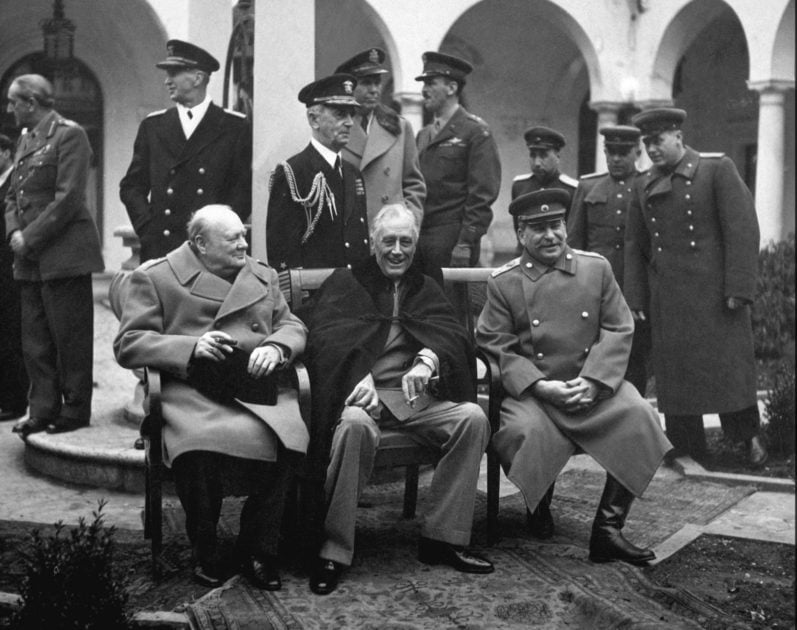
Churchill, Roosevelt and Stalin at Yalta, February 1945. Photo: US Army.
Richard Falk – TFF Associate
November 23, 2022
Disdaining Diplomacy, Seeking Victory
Ever since the Ukraine War started on February 24, 2022, the NATO response, mainly articulated and materially implemented by the U.S., has been to pour vast quantities of oil on the flames of conflict, taunting Russian and its leader, increasing the scale of violence, the magnitude of human suffering, and dangerously increasing the risk of a disastrous outcome.
Not only did Washington mobilize the world to denounce Russia’s ‘aggression’, but supplied a steady stream of advanced weaponry in great quantities to the Ukrainians to resist the Russian attack and even mount counterattacks. The U.S. did all it could at the UN and elsewhere to build a punitive coalition hostile to Russia but coupled this with a variety of sanctions and the demonization of Putin as a notorious war criminal unfit to govern and deserving of indictment and prosecution.
This perspective of state propaganda was faithfully conveyed by a self-censoring Western media filter that graphically portrayed on a daily basis the horrors of the war experienced by the Ukrainian civilian population, something to be avoided when dealing with U.S. regime-changing interventions or Israel’s violence inflicted on the long-suffering Palestinian people.
Originally published at Counterpunch on October 21, 2022
Such inflammatory behavior is underscored by a newly discovered West-oriented enthusiasm for the International Criminal Court, urging the tribunal to gather as much evidence as quickly as possible of Russian war crimes. This law-oriented posture is contradicted by intense past opposition to ICC efforts to gather evidence for an investigation of war crimes by non-signatories (of which Russia is one) in relation to the U.S. role in Afghanistan or Israel’s role in occupied Palestine.
To some degree, such one-sidedness of presentation was to be expected, and even justified, but its intensity in relation to Ukraine has been dangerously interwoven with an irresponsible and amateurishly pursued geopolitical war waged by the U.S. against Russia, and indirectly against China.
It is a war with high stakes as determining the structure of world order in the aftermath of the Cold War and the ascent of China as a credible rival to U.S. dominance. Such a geopolitical war is being waged in a manner oblivious to the wider human interests at stake and in a profound sense, contrary to the well-being and fate of Ukraine and its people.
Despite the presence of these features of the Ukraine War, Western minds continue to view the conflict with one eye closed. Even Stephen Walt, a moderate and generally sensible commentator on U.S. foreign policy, and currently, a prudent, persuasive critic of the Biden’s failure to do his best to shift the bloody encounter in Ukraine from the battlefield to diplomatic domains nevertheless joins the war-mongering chorus by misleadingly asserting without qualification that “Russia’s invasion of Ukraine is illegal, immoral, and unjustifiable..” [See Stephen Walt, “Why Washington Should Take Russian Nuclear Threats Seriously,” Foreign Policy, May 5, 2022]
It is not that such a characterization is incorrect as such, but unless supplemented by explanations of context it lends credibility to the war-oriented, self-righteous mentality displayed by the Biden presidency, while shielding its geopolitical war dimensions from scrutiny.
Perhaps Walt and others of similar outlook were striking this posture of going along with Washington’s portrayal of the Ukraine Crisis as a tactical concession needed to strike a Faustian Bargain to gain a seat at the table so that their warnings and advocacy of diplomacy could get at least a hearing from the foreign policy insiders advising Biden/Blinken.
To be clear, even if it can be argued that Russia/Putin has launched a war that is unlawful, immoral, and unjustified, the wider geopolitical context remains crucial if peace is to be restored and catastrophe avoided. For one thing, the Russian attack may be all of those things alleged, and yet form part of a geopolitical pattern of established behaviour that the U.S. has itself confirmed in a series of wars starting with the Vietnam War and notably more recently with the Kosovo War, Afghanistan War, and the Iraq War.
None of these wars were legal, moral, and justifiable, although each enjoyed a geopolitical rationale that made them seem desirable to U.S. foreign policy elites and its closest alliance partners. Of course, two wrongs do not make a right, but in a world where geopolitical actors enjoy a license to pursue vital strategic interests within traditional spheres of influence, it is not objectively defensible to self-righteously condemn Russia without taking account of what the U.S. has been doing around the world for several decades.
Antony Blinken may tell the media that spheres of influence became a thing of the past after World War II, but he must have been asleep for decades not to notice that the Yalta Agreement on the future of Europe reached in 1945 by the Soviet Union, United States, and the United Kingdom was premised on precisely the explicit affirmation of such spheres, which in retrospect, however distasteful in application, deserve some credit for keeping the Cold War from becoming World War III.
Such compromised sovereignty of these borderland countries is descriptive of the prerogatives claimed by so-called Great Powers throughout the history of international relations, not least by the United States through the Monroe Doctrine and its extensions. In this sense, Ukraine finds itself in the long unenviable position of Mexico and indeed all of Latin America. Many years ago the famous Mexican cultural figure, Octavio Paz, proclaimed the tragedy of his country ‘to be so far from God and yet so close to the United States.’
The UN Itself a Vehicle of Geopolitics more the International Law
In a somewhat insightful fit of frustration, George W. Bush after a failure to gain UN Security Council authorization in 2003 for the use of non-defensive regime-changing force against Iraq, declared that the UN would lose its ‘relevance’ if it failed to go along with the American imperial plan of action, and so it has.
The ambiguity as to international law arises from the UN Charter own equivocation, asserting that all non-defensive uses of force are prohibited, a position reinforced by the amended Rome Statute governing the International Criminal Court by declaring ‘aggression’ as a crime against the peace while conferring a right of veto on the five permanent members of the UN Security Council. How can this right of veto be conferred on these five states, which has the effect of precluding any Security Council decision that clashes with their strategic interests, be reconciled with the Charter and international law prohibition on aggression?
This right of exception as embodied in the constitutional framework of the UN is not some peculiar anomaly. It was anticipated by the post-1945 experience of international criminal law, which from Nuremberg to the present has exempted from accountability dominant geopolitical actors, even for such incredible acts as dropping atomic bombs on overwhelmingly civilian targets at the end of World War II. This grey zone separating law from power continues to be the accepted playground of geopolitical actors, never so dangerous as when its prerogatives and constraints are in flux.
The Russian and Chinese challenges can be thus understood as seeking to restore geopolitical bipolarity or tripolarity that was displaced after the collapse of the Soviet Union leading the U.S. to fill the resulting vacuum with a militarist/neoliberal form of geopolitical management. The open question, aside from worrying about how and when the war in Ukraine will end, is whether the geopolitical world order resting on U.S. primacy will be confirmed or altered.
Geopolitical Practice: Prudent or Irresponsible
These considerations are mentioned here not to defend, much less exonerate Russia, but to show that the world order context of the Ukraine War is deeply problematic in relation to U.S./NATO claims of normative authority, especially when invoked in such a partisan manner. In contemporary geopolitical relations, as distinct from normal state-to-state or international relations, precedent generally takes the place of norms and rule-governed behaviour.
What the U.S. does, can be generally done by other sovereign states, especially those with geopolitical entitlements. Blinken has again muddied the waters of international discourse by falsely claiming that the U.S., unlike adversaries China and Russia, is as observant of rule-governed behaviour in a similar manner to that of ‘normal states’ in relation to peace and security.
To gain a clearer and more objective perspective it seems appropriate to look back at NATO’s clearly unlawful war of 1999 that fragmented Serbia by granting Kosovo political independence and territorial sovereignty before uncritically condemning the Russian annexation of four parts of eastern Ukraine after admittedly dubious referenda.
Again, it is important to recognize that there may be cases where the fragmentation of existing states is justifiable on humanitarian grounds and others where it is not, but to claim that Russia overstepped the limits of law in a context where power has been consistently shaping behaviour, and political outcomes in similar cases is to prepare the public for a wider war rather than leading it to seek and be pragmatically receptive to a diplomatic compromise.
In effect, I am arguing for the wisdom and virtue of what might be described as geopolitical humility: do not require of others, what you have yourself done. In the complexity of the internal struggles of minority, it is along the same lines helpful to admit that Moscow and Washington ‘see’ the same realities of the Donbas in contradictory ways.
This contextual understanding of the Ukraine War is in my judgment highly relevant as it makes the current fashion of mounting legal, moral, and political arguments of condemnation distract from following an otherwise rational, prudent, and pragmatic courses of action, which from day one of the attack strongly supported the wisdom of making an all-out effort to achieve an immediate ceasefire followed by negotiations aiming at durable political compromises not only between Russia and Ukraine, but also between NATO/U.S. and Russia.
That the U.S. Government never to this day has publicly manifested any such interest, much less setting forth a commitment to stopping the killing and devastation by encouraging diplomacy, in the face of mounting costs and escalation risks of prolonged warfare in Ukraine. This alone should be shocking to the conscience of peace-minded persons and patriots of humanity everywhere.
Beyond the immediate zones of combat, catastrophic costs are presently being borne by many vulnerable societies throughout the world from the spillover effects of anti-Russian sanctions and their impact on food and energy supplies and pricing. Such a deplorable situation, likely to get worse as the war is prolonged and intensified in the coming Winter months, is now also bringing closer to reality the growing danger of the use of nuclear weapons as Putin’s alternatives may be narrowing to acknowledging defeat or personally falling from power.
While not relenting a bit on implementing an aggressive approach to gaining Ukraine’s ambitions of victory, Biden himself acknowledges that any use of even a tactical nuclear weapon in Ukraine would with near certitude lead to Armageddon. This duality of assessment (combining escalating the war with anxiety as to where it might lead) seems more like an embrace of geopolitical insanity than a sobering recognition of the somber realities at stake.
As always actions speak louder than words.
Blinken facing a rising public clamor for negotiations, responds with his usual feckless evasions. In this instance, contending that since Ukraine is the victim of Russian aggression, it alone has the authority to seek a diplomatic resolution and the U.S. will continue to support Ukraine’s maximal war aims for as long as it takes, including recently even the extension of Ukraine war aims to the recovery of Crimea, which has been widely accepted as part of Russia since 2014.
Context also matters in relation to the conduct of the war. Its major escalation within the month of the sabotage of Nord Stream 1 & 2 gas pipelines to Europe, which Blinken once more confounded by this act of sabotage outside the war zone ‘a tremendous opportunity to make weaken Russia and force Europe to intensify efforts to gain energy independence.’
Such an operation initially implausibly attributed to Russia by the U.S., yet later more or less acknowledges as part of the expansion of the war by reliance on ‘terrorist’ tactics of combat.
This latest expression of state terrorism is the suicide bombing of the strategic Kerch Straight Bridge on October 7 connecting Crimea and Russia, a major infrastructure achievement of the Putin period of Russian leadership, as well as a symbolic expression of relinking Crimea to Russia and as a supply line for Russian troops operating in the Southern parts of Ukraine.
These extensions of the combat zone beyond the territory of Ukraine contain the fingerprints of the CIA and seem designed as encouragement of Ukrainian resolve to go all out for a decisive victory, sending Putin unmistakable signals that the U.S. remains as unreceptive as ever to a responsible geopolitics of compromise, refusing even to respond favorably to Putin’s proposed meeting at the G-20 meeting in Indonesia.
Biden’s characteristic response was this refusal, subject only to a change if the meeting was limited to the release of an American pro basketball player being held in Russia on drug charges.
The U.S. anger directed at Saudi Arabia for cutting its oil production is an additional sign of a commitment to a victory scenario in Ukraine as well as a reaction against the Saudi resistance to U.S. hegemonic geopolitics in its co-management of OPEC+ with Russia. With such provocations, it is hardly surprising, although highly unlawful and immoral, for Russia to retaliate by unleashing its version of ‘shock and awe’ against the civilian centres of ten Ukrainian cities. Such is the course of this vicious escalation! Such also is neglect of the American precedent in Iraq.
Concluding Observations
Always lurking in the background, and at Ukraine’s and the world’s expense, is Washington’s geopolitical opportunism, that is, seeking to defeat Russia and deter China from daring to challenge the hegemonic unipolarity achieved after the Soviet disintegration in 1992.
It is this huge investment in its militarist identity as the sole ‘global state’ that best explains this cowboy approach to nuclear risk-taking and the tens of billions expended to empower Ukraine at a time of internal suffering in the U.S. coexisting with this costly mode of international overreach.
Such a tragic political drama unfolds as the peoples of the world and their governments, along with the United Nations, watch this horrendous spectacle unfold, seemingly helpless witnesses not only to the carnage but also to the spillover and Armageddon dangers and even to the potential supreme damage to their own national destinies.
Originally published at Counterpunch on October 21, 2022
About the author

Richard Falk is Albert G. Milbank Professor Emeritus of International Law at Princeton University, Chair of Global Law, Queen Mary University London, and Research Associate, Orfalea Center of Global Studies, UCSB.
Please help TFF remain truly independent by contributing if you benefited from this article