
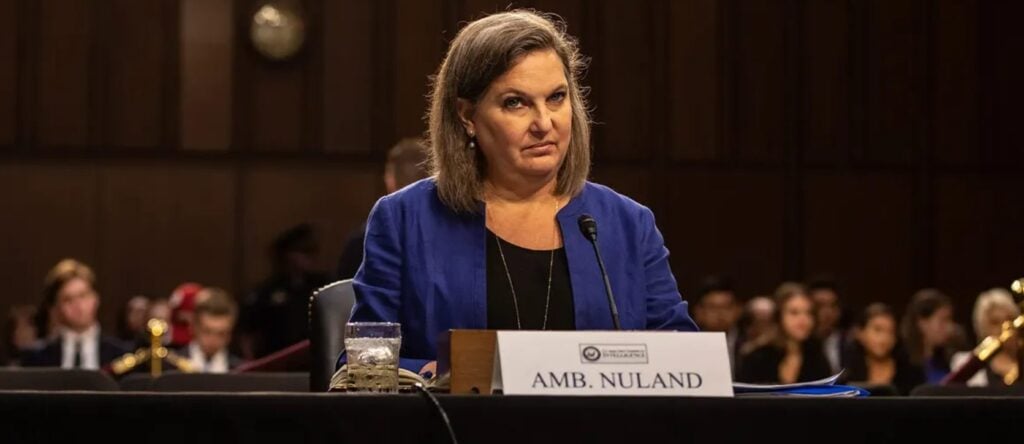
Who is Victoria Nuland? A really bad idea as a key player in Biden’s foreign policy team

Former US Assistant Secretary of State for European and Eurasian Affairs Victoria Nuland testifies during a hearing on Policy Response to Russian Interference in the 2016 US Elections before the Senate Intelligence Committee at Capitol Hill in Washington, USA on June 20, 2018. (Yasin Ozturk/Anadolu Agency/Getty Images)

A Cold War true believer who sabotaged Obama’s foreign policy, Nuland is a huge risk at the State Department

Medea Benjamin – Nicolas J.S. Davies – Marcy Winograd

October 13, 2022

Who is Victoria Nuland? Most Americans have never heard of her, because the U.S. corporate media’s foreign policy coverage is a wasteland. Most Americans have no idea that President-elect Biden’s pick for deputy secretary of state for political affairs is stuck in the quicksand of 1950s U.S.-Russia Cold War politics and dreams of continued NATO expansion, an arms race on steroids and further encirclement of Russia. 

Nor do they know that from 2003 to 2005, during the hostile U.S. military occupation of Iraq, Nuland was a foreign policy advisor to Dick Cheney, the Darth Vader of the Bush administration.

You can bet, however, that the people of Ukraine have heard of neocon Nuland. Many have even heard the leaked four-minute audio of her saying “Fuck the EU” during a February 2014 phone call with the U.S. ambassador to Ukraine, Geoffrey Pyatt. 

Originally published at Salon on January 19, 2021

During the infamous call on which Nuland and Pyatt appeared to be plotting to replace or undermine elected Ukrainian President Victor Yanukovych, Nuland expressed her not-so-diplomatic disgust with the European Union for favouring former heavyweight boxer and austerity champ Vitali Klitschko to take over as prime minister, instead of the U.S. first choice, Artseniy Yatsenyuk, who indeed took power after Yanukovych was ousted about three weeks later. 

The “Fuck the EU” call went viral, as an embarrassed State Department, never denying the call’s authenticity, blamed the Russians for tapping the phone, much as the NSA has tapped the phones of European allies. 

Despite outrage from German Chancellor Angela Merkel, no one fired Nuland, but her potty mouth upstaged the more serious story: the U.S. plot to overthrow Ukraine’s elected government — and America’s responsibility for a civil war that has killed at least 13,000 people and left Ukraine the poorest country in Europe.  

In the process, Nuland, her husband Robert Kagan — co-founder of The Project for a New American Century — and their neocon cronies succeeded in sending U.S.-Russian relations into a dangerous downward spiral from which they have yet to recover.

Nuland accomplished this from a relatively junior position as assistant secretary of state for European and Eurasian affairs. How much more trouble could she stir up as the No. 3 official at Biden’s State Department? We’ll find out soon enough, if the Senate confirms her nomination.

Joe Biden should have learned from Barack Obama’s mistakes that appointments like this matter. In his first term, Obama allowed his hawkish Secretary of State Hillary Clinton, Republican Secretary of Defense Robert Gates, and military and CIA leaders held over from the Bush administration to ensure that endless war trumped his message of hope and change. 

Obama, the Nobel Peace Prize winner, ended up presiding over indefinite detentions without charges or trials at Guantánamo Bay, an escalation of drone strikes that killed innocent civilians, a deepening of the U.S. occupation of Afghanistan, a self-reinforcing cycle of terrorism and counterterrorism, and disastrous new wars in Libya and Syria. 

With Clinton out and new personnel in top spots in his second term, Obama began to take charge of his own foreign policy. He started working directly with Russia’s President Vladimir Putin to resolve crises in Syria and other hotspots. Putin helped avert an escalation of the war in Syria in September 2013 by negotiating the removal and destruction of Syria’s chemical weapons stockpiles, and helped Obama negotiate an interim agreement with Iran that led to the JCPOA nuclear deal. 

But the neocons were apoplectic that they failed to convince Obama to order a massive bombing campaign and escalate his covert proxy war in Syria and at the receding prospect of a war with Iran. Fearing their control of U.S. foreign policy was slipping, the neocons launched a campaign to brand Obama as “weak” on foreign policy and remind him of their power. 

With editorial help from Nuland, Kagan penned a 2014 New Republic article entitled “Superpowers Don’t Get to Retire,” proclaiming that “there is no democratic superpower waiting in the wings to save the world if this democratic superpower falters.” Kagan called for an even more aggressive foreign policy to exorcise American fears of a multipolar world it can no longer dominate. 

Obama invited Kagan to a private lunch at the White House, and the neocons’ muscle-flexing pressured him to scale back his diplomacy with Russia, even as he quietly pushed ahead on Iran.

The neocons’ coup de grace against Obama’s better angels came with Nuland’s 2014 coup in debt-ridden Ukraine, a strategic candidate for NATO membership right on Russia’s border.

When Ukrainian President Yanukovych spurned a U.S.-backed trade agreement with the European Union in favor of a $15 billion bailout from Russia, the State Department threw a tantrum.

Hell hath no fury like a superpower scorned.

The EU trade agreement was to open Ukraine’s economy to European imports, but without a reciprocal opening of EU markets to Ukraine, it was a lopsided deal Yanukovich could not accept. The deal was approved by the post-coup government, and has only added to Ukraine’s economic woes.

The muscle for Nuland’s $5 billion coup was Oleh Tyahnybok’s neo-Nazi Svoboda Party and the shadowy new Right Sector militia. During her leaked phone call, Nuland referred to Tyahnybok as one of the “big three” opposition leaders on the outside who could help the U.S.-backed Prime Minister Yatsenyuk on the inside. This is the same Tyanhnybok who once delivered a speech applauding Ukrainians for fighting Jews and “other scum” during World War II. 

After protests in Kyiv’s Maidan Square turned into battles with police in February 2014, Yanukovych and the Western-backed opposition signed an agreement brokered by France, Germany and Poland to form a national unity government and hold new elections by the end of the year. 

But that was not good enough for the neo-Nazis and extreme right-wing forces the U.S. had helped to unleash. A violent mob led by the Right Sector militia marched on and invaded the parliament building, a scene no longer difficult for Americans to imagine. Yanukovych and his members of parliament fled for their lives. 

Facing the loss of its most vital strategic naval base at Sevastopol in Crimea, Russia accepted the overwhelming result (a 97% majority, with an 83% turnout) of a referendum in which Crimea voted to leave Ukraine and rejoin Russia, of which it had been a part from 1783 to 1954. 

The majority Russian-speaking provinces of Donetsk and Luhansk in eastern Ukraine unilaterally declared independence from Ukraine, triggering a bloody civil war between U.S.-backed and Russian-backed forces that still rages in 2021. 

U.S.-Russian relations have never recovered, even as the two nations’ nuclear arsenals still pose the greatest single threat to our existence. Whatever Americans believe about the civil war in Ukraine and allegations of Russian interference in the 2016 U.S. presidential election, we must not allow the neocons and the military-industrial complex they serve to deter Biden from conducting vital diplomacy with Russia to steer us off a suicidal path toward nuclear war.  

Nuland and the neocons, however, remain committed to an ever-more debilitating and dangerous Cold War with Russia and China to justify a militarist foreign policy and record Pentagon budgets. In a July 2020 Foreign Affairs article entitled “Pinning Down Putin,” Nuland absurdly claimed that Russia presents a greater threat to “the liberal world” than the Soviet Union posed during the old Cold War. 

Nuland’s narrative rests on an utterly mythical and ahistorical narrative of Russian aggression and U.S. good intentions. She pretends that Russia’s military budget, which is one-tenth of America’s, is evidence of “Russian confrontation and militarization” and calls on the U.S. and its allies to counter Russia by “maintaining robust defense budgets, continuing to modernize U.S. and allied nuclear weapons systems, and deploying new conventional missiles and missile defenses to protect against Russia’s new weapons systems.” 

Nuland also wants to confront Russia with an aggressive NATO. Since her days as U.S. ambassador to NATO during President George W. Bush’s second term, she has been a supporter of NATO’s expansion all the way up to Russia’s border. She calls for “permanent bases along NATO’s eastern border.” We have pored over a map of Europe, but we can’t find a country called NATO with any borders at all. Nuland sees Russia’s commitment to defending itself after successive 20th-century Western invasions as an intolerable obstacle to NATO’s expansionist ambitions.

Nuland’s militaristic worldview represents exactly the folly the U.S. has been pursuing since the 1990s under the influence of the neocons and “liberal interventionists,” which has resulted in a systematic underinvestment in the American people while escalating tensions with Russia, China, Iran and other countries. 

As Obama learned too late, the wrong person in the wrong place at the wrong time can, with a shove in the wrong direction, unleash years of intractable violence, chaos and international discord. Victoria Nuland would be a ticking time-bomb in Biden’s State Department, waiting to sabotage his better angels much as she undermined Obama’s second-term diplomacy. 

Originally published at Salon on January 19, 2021

About the authors

Medea Benjamin is co-founder of CODEPINK for Peace and author of several books, including “Inside Iran: The Real History and Politics of the Islamic Republic of Iran.” She and Nicolas J.S. Davies are the authors of “War in Ukraine: Making Sense of a Senseless Conflict,” coming this fall from OR Books.

Nicolas J.S. Davies is an independent journalist, a researcher for CODEPINK and the author of “Blood on Our Hands: The American Invasion and Destruction of Iraq.”

Marcy Winograd of Progressive Democrats of America served as a 2020 Democratic delegate for Bernie Sanders and co-founded the Progressive Caucus of the California Democratic Party. As coordinator of CODEPINKCONGRESS, she spearheads Capitol Hill calling parties to mobilize co-sponsors and votes for peace and foreign policy legislation.

Please help TFF remain truly independent by contributing if you benefited from this article

Related Posts

Jan Oberg May 15, 2026 Go to this Fox News page and scroll the whole way down: President Donald Trump tells the world that his meeting with President Xi Jinping yielded a lot of very concrete political and economic results – of course, only where the Chinese side, according to him, agreed with him. He does not mention the Taiwan issue, but Secretary of State, Marco Rubio, says that it did not feature prominently in their talks and that the US policy on Taiwan has not changed. Then go to China Daily – or Global Times – and you will see that for the Chinese it is framework, principles, structure of cooperation etc. that matters – all embedded in the overall idea of “constructive bilateral relationship of strategic stability.” Nowhere is any concrete agreement or deal – all that Trump refers to – mentioned. At the general level, this gives you insights into the very different social...
Jan Oberg, TFF director April 9, 2026 I was recently invited to have a good, long talk about the world – and, of course, about peace too – with Boris Malagurski on his Weight of Chains Channel on YouTube. It was a real joy and seems to have been greatly appreciated by the viewers too. Mr Malagurski and I shall of course be grateful if you share this conversation in your circles – of course, only if you like what you see and hear 😉☮️ And remember that this one – like hundreds of others with TFF Associates – can be enjoyed at our TFF Video Collection.
A friendly quarrel while we agree that the US sanctions are a weapon of mass destruction and kill more people than wars do. And that we must talk much more about sanctions than we have so far. Jan Oberg, TFF director March 16, 2026 John Mearsheimer recently stated that U.S. sanctions murdered around 38 million people between 1971 and 2021 – see the video below. It is a dramatic figure, and it has spread quickly because it captures, in one sentence, the enormous human cost of modern sanctions. I share his concern about the destructive effects of economic coercion. But the specific number he cites — and the way he attributes it — deserves a friendly academic clarification. The figure comes from a 2023 Lancet Global Health article estimating the mortality effects of unilateral U.S. and EU sanctions over the past half‑century. This is the first point where Mearsheimer’s shorthand diverges from the text: the study...

Recent Articles

Tony Robinson October 4, 2026 Violence is easy to recognise when someone is being beaten, shot or killed. It becomes more difficult when nobody is holding a weapon. Poverty, discrimination, exploitation and repression can restrict a human life just as effectively, although they do so in very different ways and with very different consequences. Simply adding more categories to an ever-growing list of forms of violence does not really solve the problem. The more interesting question is what all these different situations have in common and why it makes sense to describe them using the same word. Human beings do not simply react to what happens around them. They remember the past, imagine things that do not yet exist, make plans and undertake projects. Workers organise because they imagine different working conditions; people migrate because they imagine another life somewhere else; social movements emerge because people refuse to accept the...
It’s a matter of principles, courage, vision and pulling together – while the militarist world is falling apart… Peter Langille October 3, 2026 “Here, then, is the problem which we present to you, stark and dreadful and inescapable: Shall we put an end to the human race; or shall mankind renounce war?”The Bertrand Russell—Albert Einstein Manifesto, July 9, 1955 ⁕ The forecast for what’s ahead is worrisome. The sharp rise in armed conflicts over the past three years is adding to what was already the highest level in over seventy years. Genocides, which should be prevented are supported. A shared climate emergency that jeopardises survival is ignored. Diverse polls now suggest that people are war-weary, worried and interested in a more effective United Nations. And, there are viable policy options for a more secure world! Yet governments are doubling-down, betting on more war and investing heavily. If current trends persist,...
Johan Galtung 1930-2024October 2015 Published here on October 3, 2026 Let us focus on Civilization for conflict analysis and remedies. Major forms of disorder use violence; war is state organized violence. The most belligerent states are the United States of America and Israel, both with civilization roots. National Evangelism, the US Protestant Christian civilization– more national than evangelical–justifies US warfare as exceptionalism of a people chosen by God, with a manifest destiny to run the world. Orthodox Judaism justifies Israeli warfare to conquer and expand from Nile to Euphrates as a religious right and duty to the Eternal One. The third most belligerent country, the UK, no longer believes it is God-chosen but chosen by the USA; not quite the same but something. But the root cause of global disorder lies in the Occident–with Islam–seeing itself as the single, universal civilization valid for all at all times, all others being...

TFF on Substack

Discover and subscribe to more peace materials on TFF Substack

Most Popular

Tony Robinson October 4, 2026 Violence is easy to recognise when someone is being beaten, shot or killed. It becomes more difficult when nobody is holding a weapon. Poverty, discrimination, exploitation and repression can restrict a human life just as effectively, although they do so in very different ways and with very different consequences. Simply adding more categories to an ever-growing list of forms of violence does not really solve the problem. The more interesting question is what all these different situations have in common and why it makes sense to describe them using the same word. Human beings do not simply react to what happens around them. They remember the past, imagine things that do not yet exist, make plans and undertake projects. Workers organise because they imagine different working conditions; people migrate because they imagine another life somewhere else; social movements emerge because people refuse to accept the...
It’s a matter of principles, courage, vision and pulling together – while the militarist world is falling apart… Peter Langille October 3, 2026 “Here, then, is the problem which we present to you, stark and dreadful and inescapable: Shall we put an end to the human race; or shall mankind renounce war?”The Bertrand Russell—Albert Einstein Manifesto, July 9, 1955 ⁕ The forecast for what’s ahead is worrisome. The sharp rise in armed conflicts over the past three years is adding to what was already the highest level in over seventy years. Genocides, which should be prevented are supported. A shared climate emergency that jeopardises survival is ignored. Diverse polls now suggest that people are war-weary, worried and interested in a more effective United Nations. And, there are viable policy options for a more secure world! Yet governments are doubling-down, betting on more war and investing heavily. If current trends persist,...
Johan Galtung 1930-2024October 2015 Published here on October 3, 2026 Let us focus on Civilization for conflict analysis and remedies. Major forms of disorder use violence; war is state organized violence. The most belligerent states are the United States of America and Israel, both with civilization roots. National Evangelism, the US Protestant Christian civilization– more national than evangelical–justifies US warfare as exceptionalism of a people chosen by God, with a manifest destiny to run the world. Orthodox Judaism justifies Israeli warfare to conquer and expand from Nile to Euphrates as a religious right and duty to the Eternal One. The third most belligerent country, the UK, no longer believes it is God-chosen but chosen by the USA; not quite the same but something. But the root cause of global disorder lies in the Occident–with Islam–seeing itself as the single, universal civilization valid for all at all times, all others being...
Read More
Living-Peace-Sign-Budapest-copy
Tony Robinson October 4, 2026 Violence is easy to recognise when someone is being beaten, shot or killed. It becomes more difficult when nobody is holding a weapon. Poverty, discrimination, exploitation and repression can restrict a human life just as effectively, although they do so in very different ways and with very different consequences. Simply adding more categories to an ever-growing list of forms of violence does not really solve the problem. The more interesting question is what all these different situations have in common and why it makes sense to describe them using the same word. Human beings do not simply react to what happens around them. They remember the past, imagine things that do not yet exist, make plans and undertake projects. Workers organise because they imagine different working conditions; people migrate because they imagine another life somewhere else; social movements emerge because people refuse to accept the...
b54a1f10-8c65-4f0b-9dd5-4abc0a7d04cc_2659x2659
It’s a matter of principles, courage, vision and pulling together – while the militarist world is falling apart… Peter Langille October 3, 2026 “Here, then, is the problem which we present to you, stark and dreadful and inescapable: Shall we put an end to the human race; or shall mankind renounce war?”The Bertrand Russell—Albert Einstein Manifesto, July 9, 1955 ⁕ The forecast for what’s ahead is worrisome. The sharp rise in armed conflicts over the past three years is adding to what was already the highest level in over seventy years. Genocides, which should be prevented are supported. A shared climate emergency that jeopardises survival is ignored. Diverse polls now suggest that people are war-weary, worried and interested in a more effective United Nations. And, there are viable policy options for a more secure world! Yet governments are doubling-down, betting on more war and investing heavily. If current trends persist,...
010
Johan Galtung 1930-2024October 2015 Published here on October 3, 2026 Let us focus on Civilization for conflict analysis and remedies. Major forms of disorder use violence; war is state organized violence. The most belligerent states are the United States of America and Israel, both with civilization roots. National Evangelism, the US Protestant Christian civilization– more national than evangelical–justifies US warfare as exceptionalism of a people chosen by God, with a manifest destiny to run the world. Orthodox Judaism justifies Israeli warfare to conquer and expand from Nile to Euphrates as a religious right and duty to the Eternal One. The third most belligerent country, the UK, no longer believes it is God-chosen but chosen by the USA; not quite the same but something. But the root cause of global disorder lies in the Occident–with Islam–seeing itself as the single, universal civilization valid for all at all times, all others being...
Screenshot 2026-10-02 011738
Jan ObergPhD, director, The Transnational Foundation for Peace and Future Research, TFFLund, Sweden October 2, 2026 This is my full original manuscript. The Chinese Academy of Social Science, CASS, makes two publications out if it. 1. China’s Five-year plan emphasized the capabilities of basic research and original innovation. It is regarded as the goal of the future social development, which, as required, should be significantly enhanced. Can you comment on the importance of original innovation in research and academic study? I believe it is easier to define “original innovation” in the natural sciences than in social sciences. The breaking points of what constitutes something new, or innovative, are not quite as sharp in the latter. But in both fields it is about opening up something that was closed, unseen, unexplored before – making manifest what was earlier latent. Innovations come in many forms and shapes – naming something that was not...
arctic-circle-map
The agreement is catastrophic both because of what it says and what it doesn’t mention. It reduces further the major asset of security policies: Freedom of action. Jan Oberg TFF director September 25, 2026 A couple of hours before the agreement was signed on September 22, 2026, I published the following 13 hypotheses about what it would most likely contain on TFF Substack (in English). I was wrong on only the first point. Contrary to what Trump had written on his Truth Social platform, it does not appear to come into force immediately. In fact, it turned out to be worse than even I had anticipated. After these hypotheses now come a number of reflections in light of what the agreement actually contains, and does not contain, as well as the way in which it has generally been presented by major media outlets and by the public-service broadcaster DR. My...
girl-5894831_1280
Below are TFF-related media mentions, comments, videos and social media posts published elsewhere but not on this homepage. We happen to catch and list only a fraction. Regarding video comments and debates, we recommend that you go to the TFF Video Channel on Substack where many of them are reproduced. Jan Oberg is a contributor to China Daily – 52 million daily clicks – and Global Times, CGTN and CCTV (the national television), China Investment, Xinhua News Agency and several others. Articles and videos on these media very often multiply into countless Chinese (and Western media) that re-post them from these main media. Thanks to The China Academy, his analyses, interviews and comments are frequently posted on YouTube channels such as Thinkers Forum and Wave Media. These videos are often re-posted on Bilibili (China’s YouTube), the China Content Center on TikTok, and on the Chinese edition of TikTok, Douyin.com. This means reaching hundreds of millions of viewers worldwide over a year. While there are too many to catch on all these...




