
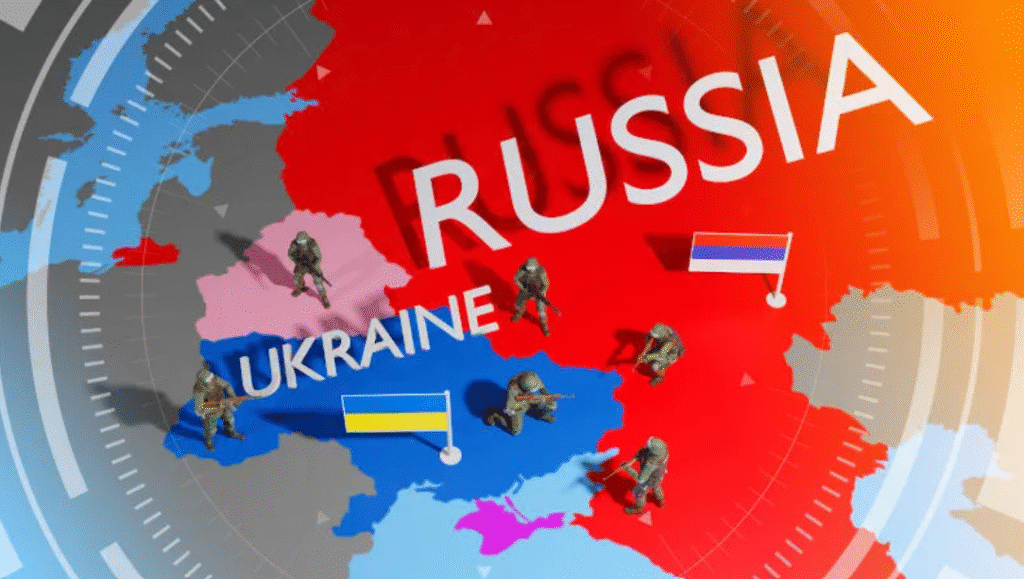
Cameron Leckie: Ukraine – The demise of the West

Yet ‘experts’ still cling to the narrative that Ukraine can somehow ‘win.’ If Ukraine can hang on for just a few more months. Image: iStock

Cameron Leckie

August 24, 2022

The more events proved them to be wrong, the stronger their defences became against admitting this to be the case’ – Norman Dixon (On the Psychology of Military Incompetence)

In my last piece for Pearls and Irritations I argued that the conflict in, or more accurately, over Ukraine was rapidly accelerating the transfer of the balance of power from West to East. The progress of events associated with the conflict has resulted in a re-evaluation of this assessment. What we are witnessing is the self-inflicted demise of the West as a major power bloc.

The belief in a series of delusions by Western leaders and governments is the driving force behind this demise, with the conflict in Ukraine being the focal point.

Originally published at John Menadue’s “Pearls & Irritations” on July 8, 2022

The first delusion was that Ukraine could be bought into the Western sphere of influence without a violent reaction from Russia. There is a long history of senior Western officials warning against NATO expansion into Ukraine and Georgia, including by the current CIA Director Williams Burns, when he was Ambassador to Russia.

Two wars against NATO expansion have already been fought, the first in Georgia in 2008 and the second the Russian annexation of Crimea and support to Ukrainians in the Donbass who opposed the vehemently anti-Russian post-coup Ukrainian Government from 2014.

The crisis leading to the current war (which maybe considered the third war against NATO expansion) was ‘wilfully precipitated’ by NATO and Western Governments according to the former US Ambassador to the Soviet Union, Jack Matlock. Despite the well documented actions by Western powers, and the US in particular (as explained in detail by John Mearsheimer and Scott Horton), Western leaders still describe Russia’s actions in Ukraine as ‘unprovoked.’

Whilst it can be argued as to whether Russia’s actions are justified, such an ahistorical representation of events is but a mechanism to absolve Western leaders of their responsibility for current events and mislead the ill-informed.

Whilst showing signs of weakening, the second delusion is that Ukraine can win the war against Russia. Russia effectively ‘won’ on 24 February 2024 when the ‘Special Military Operation’ was launched. What remained uncertain, both at the time and now, is the final end state. Specifically, how much territory does Ukraine lose, how many casualties result and the extent of damage to Ukrainian infrastructure.

Yet ‘experts’ still cling to the narrative that Ukraine can somehow ‘win.’ If Ukraine can hang on for just a few more months the ‘pendulum will begin to swing in their favour’ and partisan activities will provide the ‘precious time it needs to build the force it needs to eventually clear the Russians from its territory’ being examples. These fanciful prognostications are based on hope rather a coldly analytical evaluation of events on the ground and the capabilities of the opposing sides.

The best and only hope that Ukraine had to defeat Russia was early on in the conflict when Russian forces were spread thinly, over-extended with vulnerable supply lines and incomplete Air Defence coverage. At this point Ukraine retained its substantial military capability and had taken relatively few casualties.

The fact that it didn’t launch a significant counter-offensive implies that either Russia’s scheme of manoeuvre was successful in fixing the Ukrainian forces in place and/or the Ukrainians were incapable of implementing offensive operations on a large scale.

Months later, with Ukraine suffering up to 1000 casualties per day and its military infrastructure having been progressively and methodically destroyed, the pre-conditions do not exist for Ukraine to launch a counter-offensive.

Ukrainian officials have called for 1000 artillery pieces, 300 multiple launch rocket systems and 500 tanks from its allies, just to achieve ‘parity’ with Russia. This would require an order of magnitude increase over and above the incredible amount of support already provided to Ukraine, which has already strained NATO inventories.

It is extremely unrealistic to believe that such a level of support can be provided let alone the supplies needed for a lengthy war of attrition. To take just one example, the annual production of artillery ammunition in the US would last just 10 days to two weeks of combat in the Ukraine.

Ukraine is also running out of the personnel required to generate a force of the scale necessary to launch a counter-offensive as noted by former CIA Agent Larry Johnson. The logical conclusion is that Ukraine does not have the capability now, nor will it in the future, to successfully launch a significant counter-offensive, nor does it have capability to prevent Russia from achieving its objectives.

The third delusion is that sanctions, the West’s primary response to Russia’s invasion, would be effective in either pressuring Russia to cease its campaign in Ukraine, to weaken Russia, to isolate Russia or to overthrow the Russian leadership.

Whilst the sanctions have had a substantial effect on the Russian economy, the sanctions storm has been weathered with the Ruble being the best performing current this year, inflation falling, profits from energy exports surging and President Putin having near record popularity.

The latest inane sanctions proposals aired at the G7, banning the export of Russian gold and putting a cap on the oil price, highlight how desperate if not farcical Western attempts at sanctioning Russia have become.

Whilst the sanctions are failing against Russia, they have been extremely effective in exacerbating the already deteriorating economic circumstances in the Western world, a fact which even the most rudimentary analysis of the sanctions would have highlighted.

The sanctions can best be described as an own goal. With the UK suffering the greatest fall in living standards on record, Germany’s top union official warning of the permanent collapse of major industries due to the price of natural gas, one Government having already collapsed (Bulgaria), inflation out of control, supply chain disruptions and food and energy price rises creating real pain for economies that had not yet recovered from the COVID-19 triggered economic downturn the West, and much of the developing world, is primed for major political and social convulsions.

Yet despite the prospect of another military debacle in Ukraine, just a year after the humiliation of Afghanistan and the most severe economic recession/depression since the Great Depression looming, Western Governments appear incapable of changing direction. At every opportunity they double down in their efforts to weaken Russia, and increasingly to contain China as well.

No matter how ineffectual their policies are the only way is forward. There is no reverse gear. The quote by Norman Dixon at the head of this article describes the situation perfectly.

This is the net result of an ideological fixation where the world can only be viewed through the prism of the world as Western leaders want it to be, rather than the world as it is. There is a distinct lack of pragmatism on display, which has directly led to the current global crisis.

As noted by Singaporean diplomat Kishore Mahbubani, this is a crisis that could have been avoided by reaching a compromise with Russia. Meanwhile non-Western countries are unimpressed.

Alternative institutional arrangements, trade agreements and security architectures are slowly but surely being developed and enlarged with multi-polarity at their core.

These delusions are leading to the demise of the West as a major power bloc. The coming defeat of the Ukraine will permanently damage the credibility of both the US and NATO. Major European countries will partially de-industrialise due to structurally higher prices for energy and resources in perpetuity that will render them uncompetitive.

The underlying economic stresses, exacerbated by sanctions, will lead to political dysfunction. National self-interest will return as a major force in politics with the potential for current institutional arrangements such as the EU and NATO to be fundamentally weakened if not dismantled. The coming convulsions will result in an economically weak and politically fractured group of countries whose individual interests are more compelling than any collective interests.

Unfortunately, the die is largely cast. The direction of the general course of events is set, but the detailed outcomes are not. Thus, now is not the time for a nihilistic Australian foreign policy, such as the doubling down of our alliance with the United States and dalliances with NATO.

Now more than ever we need an independent foreign policy before Australia’s entanglement in the vortex that is the demise of the greater Western world becomes irretrievable.

Originally published at John Menadue’s “Pearls & Irritations” on July 8, 2022

About the author

Cameron Leckie served as an officer in the Australian Army for 24 years. An agricultural engineer, he is currently a PhD candidate.

Please help TFF remain truly independent by contributing if you benefited from this article

Related Posts

The agreement is catastrophic both because of what it says and what it doesn’t mention. It reduces further the major asset of security policies: Freedom of action. Jan Oberg TFF director September 25, 2026 A couple of hours before the agreement was signed on September 22, 2026, I published the following 13 hypotheses about what it would most likely contain on TFF Substack (in English). I was wrong on only the first point. Contrary to what Trump had written on his Truth Social platform, it does not appear to come into force immediately. In fact, it turned out to be worse than even I had anticipated. After these hypotheses now come a number of reflections in light of what the agreement actually contains, and does not contain, as well as the way in which it has generally been presented by major media outlets and by the public-service broadcaster DR. My...
Jan Oberg May 15, 2026 Go to this Fox News page and scroll the whole way down: President Donald Trump tells the world that his meeting with President Xi Jinping yielded a lot of very concrete political and economic results – of course, only where the Chinese side, according to him, agreed with him. He does not mention the Taiwan issue, but Secretary of State, Marco Rubio, says that it did not feature prominently in their talks and that the US policy on Taiwan has not changed. Then go to China Daily – or Global Times – and you will see that for the Chinese it is framework, principles, structure of cooperation etc. that matters – all embedded in the overall idea of “constructive bilateral relationship of strategic stability.” Nowhere is any concrete agreement or deal – all that Trump refers to – mentioned. At the general level, this gives you insights into the very different social...
Jan Oberg, TFF director April 9, 2026 I was recently invited to have a good, long talk about the world – and, of course, about peace too – with Boris Malagurski on his Weight of Chains Channel on YouTube. It was a real joy and seems to have been greatly appreciated by the viewers too. Mr Malagurski and I shall of course be grateful if you share this conversation in your circles – of course, only if you like what you see and hear 😉☮️ And remember that this one – like hundreds of others with TFF Associates – can be enjoyed at our TFF Video Collection.

Recent Articles

Tony Robinson October 4, 2026 Violence is easy to recognise when someone is being beaten, shot or killed. It becomes more difficult when nobody is holding a weapon. Poverty, discrimination, exploitation and repression can restrict a human life just as effectively, although they do so in very different ways and with very different consequences. Simply adding more categories to an ever-growing list of forms of violence does not really solve the problem. The more interesting question is what all these different situations have in common and why it makes sense to describe them using the same word. Human beings do not simply react to what happens around them. They remember the past, imagine things that do not yet exist, make plans and undertake projects. Workers organise because they imagine different working conditions; people migrate because they imagine another life somewhere else; social movements emerge because people refuse to accept the...
It’s a matter of principles, courage, vision and pulling together – while the militarist world is falling apart… Peter Langille October 3, 2026 “Here, then, is the problem which we present to you, stark and dreadful and inescapable: Shall we put an end to the human race; or shall mankind renounce war?”The Bertrand Russell—Albert Einstein Manifesto, July 9, 1955 ⁕ The forecast for what’s ahead is worrisome. The sharp rise in armed conflicts over the past three years is adding to what was already the highest level in over seventy years. Genocides, which should be prevented are supported. A shared climate emergency that jeopardises survival is ignored. Diverse polls now suggest that people are war-weary, worried and interested in a more effective United Nations. And, there are viable policy options for a more secure world! Yet governments are doubling-down, betting on more war and investing heavily. If current trends persist,...
Johan Galtung 1930-2024October 2015 Published here on October 3, 2026 Let us focus on Civilization for conflict analysis and remedies. Major forms of disorder use violence; war is state organized violence. The most belligerent states are the United States of America and Israel, both with civilization roots. National Evangelism, the US Protestant Christian civilization– more national than evangelical–justifies US warfare as exceptionalism of a people chosen by God, with a manifest destiny to run the world. Orthodox Judaism justifies Israeli warfare to conquer and expand from Nile to Euphrates as a religious right and duty to the Eternal One. The third most belligerent country, the UK, no longer believes it is God-chosen but chosen by the USA; not quite the same but something. But the root cause of global disorder lies in the Occident–with Islam–seeing itself as the single, universal civilization valid for all at all times, all others being...

TFF on Substack

Discover and subscribe to more peace materials on TFF Substack

Most Popular

Tony Robinson October 4, 2026 Violence is easy to recognise when someone is being beaten, shot or killed. It becomes more difficult when nobody is holding a weapon. Poverty, discrimination, exploitation and repression can restrict a human life just as effectively, although they do so in very different ways and with very different consequences. Simply adding more categories to an ever-growing list of forms of violence does not really solve the problem. The more interesting question is what all these different situations have in common and why it makes sense to describe them using the same word. Human beings do not simply react to what happens around them. They remember the past, imagine things that do not yet exist, make plans and undertake projects. Workers organise because they imagine different working conditions; people migrate because they imagine another life somewhere else; social movements emerge because people refuse to accept the...
It’s a matter of principles, courage, vision and pulling together – while the militarist world is falling apart… Peter Langille October 3, 2026 “Here, then, is the problem which we present to you, stark and dreadful and inescapable: Shall we put an end to the human race; or shall mankind renounce war?”The Bertrand Russell—Albert Einstein Manifesto, July 9, 1955 ⁕ The forecast for what’s ahead is worrisome. The sharp rise in armed conflicts over the past three years is adding to what was already the highest level in over seventy years. Genocides, which should be prevented are supported. A shared climate emergency that jeopardises survival is ignored. Diverse polls now suggest that people are war-weary, worried and interested in a more effective United Nations. And, there are viable policy options for a more secure world! Yet governments are doubling-down, betting on more war and investing heavily. If current trends persist,...
Johan Galtung 1930-2024October 2015 Published here on October 3, 2026 Let us focus on Civilization for conflict analysis and remedies. Major forms of disorder use violence; war is state organized violence. The most belligerent states are the United States of America and Israel, both with civilization roots. National Evangelism, the US Protestant Christian civilization– more national than evangelical–justifies US warfare as exceptionalism of a people chosen by God, with a manifest destiny to run the world. Orthodox Judaism justifies Israeli warfare to conquer and expand from Nile to Euphrates as a religious right and duty to the Eternal One. The third most belligerent country, the UK, no longer believes it is God-chosen but chosen by the USA; not quite the same but something. But the root cause of global disorder lies in the Occident–with Islam–seeing itself as the single, universal civilization valid for all at all times, all others being...
Read More
Living-Peace-Sign-Budapest-copy
Tony Robinson October 4, 2026 Violence is easy to recognise when someone is being beaten, shot or killed. It becomes more difficult when nobody is holding a weapon. Poverty, discrimination, exploitation and repression can restrict a human life just as effectively, although they do so in very different ways and with very different consequences. Simply adding more categories to an ever-growing list of forms of violence does not really solve the problem. The more interesting question is what all these different situations have in common and why it makes sense to describe them using the same word. Human beings do not simply react to what happens around them. They remember the past, imagine things that do not yet exist, make plans and undertake projects. Workers organise because they imagine different working conditions; people migrate because they imagine another life somewhere else; social movements emerge because people refuse to accept the...
b54a1f10-8c65-4f0b-9dd5-4abc0a7d04cc_2659x2659
It’s a matter of principles, courage, vision and pulling together – while the militarist world is falling apart… Peter Langille October 3, 2026 “Here, then, is the problem which we present to you, stark and dreadful and inescapable: Shall we put an end to the human race; or shall mankind renounce war?”The Bertrand Russell—Albert Einstein Manifesto, July 9, 1955 ⁕ The forecast for what’s ahead is worrisome. The sharp rise in armed conflicts over the past three years is adding to what was already the highest level in over seventy years. Genocides, which should be prevented are supported. A shared climate emergency that jeopardises survival is ignored. Diverse polls now suggest that people are war-weary, worried and interested in a more effective United Nations. And, there are viable policy options for a more secure world! Yet governments are doubling-down, betting on more war and investing heavily. If current trends persist,...
010
Johan Galtung 1930-2024October 2015 Published here on October 3, 2026 Let us focus on Civilization for conflict analysis and remedies. Major forms of disorder use violence; war is state organized violence. The most belligerent states are the United States of America and Israel, both with civilization roots. National Evangelism, the US Protestant Christian civilization– more national than evangelical–justifies US warfare as exceptionalism of a people chosen by God, with a manifest destiny to run the world. Orthodox Judaism justifies Israeli warfare to conquer and expand from Nile to Euphrates as a religious right and duty to the Eternal One. The third most belligerent country, the UK, no longer believes it is God-chosen but chosen by the USA; not quite the same but something. But the root cause of global disorder lies in the Occident–with Islam–seeing itself as the single, universal civilization valid for all at all times, all others being...
Screenshot 2026-10-02 011738
Jan ObergPhD, director, The Transnational Foundation for Peace and Future Research, TFFLund, Sweden October 2, 2026 This is my full original manuscript. The Chinese Academy of Social Science, CASS, makes two publications out if it. 1. China’s Five-year plan emphasized the capabilities of basic research and original innovation. It is regarded as the goal of the future social development, which, as required, should be significantly enhanced. Can you comment on the importance of original innovation in research and academic study? I believe it is easier to define “original innovation” in the natural sciences than in social sciences. The breaking points of what constitutes something new, or innovative, are not quite as sharp in the latter. But in both fields it is about opening up something that was closed, unseen, unexplored before – making manifest what was earlier latent. Innovations come in many forms and shapes – naming something that was not...
arctic-circle-map
The agreement is catastrophic both because of what it says and what it doesn’t mention. It reduces further the major asset of security policies: Freedom of action. Jan Oberg TFF director September 25, 2026 A couple of hours before the agreement was signed on September 22, 2026, I published the following 13 hypotheses about what it would most likely contain on TFF Substack (in English). I was wrong on only the first point. Contrary to what Trump had written on his Truth Social platform, it does not appear to come into force immediately. In fact, it turned out to be worse than even I had anticipated. After these hypotheses now come a number of reflections in light of what the agreement actually contains, and does not contain, as well as the way in which it has generally been presented by major media outlets and by the public-service broadcaster DR. My...
girl-5894831_1280
Below are TFF-related media mentions, comments, videos and social media posts published elsewhere but not on this homepage. We happen to catch and list only a fraction. Regarding video comments and debates, we recommend that you go to the TFF Video Channel on Substack where many of them are reproduced. Jan Oberg is a contributor to China Daily – 52 million daily clicks – and Global Times, CGTN and CCTV (the national television), China Investment, Xinhua News Agency and several others. Articles and videos on these media very often multiply into countless Chinese (and Western media) that re-post them from these main media. Thanks to The China Academy, his analyses, interviews and comments are frequently posted on YouTube channels such as Thinkers Forum and Wave Media. These videos are often re-posted on Bilibili (China’s YouTube), the China Content Center on TikTok, and on the Chinese edition of TikTok, Douyin.com. This means reaching hundreds of millions of viewers worldwide over a year. While there are too many to catch on all these...




