
Image: Wikimedia Commons

By P&I Guest Writers

August 24, 2022

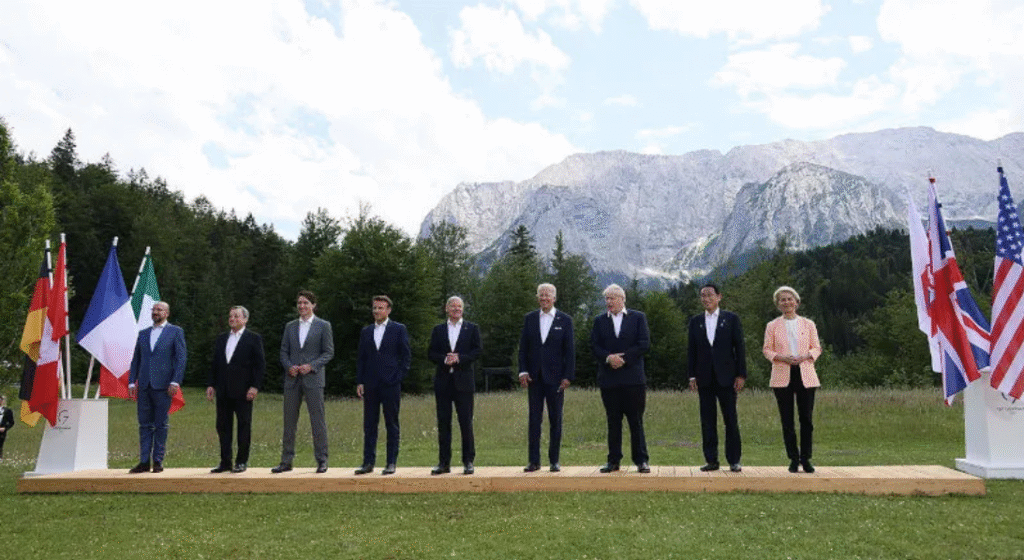
The G-7 countries are democratic domestically but are dictatorial globally. By contrast, the G-20 group, which has many autocratic regimes, represents a more democratic forum for governance.

The G-7 is dictatorial, while the G-20 is democratic.

This statement is obviously paradoxical. The G-7 countries are very proud of their liberal democratic societies. And they should be. However, while they are democratic domestically, they are dictatorial globally. By contrast, the G-20 group, which has many autocratic regimes, is more representative of the world’s population.

The spiritual essence of democracy is conveyed in the phrase: a government of the people, by the people, for the people. In short, it must represent a hundred per cent of the people. The G-7 represent just 10 per cent of the world’s population.

Yet, they make decisions and take actions that disrupt the lives of billions of people, including the world’s poor, without factoring in their interests and concerns. This is what dictators do.

Originally published at John Menadue’s “Pearls & Irritations” on August 4, 2022

The G-7 countries were right in imposing sanctions on Russia after its illegal invasion of Ukraine in February this year. But in designing the sanctions, the G-7 countries protected the interests of their own population, which makes up a minority of the world’s population. Indeed, the G-7 countries, especially the European countries, could have hastened the war’s end by boldly cutting off all the gas supplies from Russia immediately.

They didn’t do so because they didn’t want their own people to make any sacrifices. However, both the illegal Russian invasion and the subsequent sanctions led to massive increases in fuel and food prices, disrupting the lives of hundreds of millions, if not billions, of people, who had to make serious sacrifices.

Since the G-7 countries didn’t want to impose sacrifices on their own people, it was strange that they complained when China, India and other developing countries stepped up their purchases of Russian oil at a discount.

This led to two sharp responses from the Indian Foreign Minister S. Jaishankar. His two sharp responses resonated around the world. In response to criticisms about increased Indian oil purchases from Russia, he said: “India’s total purchases of oil from Russia in a month is probably less than what Europe does in an afternoon.” He also said, equally bitingly: “Europe has to grow out of the mindset that Europe’s problems are the world’s problems but the world’s problems are not Europe’s problems.”

Substitute G-7 for Europe and you get the essence of the problem with the G-7.

It takes care of the interests of the most privileged 10 per cent of the world’s population. It ignores the interests of the remaining 90 per cent. This is why the G-20 represents a more democratic forum governance. As Martin Wolf of the Financial Times wisely said: “The G-20 contains 63 per cent of the world’s people and 87 per cent of its output (at market prices). It contains the world’s most powerful countries and ones from every continent. It is our best chance for global economic governance.”

Even though the G-20 is a more democratic representation of the world’s population, some Western leaders are now suggesting that they should boycott the next G-20 leaders’ meeting, which will take place in Bali from Nov 15 to 16 2022, if Russian President Vladimir Putin is invited to attend. Any such Western boycott of the Bali Summit would be unwise. Indeed, it would damage the standing of the Western countries in the eyes of the majority of the world’s population in several ways.

Firstly, it will show the West acting in an “undemocratic” way by ignoring the wishes of the majority of the G-20 countries which want the meeting to continue, especially since the world is suffering from major global problems today. Secondly, if Mr Putin attends the G-20 meeting in Bali, he will hear the disapproving voices of both the West and the Rest on the invasion of Ukraine. He will also hear strong pleas to end the war as it is disrupting the lives of so many around the world.

Professor Barry R. Posen of MIT has argued persuasively in Foreign Affairs that the most likely result of the war in Ukraine is protracted conflict with painful losses on both sides. It’s thus in everyone’s best interests to “seek a diplomatic end to the war now”. His reasoning is sound. We’re more likely to get a diplomatic solution if Mr Putin hears clearly from his peers, both in the West and the Rest.

Finally, in ethical terms, the constituency we should care about the most is that of the very poor. On July 7, the United Nations Development Programme reported that an estimated 71 million people have fallen into poverty because of the skyrocketing food and fuel prices caused by the war in Ukraine, and that 750,000 people are at immediate risk of starvation. Given these dire challenges for the poor, it would be criminal to sabotage the November meeting of the G-20 leaders.

The West should also remember one important historical fact before taking action to undermine the Bali meeting. At the height of the Global Financial Crisis, when the Western countries were feeling threatened by an economic implosion, they convened the G-20 London Summit on April 2, 2009, to launch a global stimulus package to rescue the world economy.

All the G-20 countries – including the developing countries – participated in this US$1.1 trillion (S$1.53 trillion) rescue package, which was instrumental in turning things around for the embattled Western countries. The Rest didn’t hesitate to help the West in its hour of need. Perhaps the West should now consider repaying this debt by stepping up at the forthcoming Bali meeting to help the Rest.

Ultimately, to put it very simply, all eight billion people on Planet Earth are now on the same boat. We will sink or sail together. Let’s use the forthcoming G-20 meeting in Bali wisely to steer this common boat of ours.

Originally published at John Menadue’s “Pearls & Irritations” on August 4, 2022

About the author

Kishore Mahbubani is a veteran diplomat and a distinguished fellow at the Asia Research Institute at the National University of Singapore.

Source: The Straits Times © SPH Media Limited.

Please help TFF remain truly independent by contributing if you benefited from this article

Related Posts

The agreement is catastrophic both because of what it says and what it doesn’t mention. It reduces further the major asset of security policies: Freedom of action. Jan Oberg TFF director September 25, 2026 A couple of hours before the agreement was signed on September 22, 2026, I published the following 13 hypotheses about what it would most likely contain on TFF Substack (in English). I was wrong on only the first point. Contrary to what Trump had written on his Truth Social platform, it does not appear to come into force immediately. In fact, it turned out to be worse than even I had anticipated. After these hypotheses now come a number of reflections in light of what the agreement actually contains, and does not contain, as well as the way in which it has generally been presented by major media outlets and by the public-service broadcaster DR. My...
Jan Oberg, TFF director April 9, 2026 I was recently invited to have a good, long talk about the world – and, of course, about peace too – with Boris Malagurski on his Weight of Chains Channel on YouTube. It was a real joy and seems to have been greatly appreciated by the viewers too. Mr Malagurski and I shall of course be grateful if you share this conversation in your circles – of course, only if you like what you see and hear 😉☮️ And remember that this one – like hundreds of others with TFF Associates – can be enjoyed at our TFF Video Collection.
A friendly quarrel while we agree that the US sanctions are a weapon of mass destruction and kill more people than wars do. And that we must talk much more about sanctions than we have so far. Jan Oberg, TFF director March 16, 2026 John Mearsheimer recently stated that U.S. sanctions murdered around 38 million people between 1971 and 2021 – see the video below. It is a dramatic figure, and it has spread quickly because it captures, in one sentence, the enormous human cost of modern sanctions. I share his concern about the destructive effects of economic coercion. But the specific number he cites — and the way he attributes it — deserves a friendly academic clarification. The figure comes from a 2023 Lancet Global Health article estimating the mortality effects of unilateral U.S. and EU sanctions over the past half‑century. This is the first point where Mearsheimer’s shorthand diverges from the text: the study...

Recent Articles

Tony Robinson October 4, 2026 Violence is easy to recognise when someone is being beaten, shot or killed. It becomes more difficult when nobody is holding a weapon. Poverty, discrimination, exploitation and repression can restrict a human life just as effectively, although they do so in very different ways and with very different consequences. Simply adding more categories to an ever-growing list of forms of violence does not really solve the problem. The more interesting question is what all these different situations have in common and why it makes sense to describe them using the same word. Human beings do not simply react to what happens around them. They remember the past, imagine things that do not yet exist, make plans and undertake projects. Workers organise because they imagine different working conditions; people migrate because they imagine another life somewhere else; social movements emerge because people refuse to accept the...
It’s a matter of principles, courage, vision and pulling together – while the militarist world is falling apart… Peter Langille October 3, 2026 “Here, then, is the problem which we present to you, stark and dreadful and inescapable: Shall we put an end to the human race; or shall mankind renounce war?”The Bertrand Russell—Albert Einstein Manifesto, July 9, 1955 ⁕ The forecast for what’s ahead is worrisome. The sharp rise in armed conflicts over the past three years is adding to what was already the highest level in over seventy years. Genocides, which should be prevented are supported. A shared climate emergency that jeopardises survival is ignored. Diverse polls now suggest that people are war-weary, worried and interested in a more effective United Nations. And, there are viable policy options for a more secure world! Yet governments are doubling-down, betting on more war and investing heavily. If current trends persist,...
Johan Galtung 1930-2024October 2015 Published here on October 3, 2026 Let us focus on Civilization for conflict analysis and remedies. Major forms of disorder use violence; war is state organized violence. The most belligerent states are the United States of America and Israel, both with civilization roots. National Evangelism, the US Protestant Christian civilization– more national than evangelical–justifies US warfare as exceptionalism of a people chosen by God, with a manifest destiny to run the world. Orthodox Judaism justifies Israeli warfare to conquer and expand from Nile to Euphrates as a religious right and duty to the Eternal One. The third most belligerent country, the UK, no longer believes it is God-chosen but chosen by the USA; not quite the same but something. But the root cause of global disorder lies in the Occident–with Islam–seeing itself as the single, universal civilization valid for all at all times, all others being...

TFF on Substack

Discover and subscribe to more peace materials on TFF Substack

Most Popular

Tony Robinson October 4, 2026 Violence is easy to recognise when someone is being beaten, shot or killed. It becomes more difficult when nobody is holding a weapon. Poverty, discrimination, exploitation and repression can restrict a human life just as effectively, although they do so in very different ways and with very different consequences. Simply adding more categories to an ever-growing list of forms of violence does not really solve the problem. The more interesting question is what all these different situations have in common and why it makes sense to describe them using the same word. Human beings do not simply react to what happens around them. They remember the past, imagine things that do not yet exist, make plans and undertake projects. Workers organise because they imagine different working conditions; people migrate because they imagine another life somewhere else; social movements emerge because people refuse to accept the...
It’s a matter of principles, courage, vision and pulling together – while the militarist world is falling apart… Peter Langille October 3, 2026 “Here, then, is the problem which we present to you, stark and dreadful and inescapable: Shall we put an end to the human race; or shall mankind renounce war?”The Bertrand Russell—Albert Einstein Manifesto, July 9, 1955 ⁕ The forecast for what’s ahead is worrisome. The sharp rise in armed conflicts over the past three years is adding to what was already the highest level in over seventy years. Genocides, which should be prevented are supported. A shared climate emergency that jeopardises survival is ignored. Diverse polls now suggest that people are war-weary, worried and interested in a more effective United Nations. And, there are viable policy options for a more secure world! Yet governments are doubling-down, betting on more war and investing heavily. If current trends persist,...
Johan Galtung 1930-2024October 2015 Published here on October 3, 2026 Let us focus on Civilization for conflict analysis and remedies. Major forms of disorder use violence; war is state organized violence. The most belligerent states are the United States of America and Israel, both with civilization roots. National Evangelism, the US Protestant Christian civilization– more national than evangelical–justifies US warfare as exceptionalism of a people chosen by God, with a manifest destiny to run the world. Orthodox Judaism justifies Israeli warfare to conquer and expand from Nile to Euphrates as a religious right and duty to the Eternal One. The third most belligerent country, the UK, no longer believes it is God-chosen but chosen by the USA; not quite the same but something. But the root cause of global disorder lies in the Occident–with Islam–seeing itself as the single, universal civilization valid for all at all times, all others being...
Read More
Living-Peace-Sign-Budapest-copy
Tony Robinson October 4, 2026 Violence is easy to recognise when someone is being beaten, shot or killed. It becomes more difficult when nobody is holding a weapon. Poverty, discrimination, exploitation and repression can restrict a human life just as effectively, although they do so in very different ways and with very different consequences. Simply adding more categories to an ever-growing list of forms of violence does not really solve the problem. The more interesting question is what all these different situations have in common and why it makes sense to describe them using the same word. Human beings do not simply react to what happens around them. They remember the past, imagine things that do not yet exist, make plans and undertake projects. Workers organise because they imagine different working conditions; people migrate because they imagine another life somewhere else; social movements emerge because people refuse to accept the...
b54a1f10-8c65-4f0b-9dd5-4abc0a7d04cc_2659x2659
It’s a matter of principles, courage, vision and pulling together – while the militarist world is falling apart… Peter Langille October 3, 2026 “Here, then, is the problem which we present to you, stark and dreadful and inescapable: Shall we put an end to the human race; or shall mankind renounce war?”The Bertrand Russell—Albert Einstein Manifesto, July 9, 1955 ⁕ The forecast for what’s ahead is worrisome. The sharp rise in armed conflicts over the past three years is adding to what was already the highest level in over seventy years. Genocides, which should be prevented are supported. A shared climate emergency that jeopardises survival is ignored. Diverse polls now suggest that people are war-weary, worried and interested in a more effective United Nations. And, there are viable policy options for a more secure world! Yet governments are doubling-down, betting on more war and investing heavily. If current trends persist,...
010
Johan Galtung 1930-2024October 2015 Published here on October 3, 2026 Let us focus on Civilization for conflict analysis and remedies. Major forms of disorder use violence; war is state organized violence. The most belligerent states are the United States of America and Israel, both with civilization roots. National Evangelism, the US Protestant Christian civilization– more national than evangelical–justifies US warfare as exceptionalism of a people chosen by God, with a manifest destiny to run the world. Orthodox Judaism justifies Israeli warfare to conquer and expand from Nile to Euphrates as a religious right and duty to the Eternal One. The third most belligerent country, the UK, no longer believes it is God-chosen but chosen by the USA; not quite the same but something. But the root cause of global disorder lies in the Occident–with Islam–seeing itself as the single, universal civilization valid for all at all times, all others being...
Screenshot 2026-10-02 011738
Jan ObergPhD, director, The Transnational Foundation for Peace and Future Research, TFFLund, Sweden October 2, 2026 This is my full original manuscript. The Chinese Academy of Social Science, CASS, makes two publications out if it. 1. China’s Five-year plan emphasized the capabilities of basic research and original innovation. It is regarded as the goal of the future social development, which, as required, should be significantly enhanced. Can you comment on the importance of original innovation in research and academic study? I believe it is easier to define “original innovation” in the natural sciences than in social sciences. The breaking points of what constitutes something new, or innovative, are not quite as sharp in the latter. But in both fields it is about opening up something that was closed, unseen, unexplored before – making manifest what was earlier latent. Innovations come in many forms and shapes – naming something that was not...
arctic-circle-map
The agreement is catastrophic both because of what it says and what it doesn’t mention. It reduces further the major asset of security policies: Freedom of action. Jan Oberg TFF director September 25, 2026 A couple of hours before the agreement was signed on September 22, 2026, I published the following 13 hypotheses about what it would most likely contain on TFF Substack (in English). I was wrong on only the first point. Contrary to what Trump had written on his Truth Social platform, it does not appear to come into force immediately. In fact, it turned out to be worse than even I had anticipated. After these hypotheses now come a number of reflections in light of what the agreement actually contains, and does not contain, as well as the way in which it has generally been presented by major media outlets and by the public-service broadcaster DR. My...
girl-5894831_1280
Below are TFF-related media mentions, comments, videos and social media posts published elsewhere but not on this homepage. We happen to catch and list only a fraction. Regarding video comments and debates, we recommend that you go to the TFF Video Channel on Substack where many of them are reproduced. Jan Oberg is a contributor to China Daily – 52 million daily clicks – and Global Times, CGTN and CCTV (the national television), China Investment, Xinhua News Agency and several others. Articles and videos on these media very often multiply into countless Chinese (and Western media) that re-post them from these main media. Thanks to The China Academy, his analyses, interviews and comments are frequently posted on YouTube channels such as Thinkers Forum and Wave Media. These videos are often re-posted on Bilibili (China’s YouTube), the China Content Center on TikTok, and on the Chinese edition of TikTok, Douyin.com. This means reaching hundreds of millions of viewers worldwide over a year. While there are too many to catch on all these...




