
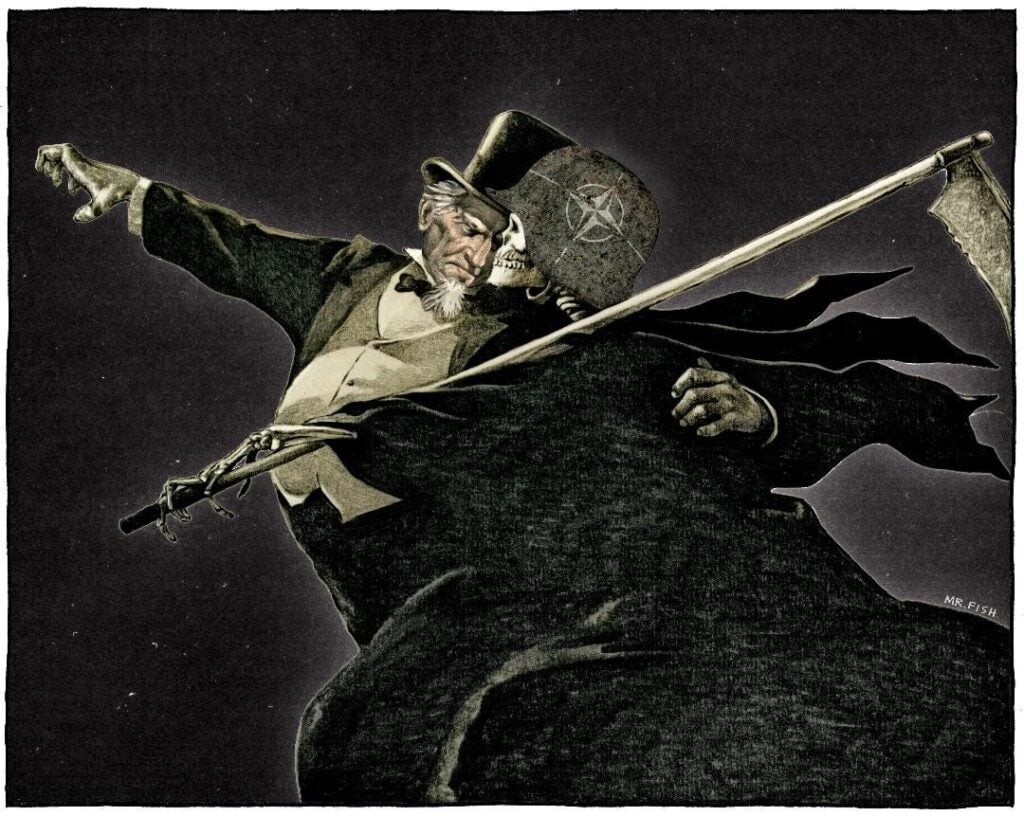
Chris Hedges: NATO – The Most Dangerous Military Alliance on the Planet

Together We Are Wrong — by Mr Fish

By Chris Hedges

August 4, 2022

The massive expansion of NATO, not only in Eastern and Central Europe but the Middle East, Latin America, Africa and Asia, presages endless war and a potential nuclear holocaust.

The North Atlantic Treaty Organization (NATO), and the arms industry that depends on it for billions in profits, has become the most aggressive and dangerous military alliance on the planet. Created in 1949 to thwart Soviet expansion into Eastern and Central Europe, it has evolved into a global war machine in Europe, the Middle East, Latin America, Africa and Asia. 

Originally published in The Chris Hedges Report on July 10, 2022

NATO expanded its footprint, violating promises to Moscow, once the Cold War ended, to incorporate 14 countries in Eastern and Central Europe into the alliance. It will soon add Finland and Sweden. It bombed Bosnia, Serbia and Kosovo. It launched wars in Afghanistan, Iraq, Syria and Libya, resulting in close to a million deaths and some 38 million people driven from their homes. 

It is building a military footprint in Africa and Asia. It invited Australia, Japan, New Zealand and South Korea, the so-called “Asia Pacific Four,” to its recent summit in Madrid at the end of June. It has expanded its reach into the Southern Hemisphere, signing a military training partnership agreement with Colombia, in December 2021.

It has backed Turkey, with NATO’s second-largest military, which has illegally invaded and occupied parts of Syria as well as Iraq. Turkish-backed militias are engaged in the ethnic cleansing of Syrian Kurds and other inhabitants of north and east Syria.

The Turkish military has been accused of war crimes – including multiple airstrikes against a refugee camp and chemical weapons use – in northern Iraq. In exchange for President Recep Tayyip Erdoğan’s permission for Finland and Sweden to join the alliance, the two Nordic countries have agreed to expand their domestic terror laws making it easier to crack down on Kurdish and other activists, lift their restrictions on selling arms to Turkey and deny support to the Kurdish-led movement for democratic autonomy in Syria.

It is quite a record for a military alliance that with the collapse of the Soviet Union was rendered obsolete and should have been dismantled. NATO and the militarists had no intention of embracing the “peace dividend,” fostering a world based on diplomacy, a respect of spheres of influence and mutual cooperation.

It was determined to stay in business. Its business is war. That meant expanding its war machine far beyond the border of Europe and engaging in ceaseless antagonism toward China and Russia. 

NATO sees the future, as detailed in its “NATO 2030: Unified for a New Era,” as a battle for hegemony with rival states, especially China, and calls for the preparation of prolonged global conflict.

“China has an increasingly global strategic agenda, supported by its economic and military heft,” the NATO 2030 initiative warned. “It has proven its willingness to use force against its neighbors, as well as economic coercion and intimidatory diplomacy well beyond the Indo-Pacific region. Over the coming decade, China will likely also challenge NATO’s ability to build collective resilience, safeguard critical infrastructure, address new and emerging technologies such as 5G and protect sensitive sectors of the economy including supply chains. Longer term, China is increasingly likely to project military power globally, including potentially in the Euro-Atlantic area.”

The alliance has spurned the Cold War strategy that made sure Washington was closer to Moscow and Beijing than Moscow and Beijing were to each other. U.S. and NATO antagonism have turned Russia and China into close allies. Russia, rich in natural resources, including energy, minerals and grains, and China, a manufacturing and technological behemoth, are a potent combination.

NATO no longer distinguishes between the two, announcing in its most recent mission statement that the “deepening strategic partnership” between Russia and China has resulted in “mutually reinforcing attempts to undercut the rules-based international order that run counter to our values and interests.” 

On July 6, Christopher Wray, director of the FBI, and Ken McCallum, director general of Britain’s MI5, held a joint news conference in London to announce that China was the “biggest long-term threat to our economic and national security.” They accused China, like Russia, of interfering in U.S. and U.K. elections.

Wray warned the business leaders they addressed that the Chinese government was “set on stealing your technology, whatever it is that makes your industry tick, and using it to undercut your business and dominate your market.”

This inflammatory rhetoric presages an ominous future.

One cannot talk about war without talking about markets. The political and social turmoil in the U.S., coupled with its diminishing economic power, has led it to embrace NATO and its war machine as the antidote to its decline.

Washington and its European allies are terrified of China’s trillion-dollar Belt and Road Initiative (BRI) meant to connect an economic bloc of roughly 70 nations outside U.S. control. The initiative includes the construction of rail lines, roads and gas pipelines that will be integrated with Russia.

Beijing is expected to commit $1.3 trillion to the BRI by 2027. China, which is on track to become the world’s largest economy within a decade, has organized the Regional Comprehensive Economic Partnership, the world’s largest trade pact of 15 East Asian and Pacific nations representing 30 percent of global trade. It already accounts for 28.7 percent of the Global Manufacturing Output, nearly double the 16.8 percent of the U.S. 

China’s rate of growth last year was an impressive  8.1 percent, although slowing to around 5 percent this year.  By contrast, the U.S.’s growth rate in 2021 was 5.7 percent — its highest since 1984 — but is predicted to fall below 1 percent this year, by the New York Federal Reserve.

If China, Russia, Iran, India and other nations free themselves from the tyranny of the U.S. dollar as the world’s reserve currency and the international Society for Worldwide Interbank Financial Telecommunication (SWIFT), a messaging network financial institutions use to send and receive information such as money transfer instructions, it will trigger a dramatic decline in the value of the dollar and a financial collapse in the U.S.

The huge military expenditures, which have driven the U.S. debt to $30 trillion, $ 6 trillion more than the U.S.’s entire GDP, will become untenable. Servicing this debt costs $300 billion a year. We spent more on the military in 2021, $ 801 billion which amounted to 38 percent of total world expenditure on the military, than the next nine countries, including China and Russia, combined.

The loss of the dollar as the world’s reserve currency will force the U.S. to slash spending, shutter many of its 800 military bases overseas and cope with the inevitable social and political upheavals triggered by economic collapse. It is darkly ironic that NATO has accelerated this possibility.

Russia, in the eyes of NATO and U.S. strategists, is the appetizer. Its military, NATO hopes, will get bogged down and degraded in Ukraine. Sanctions and diplomatic isolation, the plan goes, will thrust Vladimir Putin from power. A client regime that will do U.S. bidding will be installed in Moscow.

NATO has provided more than $8 billion in military aid to Ukraine, while the US has committed nearly $54 billion in military and humanitarian assistance to the country.

China, however, is the main course. Unable to compete economically, the U.S. and NATO have turned to the blunt instrument of war to cripple their global competitor. 

The provocation of China replicates the NATO baiting of Russia.

NATO expansion and the 2014 US-backed coup in Kyiv led Russia to first occupy Crimea, in eastern Ukraine, with its large ethnic Russian population, and then to invade all of Ukraine to thwart the country’s efforts to join NATO. 

The same dance of death is being played with China over Taiwan, which China considers part of Chinese territory, and with NATO expansion in the Asia Pacific. China flies warplanes into Taiwan’s air defense zone, and the U.S. sends naval ships through the Taiwan Strait which connects the South and East China seas.

Secretary of State Antony Blinken in May called China the most serious long-term challenge to the international order, citing its claims to Taiwan and efforts to dominate the South China Sea. Taiwan’s president, in a Zelensky-like publicity stunt, recently posed with an anti-tank rocket launcher in a government handout photo.

The conflict in Ukraine has been a bonanza for the arms industry, which, given the humiliating withdrawal from Afghanistan, needed a new conflict. Lockheed Martin’s stock prices are up 12 percent. Northrop Grumman is up 20 percent.

The war is being used by NATO to increase its military presence in Eastern and Central Europe. The U.S. is building a permanent military base in Poland. The 40,000-strong NATO reaction force is being expanded to 300,000 troops. Billions of dollars in weapons are pouring into the region.

The conflict with Russia, however, is already backfiring. The ruble has soared to a seven-year high against the dollar. Europe is barreling towards a recession because of rising oil and gas prices and the fear that Russia could terminate supplies completely.

The loss of Russian wheat, fertilizer, gas and oil, due to Western sanctions, is creating havoc in world markets and a humanitarian crisis in Africa and the Middle East. Soaring food and energy prices, along with shortages and crippling inflation, bring with them not only deprivation and hunger, but social upheaval and political instability. The climate emergency, the real existential threat, is being ignored to appease the gods of war.

The war makers are frighteningly cavalier about the threat of nuclear war. Putin warned NATO countries that they “will face consequences greater than any you have faced in history” if they intervened directly in Ukraine and ordered Russian nuclear forces to be put on heightened alert status.

The proximity to Russia of U.S. nuclear weapons based in Belgium, Germany, Italy, Netherlands and Turkey means that any nuclear conflict would obliterate much of Europe. Russia and the United States control about 90 percent of the world’s nuclear warheads, with around 4,000 warheads each in their military stockpiles, according to the Federation of American Scientists.

President Joe Biden warned that the use of nuclear weapons in Ukraine would be “completely unacceptable” and “entail severe consequences,” without spelling out what those consequences would be. This is what U.S. strategists refer to as “deliberate ambiguity.” 

The U.S. military, following its fiascos in the Middle East, has shifted its focus from fighting terrorism and asymmetrical warfare to confronting China and Russia. President Barack Obama’s national-security team in 2016 carried out a war game in which Russia invaded a NATO country in the Baltics and used a low-yield tactical nuclear weapon against NATO forces. Obama officials were split about how to respond. 

“The National Security Council’s so-called Principals Committee—including Cabinet officers and members of the Joint Chiefs of Staff—decided that the United States had no choice but to retaliate with nuclear weapons,” Eric Schlosser writes in The Atlantic. “Any other type of response, the committee argued, would show a lack of resolve, damage American credibility, and weaken the NATO alliance. Choosing a suitable nuclear target proved difficult, however. Hitting Russia’s invading force would kill innocent civilians in a NATO country. Striking targets inside Russia might escalate the conflict to an all-out nuclear war. In the end, the NSC Principals Committee recommended a nuclear attack on Belarus—a nation that had played no role whatsoever in the invasion of the NATO ally but had the misfortune of being a Russian ally.” 

The Biden administration has formed a Tiger Team of national security officials to run war games on what to do if Russia uses a nuclear weapon, according to The New York Times. The threat of nuclear war is minimized with discussions of “tactical nuclear weapons,” as if less powerful nuclear explosions are somehow more acceptable and won’t lead to the use of bigger bombs. 

At no time, including the Cuban missile crisis, have we stood closer to the precipice of nuclear war. 

“A simulation devised by experts at Princeton University starts with Moscow firing a nuclear warning shot; NATO responds with a small strike, and the ensuing war yields more than 90 million casualties in its first few hours,” The New York Times reported.

The longer the war in Ukraine continues — and the U.S. and NATO seem determined to funnel billions of dollars of weapons into the conflict for months if not years — the more the unthinkable becomes thinkable.

Flirting with Armageddon to profit the arms industry and carry out the futile quest to reclaim U.S. global hegemony is at best extremely reckless and at worst genocidal.

Originally published in The Chris Hedges Report on July 10, 2022

About the author

Chris Hedges is a Pulitzer Prize-winning author and journalist who was a foreign correspondent for fifteen years for The New York Times. There are several places where you can learn more about this extraordinary person – like Chris Hedges and The Chris Hedges Report on Substack.

“Chris Hedges is the greatest radical writer and journalist of our generation! His courage and consistency are legendary!”

– Dr Cornel West

Please help TFF remain truly independent by contributing if you benefited from this article

Related Posts

The agreement is catastrophic both because of what it says and what it doesn’t mention. It reduces further the major asset of security policies: Freedom of action. Jan Oberg TFF director September 25, 2026 A couple of hours before the agreement was signed on September 22, 2026, I published the following 13 hypotheses about what it would most likely contain on TFF Substack (in English). I was wrong on only the first point. Contrary to what Trump had written on his Truth Social platform, it does not appear to come into force immediately. In fact, it turned out to be worse than even I had anticipated. After these hypotheses now come a number of reflections in light of what the agreement actually contains, and does not contain, as well as the way in which it has generally been presented by major media outlets and by the public-service broadcaster DR. My...
Jan Oberg May 15, 2026 Go to this Fox News page and scroll the whole way down: President Donald Trump tells the world that his meeting with President Xi Jinping yielded a lot of very concrete political and economic results – of course, only where the Chinese side, according to him, agreed with him. He does not mention the Taiwan issue, but Secretary of State, Marco Rubio, says that it did not feature prominently in their talks and that the US policy on Taiwan has not changed. Then go to China Daily – or Global Times – and you will see that for the Chinese it is framework, principles, structure of cooperation etc. that matters – all embedded in the overall idea of “constructive bilateral relationship of strategic stability.” Nowhere is any concrete agreement or deal – all that Trump refers to – mentioned. At the general level, this gives you insights into the very different social...
In contrast to most, we’ll bring alternatives, solutions, hope and strategies for a better future. Times are dangerous, yes, but that only intensifies the need for constructive thinking and action! Jan Oberg, TFF director April 13, 2026 The new TFF Peace Pulse uses video messages in a new way: Max 3-5-minute-long comments, ideas or perhaps mini-lectures, all about peace – positive peace. We launch them today on April 13, 2026 with a carefully crafted visual aesthetic fitting the content. We hope to publish them regularly from now on. We launch Peace Pulse (PP) – for a number of reasons. The world is in chaos, and there are countless reasons to feel concerned, frustrated, even angry. The atmosphere is saturated with doom and gloom, with negative energy and rear‑mirror thinking, while vision, imagination, alternatives, strategies and genuine future‑mindedness remain in short supply. And without them, we simply can’t save the world. Looking at problems from a hundred angles will...

Recent Articles

Tony Robinson October 4, 2026 Violence is easy to recognise when someone is being beaten, shot or killed. It becomes more difficult when nobody is holding a weapon. Poverty, discrimination, exploitation and repression can restrict a human life just as effectively, although they do so in very different ways and with very different consequences. Simply adding more categories to an ever-growing list of forms of violence does not really solve the problem. The more interesting question is what all these different situations have in common and why it makes sense to describe them using the same word. Human beings do not simply react to what happens around them. They remember the past, imagine things that do not yet exist, make plans and undertake projects. Workers organise because they imagine different working conditions; people migrate because they imagine another life somewhere else; social movements emerge because people refuse to accept the...
It’s a matter of principles, courage, vision and pulling together – while the militarist world is falling apart… Peter Langille October 3, 2026 “Here, then, is the problem which we present to you, stark and dreadful and inescapable: Shall we put an end to the human race; or shall mankind renounce war?”The Bertrand Russell—Albert Einstein Manifesto, July 9, 1955 ⁕ The forecast for what’s ahead is worrisome. The sharp rise in armed conflicts over the past three years is adding to what was already the highest level in over seventy years. Genocides, which should be prevented are supported. A shared climate emergency that jeopardises survival is ignored. Diverse polls now suggest that people are war-weary, worried and interested in a more effective United Nations. And, there are viable policy options for a more secure world! Yet governments are doubling-down, betting on more war and investing heavily. If current trends persist,...
Johan Galtung 1930-2024October 2015 Published here on October 3, 2026 Let us focus on Civilization for conflict analysis and remedies. Major forms of disorder use violence; war is state organized violence. The most belligerent states are the United States of America and Israel, both with civilization roots. National Evangelism, the US Protestant Christian civilization– more national than evangelical–justifies US warfare as exceptionalism of a people chosen by God, with a manifest destiny to run the world. Orthodox Judaism justifies Israeli warfare to conquer and expand from Nile to Euphrates as a religious right and duty to the Eternal One. The third most belligerent country, the UK, no longer believes it is God-chosen but chosen by the USA; not quite the same but something. But the root cause of global disorder lies in the Occident–with Islam–seeing itself as the single, universal civilization valid for all at all times, all others being...

TFF on Substack

Discover and subscribe to more peace materials on TFF Substack

Most Popular

Tony Robinson October 4, 2026 Violence is easy to recognise when someone is being beaten, shot or killed. It becomes more difficult when nobody is holding a weapon. Poverty, discrimination, exploitation and repression can restrict a human life just as effectively, although they do so in very different ways and with very different consequences. Simply adding more categories to an ever-growing list of forms of violence does not really solve the problem. The more interesting question is what all these different situations have in common and why it makes sense to describe them using the same word. Human beings do not simply react to what happens around them. They remember the past, imagine things that do not yet exist, make plans and undertake projects. Workers organise because they imagine different working conditions; people migrate because they imagine another life somewhere else; social movements emerge because people refuse to accept the...
It’s a matter of principles, courage, vision and pulling together – while the militarist world is falling apart… Peter Langille October 3, 2026 “Here, then, is the problem which we present to you, stark and dreadful and inescapable: Shall we put an end to the human race; or shall mankind renounce war?”The Bertrand Russell—Albert Einstein Manifesto, July 9, 1955 ⁕ The forecast for what’s ahead is worrisome. The sharp rise in armed conflicts over the past three years is adding to what was already the highest level in over seventy years. Genocides, which should be prevented are supported. A shared climate emergency that jeopardises survival is ignored. Diverse polls now suggest that people are war-weary, worried and interested in a more effective United Nations. And, there are viable policy options for a more secure world! Yet governments are doubling-down, betting on more war and investing heavily. If current trends persist,...
Johan Galtung 1930-2024October 2015 Published here on October 3, 2026 Let us focus on Civilization for conflict analysis and remedies. Major forms of disorder use violence; war is state organized violence. The most belligerent states are the United States of America and Israel, both with civilization roots. National Evangelism, the US Protestant Christian civilization– more national than evangelical–justifies US warfare as exceptionalism of a people chosen by God, with a manifest destiny to run the world. Orthodox Judaism justifies Israeli warfare to conquer and expand from Nile to Euphrates as a religious right and duty to the Eternal One. The third most belligerent country, the UK, no longer believes it is God-chosen but chosen by the USA; not quite the same but something. But the root cause of global disorder lies in the Occident–with Islam–seeing itself as the single, universal civilization valid for all at all times, all others being...
Read More
Living-Peace-Sign-Budapest-copy
Tony Robinson October 4, 2026 Violence is easy to recognise when someone is being beaten, shot or killed. It becomes more difficult when nobody is holding a weapon. Poverty, discrimination, exploitation and repression can restrict a human life just as effectively, although they do so in very different ways and with very different consequences. Simply adding more categories to an ever-growing list of forms of violence does not really solve the problem. The more interesting question is what all these different situations have in common and why it makes sense to describe them using the same word. Human beings do not simply react to what happens around them. They remember the past, imagine things that do not yet exist, make plans and undertake projects. Workers organise because they imagine different working conditions; people migrate because they imagine another life somewhere else; social movements emerge because people refuse to accept the...
b54a1f10-8c65-4f0b-9dd5-4abc0a7d04cc_2659x2659
It’s a matter of principles, courage, vision and pulling together – while the militarist world is falling apart… Peter Langille October 3, 2026 “Here, then, is the problem which we present to you, stark and dreadful and inescapable: Shall we put an end to the human race; or shall mankind renounce war?”The Bertrand Russell—Albert Einstein Manifesto, July 9, 1955 ⁕ The forecast for what’s ahead is worrisome. The sharp rise in armed conflicts over the past three years is adding to what was already the highest level in over seventy years. Genocides, which should be prevented are supported. A shared climate emergency that jeopardises survival is ignored. Diverse polls now suggest that people are war-weary, worried and interested in a more effective United Nations. And, there are viable policy options for a more secure world! Yet governments are doubling-down, betting on more war and investing heavily. If current trends persist,...
010
Johan Galtung 1930-2024October 2015 Published here on October 3, 2026 Let us focus on Civilization for conflict analysis and remedies. Major forms of disorder use violence; war is state organized violence. The most belligerent states are the United States of America and Israel, both with civilization roots. National Evangelism, the US Protestant Christian civilization– more national than evangelical–justifies US warfare as exceptionalism of a people chosen by God, with a manifest destiny to run the world. Orthodox Judaism justifies Israeli warfare to conquer and expand from Nile to Euphrates as a religious right and duty to the Eternal One. The third most belligerent country, the UK, no longer believes it is God-chosen but chosen by the USA; not quite the same but something. But the root cause of global disorder lies in the Occident–with Islam–seeing itself as the single, universal civilization valid for all at all times, all others being...
Screenshot 2026-10-02 011738
Jan ObergPhD, director, The Transnational Foundation for Peace and Future Research, TFFLund, Sweden October 2, 2026 This is my full original manuscript. The Chinese Academy of Social Science, CASS, makes two publications out if it. 1. China’s Five-year plan emphasized the capabilities of basic research and original innovation. It is regarded as the goal of the future social development, which, as required, should be significantly enhanced. Can you comment on the importance of original innovation in research and academic study? I believe it is easier to define “original innovation” in the natural sciences than in social sciences. The breaking points of what constitutes something new, or innovative, are not quite as sharp in the latter. But in both fields it is about opening up something that was closed, unseen, unexplored before – making manifest what was earlier latent. Innovations come in many forms and shapes – naming something that was not...
arctic-circle-map
The agreement is catastrophic both because of what it says and what it doesn’t mention. It reduces further the major asset of security policies: Freedom of action. Jan Oberg TFF director September 25, 2026 A couple of hours before the agreement was signed on September 22, 2026, I published the following 13 hypotheses about what it would most likely contain on TFF Substack (in English). I was wrong on only the first point. Contrary to what Trump had written on his Truth Social platform, it does not appear to come into force immediately. In fact, it turned out to be worse than even I had anticipated. After these hypotheses now come a number of reflections in light of what the agreement actually contains, and does not contain, as well as the way in which it has generally been presented by major media outlets and by the public-service broadcaster DR. My...
girl-5894831_1280
Below are TFF-related media mentions, comments, videos and social media posts published elsewhere but not on this homepage. We happen to catch and list only a fraction. Regarding video comments and debates, we recommend that you go to the TFF Video Channel on Substack where many of them are reproduced. Jan Oberg is a contributor to China Daily – 52 million daily clicks – and Global Times, CGTN and CCTV (the national television), China Investment, Xinhua News Agency and several others. Articles and videos on these media very often multiply into countless Chinese (and Western media) that re-post them from these main media. Thanks to The China Academy, his analyses, interviews and comments are frequently posted on YouTube channels such as Thinkers Forum and Wave Media. These videos are often re-posted on Bilibili (China’s YouTube), the China Content Center on TikTok, and on the Chinese edition of TikTok, Douyin.com. This means reaching hundreds of millions of viewers worldwide over a year. While there are too many to catch on all these...




