
Meet NATO, the Dangerous “Defensive” Alliance Trying to Run the World

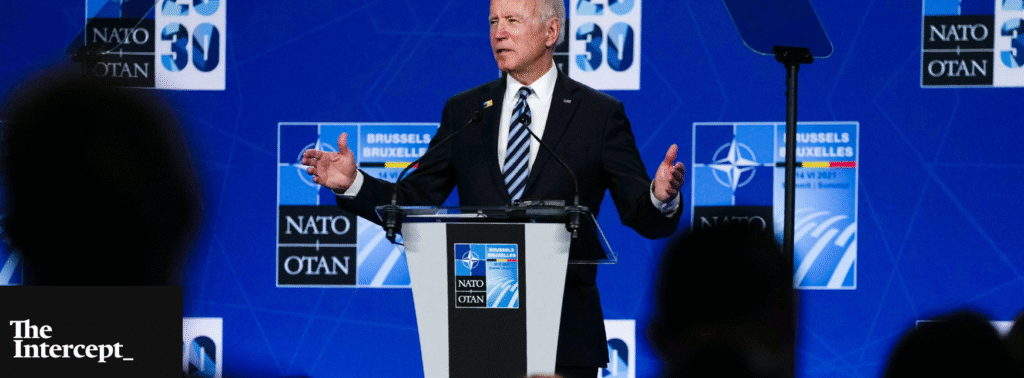
President Joe Biden speaks at the NATO summit at the group’s headquarters in Brussels on June 14, 2021. Photo: Francisco Seco/Pool/AFP via Getty Images

Jon Schwarz

June 30, 2022

NATO’s summit showed how the “North Atlantic” Treaty Organization has decided it has an extremely expansive global mission.

IN A STOP last week on his way to Belgium for Monday’s NATO summit, President Joe Biden visited a Royal Air Force base in eastern England. “In Brussels,” he told the assembled crowd, “I will make it clear that the United States’s commitment to our NATO alliance and Article 5 is rock solid. It’s a sacred obligation that we have under Article 5.”

These lines were aimed at a tiny number of human beings. Certainly almost no Americans have any idea what “Article 5” is part of or what it says.

Originally published at The Intercept on June 15, 2022

But Biden’s words were genuinely significant. Article 5 is a clause in the North Atlantic Treaty, the founding document of NATO, which states that any armed attack against any member of the alliance “shall be considered an attack against them all.”

This is at the core of how the U.S. runs the world and intends to keep running it in the future. It also signifies that should we face the prospect of sharing power with others — today that mostly means China — we may end up destroying the world.

The North Atlantic Treaty is also known as the Washington Treaty, which tells you most of what you need to know about it. It was written in 1949, a time when U.S. power was so overweening that it could simply dictate terms to its allies. Most of whatever little discussion there was with other countries’ diplomats took place in secret over two weeks at the Pentagon.

It was co-written by the delightfully-named Thomas Achilles, a State Department official who later said his boss had told him, “I don’t care whether entangling alliances have been considered worse than original sin ever since George Washington’s time. We’ve got to negotiate a military alliance with Western Europe in peacetime and we’ve got to do it quickly.”

The public rationale for NATO was that it was a defensive alliance necessary to stop the Soviet Union from invading Western Europe. The private rationale, as articulated by Achilles, was somewhat different:

At that point Western Europe was devastated, prostrate and demoralized and it badly needed confidence and energy within. With the Soviet armies halfway across Europe and still at their full wartime strength and the Communist parties the largest single political elements in France and Italy, something to inspire Soviet respect was equally essential.

Some top U.S. officials did honestly think that the Soviet Union was poised to stage a military attack. Whether that belief had any basis in reality is extremely debatable; about 27 million Russians, or 1 in every 6 people in the country, had just died in World War II.

The equivalent for the U.S. today would be 50 million dead Americans. Even Joseph Stalin might have had a tough time motivating the country to immediately embark on another such event.

A more reasonable concern for the American government was a political, rather than military, threat. As Achilles said, there were powerful communist parties across Europe, especially in France and Italy — ones that could plausibly win honest elections. The anti-communist forces in those countries needed the “confidence and energy” of NATO to fight back. Meanwhile, NATO would “inspire Soviet respect” that would hopefully lessen Russian support, material and moral, for Europe’s communist parties.

Something else is notable about NATO’s founding. The original 12 members were Belgium, Canada, Denmark, France, Iceland, Italy, Luxembourg, the Netherlands, Norway, Portugal, the U.K., and the U.S. — in hindsight, something of an all-star league of European colonialism.

It’s difficult today not to notice the blindingly alabaster complexion of the officials who signed the treaty. The original version of the treaty even specifies that it applied to any attack on “the Algerian Departments of France.”

In any case, the architects of NATO would say that they were simply responding to the Cold War, already in progress at the instigation of the Soviets. A fuller reading of history suggests that the formation of NATO helped intensify and institutionalize the Cold War.

The Warsaw Pact, after all, was not created until 1955, six years later, and its text is in many ways a replica of that of NATO’s treaty. It even has its own Article 5 language, except it’s in Article 4.

The unstated logic of both NATO and the Warsaw Pact was also the same. Indeed, it’s identical to that of similar alliances for thousands of years going back to the Delian League, founded in 478 B.C. and led by Athens. Providing protection is one key way for powerful countries to bind less powerful ones to them.

The U.S. didn’t create NATO because we believed that we’d someday need Luxembourg’s military might to save us, nor did the Soviets come up with the Warsaw Pact because they felt that way about Albania. Rather, both superpowers knew that if they didn’t promise smaller countries protection, the smaller countries would feel compelled to protect themselves — which would lead to them wandering off on their own with their own foreign policies. That’s no way to run a sphere of influence.

NATO worked during the Cold War, both in the sense that there was no Soviet invasion and that the U.S. was able to corral Western Europe into following our instructions most of the time. A smattering of new countries joined during this period: Greece and Turkey in 1952, West Germany in 1955, and Spain in 1982.

Then came the dissolution of the Soviet Union, beginning in the late 1980s. If NATO’s champions were correct, it would have similarly been disbanded, its purported purpose now moot. But NATO’s more sceptical critics, who claimed that it was largely an aggressive instrument of U.S. power, have clearly been proven right over time.

As Mikhail Gorbachev attempted to peacefully dismantle the Soviet Union and the Warsaw Pact, he sought assurances from the U.S. that NATO would not expand into the areas the Soviets were vacating. James Baker, President George H.W. Bush’s secretary of state, told Gorbachev not once but three times that wouldn’t happen. “Not an inch of NATO’s present military jurisdiction will spread in an eastern direction,” Baker promised.

Instead, in 1999 NATO incorporated the Czech Republic, Poland, and Hungary, a big chunk of what had been the Warsaw Pact. Then in 2004 Bulgaria, Romania, and Slovakia, more of the Warsaw Pact, joined, along with Latvia and Lithuania, which had actually been part of the Soviet Union. Other Eastern European countries followed, bringing NATO’s current membership to 30.

NATO’s goals have expanded along with its territory. The U.S. has found it particularly useful as a way to create legitimacy for wars when the United Nations won’t authorize them, as with the bombing of Serbia in 1999 and Libya in 2011.

In both cases, the American government pointed to NATO’s involvement as making the wars “multilateral” — that is, not unilateral acts by the U.S. — even though the U.S. provided the crucial firepower and neither war would have happened if America hadn’t wanted them to.

Russia has greeted these events with the same enthusiasm that the U.S. would if Mexico, Canada, and a newly independent Texas joined a Russian-led military alliance. Of particular concern to Russia is the possibility of Ukraine, another huge chunk of the former Soviet Union, becoming part of NATO.

NATO is also looking farther afield, to the entire planet. It just released “NATO 2030,” which describes an “an ambitious agenda to make sure NATO remains ready, strong and united for a new era of global competition. … NATO needs to adopt a more global approach to tackle global challenges to Atlantic security.” The head of NATO recently discussed this need with Lloyd Austin, the new U.S. secretary of Defense.

Oddly, it turns out that the North Atlantic Treaty Organization’s “Atlantic security” now is largely about China, a country famously located in the Pacific. After Tuesday’s summit, NATO released its formal communiqué, which said, among other things, that “China’s stated ambitions and assertive behaviour present systemic challenges to the rules-based international order and to areas relevant to Alliance security.”

It now seems quite possible that NATO will accomplish in the near future what it did 70 years ago — that is, push countries outside it into their own alliance in what they perceive as necessary self-defense. Thus just as NATO helped create the Cold War then, it’s well on its way to creating a sequel now.

Ominously, there is essentially no discussion about this in the U.S. and Europe. As Biden said, the small number of elites who are involved in these discussions see NATO as “sacred.” Similarly, when advocating for the creation of NATO, then-British Foreign Secretary Ernest Bevin said it was necessary for “the salvation of the West.”

As strange as it may seem for normal people, NATO is an institution of religious fervor for Western elites and therefore cannot be debated, any more than the Pope is open to debate about the Holy Trinity. And we all know how religions can lead to war.

Originally published at The Intercept on June 15, 2022

About the author

Before joining First Look Media, Jon Schwarz worked for Michael Moore’s Dog Eat Dog Films and was a research producer for Moore’s “Capitalism: A Love Story.” He’s contributed to many publications, including the New Yorker, the New York Times, The Atlantic, the Wall Street Journal, Mother Jones, and Slate, as well as NPR and “Saturday Night Live.” In 2003, he collected a $1,000 bet that Iraq would have no weapons of mass destruction.

Please help TFF remain truly independent by contributing if you benefited from this article

Related Posts

Jan Oberg May 15, 2026 Go to this Fox News page and scroll the whole way down: President Donald Trump tells the world that his meeting with President Xi Jinping yielded a lot of very concrete political and economic results – of course, only where the Chinese side, according to him, agreed with him. He does not mention the Taiwan issue, but Secretary of State, Marco Rubio, says that it did not feature prominently in their talks and that the US policy on Taiwan has not changed. Then go to China Daily – or Global Times – and you will see that for the Chinese it is framework, principles, structure of cooperation etc. that matters – all embedded in the overall idea of “constructive bilateral relationship of strategic stability.” Nowhere is any concrete agreement or deal – all that Trump refers to – mentioned. At the general level, this gives you insights into the very different social...
Jan Oberg, TFF director April 9, 2026 I was recently invited to have a good, long talk about the world – and, of course, about peace too – with Boris Malagurski on his Weight of Chains Channel on YouTube. It was a real joy and seems to have been greatly appreciated by the viewers too. Mr Malagurski and I shall of course be grateful if you share this conversation in your circles – of course, only if you like what you see and hear 😉☮️ And remember that this one – like hundreds of others with TFF Associates – can be enjoyed at our TFF Video Collection.
A friendly quarrel while we agree that the US sanctions are a weapon of mass destruction and kill more people than wars do. And that we must talk much more about sanctions than we have so far. Jan Oberg, TFF director March 16, 2026 John Mearsheimer recently stated that U.S. sanctions murdered around 38 million people between 1971 and 2021 – see the video below. It is a dramatic figure, and it has spread quickly because it captures, in one sentence, the enormous human cost of modern sanctions. I share his concern about the destructive effects of economic coercion. But the specific number he cites — and the way he attributes it — deserves a friendly academic clarification. The figure comes from a 2023 Lancet Global Health article estimating the mortality effects of unilateral U.S. and EU sanctions over the past half‑century. This is the first point where Mearsheimer’s shorthand diverges from the text: the study...

Recent Articles

Tony Robinson October 4, 2026 Violence is easy to recognise when someone is being beaten, shot or killed. It becomes more difficult when nobody is holding a weapon. Poverty, discrimination, exploitation and repression can restrict a human life just as effectively, although they do so in very different ways and with very different consequences. Simply adding more categories to an ever-growing list of forms of violence does not really solve the problem. The more interesting question is what all these different situations have in common and why it makes sense to describe them using the same word. Human beings do not simply react to what happens around them. They remember the past, imagine things that do not yet exist, make plans and undertake projects. Workers organise because they imagine different working conditions; people migrate because they imagine another life somewhere else; social movements emerge because people refuse to accept the...
It’s a matter of principles, courage, vision and pulling together – while the militarist world is falling apart… Peter Langille October 3, 2026 “Here, then, is the problem which we present to you, stark and dreadful and inescapable: Shall we put an end to the human race; or shall mankind renounce war?”The Bertrand Russell—Albert Einstein Manifesto, July 9, 1955 ⁕ The forecast for what’s ahead is worrisome. The sharp rise in armed conflicts over the past three years is adding to what was already the highest level in over seventy years. Genocides, which should be prevented are supported. A shared climate emergency that jeopardises survival is ignored. Diverse polls now suggest that people are war-weary, worried and interested in a more effective United Nations. And, there are viable policy options for a more secure world! Yet governments are doubling-down, betting on more war and investing heavily. If current trends persist,...
Johan Galtung 1930-2024October 2015 Published here on October 3, 2026 Let us focus on Civilization for conflict analysis and remedies. Major forms of disorder use violence; war is state organized violence. The most belligerent states are the United States of America and Israel, both with civilization roots. National Evangelism, the US Protestant Christian civilization– more national than evangelical–justifies US warfare as exceptionalism of a people chosen by God, with a manifest destiny to run the world. Orthodox Judaism justifies Israeli warfare to conquer and expand from Nile to Euphrates as a religious right and duty to the Eternal One. The third most belligerent country, the UK, no longer believes it is God-chosen but chosen by the USA; not quite the same but something. But the root cause of global disorder lies in the Occident–with Islam–seeing itself as the single, universal civilization valid for all at all times, all others being...

TFF on Substack

Discover and subscribe to more peace materials on TFF Substack

Most Popular

Tony Robinson October 4, 2026 Violence is easy to recognise when someone is being beaten, shot or killed. It becomes more difficult when nobody is holding a weapon. Poverty, discrimination, exploitation and repression can restrict a human life just as effectively, although they do so in very different ways and with very different consequences. Simply adding more categories to an ever-growing list of forms of violence does not really solve the problem. The more interesting question is what all these different situations have in common and why it makes sense to describe them using the same word. Human beings do not simply react to what happens around them. They remember the past, imagine things that do not yet exist, make plans and undertake projects. Workers organise because they imagine different working conditions; people migrate because they imagine another life somewhere else; social movements emerge because people refuse to accept the...
It’s a matter of principles, courage, vision and pulling together – while the militarist world is falling apart… Peter Langille October 3, 2026 “Here, then, is the problem which we present to you, stark and dreadful and inescapable: Shall we put an end to the human race; or shall mankind renounce war?”The Bertrand Russell—Albert Einstein Manifesto, July 9, 1955 ⁕ The forecast for what’s ahead is worrisome. The sharp rise in armed conflicts over the past three years is adding to what was already the highest level in over seventy years. Genocides, which should be prevented are supported. A shared climate emergency that jeopardises survival is ignored. Diverse polls now suggest that people are war-weary, worried and interested in a more effective United Nations. And, there are viable policy options for a more secure world! Yet governments are doubling-down, betting on more war and investing heavily. If current trends persist,...
Johan Galtung 1930-2024October 2015 Published here on October 3, 2026 Let us focus on Civilization for conflict analysis and remedies. Major forms of disorder use violence; war is state organized violence. The most belligerent states are the United States of America and Israel, both with civilization roots. National Evangelism, the US Protestant Christian civilization– more national than evangelical–justifies US warfare as exceptionalism of a people chosen by God, with a manifest destiny to run the world. Orthodox Judaism justifies Israeli warfare to conquer and expand from Nile to Euphrates as a religious right and duty to the Eternal One. The third most belligerent country, the UK, no longer believes it is God-chosen but chosen by the USA; not quite the same but something. But the root cause of global disorder lies in the Occident–with Islam–seeing itself as the single, universal civilization valid for all at all times, all others being...
Read More
Living-Peace-Sign-Budapest-copy
Tony Robinson October 4, 2026 Violence is easy to recognise when someone is being beaten, shot or killed. It becomes more difficult when nobody is holding a weapon. Poverty, discrimination, exploitation and repression can restrict a human life just as effectively, although they do so in very different ways and with very different consequences. Simply adding more categories to an ever-growing list of forms of violence does not really solve the problem. The more interesting question is what all these different situations have in common and why it makes sense to describe them using the same word. Human beings do not simply react to what happens around them. They remember the past, imagine things that do not yet exist, make plans and undertake projects. Workers organise because they imagine different working conditions; people migrate because they imagine another life somewhere else; social movements emerge because people refuse to accept the...
b54a1f10-8c65-4f0b-9dd5-4abc0a7d04cc_2659x2659
It’s a matter of principles, courage, vision and pulling together – while the militarist world is falling apart… Peter Langille October 3, 2026 “Here, then, is the problem which we present to you, stark and dreadful and inescapable: Shall we put an end to the human race; or shall mankind renounce war?”The Bertrand Russell—Albert Einstein Manifesto, July 9, 1955 ⁕ The forecast for what’s ahead is worrisome. The sharp rise in armed conflicts over the past three years is adding to what was already the highest level in over seventy years. Genocides, which should be prevented are supported. A shared climate emergency that jeopardises survival is ignored. Diverse polls now suggest that people are war-weary, worried and interested in a more effective United Nations. And, there are viable policy options for a more secure world! Yet governments are doubling-down, betting on more war and investing heavily. If current trends persist,...
010
Johan Galtung 1930-2024October 2015 Published here on October 3, 2026 Let us focus on Civilization for conflict analysis and remedies. Major forms of disorder use violence; war is state organized violence. The most belligerent states are the United States of America and Israel, both with civilization roots. National Evangelism, the US Protestant Christian civilization– more national than evangelical–justifies US warfare as exceptionalism of a people chosen by God, with a manifest destiny to run the world. Orthodox Judaism justifies Israeli warfare to conquer and expand from Nile to Euphrates as a religious right and duty to the Eternal One. The third most belligerent country, the UK, no longer believes it is God-chosen but chosen by the USA; not quite the same but something. But the root cause of global disorder lies in the Occident–with Islam–seeing itself as the single, universal civilization valid for all at all times, all others being...
Screenshot 2026-10-02 011738
Jan ObergPhD, director, The Transnational Foundation for Peace and Future Research, TFFLund, Sweden October 2, 2026 This is my full original manuscript. The Chinese Academy of Social Science, CASS, makes two publications out if it. 1. China’s Five-year plan emphasized the capabilities of basic research and original innovation. It is regarded as the goal of the future social development, which, as required, should be significantly enhanced. Can you comment on the importance of original innovation in research and academic study? I believe it is easier to define “original innovation” in the natural sciences than in social sciences. The breaking points of what constitutes something new, or innovative, are not quite as sharp in the latter. But in both fields it is about opening up something that was closed, unseen, unexplored before – making manifest what was earlier latent. Innovations come in many forms and shapes – naming something that was not...
arctic-circle-map
The agreement is catastrophic both because of what it says and what it doesn’t mention. It reduces further the major asset of security policies: Freedom of action. Jan Oberg TFF director September 25, 2026 A couple of hours before the agreement was signed on September 22, 2026, I published the following 13 hypotheses about what it would most likely contain on TFF Substack (in English). I was wrong on only the first point. Contrary to what Trump had written on his Truth Social platform, it does not appear to come into force immediately. In fact, it turned out to be worse than even I had anticipated. After these hypotheses now come a number of reflections in light of what the agreement actually contains, and does not contain, as well as the way in which it has generally been presented by major media outlets and by the public-service broadcaster DR. My...
girl-5894831_1280
Below are TFF-related media mentions, comments, videos and social media posts published elsewhere but not on this homepage. We happen to catch and list only a fraction. Regarding video comments and debates, we recommend that you go to the TFF Video Channel on Substack where many of them are reproduced. Jan Oberg is a contributor to China Daily – 52 million daily clicks – and Global Times, CGTN and CCTV (the national television), China Investment, Xinhua News Agency and several others. Articles and videos on these media very often multiply into countless Chinese (and Western media) that re-post them from these main media. Thanks to The China Academy, his analyses, interviews and comments are frequently posted on YouTube channels such as Thinkers Forum and Wave Media. These videos are often re-posted on Bilibili (China’s YouTube), the China Content Center on TikTok, and on the Chinese edition of TikTok, Douyin.com. This means reaching hundreds of millions of viewers worldwide over a year. While there are too many to catch on all these...




