
No amount of Western military aid has been able to
prevent Russia from achieving its military objective
of liberating the entire territories of both
Lugansk and Donetsk as Phase Three begins.
June 2, 2022
Russia’s “Special Military Operation”, which began on Feb. 24, is entering its fourth month. Despite stiffer than expected Ukrainian resistance (bolstered by billions of dollars of western military assistance and accurate, real-time battlefield intelligence by the U.S. and other NATO members) Russia is winning the war on the ground, and in a big way.
After more than ninety days of incessant Ukrainian propaganda, echoed mindlessly by a complicit western mainstream media that extolls the battlefield successes of the Ukrainian armed forces and the alleged incompetence of the Russian military, the Russians are on the cusp of achieving the stated goal of its operation, namely the liberation of the newly independent Donbas Republics of Lugansk and Donetsk, which Russia recognized two days before its invasion.
This article – special to Consortium News – was published on May 30, 2022, here
The Russian victory in Donbas comes after weeks of intensive combat that saw the Russian military shift gears away from what has become known as Phase One. That was the month-long opening act which, according to Russian President Vladimir Putin in his Feb. 24 address, was tasked with taking “actions throughout the territory of Ukraine with the implementation of measures for its demilitarization and denazification.”
Putin said the purpose was to restore “the DPR [Donetsk People’s Republic] and the LPR [Lugansk People’s Republic] within the administrative borders of the Donetsk and Lugansk regions, which is enshrined in the constitutions of the republics.”
On March 25, the head of the Main Operational Directorate of the General Staff of the Armed Forces of the Russian Federation, Colonel-General Sergei Rudskoy, declared that “the main objectives of the first phase of the operation have been achieved. The combat capabilities of Ukraine’s Armed Forces have been significantly reduced, which allows us, once again, to concentrate our main efforts on achieving the main goal – the liberation of Donbas.”
According to Rudskoy, Phase One’s objectives were to cause:
“Such damage to military infrastructure, equipment, personnel of the Armed Forces of Ukraine, the results of which allow not only to shackle their forces and do not give them the opportunity to strengthen their grouping in the Donbass, but also will not allow them to do so until the Russian army completely liberates the territories of the DPR and LPR. All 24 formations of the Land Forces that existed before the start of the operation suffered significant losses. Ukraine has no organized reserves left.”
Russia has completed Phase One despite the efforts of the U.S., NATO, and the E.U. to supply Ukraine with a significant amount of lethal military assistance, primarily in the form of light anti-tank and anti-aircraft weapons. “We consider it a vast mistake,” Rudskoy concluded, “for Western countries to supply weapons to Kyiv. This delays the conflict, increases the number of victims and will not be able to influence the outcome of the operation.”
‘Extremely Bad’
The history of the conflict so far has proven Rudskoy correct — no amount of western military aid has been able to prevent Russia from achieving its military objective of liberating the entire territories of both Lugansk and Donetsk.
As Ukrainian Foreign Minister Dmitry Kuleba admitted at the World Economic Forum in Davos, Switzerland, “I don’t want anyone to get the feeling that the war is more or less OK. The situation in Donbas is extremely bad.”
Gone are the bold pronouncements made on the eve of the May 9 Victory Day celebrations, when Russia’s many detractors proclaimed that Rudskoy’s Phase Two offensive in the Donbas had stalled and that Russia would, in short order, be compelled to transition from the attack to a defensive posture, signally the beginning of a retreat that the Ukrainians claimed would culminate not only in the recapture of all territory lost so far but Crimea as well.
Such fanciful thinking has given way to the kind of hard reality that ignores propaganda and favours the dirty task of destroying the enemy through firepower and manoeuvre. Complicating this task, however, was that during the eight years of incessant conflict in the Donbas, which precipitated Russian’s invasion, the Ukrainian military had prepared a defensive belt that was, General Rudskoy noted in his March 25 briefing, “deeply echeloned and well-fortified in engineering terms, consisting of a system of monolithic, long-term concrete structures.”
According to Rudskoy, offensive operations against this defensive belt were, by necessity, “preceded by a heavy fire attack on the enemy’s strongholds and their reserves.”
The Russian advantage in artillery was a key factor in the victorious outcome of its Phase Two operations, pulverizing the Ukrainian defences and opening the way for the infantry and armour to finish off the survivors.

According to the daily briefings provided by the Russian Ministry of Defense, the Ukrainians are losing the equivalent of a battalion’s worth of manpower every two days, not to mention scores of tanks, armoured fighting vehicles, artillery pieces, and trucks.
Indeed, several observers of this conflict, myself included, projected that based upon predictive analysis drawn from the basic military math regarding actual and projected casualty levels, there was a real expectation that Russia, upon completion of Phase Two, would have been able to claim, with justification, that it had accomplished most, if not all, the political and military objectives set out at the start of the operation.
Logic dictated that the Ukrainian government, stripped of a viable military, would have no choice but a modern-day version of the surrender of France in June 1940, following decisive battlefield victories by the German army.
While Russia continues to position itself for a decisive military victory in eastern Ukraine, it may likely confine itself to the liberation of the Donbas, seizures of the land bridge connecting Crimea with the Russian Federation mainland (via Donbas), and the expansion of the Kherson bridgehead to secure freshwater resources to Crimea which had been cut off by the Ukrainian government since 2014.
The State of Russia’s Objectives
In his classic treatise, On War, Prussian military theorist Carl Von Clausewitz penned what has become one of the ultimate truisms of conflicts involving nations, namely that “war is a continuation of politics by other means.” This holds as true today as when it was published in 1832.
Putin articulated two principle political objectives for the military operation: to keep Ukraine out of NATO and to create the conditions for NATO to agree to Russia’s demands set forth in a pair of draft treaties presented to the U.S. and NATO on Dec. 17, 2021. Those treaty proposals set out a new European security framework by demanding the withdrawal of NATO military power back to the borders that existed in 1997. Both NATO and the U.S. rejected Russia’s demands.
When it comes to military objectives, in addition to the liberation of Donbas, Putin declared in his Feb. 24 speech, announcing the invasion, that Russia “will seek to demilitarize and denazify Ukraine, as well as bring to trial those who perpetrated numerous bloody crimes against civilians, including against citizens of the Russian Federation.”
While the defeat of the Azov Regiment and other neo-Nazi formations during the Battle of Mariupol represented a decisive step toward the accomplishment of that goal, several thousand neo-Nazi fighters, organized into a variety of military and paramilitary formations, continue to fight on the frontlines in eastern Ukraine and carry out security operations in Ukrainian rear areas.
Denazification, however, has an important political component that, at the moment, is not being addressed by Russia’s military operation, namely the continued existence of Ukraine’s far-right and neo-Nazi political parties at a time when all other political activity has been shut down under martial law.
If anything, the “Nazification” of Ukrainian political life has expanded exponentially since Russia’s invasion, with Ukraine more under the influence of the ideology of Stepan Bandera, the Ukrainian nationalist whose followers killed hundreds of thousands of Jews, Gypsies, Poles, and Russians while fighting alongside Nazi Germany in World War Two.
Whereas Russia may have earlier been able to conceive a political settlement that saw the Ukrainian government’s right-wing political parties and their militarized progeny, the fact is today the Ukrainian government has increasingly aligned itself with the neo-Nazi movement to strengthen its rule in the face of growing domestic political opposition to war with Russia.
True denazification, in my view, would require Russia to remove the Zelensky government from power and replace it with a new political leadership that will aggressively sustain the Russian objective of eradicating neo-Nazi ideology in Ukraine. So far there is no indication that that is a Russian objective.
Re-Militarization
Likewise, demilitarization has become much more difficult since the invasion on February 24. While military aid provided to Ukraine by the U.S. and NATO before that date could be measured in terms of hundreds of millions of dollars, since Phase Two operations began this aid has grown to the point where total military aid provided to Ukraine by the U.S. alone approximates $53 billion.
Not only has this aid had a measurable impact on the battlefield in terms of Russian military personnel killed and equipment destroyed, but it has also enabled Ukraine to reconstitute combat power, which had been previously destroyed by Russian forces.
While this massive support will not be able to reverse the tide of inevitability concerning the scope and scale of the Russian military victory in the Donbas, it does mean that once Russia has fulfilled its stated objective of liberating the breakaway republics, demilitarization will still not have taken place. Moreover, given the fact that demilitarization is premised on Ukraine being stripped of all NATO influence, including equipment, organization, and training, one can make a case that Russia’s invasion has succeeded in making Ukraine a closer partner of NATO than before it began.
The Legal Questions
If Russia were the United States, operating under the notion of a “rules-based international order,” the issue of outstripping the legal justification for a conflict would not represent a problem — one only needs to look at how a succession of U.S. presidential administrations abused the Congressional authorization for the use of military force (AUMF) passed in the aftermath of the 9/11 attacks by wrongfully using it to justify operations that fell outside its legal authorities.
A party can get away with such inconsistencies if they are responsible, like the United States, for making and implementing the rules of the game (i.e., the so-called “rules-based international order.”) However, Vladimir Putin, when meeting with Chinese President Xi Jinping during the opening of the Winter Olympic games, committed himself on a policy course which sees Russia, together with China, rejecting the rules-based international order that defines the vision of a unipolar world dominated by the U.S., and instead replace it with a multi-polar “law-based international order” grounded in the United Nations Charter.
Putin was very careful in trying to link Russia’s military operation to the legal authorities that existed under Article 51 of the United Nations Charter governing self-defence. The specific construct involved — which cited what amounts to a claim of preemptive, collective self-defence — hinges on Russian claims that “the Armed Forces of Ukraine were completing the preparation of a military operation to take control of the territory of the people’s republics.”
It is the imminent threat posed by this alleged Ukrainian military operation that gives legitimacy to Russia’s claim. Indeed, both Phase One and Phase Two of Russia’s operation were specifically tailored to the military requirements necessary to eliminate the threat posed to Lugansk and Donetsk by the buildup of Ukrainian military power in eastern Ukraine.
A problem, however, emerges when Russia completes its task of destroying, dismantling or dispersing the Ukrainian military in the Donbas region. While one could have previously argued that an imminent threat would continue to exist so long as the Ukrainian forces possessed sufficient combat power to retake the Donbas region, such an argument cannot be made today.
At some point soon, Russia will announce that it has defeated the Ukrainian military forces arrayed in the east and, in doing so, end the notion of the imminent threat that gave Russia the legal justification to undertake its operation.
That came about because of the major battlefield successes of the Russian military. But it will leave Russia with a number of unfulfilled political objectives, including denazification, demilitarization, permanent Ukrainian neutrality, and NATO concurrence with a new European security framework along the lines drawn up by Russia in its December 2021 treaty proposals. If Russia were to call a halt to its military operation at this juncture, it would be ceding political victory to Ukraine, which “wins” by not losing.
Phase Three
The challenge facing Russia going forward, therefore, is how to define the scale and the scope of Phase Three so that it retains the kind of legal authority it asserted for the first two phases while assembling sufficient combat power to accomplish its tasks. Among these would appear to me to include overthrowing the Zelensky government and replacing it with one willing and able to outlaw the ideology of Stepan Bandera. It might also entail launching a military operation into central and western Ukraine to completely destroy the reconstituted elements of the Ukrainian military along with the surviving neo-Nazi affiliated forces.
As things currently stand, Russia’s actions are being implemented upon the limited legal authorities granted to Putin by the Russian Duma, or parliament. One of the most constraining aspects of these authorities is that it limits Russia’s force structure to what can be assembled under peacetime conditions. Most observers believe Russia is reaching the limit of what can be asked of these forces.
Any large-scale expansion of Russian military operations in Ukraine, which seeks to push beyond the territory conquered by Russia during Phase One and Phase Two, will require additional resources which Russia may struggle to assemble under the constraints imposed by a peacetime posture. This task would become virtually impossible if the Ukrainian conflict were to spread to Poland, Transnistria, Finland and Sweden.
Only Russia’s leaders can decide what is best for Russia, or what is deemed to be viable militarily. But the combination of an expired legal mandate, unfulfilled political objectives, and the possibility of a massive expansion of the scope and the scale of combat operations, which could possibly include one or more NATO members, points to an absolute need for Russia to articulate the mission of Phase Three and why it needs one.
Failure to do so opens the door to the possibility that Russia puts itself in a position where it is unable to successfully conclude a conflict that it opted to initiate at the end of February.
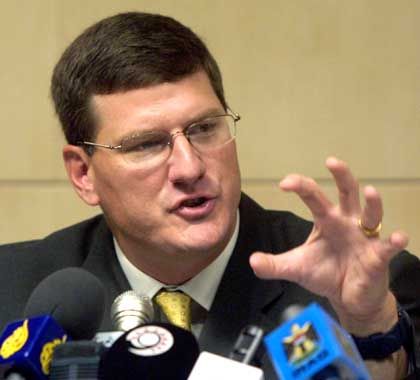
About the author
Scott Ritter is a former U.S. Marine Corps intelligence officer who served in the former Soviet Union implementing arms control treaties, in the Persian Gulf during Operation Desert Storm and in Iraq overseeing the disarmament of WMD.
The views expressed are solely those of the author and may or may not reflect those of Consortium News.
If you benefitted from reading Scott Ritter’s analysis that contrasts all
the media war reports, we are very grateful for your support.
It’s easy, fast and secure.
Now click!





